A year after bizarre rant and arrest, KS Rep. Samsel seeks forgiveness, understanding
Last April, Kansas Rep. Mark Samsel heard a voice.
He says he heard it first on a Tuesday, April 27, when he was talking with a college student who had contemplated suicide. The voice said “yes.”
It came again the next day, he says, as Samsel was substitute teaching in a high school art classroom outside Kansas City.
Samsel was speaking to the students when one began to act out. The student, Samsel said, wouldn’t listen to instructions, was getting in his face and, the way Samsel says he remembers it, chest bumped him.
“My brain didn’t process why all this would be going on unless the kids were trying to help me make some outrageous event to bring attention to mental health,” Samsel told The Star in his first public interview about the incident.
“I said, God if this is what you want me to do I’m willing to sacrifice myself for the sake of the mental health of all these people.’”
He heard a clear voice respond, “Yes.”
He saw a student wink at him. Another nodded. They were both shooting video of him on their phones.
He thought he was participating in some sort of staged script.
To this day, Samsel isn’t positive what of his memory from then is true, and what were hallucinations brought on by a manic episode.
But students in that Wellsville High School classroom told police that Samsel kicked a student in the groin. Students’ videos made national news, showing him telling the class about about God, religion, lesbianism, masturbation and suicide. The day resulted in an arrest on criminal battery charges.
It also led to a diagnosis of bipolar disorder.
Despite calls for his resignation, Samsel remains in office. He will join fellow legislators on Monday as they return to Topeka for the annual veto session, nearly a year after his arrest.
Samsel contends that he never meant to harm anyone. His experience, he says, uniquely positions him to advocate for resources for the mentally ill in Kansas and may encourage others to seek help. If his Franklin County constituents disagree, he said, they can remove him from office.
In decades past, murmurs of mental health challenges have ended American political careers. Samsel has maintained his position as a Republican member of the House, at least for now. While some commend him for his openness about his diagnosis and treatments, others say his actions last spring should disqualify him from public office.
“I think that we can have sympathy toward those that are suffering from mental health issues, but the children and their needs supersede that,” said Rep. Stephanie Clayton, an Overland Park Democrat. “When you’re given power you’re supposed to protect people, not hurt.”
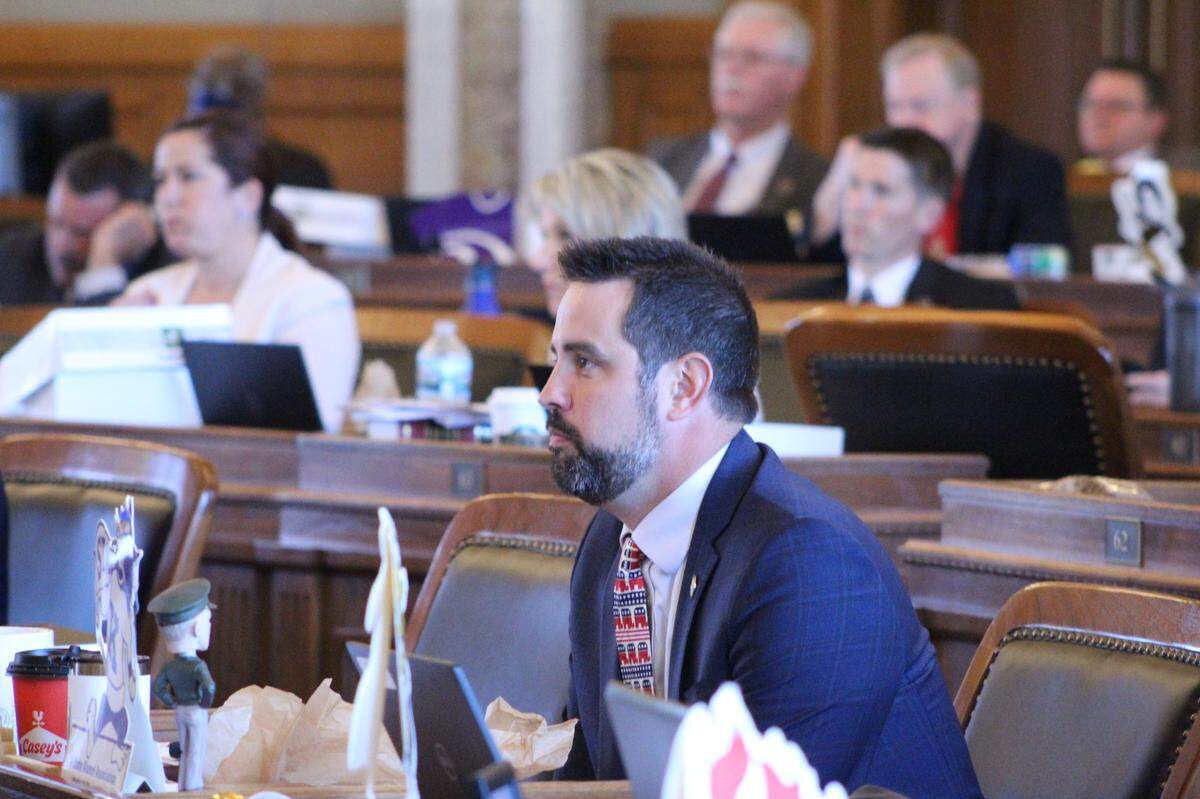
A national spotlight
Last April 29, the Franklin County Sheriff’s Office arrested Samsel on charges of misdemeanor battery.
Videos that explained why surfaced, and were shared with The Star. The story quickly became viral.
The videos were recorded by Wellsville high schoolers and showed Samsel’s rant to a chaotic class of giggling and gasping students.
Samsel had routinely worked with kids in the small town, as a referee, through his church and eventually through substitute teaching. He grew up in Wellsville, a town of about 2,000 residents just southwest of Olathe, where a handful of businesses occupy the brick-lined Main Street that has only one red, flashing stoplight.
He was viewed by friends as charismatic and likable, a high school valedictorian who went on to become an attorney and legislator. But after a day of teaching at his alma mater led to his arrest, the sleepy town was forced into the national spotlight, and residents were immediately split on their views of the lawmaker.
The videos show Samsel and a male student pacing around the classroom, and at one point Samsel grabs the teen.
Samsel tells him, “You’re about ready to anger me and get the wrath of God. Do you believe me when I tell you that God has been speaking to me?”

In court documents, a student told police that Samsel kicked him in the crotch during the class, bruising him. Samsel told investigators he was following instructions from God.
The Wellsville superintendent said Samsel will no longer be allowed to work for the district.
While many constituents called for Samsel to resign and be prohibited from working with children, others said they mostly wanted to see him get help.
Samsel was charged with three counts of misdemeanor battery. Last fall, a judge reduced the charges to disorderly conduct and gave him a 90-day suspended jail sentence following a plea agreement. Samsel was put on probation for a year, told he can’t use personal social media, is required to apologize and must follow mental health treatment recommendations and take any prescribed medications.
A few months after his arrest, Samsel wrote on Facebook that he was receiving mental health treatment and giving up his substitute teaching license after “extreme stress, pressure and agitation” prompted an “isolated episode of mania with psychotic features.”
He said the stress was at its worst last April and May, when the Kansas Legislature was in session. After multiple visits with mental health professionals, Samsel wrote, “There is no likelihood that it will happen again.”
And he said he hoped his openness would bring understanding to those who struggle with mental health.
“While my battle may be the most visible, I know from many private conversations in Topeka that my struggles are far from uncommon,” Samsel wrote.
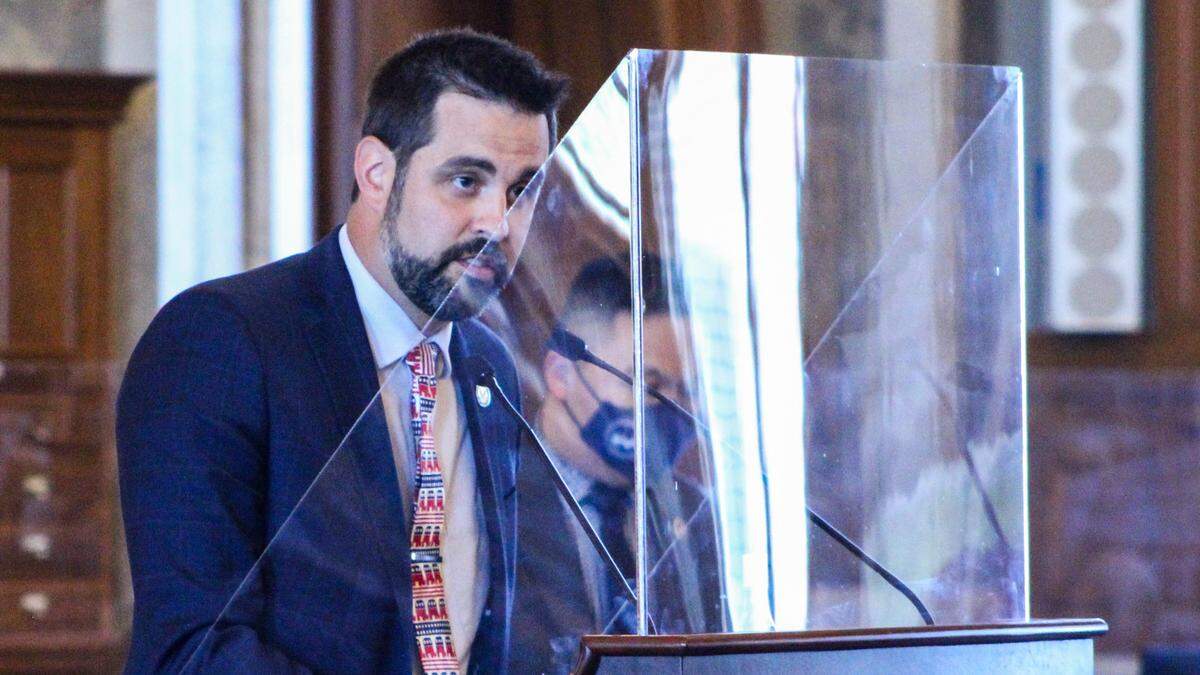
The beginnings of bipolar disorder
Samsel first talked to his doctor about his mental health in 2017.
He had just made partner at Kansas City’s Lathrop and Gage law firm, he was in the process of moving to a new house, and he was running for his first term in the Kansas House of Representatives.
Then for three straight nights he couldn’t sleep. He’d fall asleep for one hour then wake up in a “cold dead sweat,” unable to fall back asleep.
During the day he couldn’t focus. He was shaking, he got chills. Anything he tried that might manage his mental health didn’t work.
“It was too late by that point.”
Over the following weeks and months Samsel sunk deep into depression, facing days where he couldn’t get out of bed until 2 or 3 in the afternoon. The lifelong soccer fan watched none of the World Cup. He almost pulled his name from the 2018 ballot.
As best as he and his doctor can determine now, that is when his bipolar disorder began.
For the next three years, Samsel experienced extreme highs and extreme lows, consistent with the disease. But his highs weren’t caught as evidence of bipolar disorder, and he was just treated for depression.
In early 2021, Samsel thought he had beat depression and, with the advice of his doctor, was weaning off his medication. But as the legislative session drew to a close that spring, his friends and family knew something was off.
Samsel thought he was doing better than ever, but they kept asking if he was OK. They told him he wasn’t acting like himself.
In the weeks that followed his arrest, Samsel insisted he was fine.
For the first time in his adult life, he didn’t believe his therapist when he was told something was wrong. Samsel felt good, he was doing well at work and he was happy.
“My brain was in a manic mode, and it’s kind of in a self-defense mode,” Samsel said.
“That’s what’s so scary about mania. … You feel great and you feel like nothing is wrong, when in reality others can recognize that there is.”
His doctor had told him he was in a manic episode, but his “brain didn’t want to accept it.”
Samsel returned to the Statehouse for veto session the week after his arrest. Throughout the week Rep. Nick Hoheisel, a Wichita Republican, said he was in a group chat with Samsel’s mother and Speaker Ron Ryckman, all keeping an eye on Samsel and making sure they knew where he was.
Hoheisel had been friends with Samsel since a retreat for freshman Republican lawmakers after the 2018 election. The two shared an office in their first term and sit next to each other on the House floor.
Hoheisel said he could tell Samsel was in some sort of manic episode. But he could also tell Samsel didn’t realize it.
In the following weeks and months, Hoheisel said, he was in regular contact with Samsel’s family and legislative leadership to get him help and prepare for a smooth landing when he came out of the manic episode.
“Mark needs to and has taken responsibility for his actions. There was no excuse for what happened that day,” Hoheisel said. “That hourlong class, that may be the darkest hour in Mark Samsel’s life. Where he’s at his lowest point in his life in that classroom is not reflective of the whole body of work that Mark Samsel has done for his district.”
Samsel said it wasn’t until his criminal case ended, and with it the news coverage, that he began to come out of a manic state and sink into depression. His doctor told him he was likely bipolar. Samsel listened.
Now, he’s working with his doctor to find the right medication and adjust to the diagnosis. He’s coming to terms with the fact that he will likely remain on medication for the rest of his life.
“I feel like my normal self again,” he said.
In a Facebook post in February, Samsel disclosed his diagnosis to constituents. He apologized for his actions in the Wellsville classroom and his subsequent social media posts when he defended himself.
“I deeply considered whether, when, and how to continue sharing legislative info on this platform again, including whether to clean up or delete last year’s posts. I decided to be transparent, as hard as it may be, in hopes that it will help others should you or a loved one ever battle a mental illness,” Samsel wrote.

The Topeka ‘pressure cooker’
In early March, Samsel was trying to avoid lobbyists during his interview with The Star.
The Kansas House was preparing to vote on a resolution calling for a convention of states. A supermajority was needed to get the vote across, and Samsel was one of a handful of Republicans planning to vote “no.”
As a result, he was inundated with calls and office visits from groups seeking to shift his vote.
That’s the stress lawmakers face.
Since he was elected in 2018, Samsel has been a Republican more willing to buck party leadership than others. He supports Medicaid expansion, an issue staunchly opposed by Republican leadership, and was among the Republican “no” votes on a bill banning transgender athletes from girls sports.
The positioning makes him a target of lobbying and pressure from both sides of the aisle. That pressure only becomes more intense as the session draws to a close and contentious votes are held at late hours.
“At the end it’s the pressure cooker, and you press red or green and it gets to everybody,” Hoheisel siad. “I’ve seen the Legislature chew up and spit out some great minds.”
But Samsel said that with his treatment, he can handle it. And his personal understanding of behavioral health makes him uniquely positioned to advocate within the walls of the Statehouse.
“It’s hard walking around with others thinking you’re a bad guy or you’re going to hurt children when your intent is the opposite of that,” Samsel said. “By going through what I did, I hope I’m able to become one of the more effective advocates for mental health.”
According to the National Institute of Mental Health, 4.4% of American adults have experienced bipolar disorder.
The Depression and Bipolar Support Alliance declined to comment on Samsel’s case but noted in a statement that his battery arrest wasn’t typical.
“The vast majority of people living with mental health conditions do not commit crimes. In fact, people living with mental health conditions are more likely to be victims of crime. This misconception reinforces negative stigma toward people living with mental health conditions,” CEO Michael Pollock said in a statement.
The stigma, Pollock said, can be dispelled as the public gains a better understanding of bipolar disorder and how it is treated.
In the state of Georgia, Rep. Todd Jones saw that firsthand. This year, Jones began speaking publicly about his son Justin’s struggles with schizoaffective disorder as he pushed for legislation aimed at making it easier to navigate and access mental health care in the state.
Jones said he crafted a bill based on real world experience, and immediately heard from Statehouse colleagues with similar experiences.
“Justin to me was not a political prop. Justin to me was a reason to serve and have a bill,” Jones said.
An incident like Samsel’s, Jones said, should be addressed on a case by case basis, based on how the lawmaker responds to the situation and whether he or she is getting needed treatment.
“They have a perspective in life that a lot of us don’t ever get, which is the other side, and that’s something to be valued,” Jones said.
Amy Campbell, a lobbyist for the Kansas Mental Health Coalition, said it was “very brave” for Samsel to publicly acknowledge his diagnosis and take responsibility for his actions. With proper treatment, she said, there’s no reason to believe that he can’t do his job.
Samsel’s case, Campbell said, raises a longstanding question in politics of whether second chances are warranted.
“We see things that happen with legislators that the general public knows nothing about. I sure would hate to see a system where people are just rewarded because they’re able to keep their extracurricular activities or occurrences covered up,” Campbell said.
Samsel was one of four lawmakers arrested in 2021 and 2022 in Kansas, and all four remain in office.
Clayton, the Overland Park Democratic representative, is convinced that if Samsel had been a woman, a person of color or a Democrat he would have been thrown from office over his outburst. Kicking a student, she said, crossed a red line.
“The story should be told about people who do suffer who seek proper care and manage to do their job without hurting people,” she said.
Whether Samsel continues to serve in the Capitol will ultimately be decided by the voters this fall. In Wellsville, those voters are starkly divided on whether Samsel is still fit for office.
For Joshua Zeck, a parent of a student in Samsel’s art class before his arrest, he’s just happy to see that Samsel has addressed his mental health.
“It’s really a non-issue around here. Looks like he has followed his sentence and gotten some help,” Zeck said.
For others, Samsel’s actions still sting.
“Them letting him continue to represent and be around kids is just showing his actions had no consequences and it’s OK what he did,” Wellsville resident Mary Woods said. “If you’re not held responsible, how will you ever learn?”
“Some people in this town are on his side. I will never be.”
Samsel told The Star that he will run for reelection. And regardless of the outcome, he’ll keep sharing his story.
“When I grew up, (mental health) was not anything we ever learned about or talked about,” Samsel said. “It’s bigger than whether I run for reelection or whether I get reelected or whether or not I’m effective. … I hope it helps others.”
This story was originally published April 25, 2022 at 5:00 AM.