Border war is back if Kansas funds a Chiefs move across state line, Kansas City says
Editor’s note: This story has been updated to correct an error about border war legislation. The story should have said Missouri Gov. Mike Parson signed legislation ending incentives for Kansas companies relocating to certain border counties.
Less than three years after Kansas and Missouri announced a truce in their economic border war, the agreement appears to be imploding as Sunflower State developers and politicians are working to lure the Kansas City Chiefs across state lines.
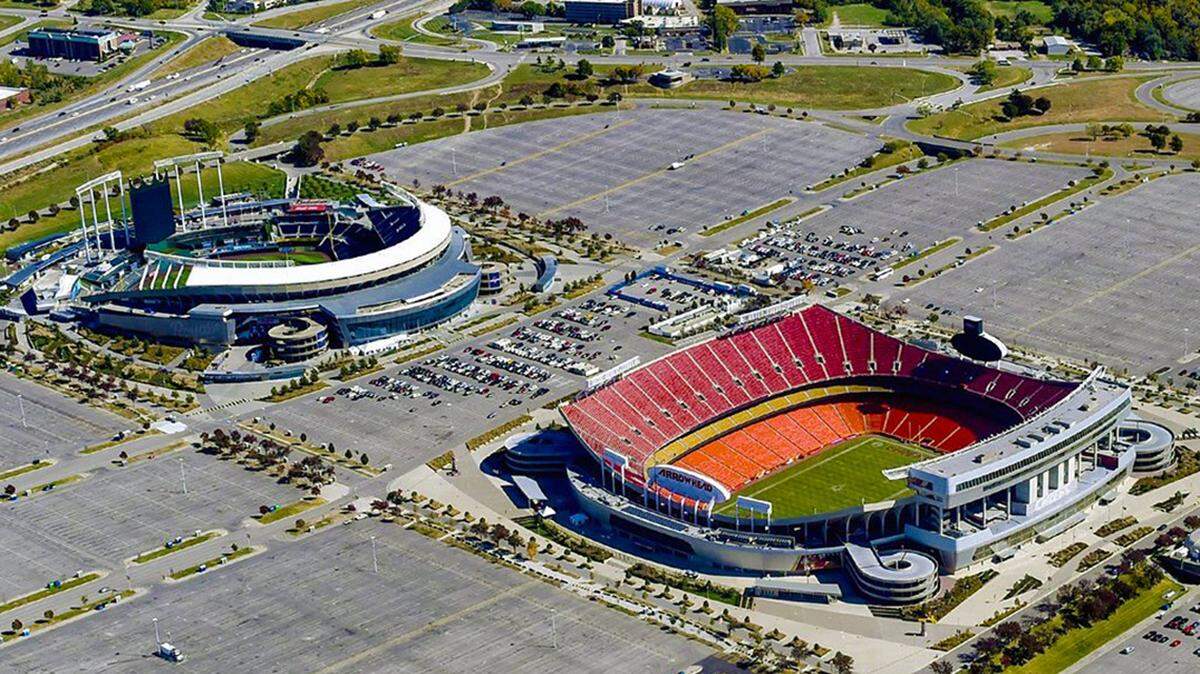
For months, the Kansas City Royals have been exploring a move to a downtown stadium. But last month, the Chiefs indicated they were also interested in moving away from their longtime home at the Truman Sports Complex.
At an NFL owners meeting in Florida last week, Chiefs president Mark Donovan said the team had considered pitches to build a new stadium in Kansas. Predictably, state and local officials in Missouri immediately pledged to do whatever it takes to keep the team in Kansas City.
“After my conversation with Mark Donovan, I assured him that Missouri will compete with any state trying to move the Chiefs from Missouri,” Missouri Gov. Mike Parson said in a statement.
Last week, Kansas Gov. Laura Kelly signaled her support of moving the team to the Sunflower State.
“You know, I would be all for it, obviously,” she told reporters. “When I signed the border war truce with Missouri, it didn’t include the Chiefs.”
The Chiefs declined to comment for this story.
A few days after Gov. Kelly’s comments, state lawmakers introduced a provision into a bill legalizing sports betting that would allow them to funnel $6 million to $10 million per year in incentives to major sports teams looking to move.
“We want to show that we would love to have the Kansas City Chiefs over here, we’d love to have the Royals if that were to happen or maybe even bring in other sporting teams,” Rep. Tory Arnberger, a Great Bend Republican, said.
Missouri officials responded with outrage. They insisted that the state, home to the Chiefs for six decades, didn’t plan to give up the team anytime soon.
“My administration and I have a great working relationship with the Chiefs organization, and this will not change. We will continue to work together to make business decisions that benefit the Kansas City region, the state of Missouri, and OUR Missouri football team – the Kansas City Chiefs,” Parson said in his statement.
Mayor Quinton Lucas spent much of Wednesday tweeting about the potential move. He rejected Kelly’s claim that the border war didn’t apply to the Chiefs because they’re a major employer in Kansas City. Use of state incentives to lure them, Lucas said, would “scuttle the entire truce.”
“Poaching to me is putting up some incentive to snag the team. If that won’t happen at all and the Chiefs just buy ground in Kansas with absolutely no government support then I’ll eat these words,” Lucas posted.
Benefits or bragging rights?
Less than three years ago, Kelly gathered with Missouri and Kansas City leaders to celebrate the end of the so-called economic development Border War. For years, public officials in the Kansas City area showered tax incentives upon companies to move them across the state line. That practice was widely regarded as wasteful as it only moved jobs a few miles without creating new economic activity for the metropolitan area.
“Sometimes commonsense does prevail,” Parson said to more than 300 people gathered in Kansas City, Kansas to celebrate the truce. “Because you don’t have to be a scientist to figure out this was a bad deal for both states.”
In the bi-state agreement signed in August 2019, both governors committed to limiting future incentives for companies in Jackson, Clay, Platte and Cass counties in Missouri and Johnson, Wyandotte and Miami counties in Kansas.
Before the truce, cities and states generally targeted larger employers. While they weren’t adding new jobs to the region, the relocations were still coveted for bragging rights.
In 2011, for example, AMC Entertainment moved its headquarters and its 450 employees from downtown Kansas City to Leawood. The move made the publicly traded company eligible for more than $21 million in state incentives.
Kelly last week claimed the Chiefs weren’t included in the ceasefire between the two states.
In a later statement a spokeswoman for Kelly said she had no intention of reigniting the border war.
“As both states agreed to in 2019, we’ll continue to compete for businesses wishing to start up or relocate, but unlike before the truce, we’re using strategies that are sensible, cost-effective, and productive for people in both states,” spokeswoman Lauren Fitzgerald said.
Kelly signed an executive order in 2019 to end the border war. Parson signed Missouri legislation ending incentives for companies moving to Missouri from certain bordering Kansas counties. That legislation is in effect until August 2025.
In an interview, Kansas City’s mayor said he believed the truce would hold. He said his office has had conversations with both governors, who remain committed to the agreement.
But he rejected the governor’s claim that the NFL franchise was somehow exempt from the border war agreement.
“I certainly view the border war truce to actually be extensive and to cover a number of different areas of economic development,” the mayor said. “And I didn’t read the Chiefs exception.”
For years, businesses pitted the two states against each other as they sought to drive up public subsidies. Even after the border war truce, a prominent employer in Kansas City’s West Bottoms nearly won millions in incentives after it threatened to pack up and move to Johnson County.
Certainly, the Chiefs owners could view such a strategy as financially advantageous, as the team’s stadium has been publicly subsidized for years. But that tactic could prove incredibly costly for taxpayers in either state.
“It’s obvious that a bidding war is not good for the taxpayers. I’ve heard from a number of our taxpayers in Missouri and Kansas,” Lucas said. “That’s what folks are most concerned about. They don’t want to get fleeced.”
Betting big
But as the hours ticked away on Kansas’ regular Legislative session, House and Senate lawmakers appeared to take Kelly’s cue that the economic development truce wouldn’t apply to athletics.
Lawmakers added a provision to the bill legalizing sports betting that would funnel 80% of profits into a fund that could be used to finance major sports stadiums.
The fund would likely accumulate between $6 million and $10 million yearly depending on how much sports wagering took place in Kansas.
The maneuver nearly sunk the bill, a bipartisan compromise four years in the making. The House approved the policy with 63 votes, the minimum needed to pass the bill. The Senate is expected to take it up when they return for the veto session on April 25.
Top lawmakers openly admitted the fund would likely be used to lure the Chiefs across state lines.
“Call a spade a spade, we would like to have the Chiefs on the Kansas side,” Senate President Ty Masterson told Pete Mundo on KCMO Talk Radio Tuesday. Masterson acknowledged that the fund may not be big enough to attract the Chiefs on its own merits but would be part of a broader incentive package.
Any need to honor an agreement with Missouri was dismissed.
“Do we just quit competing for business? I don’t think Missouri has,” Sen. Rob Olson, an Olathe Republican said.
But it’s unclear where a stadium would be built or how much new economic activity it would bring to the state.
“The biggest thing we need to do as a state, if it is something like a sports team just for bragging rights, to say it’s in Kansas is not the right reason to do it,” Sen. Richard Hilderbrand, a Baxter Springs Republican, said.
Professional teams moving to the suburbs is nothing new: Ten NFL teams alone have stadiums outside their namesake cities. The New York Giants and Jets play in East Rutherford, N.J., the Dallas Cowboys play in Arlington and the Chicago Bears are currently considering a move to suburban Arlington Heights.
While Johnson County is home to the area’s wealthiest suburbs, early conversations have targeted Wyandotte County as a potential site for the Chiefs. That area has seen hundreds of millions of dollars in new development surrounding The Legends outlet mall.
Unlike much of Johnson County, that area still boasts plenty of greenfield opportunities for new construction. It’s also well connected to Interstates 70 and 435 and is accustomed to hosting major events.
Western Wyandotte is already home to two major league sporting venues: the Kansas Speedway and Sporting Kansas City’s Children’s Mercy Park. It’s also home to the Kansas City Monarchs, formerly called the T-Bones. And a former Sporting executive plans to soon open the 300-acre Homefield youth sports complex on the site of the former Schlitterbahn water park. That complex will house indoor and outdoor sports training and competition space, new stores, restaurants and hotels, including the area’s only Margaritaville resort hotel.
“I think the Legends area has transformed into a sports mecca,” said Greg Kindle, president of the Wyandotte County Economic Development Council. “All these things make for really good family environments. That’s good for entertainment and tourism for the region.”
Kindle wouldn’t comment specifically on the prospects of the Chiefs relocating to KCK.
“All I can really say is we’re happy to talk to anybody who’s interested in considering Wyandotte County,” he said.
But he said there’s plenty of room for new projects in that part of the county.
“We still have a lot of territory to develop in that part of the county,” he said, “and we’re always looking for developments that add value to the community and to the state.”
Sen. David Haley, a KCK Democrat, said anywhere in the city would be a logical place for a new stadium. As the KC Metro grows to the South and to the West, Haley said, Kansas City, Kansas, is a logical “epicenter” for a new stadium to build while maintaining a relatively central location within the metro.
“The only available tracks tracts of land now available that could house a stadium and ancillary needs is Kansas City, Kansas,” Haley said. “From that vantage, we’re it.”
The Star’s Kacen Bayless contributed to this report.
This story was originally published April 7, 2022 at 1:34 PM.