From Wall Street to the streets: She gave up a hedge fund future to fight for renters
READ MORE
‘Landlords, we’re coming for you’
Some may question their tactics, but KC Tenants and its founder are making their mark.
Expand All
Tara Raghuveer wouldn’t be in Kansas City now, wouldn’t be leading nighttime marches on judges’ houses and protests at City Hall, demanding rights for renters, if not for two things:
A summer spent interning in the office of then-New York City Mayor Michael Bloomberg and a visit to a McDonald’s in Kansas City, Kansas.
Instead, the 29-year-old Ivy League graduate might be working on Wall Street.
But here she is, leading KC Tenants, the radical renters rights group that she and three other women formed and in just three years has become a force for change and social justice:
It successfully pushed through a tenant bill of rights and the creation of a tenant advocacy office during its first year of operation. At KC Tenants’ urging, the city finally got serious in 2021 about funding affordable housing projects through a then-empty housing trust fund and agreed to spend $2.5 million this year hiring lawyers to represent renters in eviction cases since without that aid most could not afford counsel.
Raghuveer doesn’t want to take credit for the group’s success and tries to avoid being the face of the organization. She often moves into the background at events and insists the work of improving the lives of renters is due to the organization’s five-person staff and hundreds of members and volunteers.
But there is no doubt that KC Tenants’ existence in no small way is linked to that visit to the McDonald’s at 43rd Street and Rainbow Boulevard, where eight years ago Raghuveer heard the hard-luck story of an elderly couple who were about to be evicted and had no place to sleep but the cab of their pickup truck.
As she has told the story more than once, that meeting with “Chuck” and “Ivy” (not their real names) was a “punch-in-the gut moment” for her. It opened her eyes to the tragic realities that people less fortunate than her so often face when the money runs out.
Writing in Vice in 2017 before KC Tenants was even a dream, Raghuveer said she had planned to work for a hedge fund after graduation from Harvard College.
“But I couldn’t sign up for that after meeting Chuck and Ivy, living just 10 minutes from my childhood home but in a different reality,” she wrote. “When I returned to school, a professor sat me down and told me what I needed to hear. I was about to be the luckiest person my age in the world: limited debt, no dependents, and a prestigious degree. If I couldn’t take a risk, or do something I actually cared about, who could?”
The daughter of two medical doctors from India, Raghuveer was born in Australia but from fourth grade on grew up in Mission Woods in northeast Johnson County and graduated from Shawnee Mission East High School, where she ran cross country and was president of the debate team.
Her interest in housing and evictions stems from the summer between her sophomore and junior years in college while interning in the office of then-Mayor Bloomberg.
“I spent a lot of time touring around the city’s public housing, and going to community board meetings in the Lower East Side, where I was sitting on the side with the suits with their BlackBerrys,” she said. “And the community was testifying against some luxury development that was going to displace them, and I was like, deeply aware I was on the wrong side.”
During her last year in college, she began a research project on evictions for her senior thesis, which is what had her chatting with that elderly couple at the McDonald’s. Stories like theirs and the hard data she ended up collecting would become the foundation for what would be the precursor to KC Tenants: the Kansas City Eviction Project.
Eviction data gets attention
KC Tenants board secretary Diane Charity first met Raghuveer in April 2018 at a public meeting where some brainy young woman with an Ivy League degree was supposedly going to share her findings from analyzing two decades worth of data on evictions in Jackson County.
But she couldn’t find a seat.
“So I walked in, I said, ‘Well, today’s my birthday, and I have no place to sit’ and Tara looked at me and said — I didn’t know who she was — she said, ‘well, sit over there, birthday girl.’ And smiling to myself I thought what a smart ass. I’ve been in love with her ever since.”
KC Tenants, which Charity, Raghuveer and two other women would go on to found nine months later, wasn’t even a wisp of a notion at that point. But Raghuveer and her data were fast becoming a hot ticket across town in public policy circles.
With help from some number crunchers working with the KC Eviction Project, Raghuveer had begun in 2016 and 2017 sharing their data with the folks at the University of Missouri-Kansas City’s Center for Neighborhoods, as well as housing policy experts and advocates in the social justice movement.
Eviction had suddenly become a big topic nationwide, thanks to author Matthew Desmond’s 2016 Pulitzer-Prize winning book, “Evicted: Poverty and Profit in the American City,” which described how eight Milwaukee families struggled to pay rent during the 2007-2008 financial crisis.
During and after the Great Recession, most of the focus on housing insecurity focused on the incredible number of people who lost homes to foreclosure. Suddenly, due to Desmond’s book and research like Raghuveer’s (which Desmond cited), the conversation was then shifting to the plights of renters, many of whom were occupying those houses lost to foreclosure that had been snapped up on the cheap by big businesses.
The Kansas City Eviction Project jump-started the discussion here.
“What Tara’s work did was broaden the conversation to include renters,” said Jacob Wagner, director of urban studies at UMKC.
Raghuveer got her hands on what she calls a “goldmine” of records from the Jackson County court system: data concerning 80,000 evictions over 20 years, which her analysis showed amounted to 42 evictions on average in Jackson County every business day.
Landlords almost always have the upper hand, she said in presenting her findings to the city council in the fall of 2017. That previous year, there were 9,000 evictions in Jackson County, she said.
Of the more than 6,000 that went through the formal eviction process, judges found in favor of the landlord and against the tenant, who most often had no lawyer representing them, 98.8 percent of the time.
Of the 27.5 percent that didn’t go the formal route, some likely resulted in someone losing their home. All it took was the threat.
After hearing Raghuveer describe the upheaval eviction has on people’s lives, then City Councilman Jermaine Reed gave an emotional account of how his family was upended by an eviction when he was in high school.
“We were evicted and we were homeless,” Reed said. “This is my story.”
When Raghuveer’s presentation was over, then-Mayor Sly James hugged her.
“We’ve got to fix this,” he said.
And then, as so often happens at City Hall, nothing happened.
A partnership forms
Raghuveer grew frustrated with what she saw as a lack of follow through by the city manager and elected officials at 12th and Oak streets.
In the 2018 annual report for the Kansas City Eviction Project published that June, she suggested that “next year’s municipal elections present a ripe opportunity for Kansas City residents to organize and demand robust housing agendas from each candidate for Mayor and City Council.”
At the time, she had not the slightest intention of playing a role. She merely hoped that someone would step forward.
She had not planned to return home to Kansas City. After graduating from Harvard in the spring of 2014, she moved to Chicago where she was a paid organizer for an immigrant rights group until the fall of 2017, when she jumped to her new job, also in Chicago, as head of the affordable housing campaign being waged by the progressive advocacy group People’s Action.
The Kansas City Eviction project was merely a side hustle at the time, she said.
“Then, starting in like late November 2018, I met Tiana Caldwell,” she said.
Caldwell, her husband, Derek, and their two kids were being threatened with eviction after she started having complications from cancer treatments, couldn’t work and the family was having trouble paying the rent.
“I was being forced out of my home because I was sick and it was really disheartening,” Caldwell said. “We called everything that we could find on housing in the city, and we came across Tara’s number.”
Caldwell and Raghuveer met at a coffee shop a while later. Caldwell opened her heart and told Raghuveer what she was going through, and Raghuveer shared what she learned from all the data she’d collected that showed Caldwell and her family were not alone.
The more they talked, the more they agreed that renters needed someone to look out for their interests in Kansas City and that, with the city elections looming, now was the time for that someone to step forward.
But it couldn’t be Raghuveer doing it on her own. The core group had to be people who knew what it was like to be forced out of their homes, or live in fear of it. It had to be tenants.
“I was all in after that,” Caldwell said.
Charity, the now 71-year-old “birthday girl,” was also in. Along with fellow renter Brandy Granados and Raghuveer, they co-founded KC Tenants that January.
That next month, Raghuveer let the world know on Facebook that she had moved back to Kansas City and why.
“Organizing is about creating the conditions to change what’s possible,” the post said. “It is possible that Kansas City will go the way of Denver and Seattle, that KC will be unaffordable to workers, poor people, communities of color, that yogurt shops and $5 coffees will displace tens of thousands…
“That future is possible, but it’s not inevitable. That’s why I moved back, to organize with a powerful and growing base of tenants. To imagine and implement a different outcome. To fight for safe, healthy, and truly affordable homes for all Kansas Citians.”
KC Tenants has grown big and some would say fairly powerful since then.
Sustained with a $250,000 annual budget funded by donations, KC Tenants now has a paid staff of five, as well as all those members and volunteers. Raghuveer says the group is now working toward organizing local tenant unions across the city by canvassing neighborhoods door to door and intends to expand that effort across the state.
Growing big and powerful was Raghuveer’s aim from the start, when she chose for the group’s logo a longhorn bull modeled after one on the cover of a 1952 Charlie Parker record album.
“One of the first thoughts in my head was I want Tiana and Derek to wear shirts that they can feel proud of,” Raghuveer recalled. “I wanted them to feel like they’re part of something powerful even in the beginning.”
Yet critics question how KC Tenants sometimes uses that power.
Protesting at judges’ homes
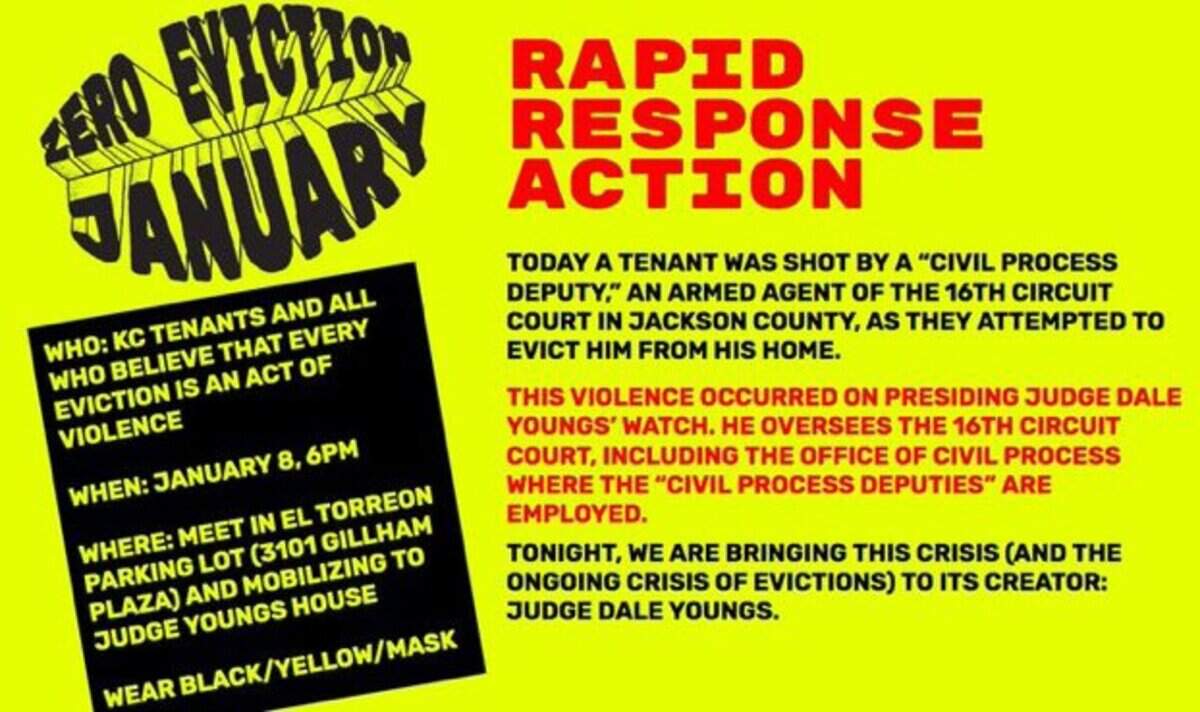
On a cold Friday morning last January, deputies serving an eviction notice shot a distraught Blue Springs man after he aimed at them with a gun, which turned out to be a toy.
KC Tenants was quick to seize the moment. That Friday night, as 38-year-old Donald “Eric” Smith was recovering from three bullet wounds to his chest and groin area, dozens of the renters rights group’s members and supporters responded to Raghuveer’s call for action.
They gathered around her in a midtown parking lot surrounded by piles of snow left over from a storm the week before. Donning a stocking cap matching the mustard yellow KC Tenants T-shirts that many wore under their heavy coats, Raghuveer issued instructions.
They would be marching to the home of the honorable J. Dale Youngs, presiding judge of the 16th Circuit Court. Youngs, she explained, oversees the eviction process in Jackson County, including the eviction deputies who wounded the man in Blue Springs.
“He has the power to end evictions in Jackson County and he has failed to do so,” she said. “So are you ready to take this crisis to its creator?”
Hoisting signs calling for an end to evictions, they trudged off to the judge’s house chanting “pay for the many, profits for the few, landlords, landlords, we’re coming for you!” Then they switched it up as they neared Youngs’ residence to “judges, judges, we’re coming for you.”
Still chanting, they stepped over the caution tape surrounding the house and came to a stop on the lawn outside the judge’s front door carrying a banner that read “Judge Youngs You have Blood on Your Hands.” Three speakers took turns at a microphone Raghuveer helped set up in the street.
The crowd hooted and hollered and chanted some more, even after the cops threatened arrest if they didn’t get off the grass. But the judge never answered the knocks on his door during the 25-minute protest.
KC Tenants had gotten its message across, though. On Monday, just three days later, Youngs issued an order postponing all evictions in the county for two weeks, citing “significant, and at times violent, social and political unrest” and “the (high) risks Court personnel face in simply carrying out their duties.”
The victory, albeit fleeting, came after more than a year of protests in which group members highlighted their cause by disrupting hundreds of eviction proceedings in person and online, falling to the pavement outside the courthouse during the “die ins” they staged and sometimes chaining themselves to the courthouse doors.
Youngs was one of two Jackson County judges — the other was Kyndra Stockdale — to whom KC Tenants paid a night-time visit, exacting criticism from even some supporters who thought they’d gone too far.
But Raghuveer does not apologize for the group’s aggressive style. Knowing when and how to apply public pressure to further their causes is just one reason KC Tenants has become what friends and foes alike say is a force to be reckoned with on the local political scene.
“We take some flack for the tactics that we use,” Raghuveer said during an interview in KC Tenants headquarters on the second floor of Trinity United Methodist Church in Midtown. “But I think everyone, whether they agree with our goals or not, can see the efficacy in our tactics. Which I think are not extreme.”
Gains at City Hall
KC Tenants’ foes may not appreciate their methods or the outcomes they seek to support the rights of renters, promote affordable housing and end homelessness.
But it is undeniable, opponents say, that they get results.
“I’ve said for years, they’re not to be underestimated,” said Robert Long, president of Landlords Inc., an association of 400 mom and pop landlords in the metro region. “They have been effective in getting what I consider to be one-sided housing policy created in the city.”
KC Tenants’ achievements on the judicial front have been temporary, only causing consternation and delay in a legal process that allows landlords to have people removed from their homes for nonpayment of rent and other causes.
But the group’s lobbying efforts on behalf of renters at City Hall have had more long-lasting impact.
Elected officials were responsive, in part, because KC Tenants played a key role in the 2019 municipal elections by evaluating candidates based on their views on affordable housing, then issuing a scorecard.
Many of their top picks won, including Mayor Quinton Lucas, who demonstrated his support of their cause by spending his first night in office at the home of a KC Tenants member with landlord issues.
Since then, the group hasn’t let up, holding Lucas and other council members accountable when they don’t follow through on their promises to KC Tenants’ liking.
In October, Lucas was peeved when KC Tenants members occupied his outer office on the 29th floor of City Hall. They shouted “House the people” and “where are you, Mayor Q?” while demanding that he hear their objections to how the city planned to spend $12.5 million in that housing trust fund, which he thought they unfairly characterized as a slush fund for developers.
“I didn’t think that was necessary,” Lucas told The Star.
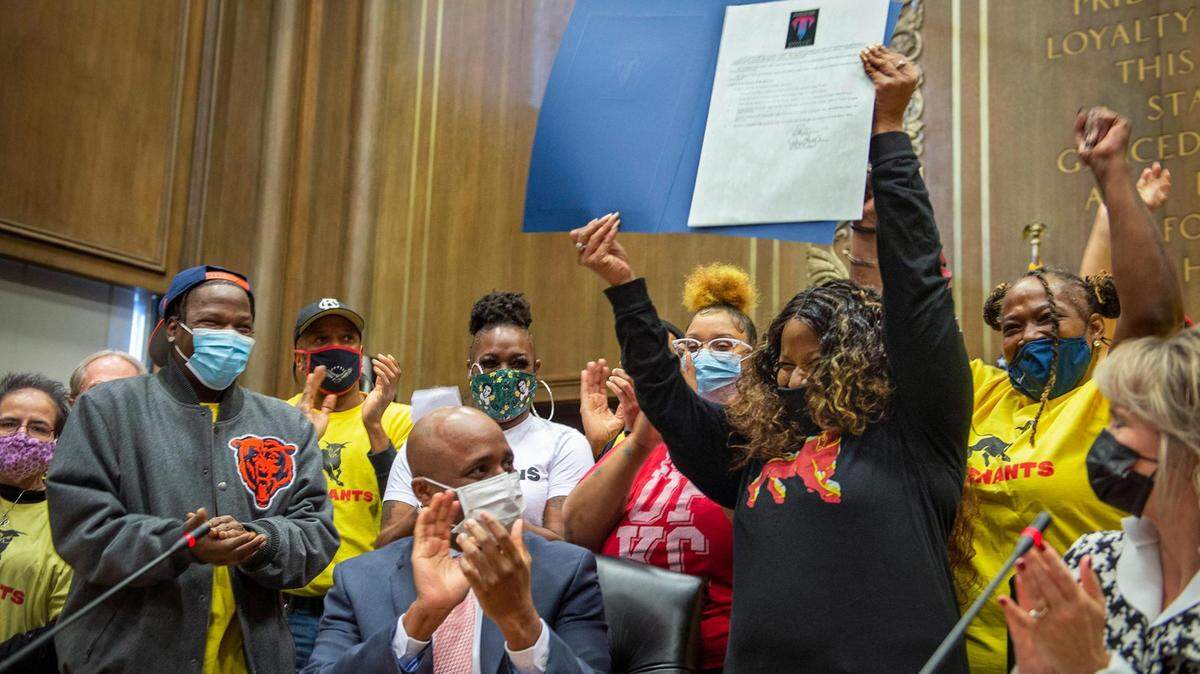
When they’re not creating a ruckus, Raghuveer and KC Tenants volunteers are getting into the weeds of public policy. It’s common now for KC Tenants’ members in their yellow shirts to fill several rows of seats at city council meetings as a show of force, either to observe or testify on policies that have an impact on renters, who make up about half of the city’s population.
After weeks of lobbying behind the scenes and on social media, they cheered this month when, at the group’s urging, council members rejected a $10.5 million tax break to Mac Properties for a mixed-use development in Midtown. One of the group’s allies, 3rd District Councilwoman Melissa Robinson, argued that it was more beneficial to deposit that $1 million a year over 10 years into the $12.5 million housing trust fund.
Midtown Tenant Union, which KC Tenants helped organize, had argued that would do more to help low-income people than Mac Properties’ promise that 20 percent of the 385 apartments it planned to build would be “affordable,” according to the city’s definition.
Afterward, Mac Properties said it was canceling the $100 million project at Armour Boulevard and Main Street.
“It feels so good to be on the winning team,” Raghuveer tweeted afterward, “a team of tenants with a sharp political analysis, deep relationships, and rigorous strategy. Big love to our first neighborhood local on their first big win.”
Not everyone thought so, however.
“So instead of 77 ‘truly’ affordable units and over 300 more units...we get zero. Another housing creator pushed away,” commented Stacey Johnson-Cosby with the KC Regional Housing Alliance, which describes itself as “a diverse group of Kansas City Metro organizations that represent housing providers across our region. “
Long-time affordable housing advocate Colleen Hernandez is impressed by how much KC Tenants has accomplished on issues that other non-profit and church groups have been working on for years.
“For a long time, a whole bunch of us have cared about affordable housing, and especially affordable housing for low and very low income. But we’re people who witnessed the problem,” she said. “And now we’ve got a group of people who are living it. And there’s just a lot more power in that. You’re living it, and so when you speak, it’s undeniable.”
Kansas City’s mayor recognizes that power and feels the city needed somebody like KC Tenants to champion housing issues in the city.
“I think we needed folks that were focused on real change,” he said.
But he says the group has crossed the line on occasion in trying to make life better for vulnerable people.
“I strongly disagreed with public actions at the homes of judges,” Lucas said. “We have seen judges get slain in this country, judges shot and killed. Not that I think that anybody in their group would do that, but once you kind of popularize the act of going to somebody’s house, that’s problematic. I’ve shared that with them.”
Those sorts of actions only make it harder for people who support their goals to support KC Tenants, he said.
“But on the whole, I think the city is better with their presence,” he said.
Planning an exit
To acknowledge the impact that KC Tenants has had, Raghuveer was one of two recipients awarded the inaugural Pinnacle Prize this past fall. Established by philanthropist Ann Baum and her late husband Kenneth Baum, the award recognizes “passionate, dedicated leaders under 40 working to improve the quality of life for all Kansas Citians — especially those who need help the most.”
Also receiving a $100,000 check was Tricia Rojo Bushnell, executive director of the Midwest Innocence Project, which was instrumental in freeing Kevin Strickland from prison after more than four decades of being incarcerated for three murders he didn’t commit.
Raghuveer seems almost embarrassed by such accolades. Her aim is to stay in the background while KC officers and members — the tenants in KC Tenants — be centerstage.
They almost always are, be it running the two-hour general membership meetings from 3 to 5 every Saturday afternoon on Zoom, planning strategy or knocking on doors in an effort to get more tenants involved.
“We know that we have accomplished a lot. But we know there is so much more that needs to be done,” said Caldwell, the group’s president, who expects to be a part of the group long after Raghuveer moves on.
And that day will come.
“I made a commitment to myself, initially, to give it at least five years, and I talk about this with our board a lot,” Raghuveer said.
“And I think they appreciate it, that the sustainability of this organization cannot depend on me. And the honest truth is it does not. We have an incredible board and our board is made up entirely of people from our base.”
What she and the group accomplish over these next two years is hard telling. They are committed to once again playing a role in the 2023 city elections and beyond.
“I think they’re here to stay,” Hernandez said.
And given their track record, one thing they chanted that cold night a year ago in the judge’s front yard was not some idle boast.
“KC Tenants, we ain’t playin’, playin,’” they said.
No, they ain’t.
This story was originally published January 30, 2022 at 5:00 AM.