
Missouri House redistricting panel roiled by partisan disputes in first session
Editor’s note: an earlier version of this story misstated the role the commissions would play in redistricting under a 2018 constitutional amendment known as Clean Missouri. They would review the maps drawn by a demographer.
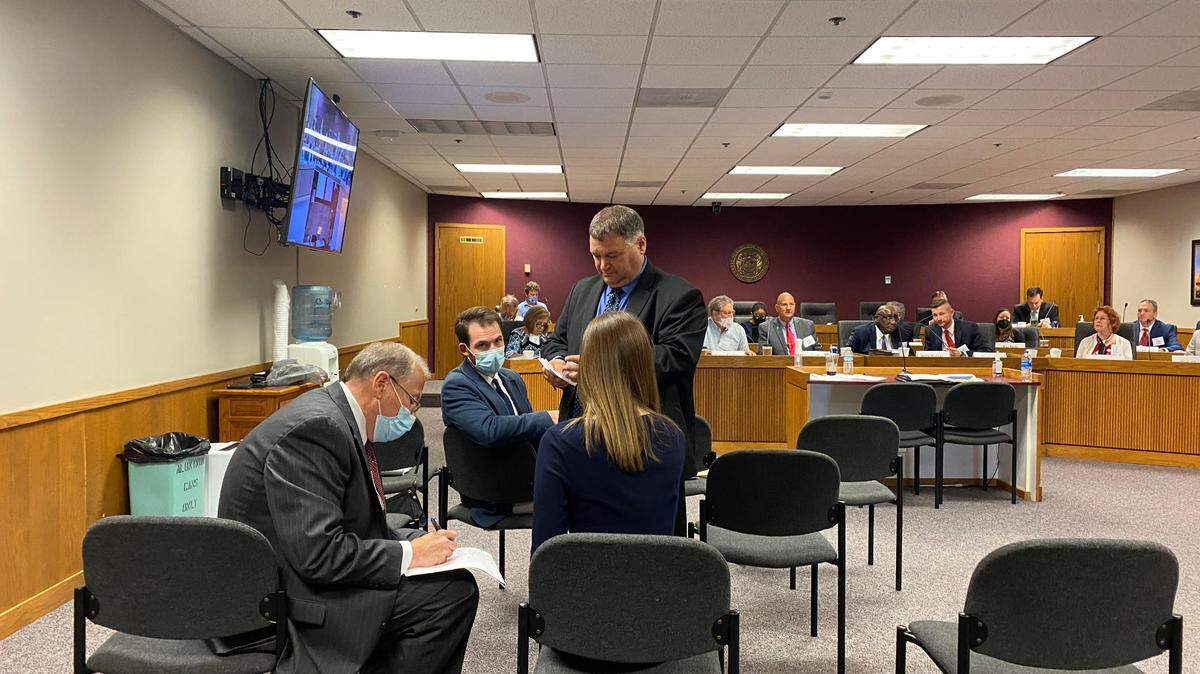
The inaugural meeting of a bipartisan commission that will draw new state House district lines quickly devolved Tuesday into eight hours of partisan bickering, deadlocks and a possibly illegal secret ballot.
The commission, appointed by Gov. Mike Parson to draw new boundaries for the next ten years, wasn’t at a stalemate over proposed maps, which won’t take shape for weeks or months still.
The 10 Democrats and 10 Republicans meeting for the first time couldn’t easily agree on the administrative task of picking a chair.
Republicans wanted their party, which holds a supermajority in the General Assembly and the governor’s office, to hold the seat. Democrats, whose statewide power has fallen precipitously in the past two decades, preferred the question be resolved with a coin toss.
Accusations of a power grab issued from each side, along with jokes that the matter be settled with a bottle of whiskey at the shooting range. At least five votes on the chairmanship question — one of which was conducted by secret ballot in a possible violation of the state’s open meetings law — ended in a 10-10 ties.
The panel finally agreed to install St. Louis attorney and former Missouri labor director Jerry Hunter, a Republican, as chair and a government employees union president Keena Smith, a Democrat also of St. Louis, as vice-chair. Owensville Democrat Mark Schaeperkoetter was named secretary. Hunter and Smith will act as co-chairs during public hearings and alternate having the power of the final say to resolve disputes during meetings.
The commission that will draw the state Senate maps conducted a more levelheaded first session. Within its first half-hour it elected Republican Mark Ellinger as chair and Democrats Susan Montee and Nicole Greer as vice-chair and secretary.
Partisan concerns
Both commissions are operating on a delayed schedule as states await the release of U.S. Census Bureau population data collected during the once-in-a-decade count last year. The numbers, expected to be released Thursday, are coming months later than usual, partially due to the COVID-19 pandemic.
The two panels are also undertaking a redistricting in which they would have played a much less prominent role , under the terms of a constitutional amendment known as Clean Missouri that voters passed just three years ago. It made major changes to the process, placing map-drawing responsibility with a nonpartisan demographer who would have been required to draw districts prioritizing partisan competitiveness. The commissions would then review the maps.
Republicans in the state legislature decried the changes as a Democratic power grab and worked quickly to undo them, putting a Clean Missouri repeal on the ballot last year. It passed with a 51% majority, returning the redistricting process largely to the usual bipartisan commissions.
The commissions include civic leaders, academics, attorneys and more overt political players, such as House Republican Campaign Committee director Jonathan Ratliff, whose organization works to elect Republicans to the seats the commission will draw.
Their first deadline to produce maps is Dec. 23. If the commissions deadlock, as has historically been the case, a panel of judges will be appointed to draw the districts by late April, which could prevent candidates from filing for office in time. The time period for candidates to file for next year’s primaries is Feb. 22 through March 29.
Democrats’ resentment over the repeal of Clean Missouri and concerns about gerrymandering were palpable Tuesday.
Republicans began the meeting proposing to follow a tradition of electing a member of the governor’s party as the commission chair, with the opposite party holding the vice-chair role. The commission formed after the 2010 Census was chaired by a Democrat, the party of then-Gov. Jay Nixon, they pointed out.
But Democrats said Parson already got to appoint the commissions, and latched onto an early idea tossed out by acting chair Jim McAdams, deputy commissioner and general counsel for the state’s Office of Administration, to break the tie with a coin toss.
Under that proposal, whichever party won the toss got to hold the chair seat, while the losing party would get vice-chair and secretary.
Republicans alternated between insisting a coin toss violated the constitution’s requirement that the commission “elect” a chair, and downplaying the power of the post.
“I doubt very seriously if we would even be here today if we were under the rules that were established by the vote of the people,” Schaeperkoetter said, referring to the Clean Missouri amendment. “Would a proper solution to this be, see who can hold their breath the longest, and come up with a chairman?”
Hunter said past commissions have been a “cooperative venture.”
“The chairs simply oversee the meeting, call on people who want to testify, who have comments,” he said. “I don’t know where this idea has come from that these Republicans are going to be doing all this underhanded stuff and we got to keep them from being the chair.”
Other Republicans slammed the Democrats for wanting to give up the custom after losing statewide power.
“It was working just fine for your party,” Republican Curtis Jared said.
Democrat Jason Ludwig snapped that Republicans hold a supermajority in the legislature, “despite only having about 58, 60% of votes” statewide.
‘The definition of insanity’
Before compromising on the commission leadership, members voted nearly half a dozen times on the Republican nominees and the Democratic coin-toss proposal, tying along party lines each time.
The final time, they agreed to do it on a secret paper ballot. One commissioner muttered as he submitted his ballot, “That’s the definition of insanity, right?”
The vote came out 10-10.
Reached by The Star, open government attorney Jean Maneke said that move could have violated the Missouri Sunshine Law, which dictates that votes of the public body be recorded and open for inspection.
“Clearly the intent is that the public be in a position to know who voted how in such meetings,” Maneke wrote in an email. “A ‘secret ballot’ is not a ‘public’ vote.”
McAdams, who conducted the vote along with other Office of Administration staff, said he did not know whether it was a violation.
“I don’t have an opinion,” he said. “The constitution mandates an election (of the commission chair). The process is not specified.”
In between debates over the chairmanship, the commission agreed to hold six public hearings across the state.
They will Oct. 18 in Springfield, Oct. 19 in Kansas City, Oct. 21 in St. Louis, Nov. 4 in Jefferson City, Nov. 9 in Cape Girardeau and Nov. 10 in Kirksville. The Senate’s redistricting commission also will hold meetings in the same cities on the three October dates. Its November meeting locations are still undetermined.
The Star’s Jonathan Shorman contributed reporting.
This story was originally published August 11, 2021 at 5:00 AM.