KCK residents urge officials to get a better deal from Chiefs: ‘Stick up for us’
Wyandotte County residents told their local officials that they’re skeptical about the Kansas City Chiefs’ plans to move into their backyard.
Numerous people who attended a Tuesday evening public hearing said they worry giving up future sales, use and transient guest taxes to help pay for the Kansas City Chiefs’ crossover into Kansas would defund needed improvements across the county.
They said their local officials should prioritize their county’s roads, public schools and long-ignored neighborhoods. And they said funding a Chiefs move could put additional financial burden on families who are already struggling.
“For me, that’s insanity that we would even think of giving one dollar to a billionaire,” said Paula Flattery-Aaron, a Strawberry Hill resident, about team owner Clark Hunt. Instead, she said she’s more concerned about the hundreds of homeless families across Wyandotte County and in the local school system who don’t have secure housing this winter.
Almost 50 people spoke during the first public meeting local officials have held about plans for a potential domed stadium in western Kansas City, Kansas, as part of the Chiefs’ proposed nearly $4 billion project.
In December, state and team officials proposed a plan to pay for the bulk of the Chiefs’ move to Kansas with $2.8 billion worth of state-issued sales tax and revenue, or STAR, bonds, which will then be paid back with new state sales tax revenue.
Tuesday’s hearing was in response to state and team officials’ request that the Unified Government also pitch in some of its local revenue to help pay off those bonds.
Miles south in Olathe, public officials on Tuesday held a similar public hearing about whether they should use local dollars to help finance the Chiefs project, as the team hopes to build a new training facility and team headquarters on 165 acres within city limits. Olathe council members approved that proposal unanimously.
What next in KCK?
Of the speakers that participated in the Unified Government of Wyandotte County and KCK’s meeting, most were either opposed to the plan or wanted to see a better deal. Even so, some of those speakers, and residents who said they supported the move, said they saw it as an opportunity to bring jobs to the county and strengthen the local workforce.
Now, after their comments, the ultimate decision on whether the Unified Government directs any local taxes toward paying for the stadium package will fall to the government’s board of commissioners.
The Unified Government Board of Commissioners is scheduled to make that vote during a Thursday evening meeting that begins at 5:30 p.m. Mayor/CEO Christal Watson said government staff will answer questions that people brought to commissioners during the Tuesday hearing before that vote. The board technically has a Feb. 20 deadline to decide.
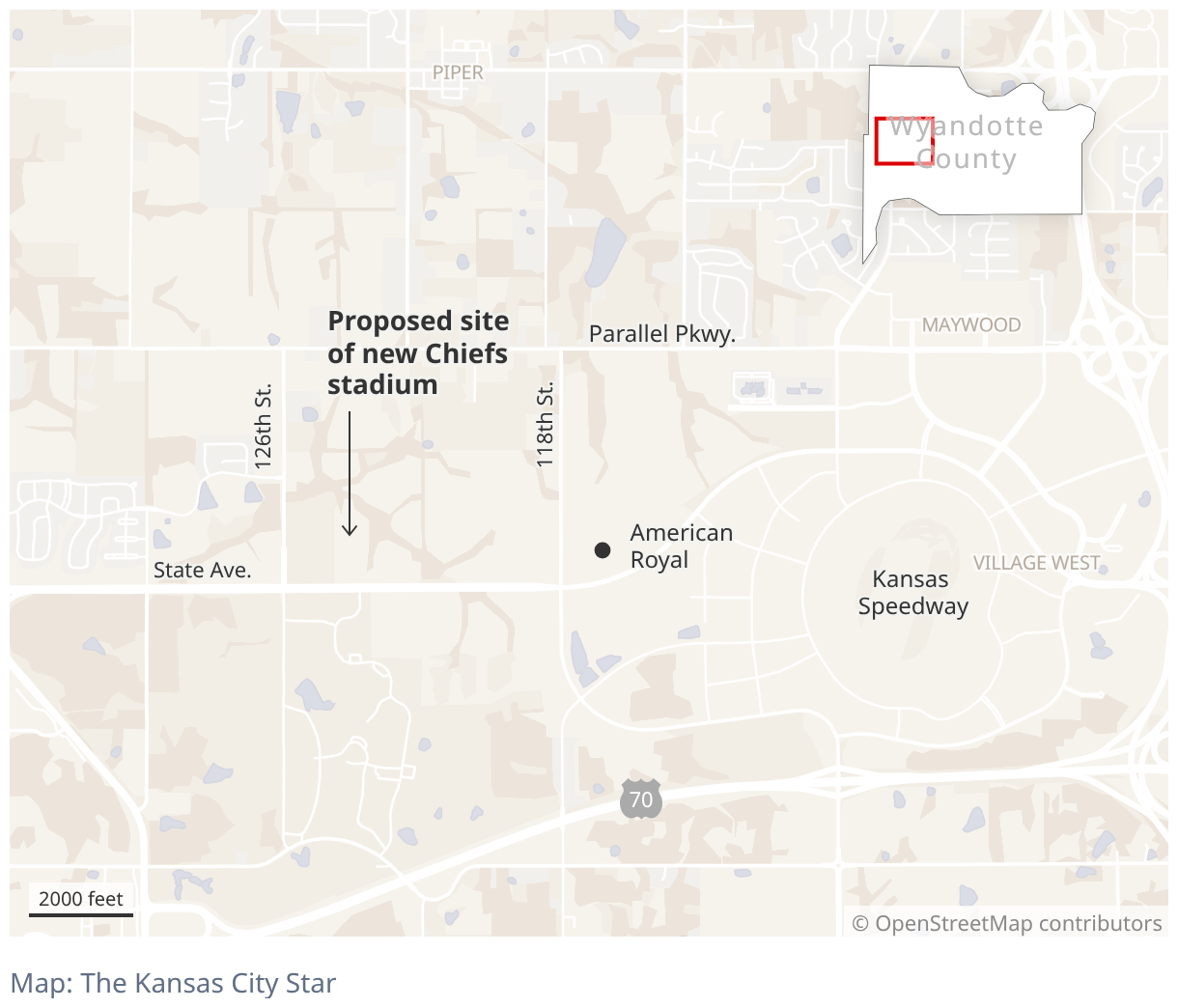
If commissioners approve the local government’s proposed plan during Thursday’s meeting, the Unified Government would direct local sales, use and transient guest tax revenues — generated on about 236 acres in west KCK around the stadium site — toward paying off bond debt taken out to pay for the Chiefs project for the next 30 years.
That would also begin the process of negotiations on acquisition of land and working to establish a development agreement. In other words, Thursday’s vote doesn’t mean a done deal, Eighth District Commissioner Andrew Davis told attendees.
If commissioners refuse to invest local revenues, the project’s funding would see a critical funding gap, a spokesperson with the Kansas Department of Commerce told The Star.
“But being a fan doesn’t mean writing a blank check,” Korri Hall, a KCK resident and recent political candidate, said toward the end of the hearing. “If anything, they should want to give back to this community, and I want you to make them give back to this community.”
They love the Chiefs. But they have concerns
Residents’ frustrations aren’t about the Chiefs as a team, or not wanting an NFL franchise in the community, some residents told commissioners during Tuesday’s hearing.
Rather, people were concerned that team and state officials looped Wyandotte County into negotiations too late in the game, while it appeared Johnson County leadership had been planning a Chiefs move under nondisclosure agreements for two years.
They also said that it’s hard to get excited about a football stadium, or the idea of giving up sales tax revenues for another major project out west, when the city’s northeast corner is in need of revitalization — and funds to do that.
“I really just want to make sure that we’re intentional, this go-around with the northeast,” said Nikki Richardson, founder of local nonprofit Justice for Wyandotte. “If the northeast looks the same 20 years from now, we have not done our job.”
Other parts of the city, particularly roads like Parallel Parkway, and bridge closures that are shutting residents off from other parts of the metro, are high on residents’ lists of funding priorities at a time when the county is grappling with financial challenges.
People are struggling with high sales taxes as they are, they can’t afford their property tax bills and they’re worried this development could tax them out of their homes, resident Christopher Overfelt said. “The wealth gap in this country is greater than it has ever been,” he said, adding that adopting proposals like what commissioners will consider next week widens that gap. “You are taking food from the mouths of our children and giving it to Clark Hunt.”
An opportunity
If the Chiefs are going to be conducting a major construction project in Wyandotte County, then local businesses should have a seat at the table during the bidding process, some residents told the commission.
“Wyandotte County businesses should have fair, transparent access to the bidding process,” one resident said, adding that funding for maintenance, infrastructure and repairs on the stadium need to be considered in the bond deal.
Adrian Lewis, a KCK resident, said the idea of the Chiefs coming to KCK excited him, and he thinks having the team in town will benefit the community. Although, he’s not a fan of taxpayers paying for it to happen. He suggested letting the team pay for the move.
When the state, team and local government announced that the Chiefs would be moving to Kansas, they said they expect that move to generate more than 20,000 jobs in the area.
Mike Kane, former Fifth District Commissioner and president of the Tri-County Labor Council of Eastern Kansas, said officials should consider the long-term economic benefits that investing local dollars toward the project could bring. Kane called it a chance to support long-term union careers for thousands, and said it would come with strong benefits for people in the community.
“Please keep this in mind, and please support it,” he said.

The project
For the new stadium, Wyandotte County and the state have agreed on a property in west KCK, just northwest of the Kansas Speedway and near the site of the soon-to-be new American Royal complex.
That 65,000-seat stadium would add to a neighborhood of STAR bond projects in west KCK that the local government annually pays off bond debt using millions in local sales tax revenues generated in that part of the county.
Tuesday’s meeting marked the first time that Wyandotte public officials have shared specifics on plans for the stadium. In the more than a month that has passed since team, state and local leadership unveiled plans to bring game day to KCK in the 2031 season, negotiations have remained largely hushed.
That’s because officials are negotiating under a special state statute that allows the involved parties to keep proposed agreements and other documents related to the stadium STAR bonds confidential.
Both the stadium in KCK and the proposed practice facilities in Olathe would be surrounded by entertainment districts, Gov. Laura Kelly said during the December announcement in Topeka, during which officials formally said the Chiefs planned to move to Kansas.
The state’s ask
The state and the Unified Government are in agreement over the section of Wyandotte County surrounding the stadium that would redirect local sales taxes to the Chiefs project, which they’re calling the “Base Revenue Area,” according to the Kansas Department of Commerce.
State and team officials are requesting the Unified Government pledge 100% of local sales and use tax revenue generated within that 236-acre area. The government also levies an 8% transient guest tax that would be included in the mix.
Beyond the requested local contribution, the stadium incentives rely heavily on a yet-to-be-finalized state STAR bond district that will redirect new state sales taxes to paying off the Chiefs project bonds. A preliminary map of that district shows it could stretch across all of Wyandotte and about half of Johnson County — which means it would pull state money from both counties.
Sales tax revenues generated in each area would go to paying off STAR bond debt for the stadium project instead of other government priorities and services for up to 30 years.
This story was originally published February 3, 2026 at 10:15 PM.