In KC’s deadliest year, Operation LeGend hasn’t improved homicide clearance rate
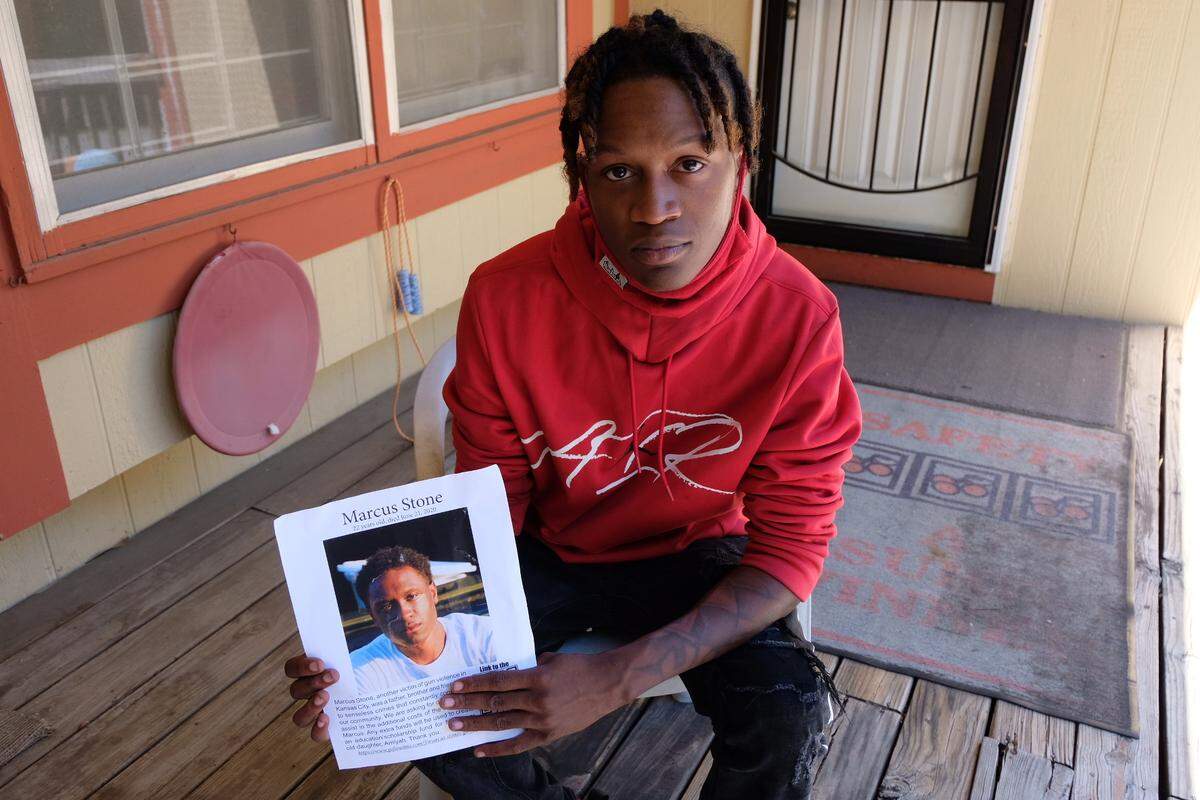
Two months after 22-year-old Marcus Stone was gunned down at 18th and Vine, his family wonders if the killer will ever be brought to justice.
His younger brother, Ke’Shawn Stone, knows it’s a question other Kansas City families face as dozens of homicides this year remain unsolved.
“It just makes me sick to my stomach to think there’s more than 10, there’s more than 20, there’s more than 50 families out there that hasn’t got closure for their loved ones that they’ve lost, and I know they’re feeling the same pain,” he said.
As of Saturday, 129 people have been killed this year in Kansas City, putting the city on pace for its deadliest year on record. At this time last year, there were 94 homicides.
Of this year’s homicides, only 56 have been cleared, according to information from the Kansas City Police Department and local prosecutors.
That’s a clearance rate of 43%, meaning murderers in Kansas City have a better chance of getting away with it than getting caught. The clearance rate for this year so far is the same as the average end-of-year clearance from the past five years.
That’s despite recent efforts by the federal government to crack down on violent crime in Kansas City.
The June 29 killing of 4-year-old LeGend Taliferro, who was shot as he slept in his family’s apartment, sparked the formation of Operation LeGend, a U.S. Department of Justice initiative that has brought 185 federal agents to Kansas City.
Now, about a month in, some local leaders aren’t sure if it’s making a real difference, even as federal authorities tout dozens of arrests, including some related to homicides.
At a Wednesday news conference at the federal courthouse in downtown Kansas City, U.S. Attorney Tim Garrison appeared with U.S. Attorney General William Barr to say Operation LeGend has led to the arrest of 18 local homicide suspects and to the seizure of 78 guns.
But most of those cases have not been charged, and it’s unclear what role federal agents had in the investigations.
In an interview Tuesday with the The Star, Jackson County Prosecutor Jean Peters Baker said she was appreciative of the work federal agents have done.
“I don’t care who solves a case,” Baker said. “If they’re solved by federal agents assisting, that’s great too, that’s fine. I just haven’t seen that yet.”
Baker said Operation LeGend is “not a long-term solution.” Unsolved homicides are a problem Kansas City has struggled with for years.
The prosecutor’s office’s 2019 annual report said most local homicides do not result in criminal charges because they are not solved.
“The national clearance rate is in the mid-50s; that’s not high enough,” Baker said. “So anything below that is sure not good enough.”
In contrast, Baker pointed to the “amazing” rate at which homicides get solved in eastern Jackson County.
Last year, 20 homicides were investigated by agencies in Jackson County other than Kansas City police. Nineteen cases were referred to prosecutors by year’s end, resulting in 17 cases charged.
Community trust was a key factor, Baker said.
“If you’ve failed at prevention, when a crime does occur, an awful crime does occur, can you prove it to the community that you will get justice for them?” she asked. “That builds legitimacy.”
The Kansas City Police Department declined a request for a phone interview, but said by email that more witness cooperation would help increase the number of cleared cases.
“The number one thing that helps us solve crimes is people telling us who did it and witnesses coming forward saying what they saw,” said Sgt. Jake Becchina, a spokesman for the department.
The department maintains that their clearance rate is higher than the national average, which factors in cases from past years that are solved in the current year.
Operation LeGend
At the Wednesday news conference, Garrison asserted that Operation LeGend “is working.”
Of 18 arrests in homicides, seven have been charged. Five of those are connected to Kansas City killings and two suspects are charged in an Independence shooting, according to Garrison’s office.
In some cases, federal agents assisted with arrests or surveillance, according to prosecutors.
Since June 1, Garrison told reporters, the rate at which homicides are solved and referred to prosecutors for charging consideration increased from 34% to 45%.
Garrison said the rate of homicides has also decreased since the operation was announced July 8, from three killings every four days to three every five days. He noted, though, that this was not about numbers, but victims.
“People like LeGend, who survived heart surgery as an infant only to be killed by a criminal,” Garrison said. “It’s about people like 8-year-old Brian Bartlett, who was killed in his sleep last August.”
Bartlett was killed Aug. 10, 2019, when more than 30 bullets ripped through his mother’s home in the 8300 block of Tracy Avenue, making him Kansas City’s youngest victim to die by gunfire last year.
His killing remains unsolved.
Damon Daniel, president of AdHoc Group Against Crime, said as far as he is concerned, the jury is still out on Operation LeGend.
“If it’s a matter of law enforcement not having the capacity to execute warrants and to go out and follow up on these leads, and Operation LeGend is leveraging these additional forces to do so, great,” he said.
“But if we’re talking about improving relationships between the community and law enforcement, Operation LeGend is not serving in that capacity.”
In June, AdHoc and civil rights organizations called for the resignation of Police Chief Rick Smith, citing police shootings and the use of tear gas near the Country Club Plaza during protests this summer sparked by the killing of George Floyd in Minneapolis.
Daniel said this year’s spike in homicides and the lack of arrests were other reasons the city needs new leadership.
At the news conference Wednesday, a Star columnist asked Smith what the federal help said about the police force and its “low clearance rate.”
Smith responded by saying the force had a clearance rate of about 60%, which he said meant “we’re hitting right about the national average, maybe a little bit more.”
However, that figure includes 27 homicides that occurred in previous years and were cleared in 2020.
“That is an extraordinary rate for our people considering the enormous homicide rate we have had this year,” Board of Police Commissioners President Don Wagner said in an email.
At a meeting before Barr’s news conference, Smith said police would not have solved some of their murder cases as quickly as they had without the federal help.
“This is absolutely making a difference,” Smith said.
Mayor Quinton Lucas’ office said the police department works hard for the community but pointed out this year’s number of homicides and the clearance rate.
“The central focus of our federal partners should be helping us solve murder and shooting investigations, tracking how so many illegal guns are getting into our city and stopping this weapons trafficking,” said Morgan Said, a spokeswoman for Lucas.
Thomas Hargrove, founder of the Murder Accountability Project, which tracks homicides across the U.S. and how effective law enforcement has been at solving them, praised the federal initiative.
He called the arrest of 18 homicide suspects “pretty fast” results.
‘Murder begets murder’
This year’s slayings include six deaths within a 26-hour period earlier this month, the shooting of a pregnant woman who was pushing a stroller and seven double homicides.
Of those 13 cases, police have cleared six.
Despite Operation LeGend and 20% more homicide detectives — added at the beginning of the year after the city recorded 151 killings in 2019 — the clearance rate has been stagnant, according to data compiled by The Star.
For other violent crimes, the clearance rates are even lower: about two in 10 are presented for charges, prosecutors said. In 2018, Kansas City police cleared 17% of its violent crime cases for rape, robbery and aggravated assault. The national clearance rate was double that.
Baker said Kansas City could be doing “a lot more” to combat violence, including focused deterrence, a crime prevention strategy that increases severity of punishment for crimes while also providing social services.
In 2013, numerous agencies rolled out a plan called the Kansas City No Violence Alliance, or KC NoVA.
The city’s homicide count dropped to 86 in 2014, the fewest in more than four decades. But it began to climb again in 2015 and the program was effectively abandoned by 2019.
Baker believes there is reluctance to restart a similar initiative because of “sustainability problems.” But, she said, that’s “not a good answer.”
Instead, officials should look at violence reduction plans that have worked in other cities and figure out a program for Kansas City, Baker said. It’s what the community wants, she said.
Baker noted she is also supportive of the formation of a cold case squad.
“My message is to never give up hope,” she said. “There is no statute of limitations on homicide.”
Hargrove, of the Murder Accountability Project, recommended police create a cold case unit. Some units across the country have been funded by grants and employ retired detectives who return part-time.
But cold case units, he said, are expensive. And most of the cases they tackle will remain unsolved.
“They were unsolved for a reason, and time . . . made it worse,” Hargrove said, noting that if homicides aren’t solved in the first month or two, there will “probably never” be an arrest.
Solving homicides, though, saves lives, Hargrove said.
“Murder begets murder,” he said. “Unsolved murder really begets murder.”
Daniel, with AdHoc, agreed.
Of the 129 homicide victims this year, 19 cases are considered “solved” but not “cleared” by the police department, meaning that an arrest was not made.
In some cases, the killing was ruled justified or the suspect has died. In many other cases, a suspect has been identified, but police haven’t made an arrest, saying they need more evidence, Daniel said.
“All too often, we get folks that have shared what they know and they’ll see the person of interest walking the streets,” Daniel said. “There’s people out here who are highly upset and angry about this reality and that is what exacerbates what we see; people get tired of waiting on police to do their job, so they take matters into their own hands.”
Daniel said to really make change, the city needs to be “investing in people and investing in these places where violence happens, making sure people have access to opportunities. That’s getting to the root causes of what we’re dealing with here.”
‘Heartbreaking’
Ke’Shawn Stone, 21, was asleep when he got a call at 1:45 a.m. June 21 from a friend who was crying.
He said Stone’s brother had been shot. Later, it was confirmed: Marcus Stone became Kansas City’s 88th homicide victim of 2020.
“It’s like heartbreaking,” Ke’Shawn Stone said. “You really can’t describe it. The feeling inside is just empty.”
Only a year apart, the siblings at times argued. They could call each other out, Ke’Shawn Stone said, but they were close, often playing basketball, fishing or just hanging out together.
“I never really spent a day without him,” Stone said. “If I wasn’t in his car, he was in my car.”
Marcus Stone, a 2016 graduate of Ruskin High School, worked at Hy-Vee and left behind a 2-year-old daughter. Everybody, his brother said, looked up to him.
Marcus Stone was shot in a parking lot near 18th and Vine as he left a party. At a vigil the next day, Ke’Shawn Stone said his brother told his friends to run amid the gunfire and was shot trying to protect those around him.
“There were tons of people down there. Somebody should have seen something. They have cameras so there should have been an arrest,” Ke’Shawn Stone said during an interview Monday.
Losing his brother has been difficult. His grief has been compounded by the fact no one has been arrested.
It’s a pain his family has lived with for more than 15 years. In June 2005, Ke’Shawn Stone’s half-brother, Curtis Robinson, was fatally shot in Kansas City, Kansas.
Robinson’s killing also remains unsolved.
Anyone with information about homicides in the metro may call the TIPS Hotline at 816-474-8477.
Gun violence will be the subject of a new, statewide journalism project The Star is undertaking in Missouri this year in partnership with the national service program Report for America and sponsored in part by Missouri Foundation for Health. As part of this project, The Star will seek the community’s help.
To contribute, visit Report for America online at reportforamerica.org.