This strategy helped stop murders, prosecutors say. But Kansas City police killed it
Soon after he became Kansas City’s police chief in 2017, Rick Smith pulled officers away from a strategy credited with reducing homicides.
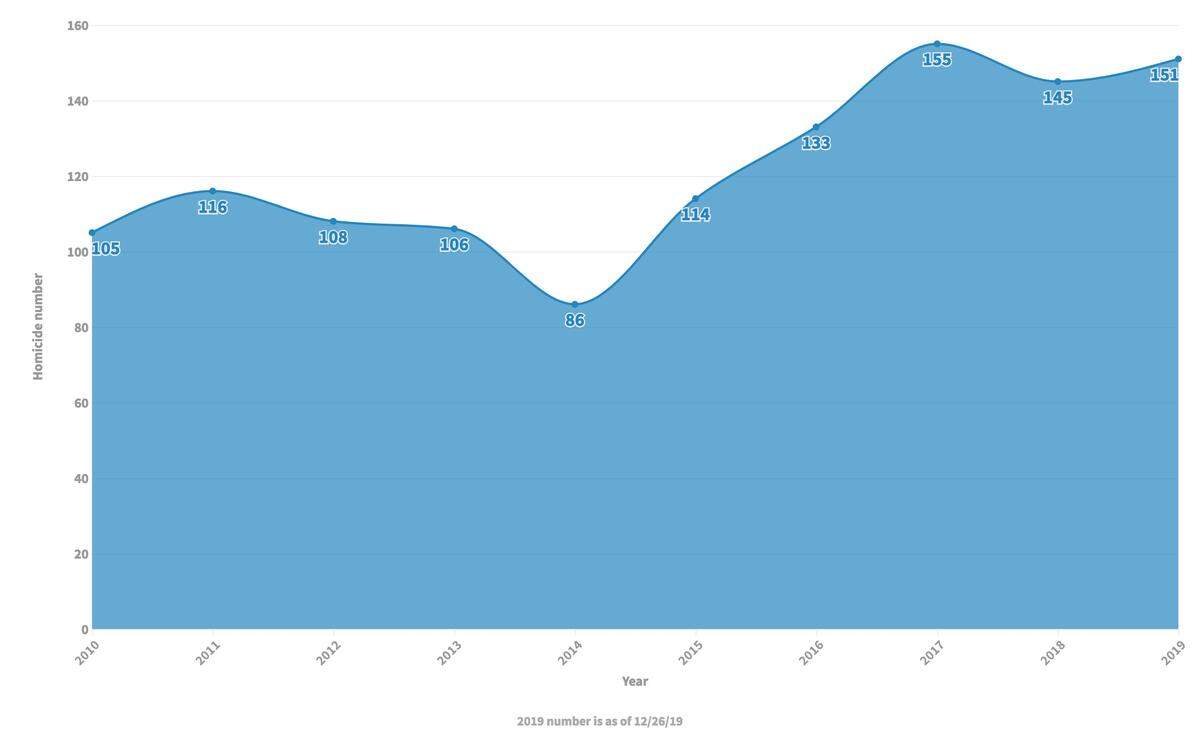
The effort, called the Kansas City No Violence Alliance, or KC NoVA, garnered national attention after killings dropped to a historic low of 86 in 2014, the fewest in Kansas City in more than four decades.
Under NoVA, law enforcement agencies used “focused deterrence” — targeting violent people and their associates and offering them a choice: change your behavior or go to jail. In exchange, they would get help finding jobs, getting an education and other assistance.
But when homicides increased again by the end of 2015, authorities went back to their separate agencies and “started chasing the bloodstain,” Jackson County Prosecutor Jean Peters Baker said.
By 2019, the strategy was effectively abandoned.
Now, an assessment obtained by The Star offers candid insight into why: Despite the effort’s early success, the Kansas City Police Department had grown weary of the strategy and began to step away, angering other participants who wanted the program to continue.
“Instead of really steering into the problem and retooling ourselves at that moment, we kind of threw in the towel,” Baker, one of the chief architects of KC NoVA, said in December. “We kind of gave up.”
Some key figures who were part of KC NoVA’s launch were reassigned or moved on. Its effectiveness was questioned as killings rose in 2016. Significant elements of the strategy were dismantled over time.
Since then, murders have continued to increase. In 2019, the city nearly hit an all-time record.
Other cities that stuck with and adjusted their focused deterrence strategies over time eventually prevented homicides by targeting a small group of chronic offenders vulnerable to sanctions, supporters of the approach say.
Kansas City police instead announced last summer they were partnering with federal authorities on a program that has been around since 2001 and was retooled in recent years under then-U.S. Attorney General Jeff Sessions. It focuses on targeting the most violent individuals, but not their associates.
That shift, Kansas City police said, was endorsed in an assessment conducted by the National Public Safety Partnership.
“Today, we are focusing the limited resources of the KCPD to the individuals who are ‘trigger pullers,’” the department said, noting it is constantly evaluating what works and what needs to change. “We don’t rule out any potential solution and will consider all options in order to reduce violent crime.”
Mayor Quinton Lucas, as a member of the Kansas City Board of Police Commissioners, said his office plans to soon review KC NoVA and other crime prevention programs with City Council, police officials and other community leaders.
NoVA working
Launched in 2013, KC NoVA was considered innovative. City officials had high hopes.
The effort was a collaboration between agencies, including the prosecutor’s office, the police department, the U.S. attorney’s office, the Missouri Board of Probation and Parole, the FBI and the U.S. Bureau of Alcohol, Tobacco, Firearms and Explosives. They used prevention and discipline, which was credited with curbing homicides in other cities, such as Boston.
KC NoVA identified 1,100 offenders in as many as 70 groups who qualified for participating in the effort, which included “call-ins,” or large meetings.
During one session in 2014, city officials, law enforcement and the mothers of murder victims stood at a podium in front of 45 offenders at the Morning Star Missionary Baptist Church at East 27th Street and Wabash Avenue.
Baker made them a two-pronged promise: “If you or one of your associates engage in an act of violence,” she said, they would be prosecuted. But stay out of trouble, and “people in the back of this church tonight are willing to help you.”
The strategy saw an immediate reduction of violence.
During KC NoVA’s initial implementation, conversations involving officers, social workers, academics and other stakeholders at times saw them flip roles.
“I’d watch the social worker become the one that wanted a law enforcement approach,” Baker said, “and I’d watch a police officer be one that thought we should try a community approach on a particular individual.”
Baker said she watched the “light bulb go on about how we could do this different.”
Jackson County Sheriff Darryl Forté, who was Kansas City’s police chief when KC NoVA launched, said focused deterrence was effective in reducing group violence. Many participants benefited from the services offered, he said. It provided options other than incarceration.
“I wonder how many additional lives would have been negatively impacted had KC NoVA not been in place,” Forté said this month, noting though that it was “not intended to serve as a cure-all to violent crime.”
After being confronted by NoVA, some young men changed their conduct, Forté said. Less than 5% of those involved in the program were convicted of a new crime, according to the assessment.
Smith has acknowledged NoVA’s initial success, saying group-related violence has fallen since 2014 from 64% of all homicides to 37%.
KCPD pushes back
Thomas Woodmansee, a former detective who implemented a focused deterrence unit at the Madison Police Department in Wisconsin, completed the June assessment by conducting phone interviews and site visits with nearly two dozen police officials, correctional staff and state and federal prosecutors.
Police thought the most violent offenders were not attending call-ins, which were held four times a year. Even those who did were not influenced, police told Woodmansee, because law enforcement did not have the resources to follow up to hold so many people accountable for violations.
Authorities have not done a call-in since the summer of 2018.
Police see their role as holding offenders accountable “through arrest and incarceration,” according to the report.
Even mentioning the term “focused deterrence” evokes strong negative reactions by many in the force, multiple people told Woodmansee. The department told The Star that some officers viewed NoVA as valuable while others did not.
Police have not referred people to KC NoVA advocates in more than a year.
Smith said he was concerned that referring people on the NoVA list to social workers constituted an unauthorized disclosure of criminal intelligence under federal law, according to an email sent by Jackson County Deputy Prosecutor Dan Nelson.
At one meeting where officials talked about NoVA participants, Smith asked Darren Faulkner, NoVA’s director of community engagement, to leave.
The department told The Star it was worried about violating the Sunshine Law and other laws. A police spokesman said officials asked their legal counsel, who agreed there was a concern.
But simply sharing the names of clients and their contact information was not a violation, Nelson wrote in the email, which was obtained by The Star through a records request.
Because police were unwilling to make referrals, NoVA advocates had to obtain client information in other ways, such as through probation and parole, according to Nelson’s email. Sometimes, advocates got their information during call-ins, but those were discontinued by the department, he wrote.
“So the indirect channels for NoVA advocates to receive client referrals have dried up,” Nelson wrote to the police department’s Office of General Counsel in March. “The purpose of referring names is to qualify such persons for services to offer them affirmative opportunities to embark on a different path.”
An official at the National Network for Safe Communities, Nelson added, said she was unaware of any other city police department “taking this stance.”
In May 2018, NoVA listed 900 possible perpetrators or victims of crime, about 300 of whom advocates were in contact with. But police stopped updating the list in October 2018, Nelson wrote.
By early 2019, advocates were in touch with 135 people on the list, which fell to just 105 by March.
“This trend is alarming,” Nelson wrote, noting that NoVA’s grant funding required the program to use police intelligence to make referrals to advocates. “We need to recommit to finding a way to make targeted client referrals.”
NoVA does not have a list anymore. It went away with focused deterrence, Faulkner said.
Chief Smith’s approach
Five years after the strategy was implemented, an evaluation by the National Institute of Justice concluded the effort had no significant effect on homicides in Kansas City.
After becoming police chief, Smith had the U.S. Department of Justice spend 18 months evaluating the city’s focused deterrence strategy. They recommended a different crime-fighting initiative connected to Project Safe Neighborhoods, he said.
“The result is this new enforcement strategy that targets the trigger-pullers,” Smith wrote in a June blog post.
The effort has been credited with reducing homicides in Tampa, Smith noted. However, the effectiveness of that plan has yet to be seen in Kansas City.
Because slayings continued, the department “needed to adapt,” Smith said. The move shifted from concentrating on criminal gangs and groups to targeting individuals police believe to be responsible for the vast majority of violence.
The changes Smith implemented reassigned officers who had been following up with offenders in KC NoVA and gave more resources to patrol, according to the assessment. Since then, police have added more homicide detectives.
Smith was not available for an interview, a police spokesman said.
But in his blog posted Friday, he said the department continues to work with KC NoVA state and federal partners.
“All of those partners remain at the table with us, and they are integral in reducing the gun-related crimes that plague Kansas City,” Smith wrote.
In the assessment, federal prosecutors in Kansas City suggested more attention be placed on individuals rather than groups responsible for gun crimes. Such a move would allow prosecutors to pursue federal charges that carry stiffer prison sentences.
Since then, police said they have sent several gun-related cases to federal prosecutors.
Nathan Garrett, president of the city’s Board of Police Commissioners, said early indications of the new effort were positive.
“So while we may not all agree on every aspect, there is no doubt that we all want the same outcome: a safer, less bloody Kansas City,” Garrett, a former federal prosecutor, said in an email.
But by the end of 2019, the city recorded 491 nonfatal shootings and 151 homicides — 65 more homicides than in 2014, according to data kept by The Star, which includes fatal police shootings.
Other cities
Some experts suggest focused deterrence strategies such as KC NoVA curb shootings in American cities more often than other approaches.
Nothing works as well, they say.
But those violence reduction strategies have to be designed to evolve, which was a challenge in Kansas City, said Andrew Fox, who helped implement KC NoVA as a University of Missouri-Kansas City professor. He is now a Washington state researcher.
Fox compared it to flu vaccines: they are different every year for a reason.
“I take an Advil because I have a headache, but I don’t expect that to eliminate my headache for five years,” he said. “The same thing is true, I think, with these societal issues.”
Baker pointed to Oakland, California, and New Orleans as examples of cities correctly using focused deterrence.
Oakland’s strategy got off to false starts before it became effective. Its initial implementation lacked clear communication among agencies, according to one study, which noted if reducing gun violence could happen in Oakland, “it can happen anywhere.”
New Orleans, with a historically high murder rate, has seen a decline in homicides in the past three years, ending 2019 with the fewest since 1971. Crime analysts now expect its murder rate to be about the same as Kansas City’s.
New Orleans’ mayor recently launched a 50-year plan to reduce gun violence, which includes data collection, public health interventions and research into what works.
In Kansas City, Baker hopes focused deterrence will be used in the future.
“I saw it work,” she said.
KC NoVA now
In 2014, about 190 people on average received NoVA services each month. The number fell to about 120 by 2016.
The program continues to provide social services to about 95 clients, with referrals from family court, mental health providers, crime victim services and other agencies — but not police.
Workers focus on people most likely to be the victims or perpetrators of gun violence, Faulkner said.
The clients are divided among three social service advocates who assist them with educational assistance, housing and substance abuse and mental health counseling. They also work with local companies that hire people with criminal convictions. Advocates have helped clients buy car parts and get bus passes, Faulkner said.
“It is not so much the carrot and stick anymore that it used to be with the focused deterrence,” he said.
To highlight the program, KC NoVA in late 2019 posted videos on YouTube showing advocates helping men get jobs and new suits. In one video, several men worked out at an indoor rock climbing gym.
When focused deterrence is deemed not effective, it is usually missing one or more elements, the assessment of Kansas City’s focused deterrence effort noted. Previously effective strategies should be tweaked before they are abandoned, Woodmansee wrote.
If Kansas City decides to continue with focused deterrence, it should be rebranded because of the negative reputation of NoVA within the police department, Woodmansee concluded.
Bridging the divide between the “services side and the enforcement side” was the biggest challenge, one unnamed partner told Woodmansee.
“Until that is done, we will be stuck with everyone operating in their own silos with inefficiency,” the person said.
Damon Daniel, president of the Ad Hoc Group Against Crime, said focused deterrence is most effective when community-based groups first provide “wraparound services,” such as trauma-informed counseling and cognitive behavioral therapy, which studies have shown reduces recidivism.
“There are some people in our community that truly have not had that moral guidance to make good decisions, in addition to a lack of opportunity that would otherwise provide a pathway to better means of living,” Daniel said.
Meanwhile, seven people, including a 17-year-old boy, already have been killed this year in Kansas City. An infant has been among those wounded by gunfire.
Lucas said he would like to see more than a dozen NoVA social workers talking with shooting victims at hospitals. No matter what the city does next — be it NoVA or NoVA 2.0, he said — those involved have to make sure it is reducing violence.
“None of us are doing as well as we need to,” the mayor said. “I am not; our NoVA program is not; none of us are.”
This story was originally published January 19, 2020 at 5:00 AM.