After keeping contentious name, Johnson County adds new signs to Negro Creek
Residents and visitors can finally learn more about the contentiously named Negro Creek with new informational signs posted along the creek’s corridor — tying together the last step of several years of research, advocacy and effort in Johnson County.
“The decision by the committee was to preserve the creek as an educational landmark, you know, transforming the name from a label into a legacy of resilience,” First District Johnson County Commissioner Becky Fast said. “I’ve always believed that unless you know your past, you don’t know where you’re going.”
Part of the Blue River watershed, Negro Creek’s main stem flows east for 4 miles in Leawood near 151st Street and Kenneth Road to just west of the state line. It’s one of 20 creeks named in Johnson County, but it comes with a dark and painful past.
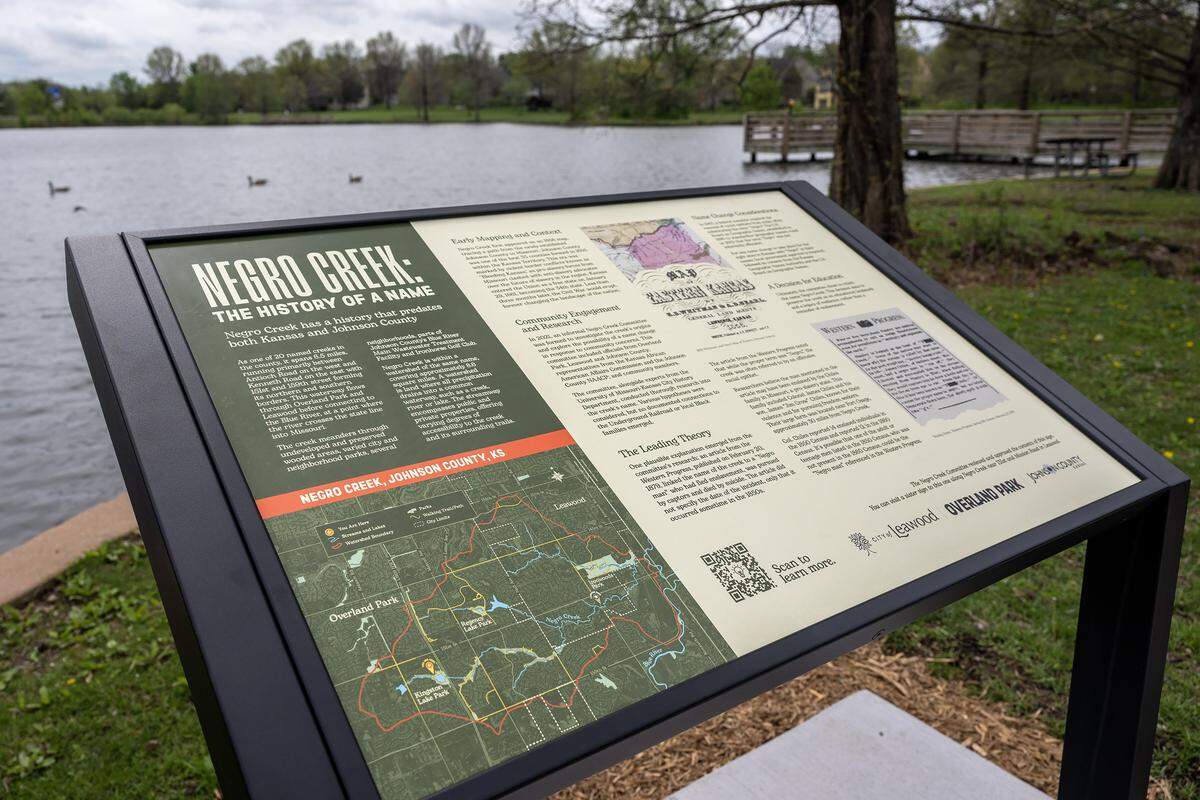
“Negro Creek has a history that predates both Kansas and Johnson County,” one of the new signs reads in Kingston Lake Park in Overland Park.
After a two-year study, in 2021 historians shared that the creek’s name most likely came from a story of an enslaved man who ran away in the 1850s from a Missouri farm owned by a prominent and notoriously violent local family.
It’s likely that the family tracked him along the Blue River as he fled toward Kansas and made it to a tributary across the state line. Historians believe that he chose to die by suicide there rather than be recaptured and returned to a life of slavery.
People were largely unaware of the small unmarked creek until activists brought attention to the tributary and pushed for the county to rename Negro Creek in 2019 and 2020, arguing that the name is too offensive to stay. Despite pushback on the name, the county ultimately decided to keep it in 2023 after a two-year study, worrying that changing it would remove a piece of the county’s history.
Nearly three years after deciding to keep the name, Johnson County, the Kansas African American Affairs Committee and cities of Leawood and Overland Park celebrated the installation of the new signs placed along the creek in late March.
“At a time when there is increasing pressure in many places to simplify, alter, or even erase parts of our past to make them more comfortable, I appreciate the time and care that went into this conversation,” said Stacey Knoell, the executive director of the Kansas African American Affairs Committee. “The likely history of the creek is not pleasant, but I’m grateful that the community didn’t suppress the story. It is only through truth that we can find healing.”
‘Legacy of resilience’
During the two-year study, the Johnson County committee worked with historians at the University of Missouri-Kansas City to uncover the name’s origins. While some had theories, including speculations of the site serving as an Underground Railroad route, researchers found little evidence to back those ideas up.
The new signs along the creek delve into the leading theory.
Historians discovered that the creek’s name was first mentioned in a Spring Hill newspaper article in 1879 — detailing the story of an enslaved man who fled from the Chiles’ farm — a well-known family who lived in southwestern Jackson County near the creek. Col. James C. Chiles was a slaveholder and politician in Jackson County, who pushed to make Kansas a slave state and organized the settlement of pro-slavery migrants.
Chiles was an infamous bushwhacker who was reportedly connected to several murders. The family enslaved more than a dozen people in the mid-1800s, including some young adult and teenage men, according to census records.
“This signage at Negro Creek has been a long time coming, and I feel good about where this process ultimately landed,” Knoell said. “The signage allows us to preserve history while also providing context needed to better understand it.”
Records show that people tracked down the unnamed man to bring him back to Missouri, and he took his own life before he could be captured. While not enough evidence exists to come to complete conclusions, researchers believe that the story is most likely the reason for the creek’s name.
First District Commissioner Fast, who served on the committee to rename Negro Creek, said that they were never able to find the name of the man who tried to escape and ultimately died in the creek because enslaved individuals weren’t often named in official records.
She said she hopes that by commemorating the creek and preserving the past that Johnson County residents can “become a stronger community as a whole.”
“I hope that this is the beginning of uncovering more stories of Black Johnson County residents. We need to tell the history,” she said.
This story was originally published April 14, 2026 at 5:40 AM.