‘It was horrific’: Historians find a new reason to rename Johnson County’s Negro Creek
For decades, Johnson Countians passed down the story of a Black man who ran away from the Missouri farm of a prominent and notoriously violent family to escape slavery.
Col. James C. Chiles was a slaveholder and politician in Jackson County, who pushed to make Kansas a slave state and organized the settlement of pro-slavery migrants. His son, James J. or “Jim Crow” Chiles, was an infamous bushwhacker who was reportedly connected to several murders but never served time for his crimes.
A story circulated that a man enslaved by Chiles escaped and fled toward Kansas. Men tracked the slave, following the Blue River and eventually catching up to him at a tributary just across the state line.
It was there that the man chose to die by suicide rather than continue a life of brutal abuse and captivity.
Today, that tributary, which flows through a part of Leawood and southern Overland Park, is named Negro Creek.
Many Johnson County residents said they were unaware that any such place existed near their backyards — much less knowing the painful piece of history that experts only recently discovered is the probable origin of the creek’s name.
But the small, unmarked creek that runs through a golf course in one of the most affluent areas of Kansas’ wealthiest county has held the name since at least the 1850s when it first appeared on a map, historians found. And in several cases, the stream was called by the racial slur “N----- Creek.”
Many say it’s time for the name to change.
“It’s very painful and traumatic to read the historical narrative about what happened,” said Kenya Cox, executive director of the Kansas African American Affairs Commission, a state advisory commission. “To think that one human being could inflict this type of brutality on another human being is just deplorable and downright hurtful. It wasn’t humane. The way we learn from this is to tell the truth. This is who we were. And now we’re moving forward.”
Johnson County officials, activists and historians have formed a committee to learn more about the origins of the creek’s name and change it. It’s a months-long process that requires federal approval, extensive research and community buy-in — to not only remove the name but choose a new one.
And they hope it will only be the start. Throughout Kansas, there are at least six geographical features containing the word “Negro” in their names, including an oil field in Cowley County south of Wichita and a stream in Atchison County.
And they share more in common than their names. Many of the places have a history linked to the death of Black Americans and racial violence, researchers found.
“How we name places and how we see ourselves in public spaces really speaks volumes to what we value and what is important to us,” Cox said. “It’s time for us to have this conversation. We have to be willing to lean into discomfort and do the hard things. I think we’re going to be better for it and our children are going to be better for it in the end.”
‘Obscure little creek’
It’s easy to overlook the creek.
Several residents who live near it say they haven’t given it much thought over the years as it babbled near their southern Overland Park neighborhood or swallowed a ball on a player’s off day at Ironhorse Golf Club in Leawood.
The creek trickles out of a small lake west of Antioch Road and flows east, over parkland, under Mission Road and through the golf course, ending at the Blue River in Missouri. Its name seldom shows up on modern-day maps and documents. While the name does appear on Apple Maps, it can’t be found on Google Maps.
“A lot of people have had no clue it even existed or what it was called. That’s why it’s been able to fly under the radar for so long,” said Diane Mutti Burke, chair of the University of Missouri-Kansas City history department. “It’s an obscure little creek. It doesn’t go very far. It’s not very big. But officially, it has this name.”
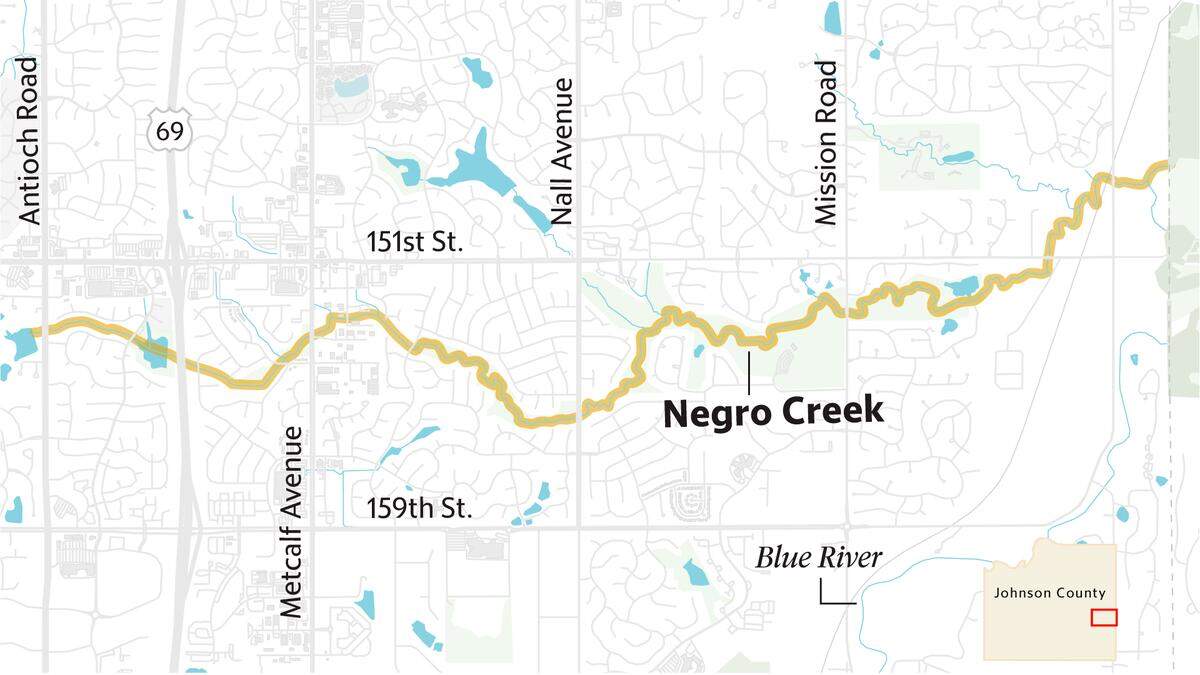
Last summer, more residents became aware of the name when activists brought new attention to a Change.org petition to remove it. Residents contacted Johnson County Commissioner Becky Fast, who represents northern Overland Park and parts of Leawood, as well as the Johnson County NAACP and others, who soon after helped start the committee to look into the creek’s history.
The story behind the name has remained a mystery. But there have been many theories over the years.
Some have speculated that the stream was named after the Black families who lived in the old Oxford Township. Others wondered whether there was a connection to the nearby Santa Fe Trail, and the Spanish word for “black.” Perhaps the most common theory, though, was that the creek might have been a route on the Underground Railroad.
But researchers have so far found no evidence to back up those stories.
“Thinking it could be part of the Underground Railroad got me excited, because I thought we could change the name to Freedom Creek or Prosperity Creek — something that would pay homage and commemorate the history,” Cox said. “In a sense, that would have been a nice narrative. But unfortunately, so far, we have found that is not the case.”
Historians at the Johnson County Museum found the name first listed on a map in 1856, two years after Kansas became a territory — although it was not drawn to scale. They also discovered that the creek, and the epithet by which it was once called, were first mentioned in a newspaper in 1879.
The gut-wrenching column in the Western Progress, a Spring Hill newspaper, led researchers to believe that the name is likely rooted in a history of trauma and racial violence.
It read:
“Stanley is located at the head of ‘[epithet] Creek.’ Some of the curious may want to know why the stream is called by that name. As the poet would say, ‘thereby hangs a tale.’ In 185--, James Chiles, of Jackson count, Missouri, had a negro man to ‘run off,’ they followed and surrounded him on the stream running to Stanley to Blue, when finding they would capture him he drew a knife and cut this throat from ear to ear. From that day to this it has been known as [epithet] Creek.” Of course the proper name is negro, but we being Democrats down here, (for short) spell it with two “g’s.”
Embedded in racial history
After struggling to confirm the origins of the name, county officials asked historians at UMKC to find out more.
Burke, an expert on slavery and the Civil War in the Kansas City region, along with doctoral candidate Deborah Keating, took on the project. They struggled with a lack of records, as well as historical archives that were closed during the COVID-19 pandemic, but Burke said they found enough information that she feels confident the tragedy spelled out in the Spring Hill newspaper is the most plausible story.
The wealthy Chiles family was well-known in the region, and many family members lived in southwestern Jackson County near the creek. Throughout his life, Col. Chiles was a Jackson County commissioner, state senator and speaker of the Missouri House, where he pushed his pro-slavery agenda. His son married Sarah Ann Young, the sister of Harry Truman’s mother, Martha Ellen Young.
The family enslaved more than a dozen people in the mid-1800s, including some young adult and teenage men, according to census records. While oral history and some written records suggest that the enslaved man who may have died at the creek escaped the property of Chiles, Burke said that the researchers haven’t verified that.
But because of the family’s prominence, she believes it is likely that such a story would have been commonly known, rooted in some truth and passed down in the region. It is also plausible that enslaved people would have known to follow the Blue River into Kansas territory.
“The fact that he tried to escape going down that route rings true to me,” she said. “It’s impossible to know. But it appears he was essentially cornered and chose this really drastic action rather than be taken back into slavery.”
“He liberated himself in a way that is horrible, but in fact that is what he did.”
In addition to the column in the Spring Hill newspaper, the creek is mentioned, typically using the racial slur, in records of everyday happenings, such as church baptisms and the building of a new bridge in the late 1800s and early 1900s.
In 1993, the Johnson County Sun said that there was a local legend that a “black person was hung near the creek.”
Burke said that there is often a history of racial violence behind such geographic features. Kansas alone has several Negro Creeks:
One southwest of Wichita comes from a story of a Black man who froze to death in a blizzard near the stream in 1872. A newspaper reported that one in Atchison County was so named after the lynching of a Black man. One that flows into the Arkansas River near Wichita is named for four freedom-seekers who were killed or wounded there.
“I couldn’t believe what happened. It was horrific, the events associated with these names,” Cox said.
Officials removed the racial slur and changed the names of many of these places to “Negro” after a federal mandate in 1963.
Historians continue to research the background behind the name of the creek in Johnson County, with several questions left unanswered and details unverified. And while the history of some other waterways is better documented, Burke said that she found enough evidence to know that the theories of the stream being named to commemorate the freedom of enslaved people or honor Black Americans in the region are less likely.
“The name was in fact deeply embedded in the racial history of the county, the region and really the United States as a whole,” she said.
‘Can’t run from the past’
Many agree that the troubling history of the creek’s name justifies the efforts to change it.
“I think there was a total consensus in our group that this needs to change. And my hope is that this process will provide a larger conversation as we struggle to reconcile with our county’s history and educate ourselves on where we want to go,” said Fast, the commissioner who has helped lead the effort. “You can’t run from the past, but you can use it to better who you are now.”
Officials argue that it’s time for Kansas to clear its maps of the term “Negro,” which has been removed from many federal documents. In 2013, the Census Bureau decided to stop using the word on its surveys — making last year the first time it did not appear on the U.S. Census. The following year, the U.S. Army dropped the term from its equal opportunity policy.
“Our younger generations really do perceive it as a derogatory term,” Cox said. “If it can be removed off the U.S. Census, I think that gives credence to us really looking at whether this should be a term used as an identifying marker for the state of Kansas.”
Similar steps have been taken across the country. In 2019, Georgia officials successfully renamed Runaway Negro Creek near Savannah to Freedom Creek, for example. While ideas for a new name for Johnson County’s creek have been floated, leaders held off judgment until the community has a chance to chime in.
They want the effort to result in more than just a name change. Officials agree that signs should be put up along the creek, explaining the history of the original name and slavery in the region, as well as accomplishments of Black Johnson County residents.
“I think this will be a catalyst for even more important, crucial discussions on race and the way we related to each other,” Cox said.
Applying to change the name of the creek is poised to be a lengthy process. It requires historical documentation about the creek’s history and name, community input and approval on several levels, including final approval by the federal U.S. Board on Geographic Names.
Fast said that leaders plan to offer community input sessions, so that residents can learn about the history and discuss the potential change.
Cox hopes that the process will be successful in Johnson County, then carve a path for other counties in Kansas to rid their maps of names rooted in racism.
“We do not want to sanitize the history at all. It’s very important to document it and tell the story as it was,” she said. “But then we also need to realize that this gives us an opportunity to find our way forward. What do we want the next generations to think of us?”
This story was originally published March 23, 2021 at 5:00 AM.