A new Royals ballpark remains a ‘Field of Speculation.’ Here’s how it might look
AI-generated summary reviewed by our newsroom.
- Council authorized city manager to negotiate with the Royals for up to $600 million.
- The park (4.8 acres) plus Blue Cross (6.76 acres) total just short of 11.6 acres.
- No official renderings or final funding commitments from the Royals have been released.
So many questions remain unanswered about a new Kansas City Royals Stadium at Washington Square Park, that, at this point, the proposed $1.9 billion project — while more now than just a “Field of Dreams” — is still a “Field of Speculation.”
Who will pay for it? It’s unclear. On Thursday, the Kansas City Council approved an ordinance authorizing City Manager Mario Vasquez to negotiate with the Royals a deal of up to $600 million, a major step towards securing a new stadium.
But how much money the Royals, controlled by billionaire owner John Sherman, will pitch in is still an open question, because Sherman and the Royals have yet to announce it. What monies the state of Missouri and Jackson County might contribute, if the county contributes any, is also unclear.
As for what the ballpark will look like: no official renderings have been released.
In fact, so much is currently left to speculation — where home plate will be, the outfield, the entertainment district à la Chicago’s Wrigleyville — it seems only fitting to do just that: speculate, based on what is known about other ballparks, what City Hall insiders are saying, as well as a few hints inside public documents.
Consider:
A Royals stadium in Washington Square Park
Don’t expect it to look like The K.
Opened 53 years ago, on April 10, 1972, Kauffman Stadium remains beloved by fans who speak rapturously about the outfield’s geyser-like fountains and crown-capped scoreboard.
But a simple outline of Kauffman Stadium placed over the footprint of Washington Square Park — coupled with the property owned by neighboring Blue Cross & Blue Shield — shows that the 38,000-seat Kauffman Stadium would never fit in that space. Too wide, too circular.
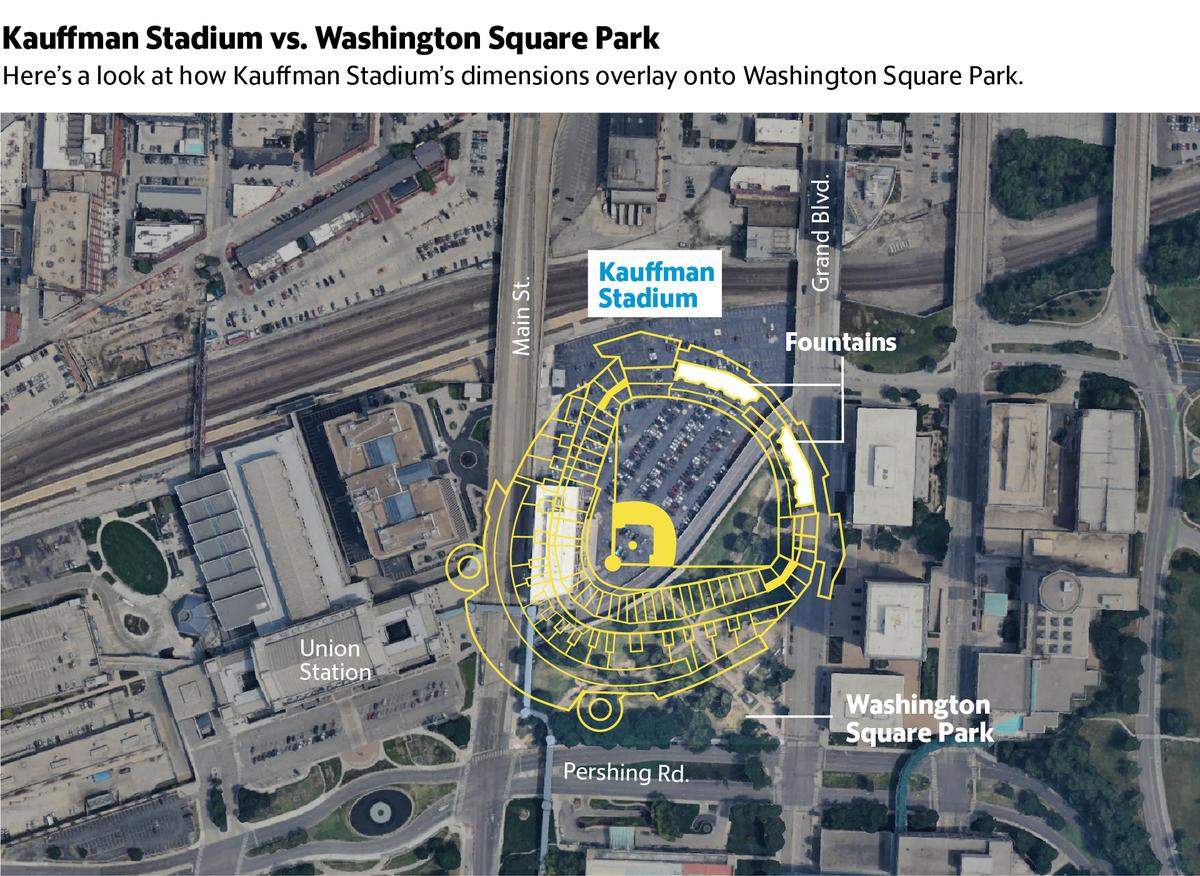
Sherman, in media, has said that a new ballpark in that spot would have to be more constrained, similar to Target Field in Minneapolis, home of the Minnesota Twins. While most modern Major League Baseball parks sit on 15-plus acres, the Twin’s field, still with 38,544 seats, is wedged into a tiny 8.5-acre site. Washington Square Park is 4.8 acres.
But part of the deal involves the purchase of the adjacent Blue Cross and Blue Shield building (to be demolished) along with its parking. Add the park’s 4.8 acres to the Blue Cross’s 6.76 acres and the overall area is just short of 11.6 acres — more than enough room.
Before this year’s home opener, Sherman discussed the future stadium and what the Royals learned from a fan survey. Sherman said he requested that Earl Santee of Populous, the Kansas City architectural firm, include certain features in future renderings.
“Kauffman Stadium is beautiful, symmetrical. The ballpark itself, I’d like to see that basically duplicated wherever we go,” Sherman said. “Now, you know, the architects will want to do some different things around it. Another thing that came through in the (fan) survey ... if we’re going somewhere else, here are the things that we want. And you get the traditional stuff, parking, traffic, etc. But they want a crown, and they want a water feature.
“And really they want the crown and they want the fountains, right? And when Populous shows me drawings without those, I say, ‘Earl, you need to put the crown and the fountains back in there.’ Because I think architects want to do something new and cool, but I think you can do something new and cool but still bring the tradition into the things that are special about the ballpark. That doesn’t mean build an exact replica, but I think the ballpark itself is pretty special.”
Will there still be an outdoor park with green space?
Seems very possible.
On Tuesday, the Kansas City Parks Board approved a resolution authorizing the city manager to execute a 30-year lease for Washington Square Park with the Royals. Stated in the resolution, No. 33200: “The agreement includes provisions requiring the inclusion of parks and recreational areas and facilities that all inhabitants of the City may use and enjoy.”
What that may look like, or where? Again, unclear.
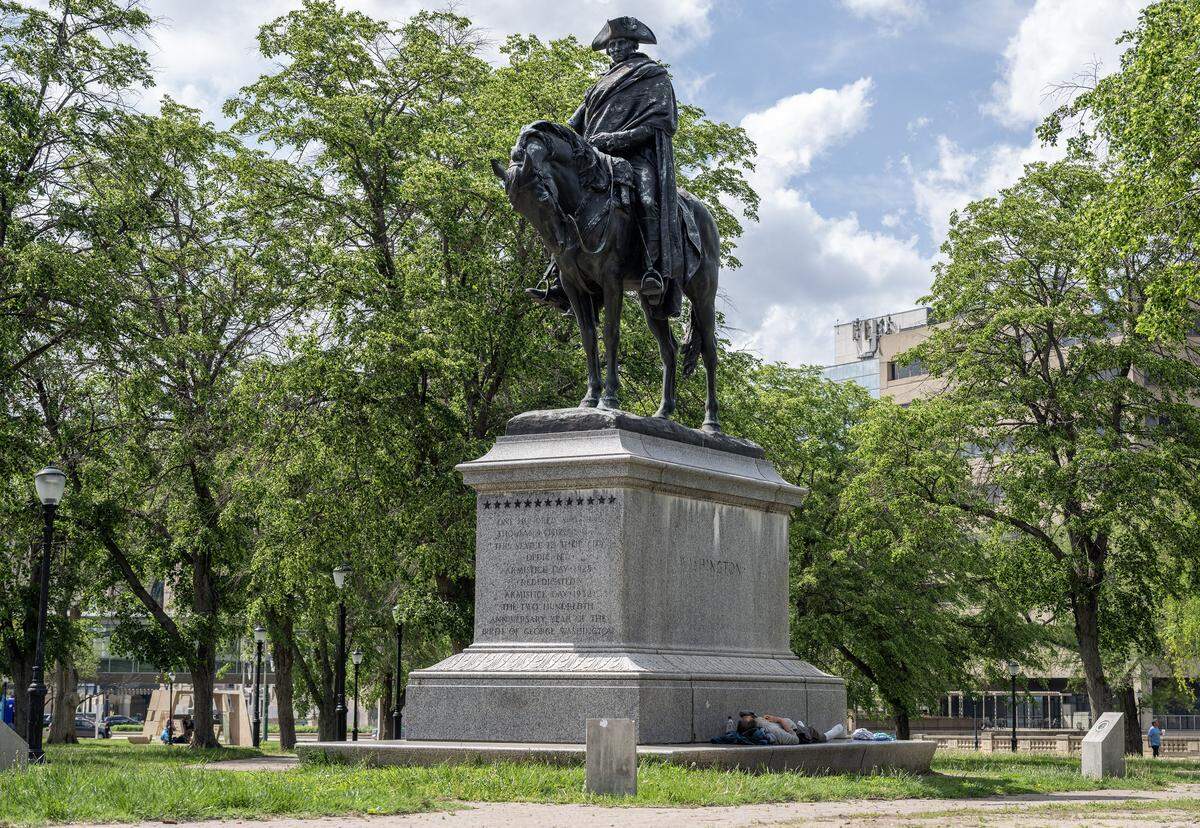
“We don’t even know what that exactly would entail,” Parks Board Commissioner Pat Contreras told The Star. “But, at this point, what I’ll be focused on, and what my colleagues will be focused on from a parks perspective, is making sure this delivers real benefit to the public as details come forward.”
Where will home plate be?
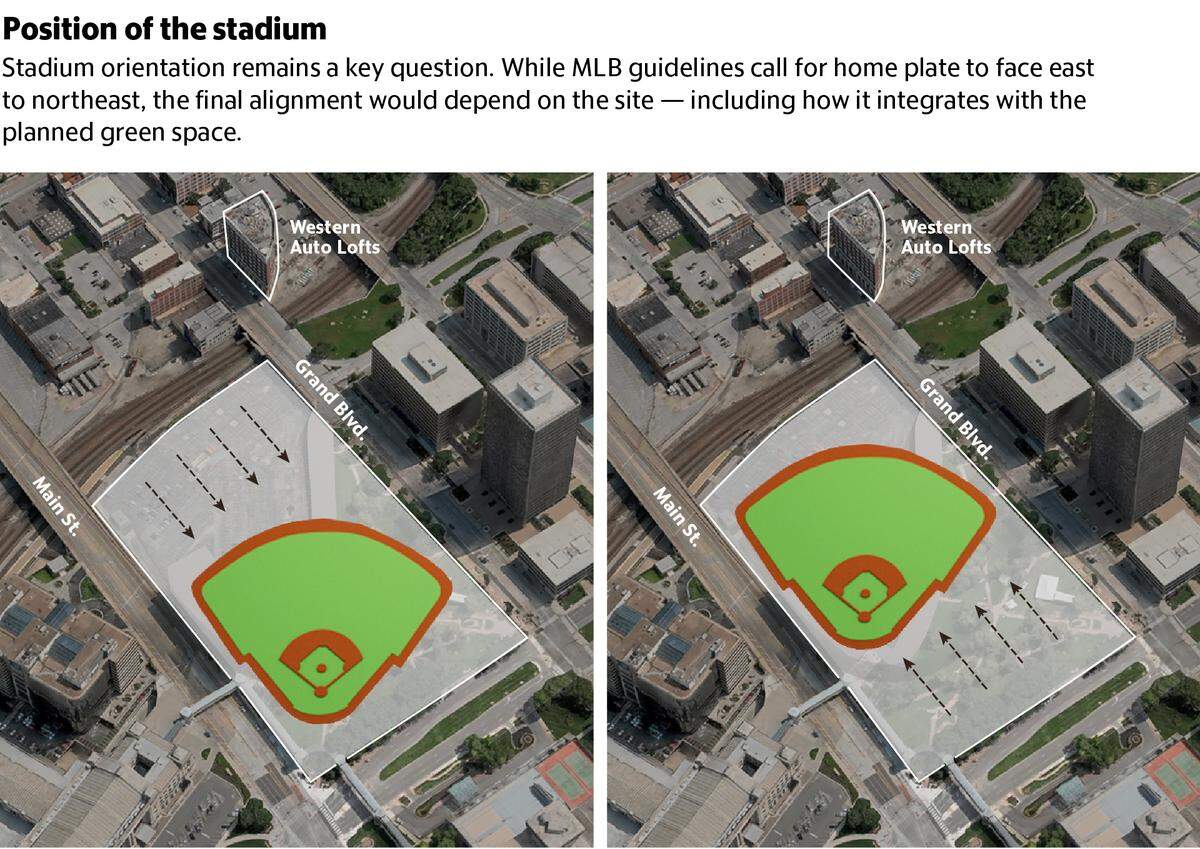
Pure speculation, but most major league ballparks tend to have batters, at home plate, point toward the northeast or north, or north-northeast to keep the rays from the setting sun out of their eyes.
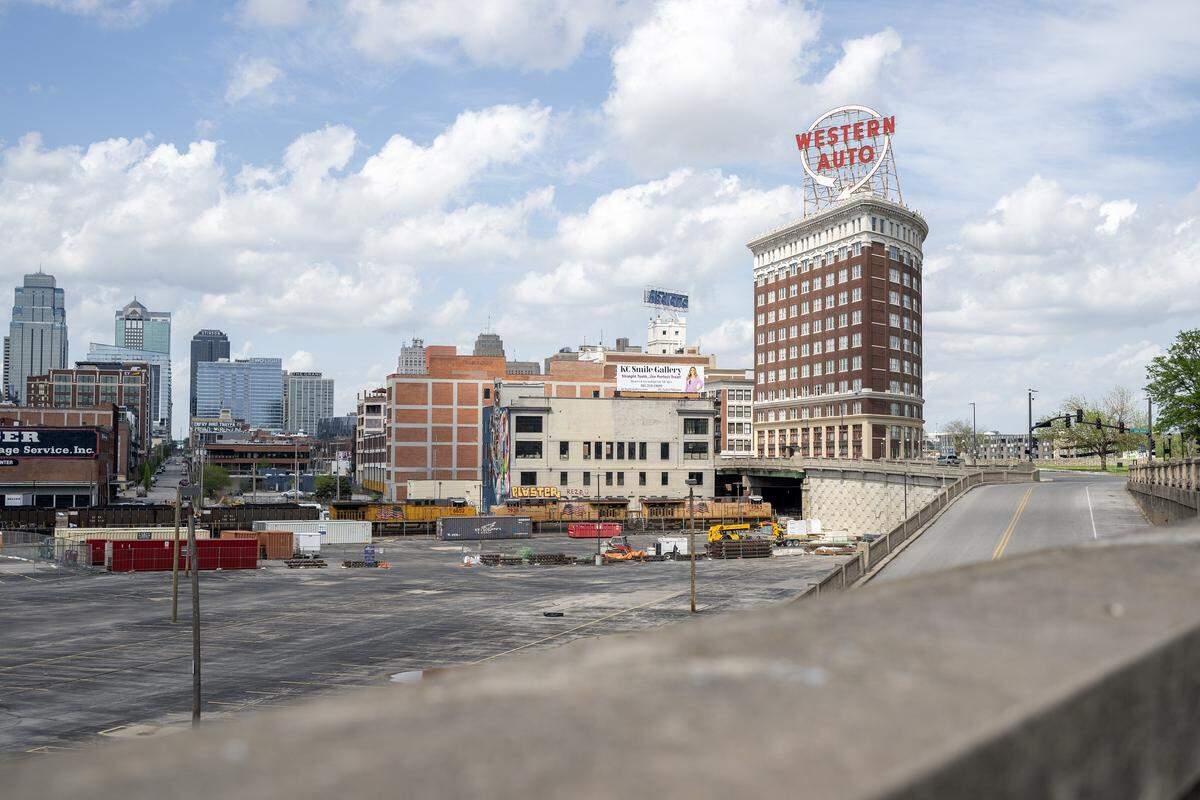
That would mean home plate would likely be on the far west side of the park, pointed toward the northeast where the Western Auto Lofts and its neon sign — should it ever be relit — would be visible beyond right field or center field.
Major parks, like Wrigley Field and Fenway Park and Yankee Stadium, are all oriented easterly. But not all ballparks are. The New York Mets’ Citi Field is oriented toward the southeast as is the St. Louis Cardinals’ Busch Stadium.
Where might the ‘baseball district’ or ‘entertainment district’ go?
Sherman, the principal owner of the Royals, has spoken about developing a year-round “baseball district” — similar to Wrigleyville in Chicago or Atlanta’s Truist Park — from the time, in November 2022, he first publicly announced his vision to build a new, downtown Royals stadium. City Hall insiders have said that Crown Center, owned by Hallmark Cards, Inc., and run by the Crown Center Redevelopment Corporation, could play an instrumental role. A Crown Center spokesperson was noncommittal.
“Our statement at this point is just we believe it’s important for Kansas City to be the home of the Royals,” the spokeswoman said, “and we support their efforts to bring their ballpark downtown. We want to continue cheering for our boys in blue for generations to come.”
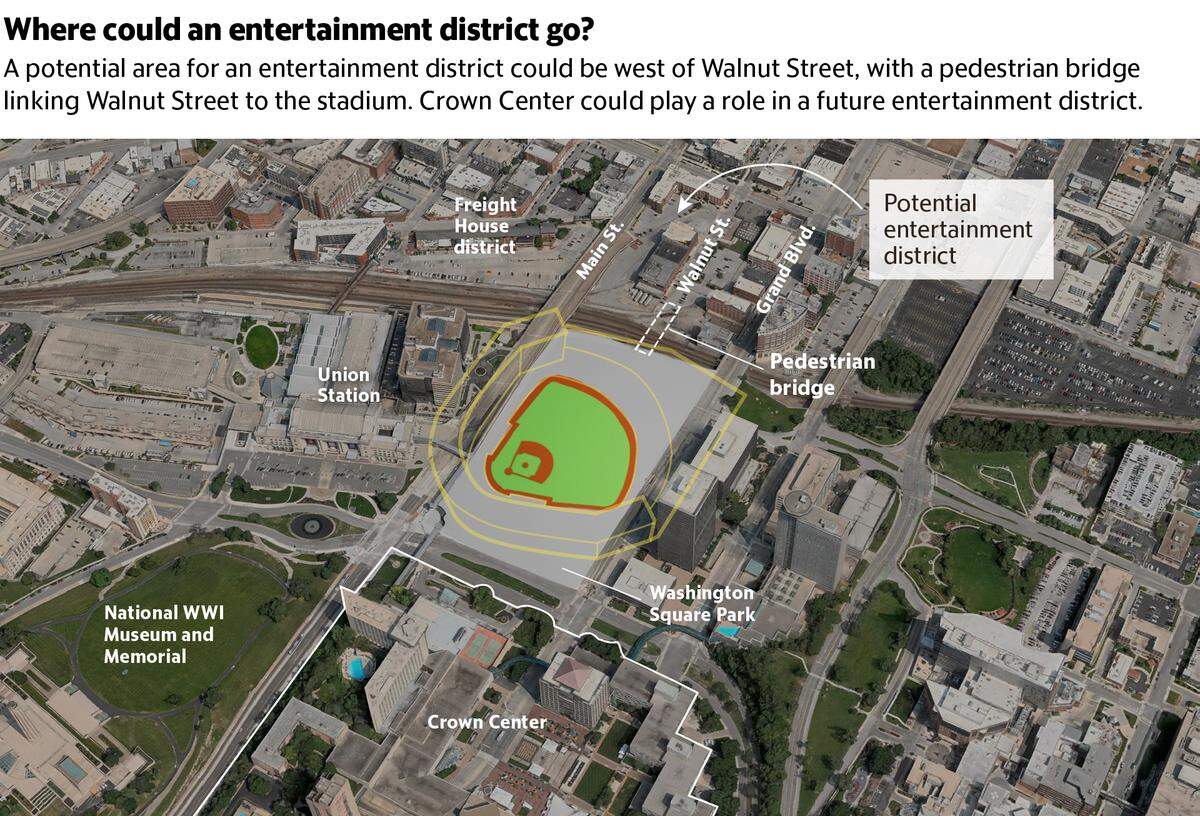
It’s also speculated that the district could encompass properties to the north, just beyond the railroad tracks, south of 20th Street between Main Street and Walnut Street Several properties there are owned by the Planned Industrial Expansion Authority, which is a part of the Economic Development Corporation of Kansas City.
The Belger Arts Center is located at 2100 Walnut St. And 3D Development, a company founded by Kansas City developer Vince Bryant, owns an historic building being used for storage. at 2020 Walnut St.
Bryant’s company, which also includes business partner Erik Wullschleger, has completed several downtown developments, including the adaptive reuse and renovation of Corrigan Station, 2100 Central Street, and the renovation of a 1912 historic building, now known as The Creamy, 2100 Central Street, into modern office space.
Since 2018, 3D Development has been behind the still ongoing renovation of The Kansas City Star’s former building at 1729 Grand Blvd. Working with DaVinci KC partners Dante Passantino and David J. Belfonte, Bryant is also a prime force behind the as-of-yet-unfinished Pennway Point entertainment district, adjacent to the Ferris wheel operated south of Union Station.
The Star made several attempts to contact Bryant, but received no response.
A pedestrian bridge
The ordinance, authorizing the city manager to negotiate a lease and development agreement with the Royals twice mentions “pedestrian bridges.”
Where a bridge or bridges might be needed is unclear.
But should the area north over the railroad tracks become tied into the stadium, one could envision a pedestrian bridge being built that connects Walnut Street to the stadium.
Royals traffic in downtown Kansas city
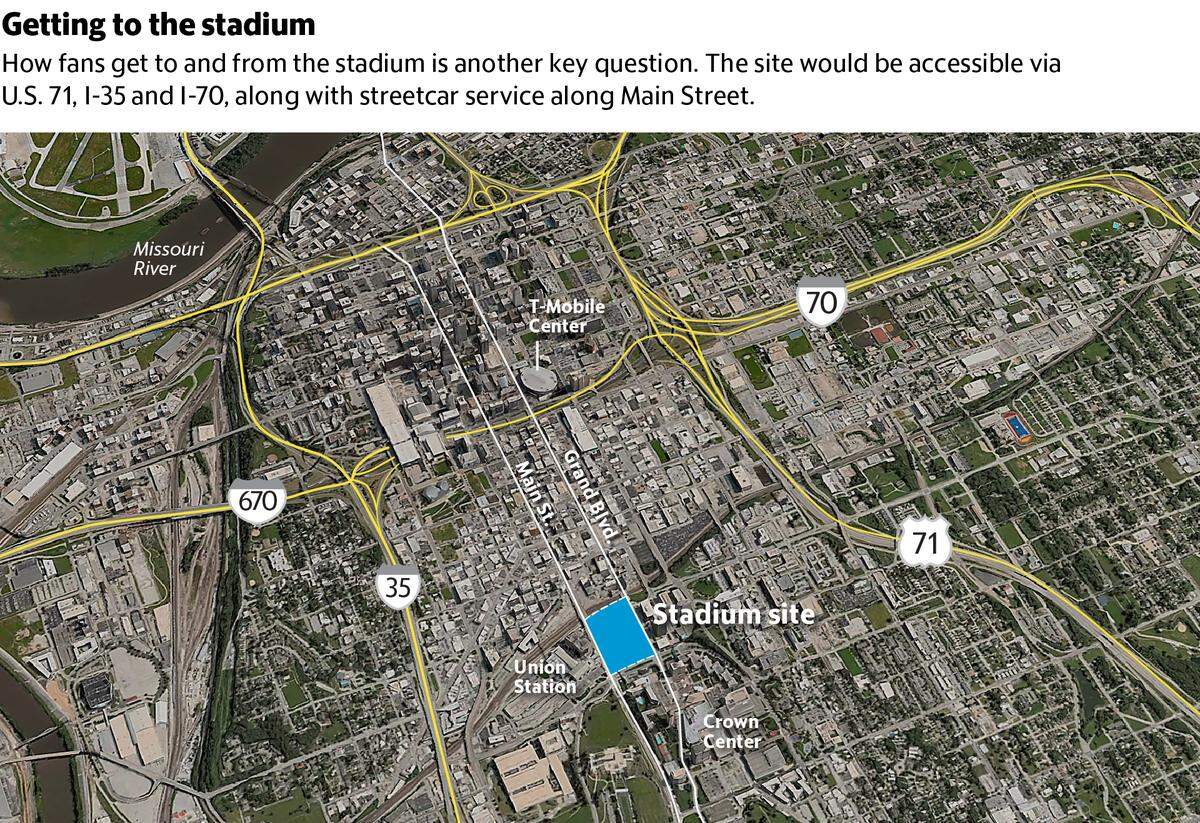
Kansas Citians love easy access. (Who doesn’t?) The Kansas City Council said there are about 20,000 parking spaces within a 10-minute walk of the proposed stadium site. Kansas City’s streetcar would also be available, bringing people to the ballpark from as far north as CPKC Stadium, where the Kansas City Current play along the Missouri River, to as far south as the stop serving the University of Missouri-Kansas City.
Driving in and out may be a different matter — perhaps.
The T-Mobile Center located downtown holds about 18,000 people. Drivers tend to come and go without significant delays. Access to a new Royals ballpark would be similar with Interstate 70 lying to the north of Washington Square Park, Interstate 35 to the west and U.S. 71 Highway to the east.
Just as the ordinance mentions “pedestrian bridges” it also mentions “transportation access” and “traffic improvements.”
The Star’s Pete Grathoff contributed.
This story was originally published April 19, 2026 at 5:00 AM.