Why fate of Missouri’s historic abortion vote will center on Kansas City
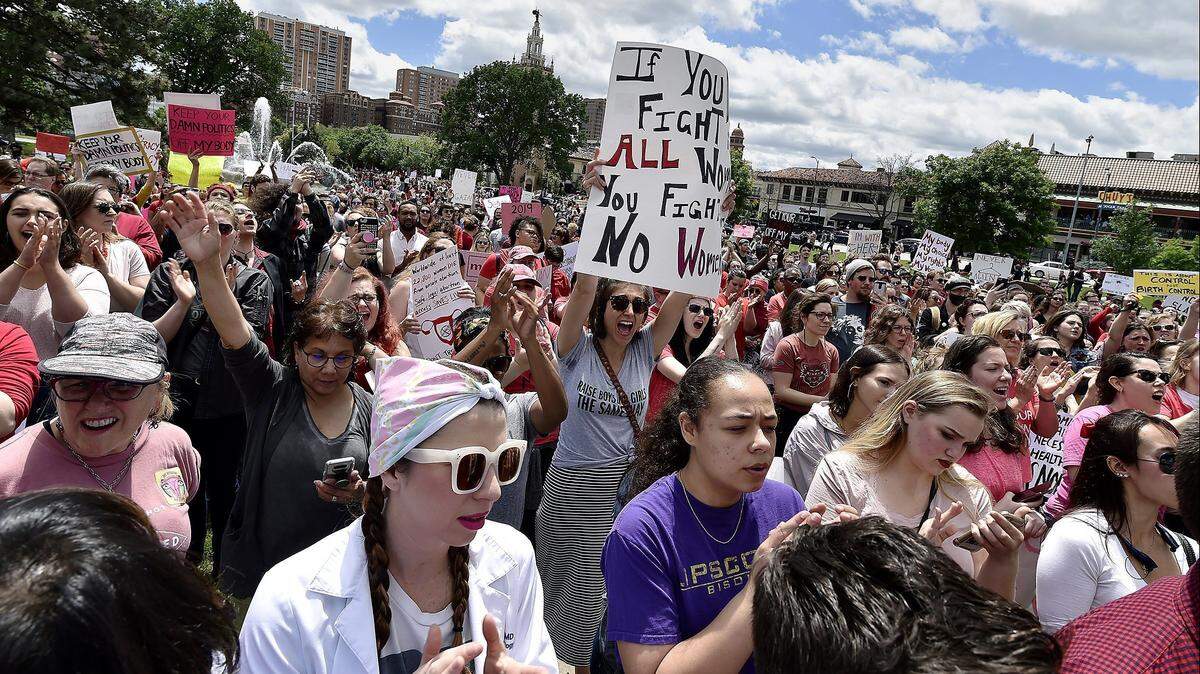
Months before the historic election that legalized abortion in Missouri, Cara Hile rallied her neighbors to put the amendment to a vote.
Hile, who hails from Grandview, spearheaded signature-gathering efforts for Abortion Action Missouri. She trained volunteers and went door to door encouraging people to sign a petition to expand abortion access as the campaign faced an onslaught of attacks from state officials.
For Hile, Kansas City played a major role in securing the 2024 vote that made Missouri the first state in the country to overturn a near-total ban after the fall of Roe v. Wade. Now, Hile has been watching Kansas City take center stage in another key fight inside the Jackson County Courthouse.
“We have been without access in Kansas City for so long,” Hile said in an interview with The Star. “It feels especially important to me and to Kansas City.”
More than a year after Missouri legalized abortion by enshrining reproductive freedom in the state constitution, the fate of abortion access rests on Kansas City. The result of an ongoing trial in Kansas City could either widely expand abortion services in the metro and across the state or sharply curtail them indefinitely.
The roughly two-week bench trial, which began Monday, poses the most consequential test of abortion rights in Kansas City and Missouri after voters expanded statewide access in 2024. Jackson County Circuit Court Judge Jerri Zhang will decide whether the state’s previous abortion ban and a series of longstanding restrictions on the procedure should be struck down.
Missouri, led by staunch anti-abortion politicians, had for decades built a fortress of regulations that whittled away at access, culminating in a near-total abortion ban in 2022. Abortion rights advocates, including Planned Parenthood and the ACLU of Missouri, have moved to strike those restrictions, arguing that they now violate the amendment voters approved in 2024.
“If they strike them down, clinics should be able to provide a broader level of care, including medication abortion, than they have been able to in years,” Mallory Schwarz, executive director of Abortion Action Missouri, told The Star. “It really is about whether Missourians are going to be granted the freedom and the rights that they demanded in 2024.”
Meanwhile, attorneys for the state of Missouri will attempt to cast doubt on those arguments and convince Zhang to keep the restrictions in place. Republican Attorney General Catherine Hanaway and her predecessor, Andrew Bailey, have routinely fought against expanded access in the wake of the 2024 vote.
Abortion opponents argue that if Zhang strikes the restrictions, the decision would lead to the dramatic expansion of abortion access, which they frame as dangerous. Sam Lee, a longtime anti-abortion lobbyist in Missouri, told The Star that the trial will “literally decide how many abortions are performed or not performed in the state.”
“It would change the face of abortion in Missouri,” said Lee, who traveled from Jefferson City to Kansas City to watch several days of the trial. “We would be like Illinois or Kansas, where lots of abortions are being done because of their state laws.”
The stakes are high for Kansas City, where last year doctors performed the state’s first procedural abortion after voters approved the 2024 amendment. Kansas City’s Planned Parenthood clinic had not provided abortions since 2018, forcing Missouri residents to cross into neighboring states to receive services.
“I hope Kansas Citians are paying attention to this trial because they voted in such strong numbers in support of the right to reproductive freedom amendment in 2024,” Schwarz said.
In the Kansas City area, support for the amendment was strongest among Kansas City voters who live in Jackson County, where 80.5% approved the measure. The amendment received 62.3% of the vote in Platte County, 61.2% in Clay County and 58.9% in the portions of Jackson County outside of Kansas City.
Most of the trial is expected to focus on a cluster of TRAP laws, or “targeted regulation of abortion providers,” that lawmakers enacted over the years. Those restrictions include a requirement that women wait 72 hours between seeing a doctor and having an abortion and another that requires doctors to have admitting privileges at a hospital no more than 15 minutes away.
The patchwork of regulations, providers argue, severely restricted services and reduced abortion access to one clinic in St. Louis before the ban took effect. The number of abortions performed in Missouri also plummeted from 6,163 in 2010 to 150 in 2021, according to statewide data.
As she watched the trial unfold, Hile said she noticed a “clear difference” in expertise between the state and abortion rights providers.
“We have professional, accredited, working doctors as our witnesses,” Hile said. “And they’re really able to speak to the importance of abortion access.”
The upcoming ruling will mark the culmination of a grueling effort by abortion rights advocates to gather more than 380,000 signatures across the state to force a statewide vote. A series of court battles and roadblocks from state officials forced the campaign to scramble and gather signatures in roughly three months.
“It’s so important,” Hile said of the trial, “because this is going to be ruling on all of the work we did.”
In addition to the TRAP laws, the trial could also clear the way for Missourians to access the most commonly-used form of the procedure: medication abortion. Access to procedural abortions has partially resumed in Kansas City, Columbia and St. Louis, but medication abortion is still inaccessible inside state lines.
Schwarz, with Abortion Action Missouri, emphasized that medication abortion was safe to use, saying that expert witnesses at the trial have testified that the state regulations blocking the procedure “have nothing to do with keeping women safe.”
Another abortion vote looms
While all eyes are on Kansas City, another fight at the ballot box still looms.
Missouri Republican lawmakers voted last year to put a new abortion ban on the 2026 statewide ballot, a major retaliatory response after nearly 52% of voters approved abortion rights in 2024.
Zhang’s upcoming ruling is likely to be appealed and eventually decided by the Missouri Supreme Court. However, it’s unclear whether the courts will make a final decision before the upcoming vote on a new abortion ban.
The effort marked a continuation of GOP attempts to curtail direct democracy in Missouri as voters have used the ballot box to pass policies seen as progressive, such as a minimum wage increase, Medicaid expansion and marijuana legalization.
The proposed constitutional amendment would completely strike down last year’s vote and allow abortions in only a few rare instances. It would also ban gender-affirming care for minors, which is already illegal under state law.
Abortion rights supporters frame the effort as an intentional attempt to mislead voters into approving a new abortion ban. They point to the fact that the amendment, which will be called Amendment 3, uses the same name as the 2024 measure that expanded access, also called Amendment 3.
Republican lawmakers and state officials have also faced fierce backlash over the wording of the ballot measure they crafted, which critics argue reads like it would expand abortion access.
An appeals court last month struck down Republican Secretary of State Denny Hoskins’ language, finding the question he wrote failed to inform voters that the measure would strike down the 2024 vote. The court rewrote the question that will appear on the ballot in more politically-neutral language.
Meanwhile, supporters of the fresh effort to ban abortions cast the amendment as a middle ground designed to appease the average voter. Republican lawmakers have argued, without providing evidence, that voters did not understand the full impact of the 2024 amendment when they approved it.
Rep. Brian Seitz, a Branson Republican who carried the legislation, said in a statement to The Star that anti-abortion advocates believe the new amendment will pass on the ballot.
“(The) limited exceptions within the ballot language are, in fact, in my opinion, what many people who supported the previous Amendment 3 were actually voting for,” Seitz said.
But Hile, who led that campaign’s signature-gathering efforts, said the results of the 2024 vote made clear that Missourians want legal abortion. They’re going to make that known again, she said.
“It’s very top of mind, especially with the trial going on,” Hile said. “Just thinking that we’re going to have to prove, once again, that Missourians do want abortion access.”