
She makes gingerbread replicas of famous KC buildings. And it started as a hobby
AI-generated summary reviewed by our newsroom.
- Michelle Tobiason builds massive gingerbread replicas of Kansas City landmarks.
- She scaled, measured and assembled 70-pound structures using royal icing as glue.
- Museum display sparked public access and potential annual Kansas City tradition.
This is the fourth Christmas professional baker Michelle Tobiason has indulged in an eye-popping passion project of building huge gingerbread replicas of historic Kansas City buildings.
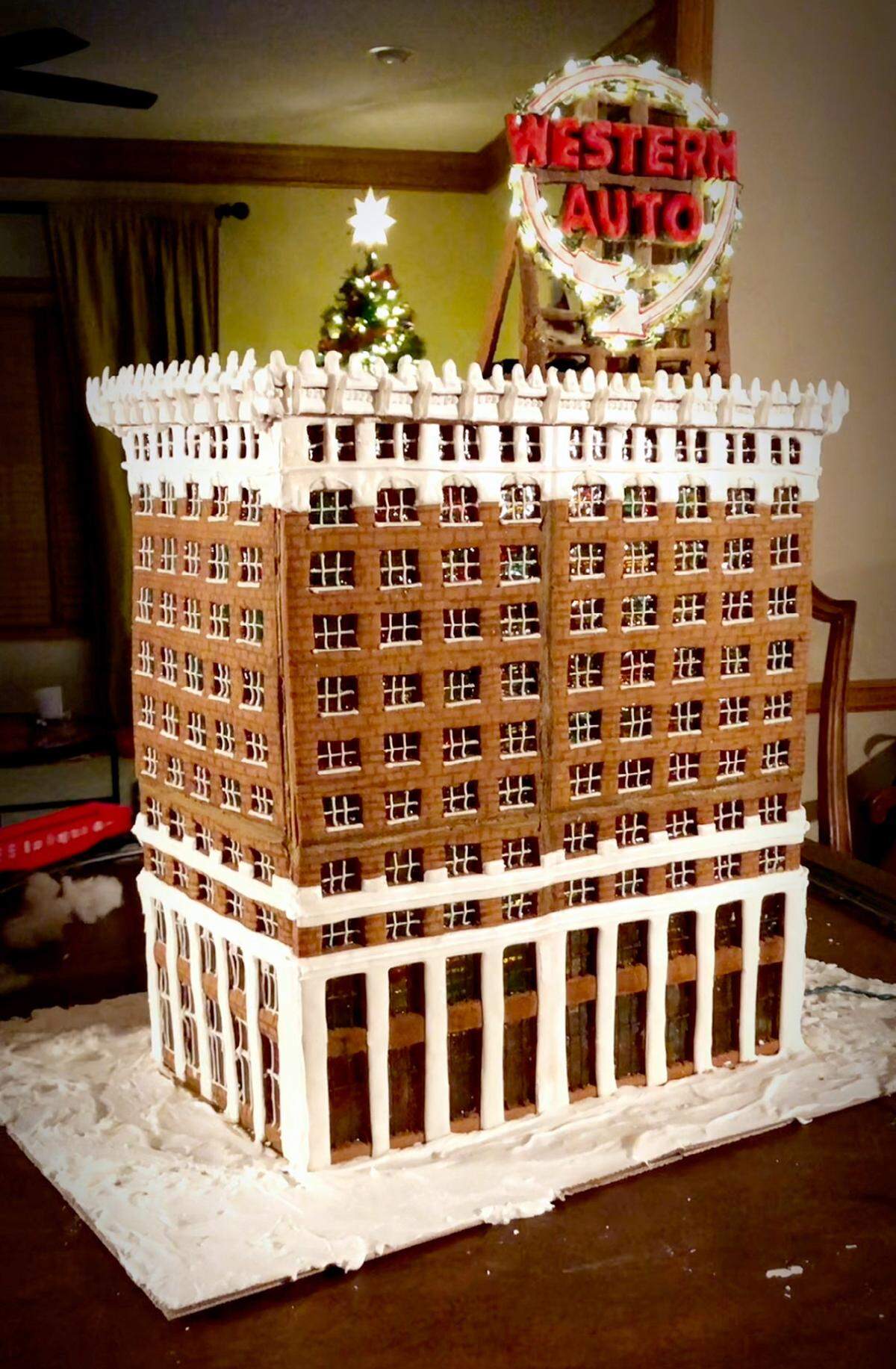
She has constructed Union Station, the Western Auto building and the Harry S. Truman home, all out of gingerbread dough and royal icing.
They were huge, each bigger than a Barbie Dreamhouse.
She built them on her dining room table in Blue Springs and there they sat while friends and family oohed and aahed over them before they became teardowns.
It finally dawned on her last year that other people might enjoy seeing them, too.
So when Tobiason decided to recreate The Museum of Kansas City this Christmas, she asked the museum to display it. She showed museum officials her gingerbread resume and the answer was: Let’s do it.
So late last month she and her sister gingerly transported the 70-pound house in the back of Tobiason’s compact Toyota RAV4 to the museum’s breakfast room, where it will be displayed until Dec. 28.
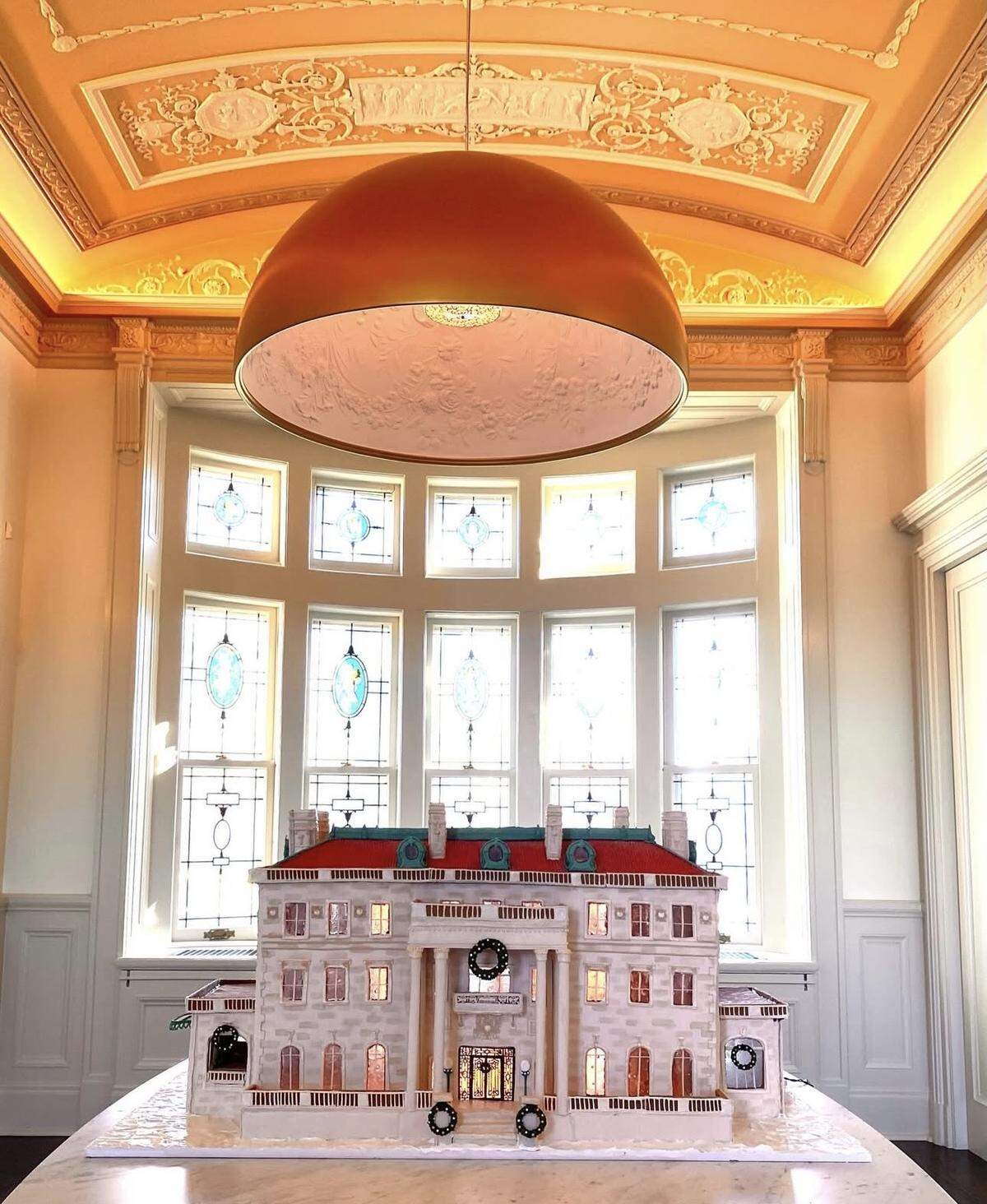
“I’ve been covered in icing all month, but I’m so grateful people can finally come see it in person this year!” she announced on the Instagram of her home-based bakery, Michelle Leigh’s Baked Goods.
With a bucket list of other buildings she would like to build from gingerbread, Tobiason hopes this is the beginning of a holiday tradition. The Folly Theater folks have approached her about turning that 125-year-old building into cookie dough.
“Hopefully going forward I can have these on display because it really is a waste to just have them sit at home and only have me look at them. I really want it to be a Kansas City tradition,” she said.
“I know a lot of people around town make gingerbread houses. But these are big and grand and I just want people to get excited to see them. Hopefully, somebody else will let me do it next year.”
A major interest in history
Tobiason didn’t set out to bake cakes and cookies for a living, though when she was younger she “used to gift my friends cakes,” she said.
History was and still is her first love. She has a minor in history from the University of Missouri-Kansas City, she said, “and I wanted to do history, but there’s not a lot of opportunities with that. Only teaching.
“So I did the business school and I just fell into these corporate jobs. When I graduated I did human resources, which is so, like, the worst fit for me possible.”
Baking was just a hobby. Then everything changed five years ago when she discovered the work of Christine McConnell, self-taught baker, artist and popular Internet celebrity who starred in the Netflix series, “The Curious Creations of Christine McConnell,” making macabre confections for Halloween like gingerbread haunted houses.
In 2019 McConnell posted a YouTube video about how she constructed a monster-sized, 500-pound, four-sided gingerbread house of the Winchester Mystery House in San Jose, Calif.
“I saw that video and something went off inside me. I was like, ‘OK, that’s cool. I need to do that,’” Tobiason said. “I guess you could say sugar art came back into my life.”
So she started making the giant gingerbread replicas of Kansas City buildings, which prompted friends to encourage her to open her own bakery, which she did two years ago.
“It wasn’t until this gingerbread house a few years ago that people started saying, ‘Michelle you should have a bakery.’ I’m like, ‘No, that’s just a hobby.’ But eventually it snowballed into my career,” she said. “You can never predict life.”

Trial and error
She has taught herself everything she knows so far about working with gingerbread.
She didn’t come from a family that made gingerbread houses for Christmas. Her mom’s side of the family is Italian, so Italian cookies were their holiday tradition. But her grandfather built dollhouses for the grandkids and that example, coupled with her love of Kansas City and its architecture, has sort of “blossomed into this gingerbread career for me,” she said.
Each gingerbread house took about a month “of working on it a little bit each day. And usually when I’m trying to really finish it up the last week I’ll just work on it the whole entire day until like 2 a.m.,” she said.
There’s a lot of downtime involved while waiting for icing to dry before she can move onto the next steps.
Her first creation was tiny-house small, “the size of a tissue box and a little Dutch-looking, like a European house,” she said. “I don’t even know if I still have a picture. It’s nothing to brag about.
“That’s where it all started five years ago. And when I was making that gingerbread house I thought, you know what ... next year I’m going to do something big just like (McConnell). I’m going to do Union Station.”
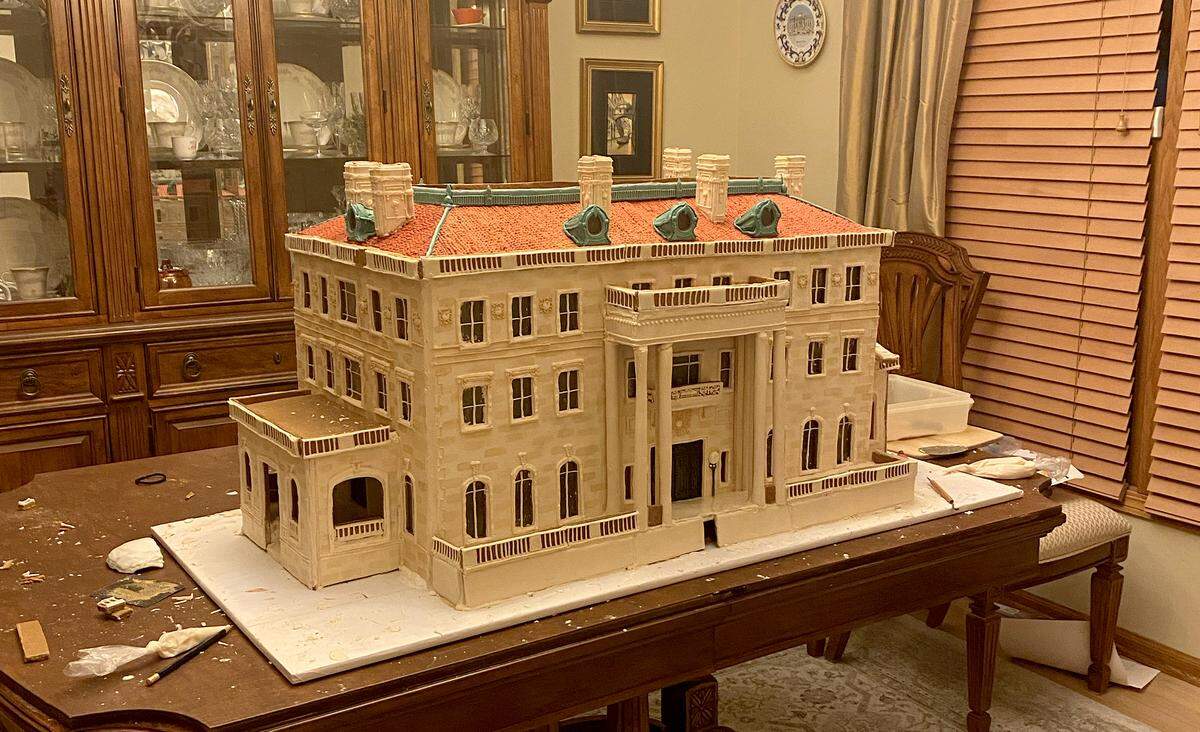
She has determined that brick buildings are the easiest to replicate because the outside walls don’t have to be iced, unlike the museum, which is entirely covered with icing to mimic its light-colored, limestone facade.
She’s promised herself to only recreate older buildings around Kansas City, which she finds more architecturally and visually interesting than newer builds. She’s also aware of her shortcomings, which is why she would never tackle something like the Kauffman Center for the Performing Arts — too many curves.
Each structure begins with hours online hunting photos and other images of the building. The front. The back. The sides. Detail shots of the windows, roof, balconies. She doesn’t have to take her own photos, she said, because especially with today’s drone technology there are more than enough images available.
She also looks for historical photos, even paintings, of the buildings. For the museum, she referenced Google Maps photos, too.
Then she places all those images into a Microsoft Word document, where she sizes them to be uniform.
“From there I take measurements of absolutely everything. The windows, the doors, the steps, the decorative details, the roof. Everything you could imagine,” she said. “So I have a huge list of all of my measurements. And I multiply that by however big I want the gingerbread house to be.”
That part requires a lot of math, which she was never good at in school. But by now she knows she has to enlarge those images at least five or six times to create the grand scale she wants.
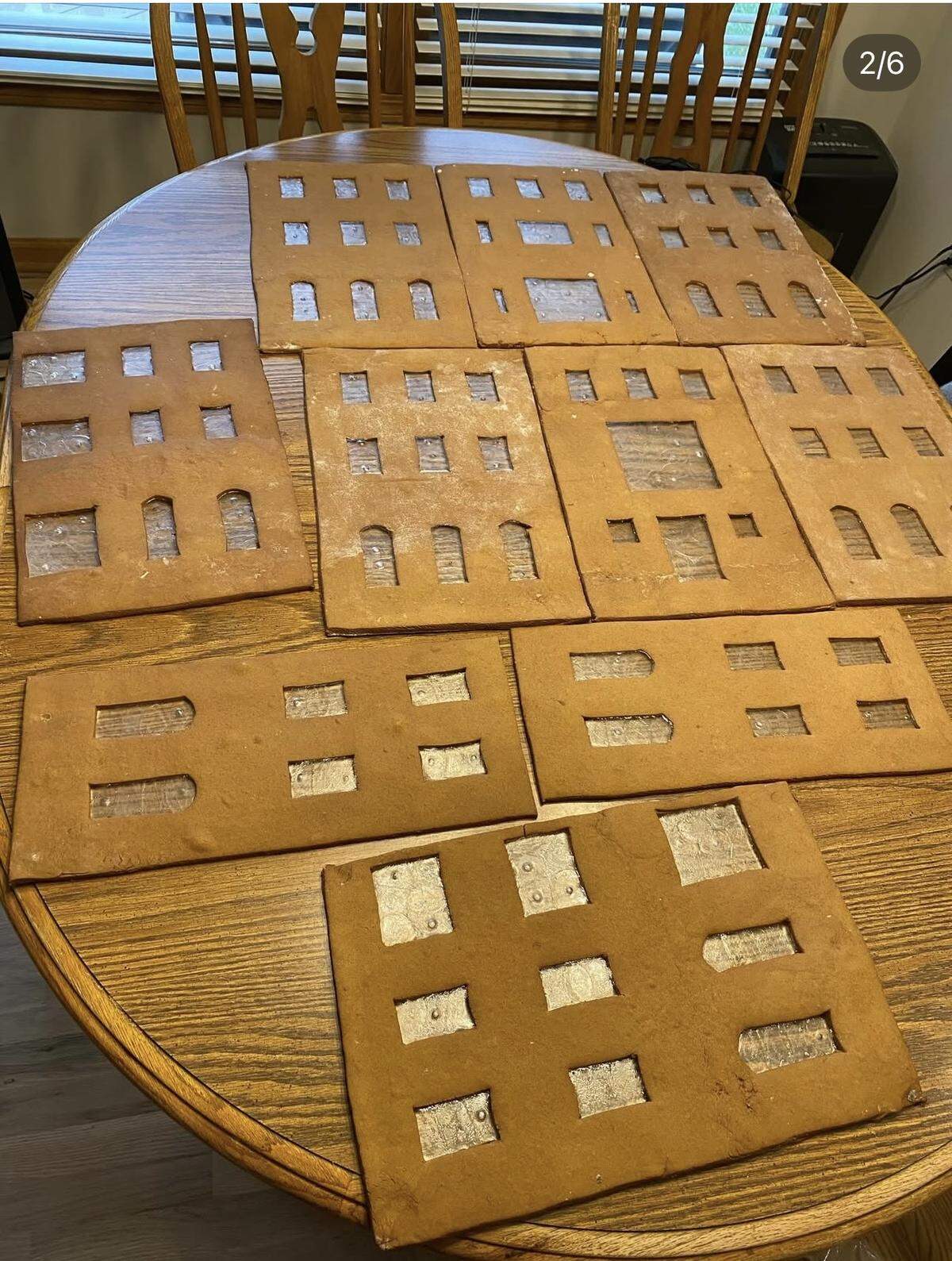
The buildings thus far have all been about the same size — 3 feet tall, about 4 feet wide. She draws the scaled images of all the parts on poster board which become her templates, essentially cookie cutters.
Wine bottles are a necessity
Then she makes her dough. For some inexplicable reason the museum required six-and-a-half batches, “an astronomical amount of dough,” she said.
So what went into that “astronomical” 28.5 pounds of dough?
About 12 pounds of flour, five pounds of butter and brown sugar, and two pounds of eggs and spices combined. And molasses, a key ingredient of any tasty gingerbread, though no one will ever taste these creations.
The 31 pounds of royal icing — the “glue” — required 14 pounds of powdered sugar and about 17 pounds of everything else, including corn syrup, water, vanilla and meringue powder.
She only uses McConnell’s gingerbread recipe, which is posted on Food.com.
“Gingerbread is material that is not reliable,” she said. “But her cookie recipe bakes really hard, which is easy. If I need to saw off a piece — I’m constantly shaving pieces to fit — her cookie recipe bakes so hard that it’s just so easy to work with.
“I don’t even want to attempt using another recipe because it’s literally perfect for these gingerbread houses. Gingerbread is very finicky. Sometimes if you don’t bake it enough it will be too soft and break. Or in the oven, even though my templates are perfect, it will shrink or bake really funky and weird and I don’t know it until I put it up.”
Most of the tools she uses are things from around the house. A bread knife works great for carving pieces. She already owned tools from a ceramics class and uses those to sculpt and trim pieces. A Dremel rotary tool is perfect for sanding. “I’m constantly sanding things down to fit into the gingerbread house,” she said.
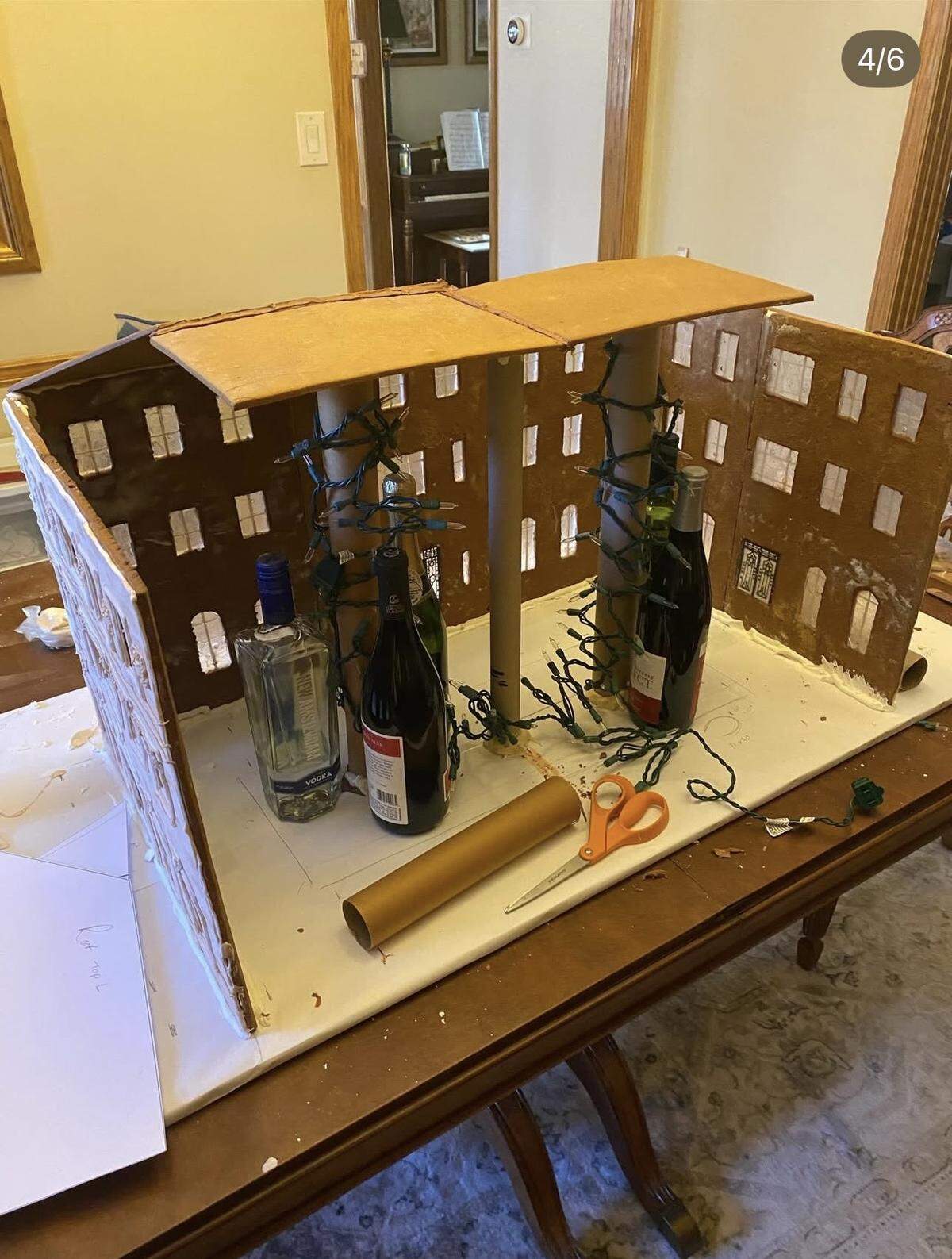
She also scrounges around the house to find tall items to brace the heavy walls while the icing “glue” dries.
“I will find wine bottles, I’ll find books, I’ll find tall candles, weird things around the house that are tall and heavy,” she said. “So when I put up those initial walls I’ll shove them all together and that’s what holds them in place, because I’m the only one that’s putting this together. I wouldn’t want anybody else touching this.
“So yeah, I’m just figuring all this out. I’m not a professional. You wouldn’t want me building your own house.”
Can you eat them?
Yet, people ask.
“I’ve had people reach out to me and say, ‘Can you turn my house into a gingerbread house?’ But it’s the holiday season and I’m really busy and these gingerbread houses take an insane amount of time, and I’ve had to say no,” she said.
“Maybe I should have been an architect. I don’t know.”
The gingerbread project is just something she does for herself, kind of like that end-of-the-year project in school that demonstrates everything you’ve learned.
“This is my own thing. This is my one project every year that is my own,” she said. “And I do it out of food because it’s a challenge.
“I’ve had so many people say, ‘Why don’t you just make it out of wood and cover it with icing and you can keep it forever?’ But that defeats the whole purpose, defeats the whole wow of it, that ‘oh my gosh, this is made from food.’”
If she finds interest in her gingerbread houses, she might have to hire some muscle, though she and her sister successfully navigated the 30-minute trek from her home in Blue Springs to the museum in Northeast Kansas City with no mishaps.
She was very nervous about lifting that 70-pound house off her dining room table because she’s never had to do that before.
And those roads. “Missouri roads are notoriously full of potholes, so I was very nervous about how this was going to turn out,” she said.
She was surprised when she opened the trunk and saw that the house had made the trip intact, no broken pieces. A museum employee helped them wheel it into the building on a cart.
At this point, she calls royal icing “my friend” because it holds gingerbread together like glue. “I think it would literally withstand a hurricane,” she said.
And therein lies the caveat for gingerbread houses of this size.
“I don’t want to lead people on because the secret to making these gingerbread houses so sturdy is that royal icing dries so hard,” she said. “So the fact that I’m leaving it out, it’s like cement by the time I’m done.
“While I’m doing the gingerbread house I’m just leaving everything out. I’m not being really particular, like keeping it fresh. Because I know I’m not going to eat it. The only reason it’s so hard is because I’m letting it get stale on purpose.”
The gingerbread houses don’t have to be melt-in-your-mouth soft like the decorated sugar cookies she sells.
“That’s my most-asked comment is: ‘Are you going to eat it?’ And the answer is no,” she said. “I would love to eat it, but since I put so much work into it, there’s no chance that I’m going to let anyone take a bite out of this.
“I wouldn’t give it to anybody anyway because by the time I finish it it’s already a month old and it’s kind of stale and gross. I mean, it is all edible. You could take a bite out of it. But you might get a little sick.”
These houses will last about three months before they get so stale that pieces like chimneys fall off.
That’s when Tobiason reaches for her last tool.
When the chimney takes a nosedive, “that’s when I have to take a hammer and destroy it,” she said.
Sorry, Santa.
.jpg)