
JoCo boy, 9, is known as ‘Menorah Man’ for whimsical creations — made of dominoes
AI-generated summary reviewed by our newsroom.
- Third-grader Noah Unell builds menorahs from dominoes and gains local notice.
- His creations connect Kansas City’s Jewish community during Hanukkah.
- Noah combines his domino art with sports and other talents.
Third-grader Noah Unell is a Rubik’s cube whiz and a hustling point guard who can spin a basketball on his finger like a Harlem Globetrotter. He lives with his mom, dad and little sister, Ella, in Overland Park where on Sunday they celebrated the first night of Hanukkah.
Noah is also a budding artist who, at the ripe young age of 9, is making a name for himself in Kansas City’s Jewish community for a talent that is lighting up the world around him.
Noah builds menorahs out of dominoes.
Yes, dominoes.
Yes, menorahs, the candelabrums that hold the candles lit during Hanukkah, the eight-day Jewish Festival of Lights which ends Dec. 22.
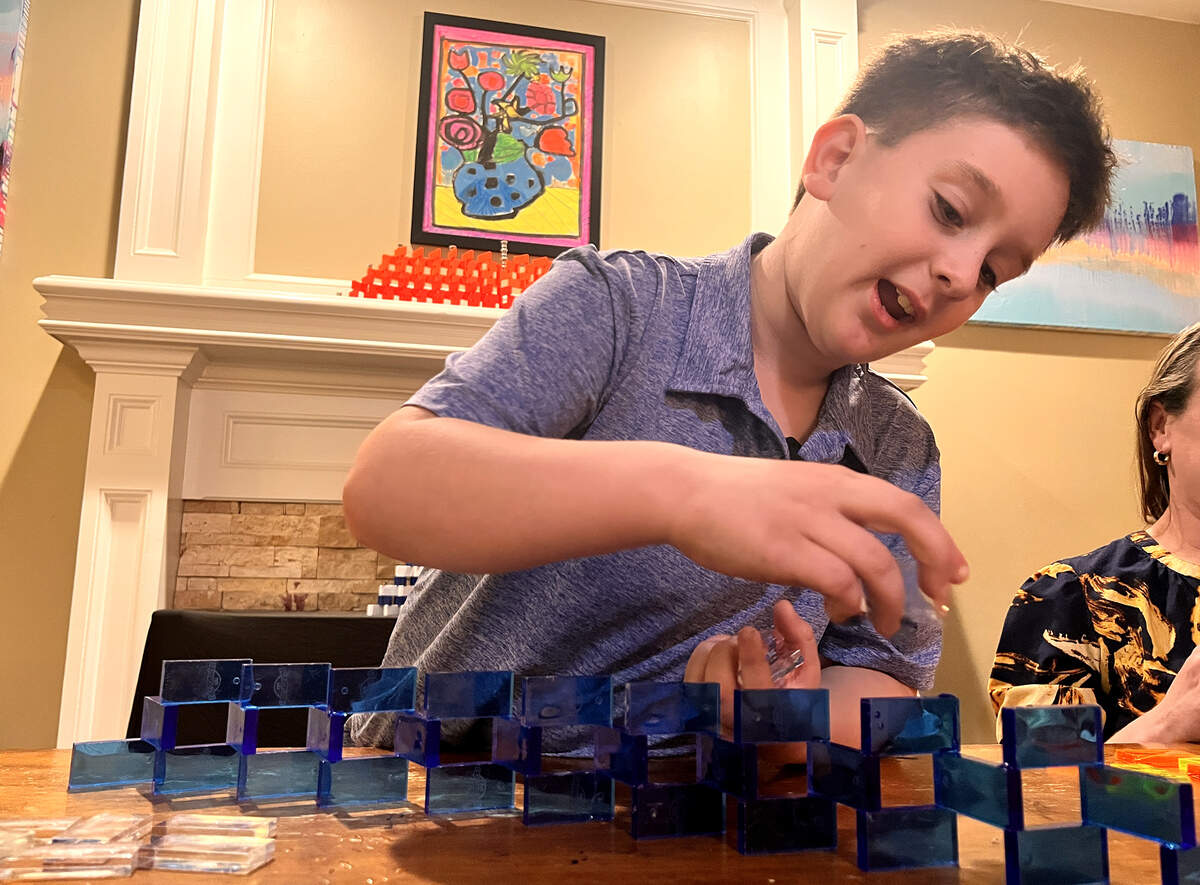
Noah began building with dominoes in 2022 after watching popular YouTubers construct elaborate, large-scale domino structures and set-ups and knock them down in showstopping chain reactions.
What began as play time in his bedroom has evolved into an act of service connecting Noah to his faith communities in Johnson County and thousands of miles away in Israel.
The word is out about Noah’s menorahs, which appear to be unique among both Judaica and domino art. People have bought and commissioned them, and Noah’s family sent proceeds to communities in Israel devastated by the Oct. 7, 2023 attacks.
“One day my mom was like, this would make a great menorah,” said Noah. “So she showed me step-by-step how she thought I could make it. Then I started making menorahs. Then I started to sell them (to) families, neighbors, friends.
“Then a lot of people started finding out about me. Then I got to display some of my things. And now I’m here.”
His menorahs have been featured in three public shows in Johnson County. A new exhibit, called “Eight,” is currently displayed at Blue Valley Library. He created eight new menorahs, one for each night of Hanukkah.
Last year was his busiest year with shows at the Lenexa public library and a larger display at Village Shalom retirement community in Overland Park, where Noah also led a class teaching residents how to make their own.
There he was, helping seniors with Alzheimer’s stack and glue dominoes. One woman turned her menorah into a seven-candle candelabra for Kwanzaa.
Noah and his family also hosted a Hanukkah-themed Sabbath for the residents, lighting candles on a three-foot-long menorah Noah made in the blue-and-white colors of the Israeli flag.
When residents asked to buy the menorahs, Noah donated the money back to Village Shalom which used the money for its financial assistance program.
“Village Shalom residents loved having Noah’s menorahs on display,” said David Spizman, director of philanthropy and community education at Village Shalom.
“As my office was near the display cases I would often hear residents tell each other which were their favorites and marvel that someone so young designed and built them.”
Noah’s mother, Leah Karchin, an artist herself, is her son’s enthusiastic coach and cheerleader. This is their second mother-son art project.
While living in Florida during the first months of the pandemic, they created an interactive public art project — dubbed “The Great Gnome Project” — in their neighborhood that is now part of the permanent collection of the Orange County Regional History Center.
“I think one thing that is very special about Noah doing all of this and giving back to the Jewish community is because my grandparents and my great-grandparents were all Holocaust survivors,” Karchin said. “It’s a miracle that we in fact exist.
“So it’s amazing to have these generations connect, not just to pass down the religion but the culture and the values and a lot of hope.”
Noah has been featured twice in the Kansas City Jewish Chronicle which revealed the nickname Noah’s family and friends have given him.
They call him “Menorah Man.”
It began with Jenga blocks
This all began because of YouTube.
A few years ago Noah became enthralled by the “crazy domino stuff” he watched people do on YouTube Kids. Professional domino artist and YouTube content creator Lily Hevesh - Hevesh5 - in particular caught his attention.
“I set up thousands of dominoes in intricate arrangements. Then, I knock them down!” Hevesh writes on her website.
Noah began stacking Jenga blocks and knocking them down, which made him laugh. Then he graduated to meticulously stacking, spacing and balancing specialty dominoes like the ones used by all those YouTube pros.
He was too young to understand that he was learning as he played, a head start for a boy who wants to be an engineer some day.
“Noah did this for hours,” said Karchin, who used to teach in the Blue Valley School District. “And you can see, it’s the whole STEM education, right?
“It’s science, it’s technology, it’s no screen time, it’s engineering, it’s all the things you want to encourage with your child. It was great because it transitioned him off the screen into a constructive activity.
“So he would spend hours building these structures and then we would slow-motion film him on our phones and he would be watching them fall down. There was great fun in there.”
Karchin, who has an art degree from Michigan State University where she was also a collegiate ice skater, began to recognize that some of Noah’s pyramid towers were shaped like menorahs “and I could kind of see where we could put the candles.”
So she asked him: What if we glued them together?
Noah was reluctant.
“At first he was like, ‘Mom, then I can’t build them and knock them down.’ And I was like, ‘Well I’ll get you extras. Just try one.’ And once he started building one he started cranking them out.”
Noah’s dad, Justin Unell, corporate communications manager for Blue Cross and Blue Shield of Kansas City, estimates Noah has built more than 40 menorahs and is “approaching 50.”
His son’s whimsical creations, he said, are “a fun way to celebrate Hanukkah.”
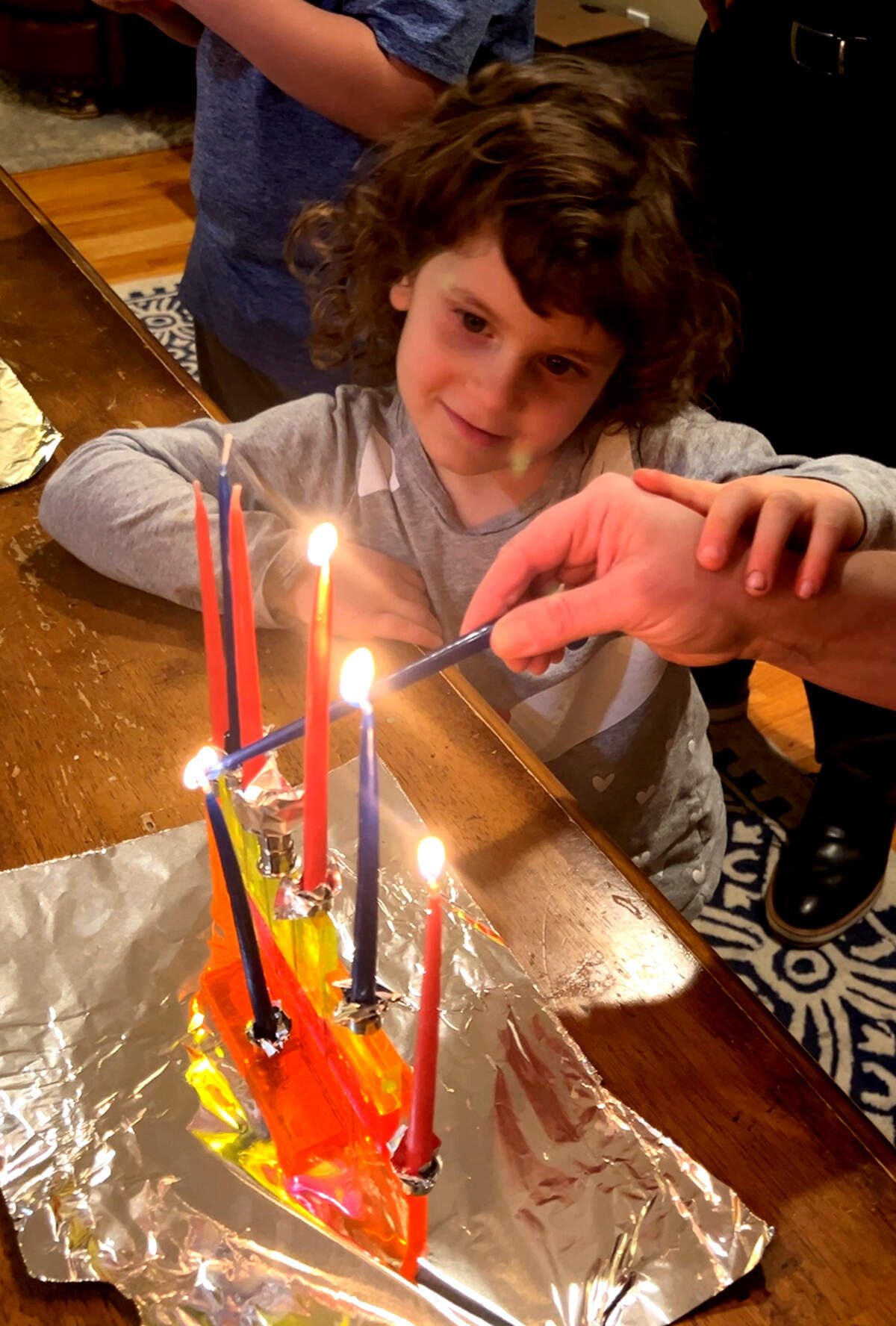
Glue is tricky and icky
Noah’s “studio” is the family dining table where he begins each menorah by lining up tiles to create the base row, which he demonstrated at his home on Friday.
The only thing these dominoes have in common with the black-and-white dotted ones used for the game is their rectangular shape. The niche tiles used by domino artists come in a rainbow of colors and various opacities. Translucent. Opaque. Some are neon and glow in the dark. They don’t have dots.
Noah has amassed quite a collection of dominoes, all separated by color. “I think the hardest part about building a menorah is just finding a good combination (of colors),” said Noah, who designed a University of Kansas menorah from blue and red dominoes.
His first menorahs were simple structures, just a few rows tall, just a handful of dominoes that “for some reason sold really good,” he said.
His biggest menorah, built from more than 100 dominoes, reached up to his chest when it stood on the floor.
It sat in a place of honor on the fireplace mantel until one of Noah’s friends knocked it over with a football and broke it. The surviving rows still sit on the mantel. (His mom was proud of her son’s restrained response to the catastrophe.)
His designs quickly evolved beyond basic pyramid shapes. His more dynamic ones call to mind molecular arrangements,
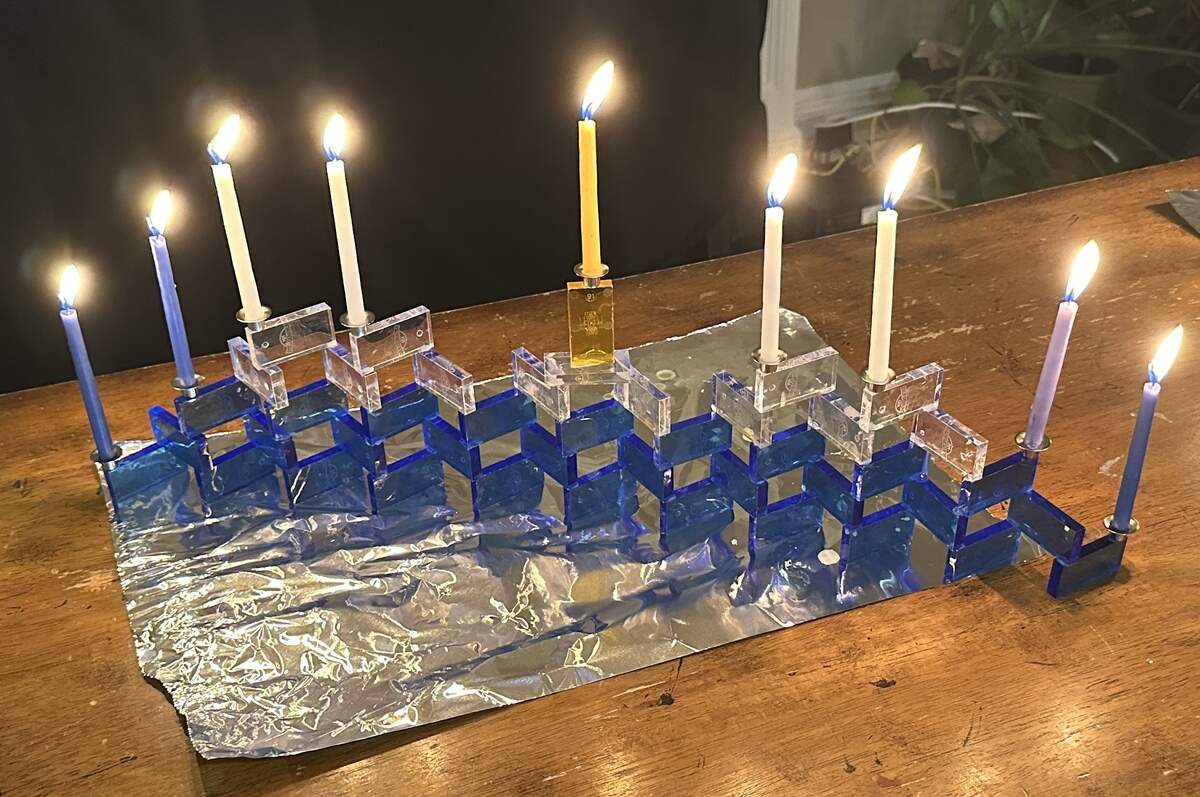
One design is called the “floating gem.” It’s built of transparent dominoes, see-through like ice. That makes the middle candle — the shamash or “helper” candle that sits higher than the eight others -— seem to float in the air.
His latest menorah, colorful like stained glass, conceals a bit of light magic, casting rainbow-like light when he holds it above a sheet of white paper.
“I told Noah it kind of reminds me of the Chagall windows at the Hadassah Hospital in Israel where there’s a different colored window for each of the 12 sons or tribes of Israel,” Karchin said. “It’s like a kaleidoscope. It’s amazing how the light passes through these.”
Working with glue is not Noah’s favorite part of making domino menorahs. It’s especially tricky to squeeze glue under the tiny metal cups that hold the candles, then delicately place them on top of the thin dominoes.
“When I started building menorahs it was not fun because I kept getting the glue on my fingers. Then I started getting used to the glue,” he said.
His mom jokingly called it “sacrifice for the art.”
Once, Noah said, he was wearing shorts and accidentally glued his leg to the chair. “And oh gosh, it was very fun to do that,” he said.
Finding the best glue to hold the dominoes together took trial and error. When he was still working with wood dominoes he and his mom used Elmer’s and wood glue, but they weren’t strong enough. He uses Gorilla Glue now.
The search for the perfect adhesive became “a whole scientific study in epoxy and chemical bonds, what’s going to hold plastic dominoes together,” Karchin said.
Worried that Noah would accidentally glue his fingers together, she did the gluing before he became proficient and careful.
Hope at Hanukkah
Noah’s parents hosted his first art show in their home two years ago, inviting family, friends and neighbors. It came a few weeks after the attacks in Israel and Karchin asked her son if he’d be willing to sell his menorahs “to help some of the people that suffered great loss.”
“He first started building them right before October 7, so it was kind of an opportunity to say, you know Noah, you built all this amazing art. What if you sold some of it and we raise some money, whether it was $10 or $100, whatever it was going to be, and we could send this to Israel and help people whose homes have been burned down,” Karchin said.
He sold 10 of 18 menorahs that night, raising several hundred dollars that Karchin’s mother matched. “We sent it all to Israel to two different kibbutzim that were devastated in Oct. 7 attacks,” Karchin said.
“I think it felt good for everyone in our community that came to Noah’s show ... everyone felt like we could do something to help, because we were all just in such shock and no really knew how to help or what to do or what the next steps were or what the future was going to look like.
“So Noah created sort of this magic. And you know, sometimes you feel like a little amount of money isn’t a lot. But we were able to find such local organizations in Israel that it meant a lot to them.
“And the fact that it came from a kid who made something from his heart that was original and hadn’t ever been done before, it was really quite momentous.”
Noah said he’s “way too focused” on his art to think too much about the “scary” and “intense” things happening in Israel. Sometimes he thinks about it. Sometimes he doesn’t. He doesn’t want to have nightmares.
Thanks to people buying his menorahs for gifts, his menorahs are in homes from coast-to-coast. But he’s not in business. The menorahs are a hobby at this point for a 9-year-old who is always playing the latest sport.
He inherited that interest from his dad, a former KSHB 41 producer whose job at The Golf Channel relocated the family to Florida for a few years.
They haven’t sent a menorah to Israel, said Karchin, who hasn’t quite figured out how to safely ship the delicate art pieces.
“It would be so amazing to see them at The Holocaust Museum in Israel,” she said. “I think there are some really interesting museum opportunities. Maybe that should be his next goal?
“He’s had so many art exhibitions already. Maybe he’s got to get in some people’s collections so his art is preserved for years to come ... it is fun to see his work in people’s curio cabinets and being used on holidays.”
.jpg)