Pride, pain and progress: The history behind Kansas City’s LGBTQ+ community
It was 1986 and Mark Manning’s 23rd birthday when he moved to Kansas City, away from his hometown in Nebraska. A necessary change, he said, to find an established queer community.
“Kansas City’s a little blue or purple island in the middle of a red state,” Manning said.
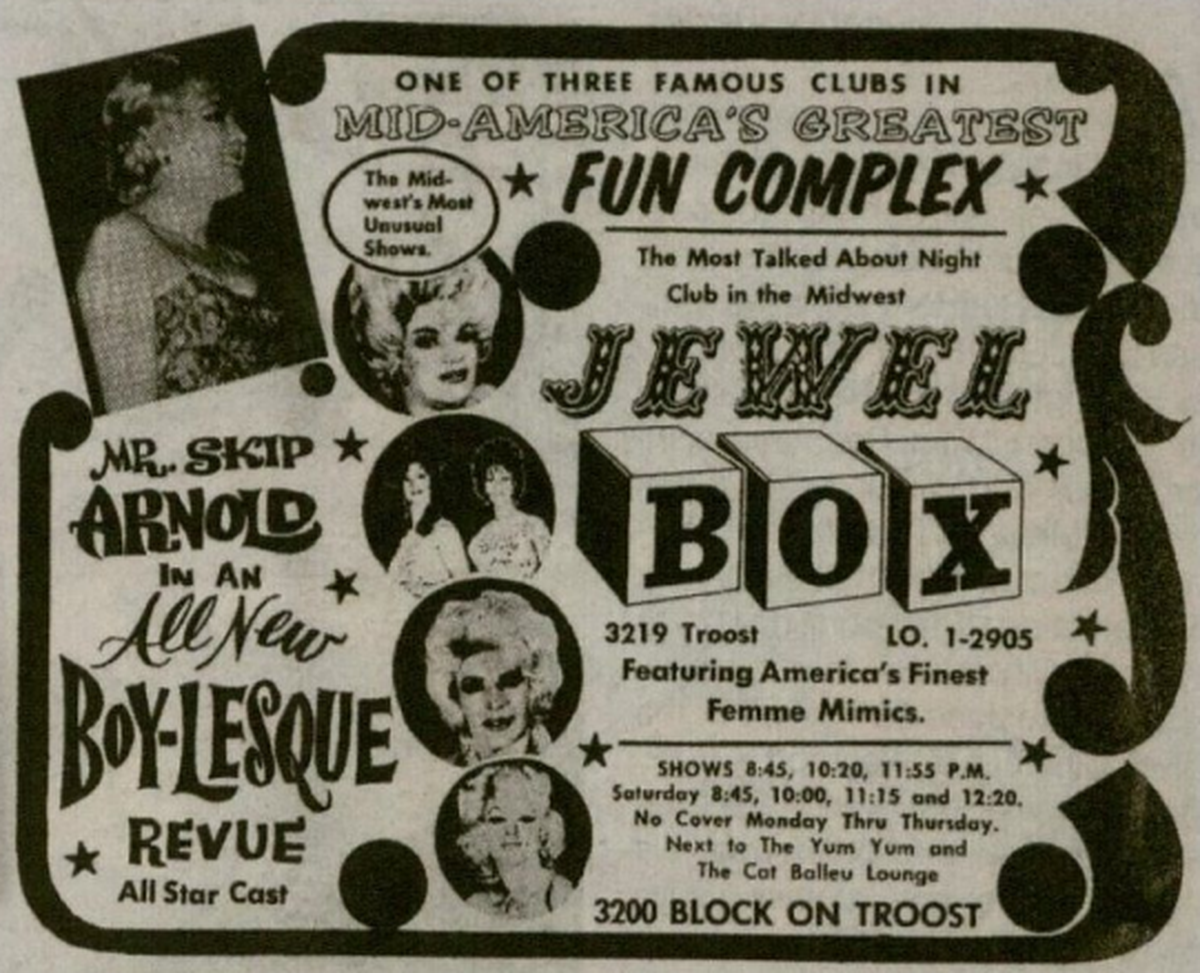
Manning, a recent theater major at the time, immediately moved in with friends and found a city with plenty of LGBTQ+ friendly nightlife and acting opportunities at the Unicorn Theater and Club Cabaret, among others. The area elected several gay lawmakers in Missouri and Kansas City in the years that followed.
Although Manning said the established community made KC feel welcoming to those from small towns, there was still lots of fear, intolerance, and legal barriers to marriage, which was illegal in both Missouri and Kansas until the Supreme Court ruling in 2015.
In light of this month marking 50 years of Pride celebrations in Kansas City and 10 years of legalized gay marriage, The Star sat down with several activists who have pushed for gay rights over the decades, to reflect on how the LGBTQ+ community in Kansas City has changed in that time.
Activists recalled the problems they’ve fought over for years, including violence, discrimination, a deadly epidemic, and more. They also spoke abundantly about how the struggle was warmly wrapped in the pride and joy their community has shown.
Violence and gay bashings
Despite the supportive businesses Manning came to love, the Pride parades and friendly neighborhoods, he knew there was violence and intolerance in Kansas City as well, even before he encountered it himself.
In the early hours of July 5, 1989, Manning was leaving Club Cabaret at 5024 Main St. walking north toward his home in midtown.
He lived four blocks away and hadn’t even made it a block when a man from a group on the street hurled an insult at him. Manning ignored it and kept walking, but that’s when the man punched him in the back of the head, cracking his skull.
“I got on my hands and knees and I was kicked in the face and kind of brutally bashed by a group of these people, and I somehow was able to go back to the gate to the Cabaret,” he said.
Manning called 911 and was told to return to the scene. When he did, the same group laughed and told him it wouldn’t have happened if he were straight.
“I just collapsed on the side of the street, and someone found me and took me home, and I ended up going to the hospital the next day,” he said.
He had suffered a concussion and was sick in bed for days after the bashing.
Manning wasn’t the only victim in Kansas City. A 1991 report by the mayor’s Commission on Lesbian and Gay Concerns found targeted violence was not uncommon in Kansas City. Of 900 LGBTQ+ people surveyed, 32% reported being threatened, attacked, bashed or physically hurt, The Star reported at the time. And an additional 37% reported verbal assaults, threats, and name-calling.
Between 1991 and 1992, Kansas City police recorded 59 bias crimes, but only one was classified as a gay bashing. The Star previously reported that LGBTQ+ leaders at the time said gay bashing was underreported because victims didn’t want to be outed or be associated with gay gathering spots like the Liberty Memorial Mall.
Organizing around HIV and AIDS in Kansas City
As violence was perpetrated in Kansas City, the HIV/AIDS epidemic was on the rise. The disease has killed over 42 million people worldwide, according to UNAids, a global organization that helps communities respond to AIDS cases. The epidemic in the U.S., which led to widespread misinformation and fear of gay people, was declared on Manning’s 18th birthday in 1981.
“In the early years, there was so much misinformation about AIDS that funeral parlors would turn away an AIDS death because they didn’t wanna have it in their funeral parlor,” Manning said. “And gay funerals, the funerals for our friends who died of AIDS, you would go to the funeral and it would be as if it was a whole different person.”
In some cases, Manning said, the fact that the deceased person was gay was wiped from their identity in the funerals. Their love of art or theater might be hidden as well, Manning said.
In eight years, he lost between 20 and 25 people close to him.
Organizations like the Good Samaritan Project, which was created in 1985, were established to serve as a hospice center for people with AIDS who had no other places to stay.
“It was just heartbreaking,” Manning said. “It’s hard to explain that to Gen Z and the millennials. It’s hard for them to even wrap their mind around what that was like.”
Members of the LGBTQ+ community banded together and created resources to help others in the community feel safer by establishing neighborhoods and creating easier-to-obtain resources, including a hotline.
The hotline, called Gay Talk, was created in the 1980s by Keith Spare, who was known in the community for his gay rights activism. Staffed by volunteers, the hotline provided the caller with anything from counseling to help finding those queer-friendly establishments in Kansas City. It was seen as a viable resource for anyone to get the help they needed or have a safe space to talk.
Racial disparities in LGBTQ+ community
Despite all the resources, businesses and events available for the queer community in Kansas City, LGBTQ+ people of color often had different experiences from white people in the same community.
There was -and still is- racism within the LGBTQ+ community, according to Rashaan Gilmore, founder and CEO of BlaqOut, a local health care nonprofit that works to treat Black queer and trans individuals.
“We should be under no illusion that, then or now, that there is this really big rainbow and we’re all just dancing under it, holding hands and singing kumbaya, and (that) we all experience oppression the same, and we experience progress the same. That’s not true,” Gilmore said.
It’s crucial to include the HIV/AIDS crisis when telling the story of Black history in Kansas City, Gilmore said. While everyone in the community was suffering, the Black gay community was particularly hit hard when it came to both the rate of infection and resources.
Gilmore said that in the early years of the pandemic Black voices were missing from the discuss, “even though Black bodies were being decimated by the illness.”
While there were places anyone could go to for care during that time, there was also structural racism and health care disparities at play, especially for Black gay men, leaving them much more vulnerable to HIV. The U.S. Department of Health and Human Services Office of Minority Health found that Black men were seven times more likely than non-Hispanic white men to be diagnosed with an HIV infection in 2022.
“...It’s a colloquial expression, for Black folk, Obama used to say it all the time when he was in the White House, that if white America catches a cold, Black America gets pneumonia,” Gilmore said.
Gilmore said that Black men still frequented organizations trying to combat the AIDS crisis, but there’s a difference between being able to go somewhere and it being a place that will make you feel welcomed in the face of the stigma Black patients often feel.
“A lot of folks suffered in silence. They died in a cloud of secrecy and stigma,” he said.
Fight for an anti-bias ordinance in KC
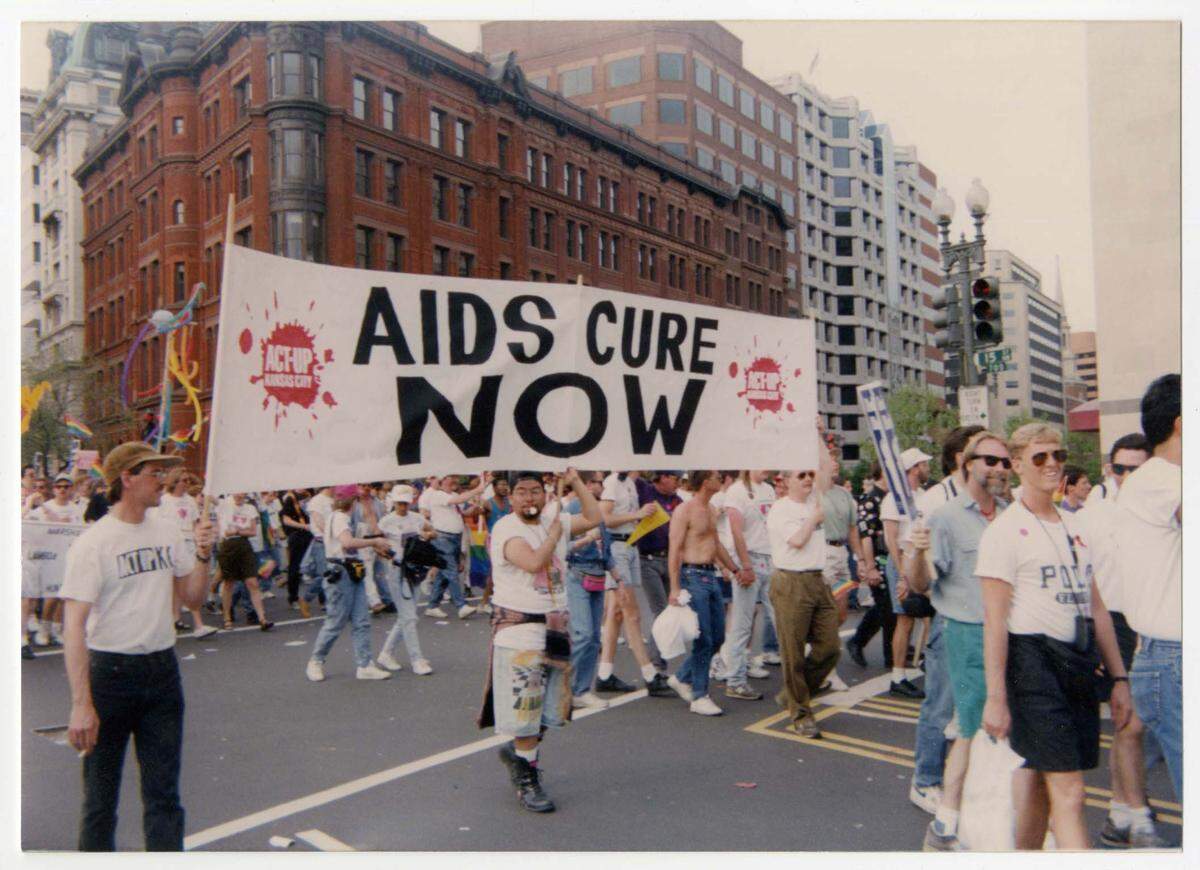
As the AIDS crisis intensified in the late 1980s, a group called ACT-UP/KC – a subset of a larger national protest organization called ACT-UP, made up of gay rights activists, advocates and allies – was created to pressure the city to increase their efforts to combat the disease through protests in the street.
ACT-UP/KC was a counterforce to the Human Rights Campaign, which advocated for the same gay rights, but centered their efforts on talking to local legislators. ACT-UP/KC was known for their confrontation and disruptive protests.
“In retrospect, we both needed each other,” said Janice Woolery, Kansas City native and lesbian who was a member of the Human Rights Campaign. She said having both disruptive and more diplomatic organizations helped pressure the Kansas City City Council in different ways.
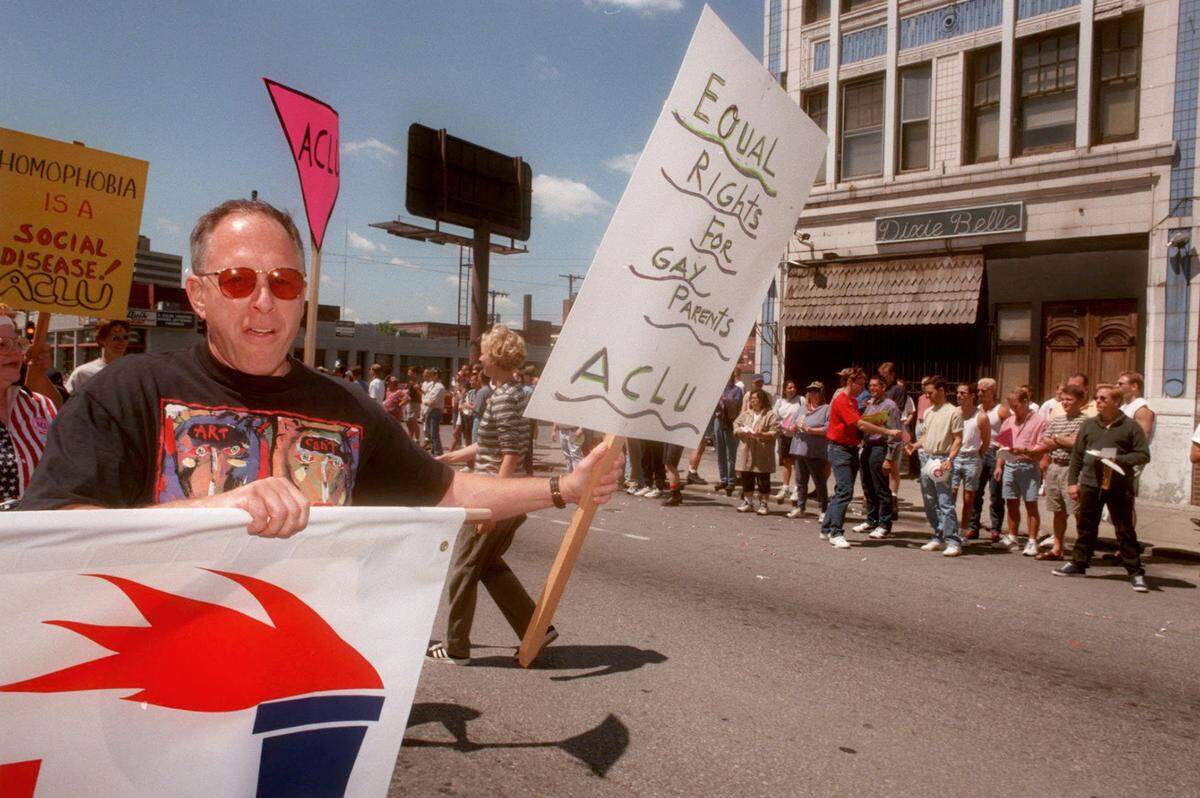
Their efforts came to a head in 1990 when the city council stalled the initiative to expand anti-bias laws on sexual orientation and HIV/AIDS status. Protesters took to the streets, heckling then-Mayor Pro Tem Emanuel Cleaver II and chanting, “Cleaver and the Klan go hand in hand.”
A year later, in 1991, Cleaver, by that time the city’s mayor, showed up to the Gay Pride Week Parade and picnic, becoming the first mayor in KC history to do so.
But Cleaver’s presence sparked mixed feelings. Two weeks before, he had declined to sign a Gay Pride Week proclamation, which would have acknowledged the celebration. Several threats were made against him over his attendance the day of the picnic.
“We all kind of knew about the fact that they had to put a bulletproof vest on him, because we all were kind of ready for whatever bad could happen,” said Woolery, who was in attendance.
That day, Cleaver announced he would create a commission to investigate discriminatory barriers for gays and lesbians in Kansas City. The Commission on Lesbian and Gay Concerns would report those problems to the mayor.
After years of advocacy from ACT UP/KC and other groups, City Council passed an ordinance in 1993, which banned discrimination against gay people when it comes to housing, employment and unions, and public accommodations.
“I felt lucky to be living in Kansas City, Missouri,” Woolery said, adding the ordinance was the first step to making LGBTQ+ residents feel safe enough to report other crimes. “It’s like if you got shot, why would you go to the police? It’s your fault, you’re gay. So that was very huge and necessary and made me feel proud of this city.”
Celebrating queer identity and community
Amid many of the challenges the LGBTQ+ community in Kansas City has encountered over the past 50 years, a diverse spectrum of KC residents from intersecting identity groups come together for Pride celebrations and formed communities that celebrate LGBTQ+ identities.
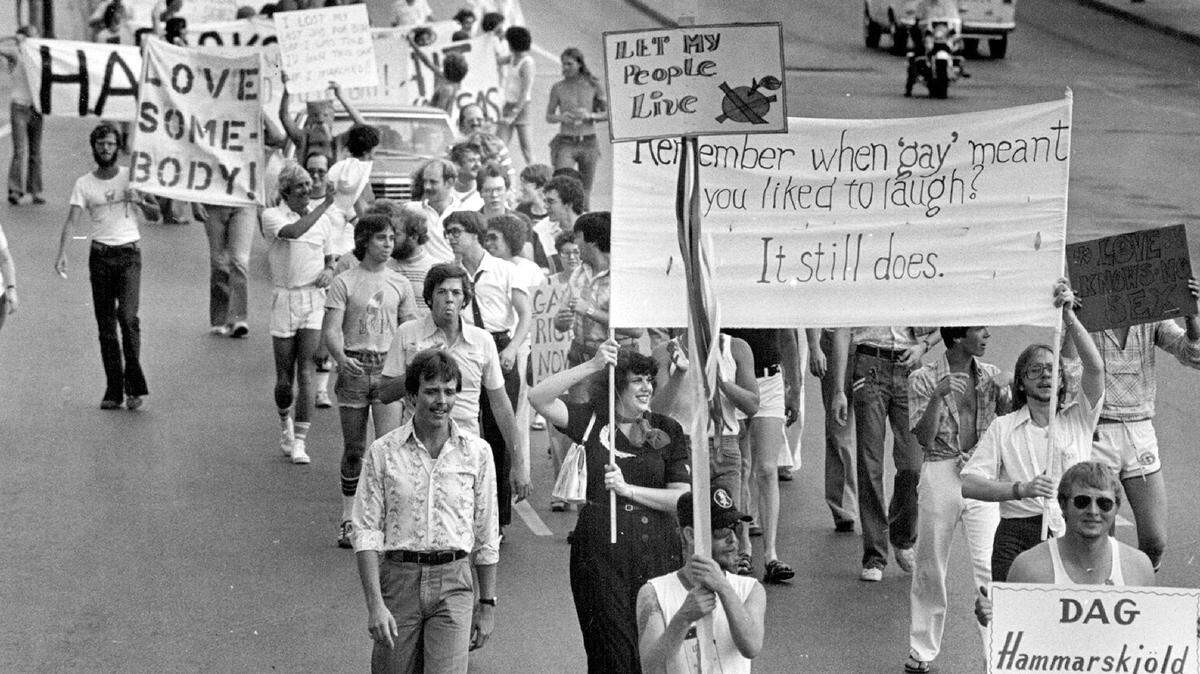
The first Pride gathering in June 1975 was a three-day event called the Gay Pride Festival. It was spearheaded by the Gay People’s Union, Kansas City Women’s Liberation Union, the Joint Committee for Gay Rights and the Metropolitan Community Church, according to the Gay And Lesbian Archives of Mid-America.
The event included skits, workshops like “Can you be Gay and Christian too?” and socialization with a banquet and a picnic.
By 1979, the LGBTQ+ community had become more overt in celebrating, but still considered their efforts as grassroots, according to the GLAMA archive. There was a parade Friday night at Crown Center, a Gay Pride Dinner and Dance, and a day-long hoedown at a farm in Gardner.
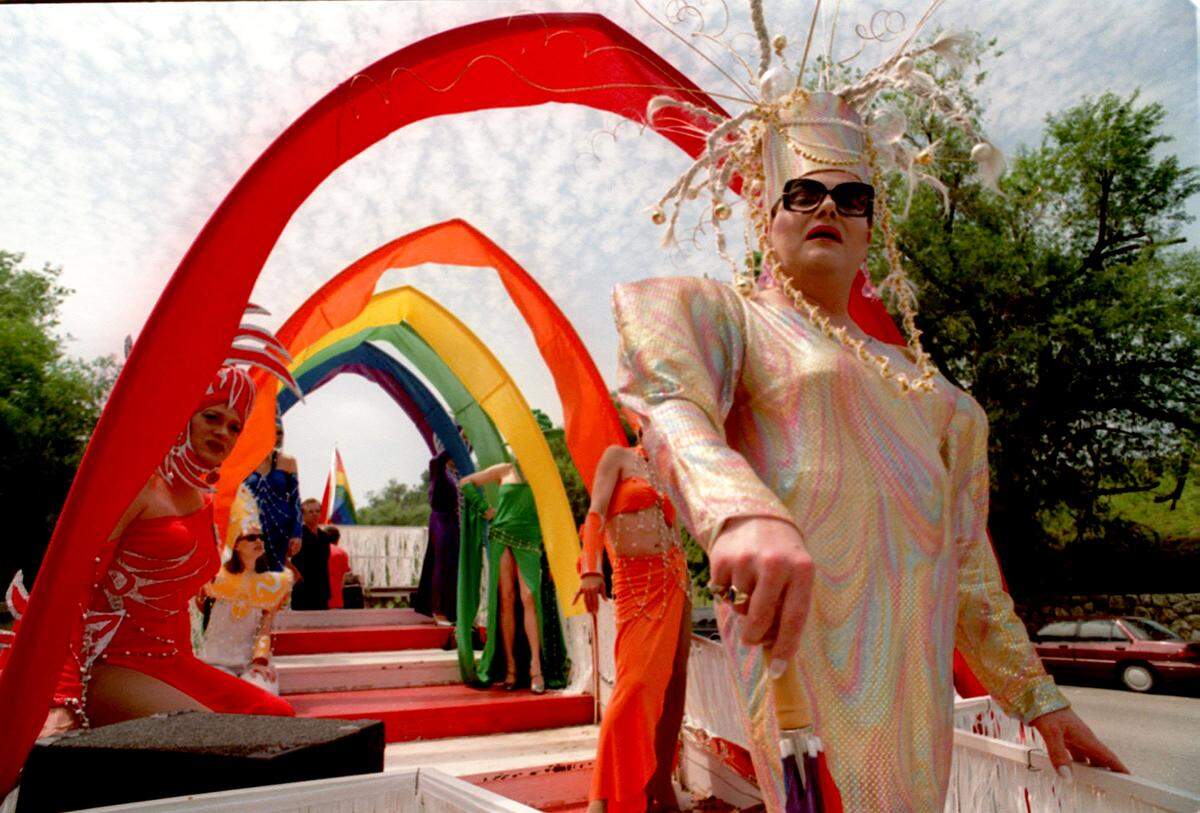
June isn’t the only time the LGBTQ+ community came together.
In the early 1990s, partners Andrea Nedelsky and Mary Ann Hopper established a lesbian enclave inside the Longfellow neighborhood called Womontown: an urban oasis for women who wanted to avoid homophobic harassment. They bought a home together and began their outreach efforts to bring lesbians from around Kansas City and across the country to Longfellow, a neighborhood just east of Crown Center.
It eventually grew to cover 12 blocks, complete with purple fire hydrants and potluck dinners. At its peak in the mid-90s, more than 80 lesbians called Womontown home, owning 28 homes and 14 apartment buildings. A plaque was placed in the neighborhood in 2024 to commemorate Womontown, though many of its residents have since moved away.
The Pride parade remained a community-based celebration up through the mid-1990s, and those involved in that and or the Pride picnic were organizations that directly served the community, according to Stuart Hinds, who leads GLAMA at UMKC.
The passing decades brought more visibility of LGBTQ+ people in the media, and the public’s opinion on the queer community began to warm. In 2015, the United States Supreme Court legalized gay marriage, and shortly thereafter came a boost in corporate funding that changed the way Pride was celebrated.
“You see progress in the sense that being gay is more mainstream. I mean, everybody probably knows a gay person or has seen it on TV,” Hinds said.
He said that over the last 10 years he’s seen an “incredible” expansion of the types of organizations participating in the Pride parade, like military, suburban police departments and larger companies.
But this year, there was a distinct decrease in funding. Organizers with Kansas City’s Pride Fest reported in early May being short $200,000 in funding this year and tied it directly on the anti-DEI (diversity, equity, inclusion) and anti-LGBTQIA+ rhetoric that has emanated from President Donald Trump’s White House.
Corporations told organizers that they had seen budget cuts, so they wouldn’t be participating in events this year or were decreasing their contributions.
“I think it’s a clear indicator of how easily the rights that we have pushed for and struggled forever for in the past 50 years can go away,” Manning said.
But Pride continued in 2025 with a vibrant celebration, drawing thousands of people crowding the sidewalks, holding flags and signs, cheering fin the pouring rain for various parade participants.
Despite state legislation in the works to restrict the rights of LGBTQ+ individuals and general political opposition for preserving LGBTQ+ rights, people in the community refused to be silent, even when it meant standing outside in the torrential rain.
“People have done so much work, and it’s really kind of astounding how much effort they put into moving the community forward, decade by decade,” Hinds said.
This story was originally published July 1, 2025 at 5:00 AM.