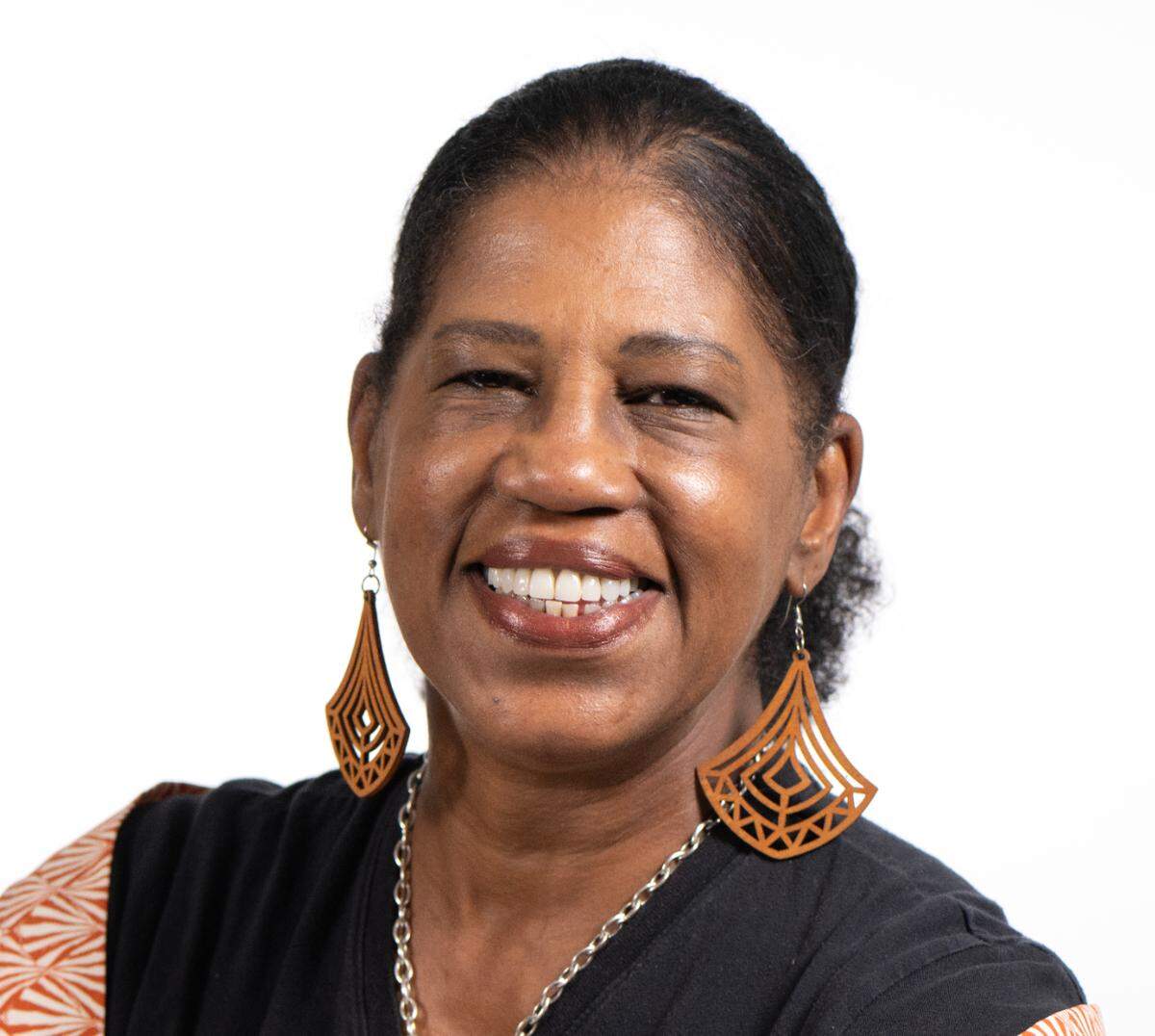
Because her instruction saves lives, this educator loves teaching adults to read
Dianne Brewington grew up in a Kansas City household where she and her siblings were taught that education was important and she believed it. Her mother, who earned her high school equivalency through a federal and state work incentive program called WIN, viewed teaching as “the noblest profession in the world.”
So it’s no wonder, that after a career in human resources, Brewington gravitated to becoming a certified adult education instructor.
These days, Brewington is loving her work with Literacy KC, teaching adult learners to read.
Mará Rose Williams, assistant managing editor for race and equity at The Star, wanted to know more about why someone dedicates so much time to adult education and invited Brewington to the KKFI 90.1 FM Kansas City Community Radio studio to talk about her passion for education. That interview, with minor editing for space and clarity, is published here in a question and answer format to share Brewington’s authentic voice.
Meet Dianne Brewington
The Star: You deal with adult literacy, right? Tell me a little bit about Literacy, KC and what you do there.
Brewington: Well, Literacy KC is a nonprofit in adult education. We are the largest nonprofit in the state of Missouri that has received a grant from the Department of Education, DESE. And so it’s been in existence since 1985, and the vision of it is literacy for all. Our mission is to advance literacy within the Kansas City metropolitan area through direct services, advocacy, and collaboration.
Our students, we serve them from all over the city right now. Over 1,650. And the ages range from 16 to above 60-years-old. So right now, we also serve English language learners, and we have approximately 997 in the program.
Wow!
For high school equivalency preparation, we have about 362 students. We also include workforce development, which includes certifications in certified nursing, forklift operation, and food handling.
Our digital program builds essential technology skills for students, which are also open to the community. You do not have to be a student at Literacy KC to be able to take advantage of them. So far (this year) 23 students have earned their high school equivalency. We have 104 students that have completed certifications, workforce certifications, and then 75% of the students come all the time.
I’m going to gather from all that you just said, and the fact that you are an instructor at Literacy KC, that you have a personal passion for education and literacy. Where does that come from for you?
It comes from my mother, Katie Blue. She wanted all of her children to be educated. She considered teachers and teaching as the noblest profession in the world. And so she was always on us, all the kids in the family, about the importance of education. And she also worked in adult education. As a matter of fact, she actually received her GED from a program that she attended, which was the work incentive program years ago called WIN.
And after that, she ended up getting an associate’s degree. And before she passed away, she had accumulated 104 hours of college.
How many brothers and sisters are we talking about?
Well, there were 12 of us. And so, my brother, who passed away about three years ago, Carl Evens, he was known throughout the Kansas City area. He had been a principal. He was on the school board. He was like the first in our family to get a college degree. And so other people just started falling in line.
So my older brothers and sisters, some of them, they did not even finish high school, but they retired off jobs. All of the younger kids graduated from high school. We have college graduates. And so, just a vast amount of different levels of education in the family. My daughter, of course, she knows she had to go to college.
So what about your education? What does that pursuit look like for you?
Well, I am a product of the Kansas City School District. A lot of times, people, they try to give the Kansas City school district a bad rap. And so you get out of something what you put in. And that’s the message that I have for any parents who have any kids in the Kansas City district.
Our parents were very involved in the district. And we had wonderful teachers. I was thinking about them. My elementary school teachers were just totally awesome. And I thought about when I was pursuing a degree in education, and they were talking about all of these new theories and all of this new education.
Guess what? They were doing it. Project-based learning — I was doing that back in the 60s, and you didn’t hear a lot about it until, what, maybe 20 or 30 years ago? Maybe they didn’t have a name for it, but it was being done anyway.
So was there a teacher, in the Kansas City school district who had a particular influence on you, who led you to say, you know what, I think I want to be a teacher, too.
Gosh, I wish it was one. But the one that comes to mind is Mrs. Reams. She was my sixth-grade teacher. Years ago, the schools or teachers would take you on an out-of-state trip at the end of the year, and I never will forget, she took us to Chicago. That was my first experience riding a train.
We had so much fun. We did projects all year. Every holiday we were doing something. We did ceramics. We had the little white mice in the classroom where we did experiments. We fed one junk food and the other healthy food. She was all about us learning and broadening our horizons, about anything that was in the world.
So when you got your degree in education, what did you do with it? Where did you go and what did you teach?
Well, I actually got my degree in human resources, business administration. What did I do with that? Kansas City had a program that was for the associate teachers. And so if you had a degree, they paid for you to pursue an education, to get an education degree, Unfortunately, I did not complete.
And so I started working at Citicorp Credit Services, and I was there for 13 years. But while I was there, I finished my bachelor’s degree in business administration with an emphasis in human resources.
I did go back to school and started working on my graduate degree at UMKC (University of Missouri Kansas City). I did not finish, but I am a certified adult education instructor.
How did you get from human resources to adult literacy and adult instruction? What drew you to that?
I started working with the Kansas City school district first in adult education, and I always thought about my mom. She always said that adult education was a perfect program or a curriculum for anyone that had not finished high school because it was independent learning.
It’s not like when you are in a school where you have, when I taught you had what was called objectives at a glance or whatever. They gave you this set of objectives that you were supposed to have completed by the end of a quarter.
And you went through, right, and made sure that you covered everything, or you attempted to cover everything. It wasn’t necessarily individually focused on students because students learn at different paces. And so, this is when we start having some fall through the cracks.
And that’s what happened.
I know what you’re talking about. When I was an education writer, one of the things that I learned was that there’s a reason why kids who are home taught, and whose parents really focus on home teaching, tend to do really well. Because they are the only child in the room.Their parent can work with them on one single thing until they master it. But in a classroom, often you have 15, 20 students and you are on a pace to get to what you call those objectives that have to be taught. And sometimes there is a child who hasn’t yet mastered it. They, as you said, may fall through the cracks.
When you first started with adult literacy and adult education, what were some of the challenges that you faced doing that work?
Well, the standards were different than what they were in public education. So learning what the standards were, the testing that they do. We use TABE or testing for adult basic education. It was different. The levels were different. Then you had to learn the language of adult education.
What do you mean? The language of adult education. How was that different?
One of them is, we look at NRS (National Reporting System), an outcome-based performance accountability system. And so it is the rating system that the government gives for levels of education that if you are a funded program through the state, you have to report all of those levels. So when students come through orientation we give them a pretest.
We look to see where they are. So when we post test them again, normally after 40 hours of instruction, we look to see did they make a gain? We call it a progression rate.
And so what the state does is they give each program a goal that you have to reach. That is where your funding comes from.
So the funding is based on the success of the program. And success of the program is based on the success of the students. And the success of the student is based on the success of the instructor.
Absolutely.
It is also based on, do they come to class. Some students, they come in, believe it or not, they don’t miss any days. Some we lose along the way because, you know, that’s the nature of adult education. When our students come to us, they are not like students that are being sent to school.
These people have lives outside of school. They have families. Some of them have illnesses. Some of them are taking care of ill adults, or whatever that’s in their families and all. And so what happens is that they have a few more distractions that come up in their lives and, you know, they come and go. I have some students that this might be their third time coming through the program because they did not finish.
So students will come back and come back. Why is that? Why do they come back and come back?
Because they do have a goal that they set out to reach. And when they came through the first time, they never knew that they were not going to be able to complete that goal. They didn’t think they were not going to be able to complete it the second time. And so I always tell them that it wasn’t your time. So, yes, 90% of the students that come through the program, they actually do want to get a HSET (High School Equivalence Test) or a GED.
And so some of them come through quickly and achieve it, and then some it takes years for them to be able to do it.
Are there really adults in 2025 who cannot read? I think a lot of people think, oh, of course, everyone can read.
We have students that come in that are at a very, very low literacy rate. And when we say read, we’re talking about actually you’re putting something in their hand, a story, a text, a paper. They cannot read it. What they’ve done is they’ve memorized words because all the advertisements that we have. I mean, it’s just like our (k-12) students as well, they memorize a lot.
And so, yes, I have a student now, when she came to Literacy KC she could barely read, and she is still there. And she has definitely improved tremendously. And she was just telling me yesterday, because everyone is excited about this interview that I’m doing, she was telling me yesterday, “I have just been wanting to tell you, Miss Brewington, how far I have come. I am so happy because when I first came here, I couldn’t even read, and now I can.” And so we do have people in Kansas City who cannot read.
And so I imagine there is some training or instruction that a person who wanted to volunteer with Literacy, KC would need to go through to teach an adult to read. I can’t even imagine what that takes, to teach an adult to read. Is it easier or harder to teach an adult than, let’s say, a third grader?
Well, a third grader goes to school five days a week. So that’s the advantage that kids have. But when you’re talking about an adult, they’re only in class two days a week, at the most. And that’s if they come to every class. So you’re talking about approximately five hours a week versus 35. And so you’re going to have more challenges.
And then it depended on how an adult was taught. You have to learn how to teach them once you find out how they were taught, because you have to maybe undo, like, if they were taught whole word. They memorize words, but they do not have the skills necessary that teaches them how to break down a word if they come across a new word that they do not know. That is what phonics does.
Can you share with us maybe a story about an adult student passing through your literacy classes who came to you unable to read.l One that really tugged at your heartstrings. Do you recall having had a student like that?
I have one right now. She’s been with me for six years. Miss Elizabeth Walker. And she doesn’t mind me saying her name.
She could not read. She had memorized some words, but when it came time to reading text on a page, then that’s where the problem was. And she told us her story. I’m a person that loves stories because it helps me to connect with them.
She told me how she actually had jobs, how she worked, and she couldn’t read. She came across a teacher when she was working in Head Start who noticed that she could not read and had started helping her. But she (Elizabeth Walker), was the oldest in the family, and so she helped the parents with the younger kids.
You have a lot of older siblings in a family that helped to make sure that the younger ones in the family are successful, and that was the situation with her. Because some of her younger siblings, some of them have their master’s degrees. But she didn’t learn how to read. And so now she gets the opportunity to learn how to do that,
She is just really excited. She has health problems. She’s in a wheelchair, and she comes to class. She rarely misses. Because that’s how excited she is.
She wants it.
She’s getting it.
How does that make you feel when you see a student who’s working that hard to get something they missed along the way. And you are able to be a part of that?
Well, it makes you really feel good, because a lot of times they’ve never known how to set goals for themselves. When most people come in the program, they say, “Oh, well, I want to get my GED in six months,” but they’re reading on a second-grade level, right? And so, you know that they want to do this, but you have to kind of steer them or help them to make goals that are achievable in a short amount of time.
And we never tell them to give up a goal. We just let them know whether that’s a long term goal. So let’s work on some short term goals. And that way you will see yourself moving towards that long-term goal. And so you motivate them every time they do something or they accomplish something.
And it might be like being able to say the first 100 words on the Fry word list (A compilation of the most frequently used words in the English language.). And so that makes them feel good. And so that makes them try even harder.
So, Diane, you were talking about how it makes you feel when you get a student who you see progressing and growing.
Do you ever have students who come back years later and tell you how much learning to read changed their life?
Oh, absolutely. One of the students that I have this year, actually, she passed her HSET. They don’t have to come back after they get their HSET, but they do. They come back. We actually have a luncheon that we do every year and we invite some of our past students to come in and talk about their experiences that they had with Literacy KC. They have jobs, some of them are in college and they come in and they share with you.
Back to Miss Elizabeth. She had to use her family members to read her lease agreements, to read important papers that she needed. And so she came in one day and she said, “Guess what? I read my lease agreement. I didn’t know all the words, but I did know enough to understand what it was I was signing.”
Wow. And that made you happy, didn’t it?
Yes it did.
Wow. So, how long have you been working with Literacy KC?
I started with Literacy KC in April 2017. I partially retired. So, I knew that I didn’t wanted to work part-time and it ended up being the best decision that I ever made. Because it is the first job that I ever had that I love. I love going to work, and it’s because of the students. They they make you feel like you are accomplishing something every day that you leave, every day.
So would you say it’s a passion of yours?
Oh, absolutely. It is a passion. That’s why I’m still doing it.
What does it do for you when you’re not in the classroom, just for Diane Brewington? What does having someone like Miss Elizabeth come tell you “I read my lease,” do for you?
It encourages me to think about all the other different ways that I can learn how to do my job better. That’s what I’m always thinking about. Like, I may wake up at night and say, oh, I’m going to try this lesson. You’re always thinking about lessons. You’re always thinking about something that you can do better to help.
Yeah, adult literacy is extremely important.
It really is important because when they come to class, the one thing that our students are, they are so honest, they will tell you, “I need to be able to help my kids in school.” They will tell you, “my kid brought home a lesson last night for homework, and I felt bad because I could not even help them and I need to be able to help them.”
They will let you know and they will tell you, “I don’t want the same thing to happen to my kids that happen to me.”
So they want to break the cycle.
Absolutely.