He dreamed of an urban youth orchestra in KC, but was told it would never work
The Star met Darryl Chamberlain around 2017 after the newspaper learned from a tipster that a Kansas City engineer was starting an urban youth orchestra using children who had never played an instrument before, and he was looking for instrument donations.
This sounded like the do-good story that so many readers often call The Star to complain that we just don’t write enough of. The kind of story that might make you want to stand up and cheer.
So we reached out to Chamberlain. They were meeting in the basement of a local church. There were only a few students and their sound was still a bit squeaky and scratchy. When he started, Chamberlain, wasn’t a music teacher per se, he was an engineer who played piano and loved music. He had moved back to his native Kansas City from Texas where he had been working and raising a family, and right away learned that a lot of the KC urban schools no longer had music programs. He had some experience playing music in a little family band and thought he could single handed build an urban youth orchestra.
Chamberlain has a theory about passion, dreams, vision and hard work, and about taking on something big. Chamberlain spent a lot of time trying to teach children with little or no music history, how to understand and play orchestral music well enough that people would want to hear them play and would applaud for them not because they were kids, but because they were good.
The Star asked Chamberlain to participate in this year’s Voices of Kansas City, focused on Black educators in Kansas City. He joined Mará Rose Williams, assistant managing editor for race and equity, in the studio at KKFI 90.1 FM Kansas City Community Radio, to talk about his and his orchestra’s journey over the last decade. That interview, with minor editing for space and clarity, is published here in a question and answer format to share Chamberlain’s authentic voice.
Meet Darryl Chamberlain
The Star: Mr. Chamberlain, we met, I believe it was in 2016 or 2017. I know a lot has happened in the eight or so years since then, but let’s kind of start at the beginning. You’re not a music teacher by trade, are you?
Chamberlain: Yes and no. I’ve been working with kids and music for, golly, maybe over 30, 40 years.
Tell me about that.
It started in Texas. I have six sons who are also musicians.. And we formed a family group called the Chamberlain Ensemble.
Nice.
And then other kids would join from the community and it grew to a small ensemble. About 20 kids.
And how long ago was that?
We started that around 1992.
So some years ago. So are you originally from Kansas City?
Yes, Kansas City is my home. But I left Kansas City in 1982 to go to work for Texas Instruments.
I was an engineering technician for the semiconductor industry or the semiconductor section of Texas Instruments.
So while you had this experience with music and with your children and playing music yourself, but did you go to school to become a teacher or an instructor or a music instructor?
No, not formally like most people get that undergraduate degree in music and such. What I did was I took music classes while I was studying in college and I needed to make sure I had a full-time schedule. And so what I would do is add a music class, because I was a musician. I’ve been a musician since 1975, I think.
And then when it got to a place where it looked like I was going to form an orchestra, then I started taking private lessons on the various instruments that I was going to be teaching.
What brought you back to Kansas City?
Oh, that’s a long story, but I’ll try and keep it short. Well the last thing I did when I left Kansas City. I went to the parade because, I grew up attending the parade. The American Royal Parade was just the thing for kids to see.
And then, while in Texas, I went from Texas Instruments to where I was working for FSI international. They closed. And I said, well, if I stay in Texas and find another job, I’m going to be stuck here. So I’m going to pack my bags and go home because I wasn’t supposed to stay there for 22 years.
So you come back to Kansas City. And what makes you decide that you want to start a urban youth orchestra in Kansas City?
Well, strange enough, all the time I was in Texas, I kept saying I sure wish I was in Kansas City to go to the parade. Now they do have a parade in Dallas, but, there’s nothing like the Kansas City American Royal Parade.
And I went to the parade and there were no bands in the parade. Not from Kansas City. That’s the American Royal Parade.
And that shocked me. Where did the bands go? And so I started doing research on it. I went from school to school talking to band directors or those schools that had ban directors left. I talked to principals trying to find out why the bands weren’t in the parade.
And what did they tell you?
Central High School didn’t have a band. North East didn’t have a band. Southeast didn’t have a band. East was closed. Van Horn was struggling to survive because the graduation rate of Van Horn at the time was 42%.
So you saw an opening?
Yes, and I said, well, I got all the materials and things because I had a music fundamentals course that I was doing in Texas. And, I said, since I’m here and I got the materials, I can just do it here.
So what was the first thing that you did?
The first thing I needed was instruments. I was playing piano at James Memorial Temple CME church at the time. I started taking the money that they paid me to play the piano and buying instruments with it.
And when you talked to people about wanting to start a youth orchestra in Kansas City, what advice did people give you?
Yeah. Anytime you start a business, you ought to do a survey of your communities to see is this practical. And so I wanted to talk to music teachers and get their opinions of it. And, one teacher in particular said that it’s not going to work. And, he’s a long standing music teacher in the district.
And I said, why? He said, because the parents won’t support it. And then he said because the kids won’t support it. And then he said, you don’t have enough money to do it. It takes about $300,000 to equip an orchestra. And I didn’t have $300,000. And that was something I didn’t want to get a loan to do.
That was ridiculous.
So what did you do instead?
So I took the money that I made playing the piano and started buying the instruments. And I bought them from everywhere you can find a used instrument to be sold; from eBay to the classifieds in the newspaper, Thrifty Nickel, Kansas City Star classified, pawn shops. So I got to know every pawn shop in the city.
Because you knew that the students that you were going to seek to join this orchestra, we’re going to be students who did not have instruments, pretty much.
My purpose was to serve the urban core. I was concerned that the Kansas City area had lost its focus on instrumental music and music instruction. And so those were the kids that I wanted to serve, and I knew some of them were going to be coming from low to moderate income families that couldn’t afford, say, $1,800 for a saxophone.
Right. So how long were you collecting instruments before you brought students in?
From 2005 to about 2007 I had enough instruments to form a small ensemble. And, we did form a small ensemble in 2007.
Now you were still working a nine-to-five while you were doing this?
Yes, I was.
And you were buying instrumentals out of pocket.
Yes. I’m buying instruments. No donations, No funds coming in from lessons or anything. It was just me buying instruments by faith, believing that this was going to be worth the effort.
And where did the students come from?
The first students came from the church. I just started advertising in the church. And that was the first ensemble that we formed around 2007. Now that ensemble was called the A-flat Youth Ensemble.
And then I was in school at the time. I was trying to get certified to, well, not trying, I did get certified to teach in the public school system. Then when I graduated, Tyrone Yarbrough, he’s the music director at Saint James United Methodist (Church), asked if I would come to that church and do the same things there. And so we started offering formal classes at Saint James United Methodist. Before, I was going by the name A-flat Music Academy. And then I changed it to A-flat Music Studio. And off of that name we formed the A-flat Youth Orchestra.
But because we were partnering with Saint James and they were giving us the rehearsal space for free, I incorporated their name into our name and called it the Saint James UMC A-flat Youth Orchestra.
How many students did you have in this orchestra?
At Saint James we did have all the sections. We had woodwinds, we had brass, we had strings, we had percussion.
And so instead of calling it an ensemble, I called it an orchestra. But we were a small orchestra initially, about 10 kids. And then it grew to about 15. And, from there it’s just been slowly growing each year.
Now, these students who came to you were students who, some of whom, had never picked up an instrument before, right?
Yes. I started a fundamentals class, and my philosophy was to teach them how to read the rhythms of the music first, because that’s the weakness I see in a lot of public school kids. They can play an instrument because they were taught by rote, but they can’t read the music, right?
When I go from city to city looking at school bands, you see kids who play extremely well, but they can’t read the music, which means they cannot get in anybody’s college program playing music.
So were you giving lessons to each and every one of these students, or did you bring in some other instructors to help teach maybe flute or sax or, you know, viola?
Initially when we started, I taught everything and particularly I had the fundamentals class, which I had to teach because I developed it and understood what the goals of that was, which was to teach them how to read rhythms at a sophisticated level. And then later we had a teacher come and join us. I think I met her while I was at a show somewhere.
What was it about music that you thought would work? You once said something about the science of music and how that translates into how you live your life and how it impacts your life. Talk to me a little bit about music and young people who engage in music, and what they can learn from that.
Yeah. My biggest concern is the education levels that we see in the community today. I’m hearing people say eighth-grade students are reading at a third-grade level. And then last year, I volunteered for the Lead to Read program, and some of those kids in the third grade couldn’t read at all.
And I wanted to be involved in the processes by which our kids could learn to appreciate education and improve themselves.
And you’re good at it too, Mr. Chamberlain. And I say that because I went to an early class, one of your orchestral sessions. I sat and listened and what impressed me most of all was that as you were teaching the music, you kept imparting these little tidbits of life lessons. You were teaching life lessons while you were teaching, you know, someone how to hit the drum or to pull that bow across that viola.
Yeah. That’s because music and life are one and the same. And I tell people that before a man could untangle a participle or split the infinitive, he was a musician. Before there was a Pythagorean Theorem, Norton’s theorem, he was an artist or a musician. And music is the core of what it means to be human.
And so, I’m always looking for parallels between music and life. And, a lot of times I’ll tell the kids that when you start a song it’s like what happens when you enter a room. There’s one person that comes in, and you don’t know how he got in there. He just kind of, you know, you looked around and there he is. That’s a bad song. The song started and kind of wandered into itself.
There’s another person who comes in. ‘Hello, everybody. It’s so good to see you.’ That’s a good song. That first introduction of the song, the first note you play, should be something that sets their expectation to say, ‘this is a good song coming on,’ and that’s the same as when you enter the room.
Now, when the song ends, it’s like when you leave the room. Some persons leave the room with a bang, slamming the door and they’re gone. And you’re just kind of, I’m glad he’s gone. There’s another person that he left, and it’s like, Where did John go? You didn’t realize he left. But a good exit is where you say, I had a good time, everybody, goodbye., and you wave, and everybody’s like, come back again next week. That’s a good song. The intro introduces you well, and the exit is also memorable.
That’s really a great analogy. Do the kids seem to get it when you present the musicality in that way?
They do.
The Atlas group came down and did a video of us two years ago and one of the students was interviewed. He said, “he doesn’t want us to play like kids. He wants us to play like musicians.” And I never really told him that. But, he got it.
So here you are in the basement of a church with a bunch of kids who never played music before. But they’re learning, they’re interested, they’re engaging, they’re trying, they’re working hard, and you can see that they’re getting better. What happens to the A-flat Youth Orchestra? Where does it go? From that basement to where?
Well, initially, I told them if we keep getting better, somebody is going to put us on the radio. And it wasn’t but a month or two later, somebody put us on the radio. And then I said, we just have to keep getting better, and somebody is going to put us on TV.
And, before then, you took our story and put us on the front page of the Kansas City Star. And then the producer from the NBC Today show in New York City saw that story and he came to Kansas City to capture our story. And I was thinking, TV, we’re going to be on local TV, not national TV.
And man, after that, then we got into a media blitz where everybody was hitting us — magazines, newspapers, and somebody from the Saint Patrick’s Day parade contacted me and asked if we could be in the parade. And I said, well, we’re primarily a string orchestra, and you can’t march in a parade with string instruments.
Are we talking about the Kansas City St. Patrick’s Day Parade?
Yes, the Kansas City Saint Patrick’s Day Parade. And so I went to work and I talked it over with some of my coworkers. They said, why don’t you build a float? And I said that’s possible. But how? They said talk to, I forget his name but it was Snelling Construction, because he might lend you a truck.
I talked to him. He said, “Yeah, I can get you a truck.” And in fact, he said, “I’ll lend you my driver and my tractor to pull it.” Then I hired Bonnie Brown, who was a teacher at Paseo (Paseo Academy of Fine and Performing Arts). She’s a premier art teacher, for sure. And I asked her if she could design the float for it, and she got her students together. And they designed the float for that parade. I guess we became the first time a string orchestra has played in the Saint. Patrick’s Day parade.
And that really brought you full circle. Because that’s what had kicked the whole thing off, this idea that Kansas City students weren’t in the parade.
Right? Isn’t that something? We started because I was concerned that students were not in the parade. And then, here we are in the parade. And then after that, we wound up playing at the Future Stages Festival at the Kauffman Center for the Performing Arts. Now, that was big. Here we are, a little rinky-dink bunch of kids. I think by then we were about 19 kids that we took up there that year. But golly, that was a big thing for me, for the kids, to be on that stage And this year is our seventh year, since that time, participating in the Future Stages Festival at the Kauffman Center.
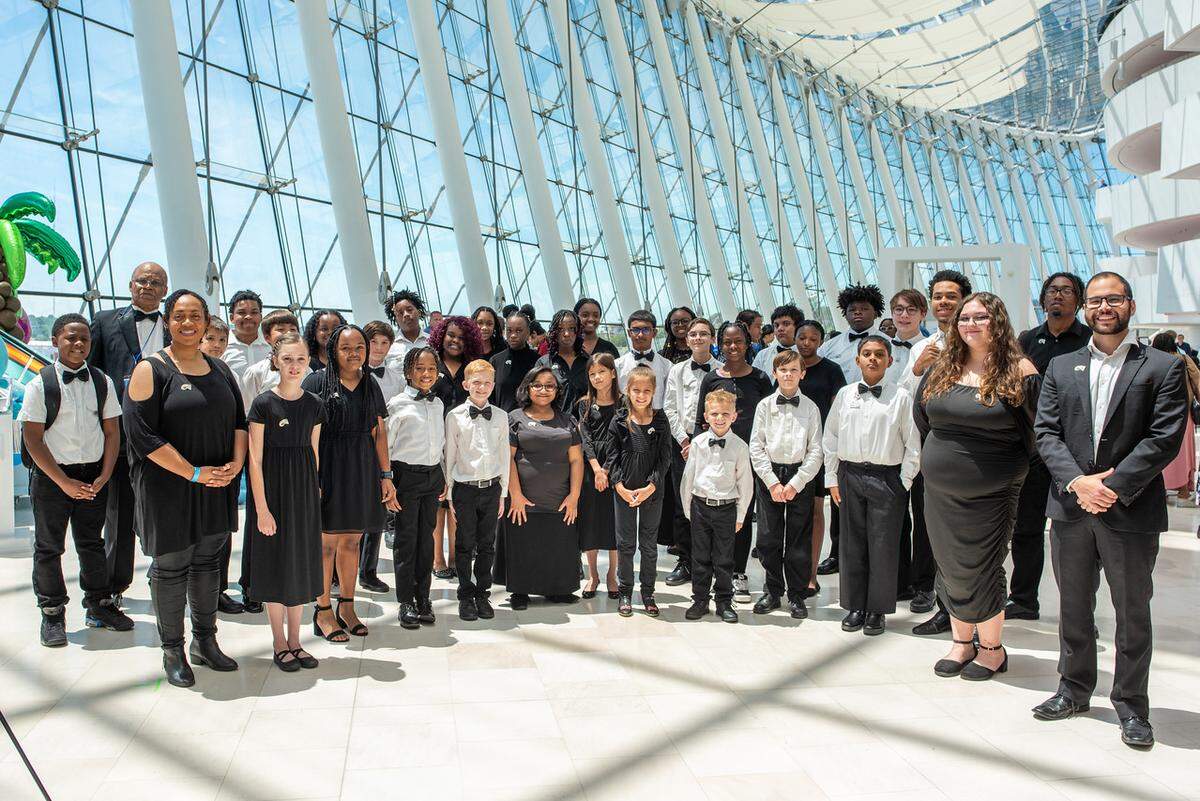
Tell me how that makes you feel. Seeing these kids on a stage like that at the Kauffman Center, with the desire that you had initially and what you wanted to do and the people that told you wouldn’t happen.
It’s amazing because I really had not dreamed that far. I tell people it’s an idea that grew up. And, I say, you take an idea and add to it imagination and an idea will become a dream. Then you take a dream and add to that focus. And a dream will become a vision.
And you take a vision and add to that hard work, and a vision will become a reality. And that’s what this orchestra was.
And now the vision is becoming a new dream to where we’re going places I had not planned. And so now I have to add more imagination to this new dream. Because, here’s a new dream: We want to see the A-flat Music Studio become the A-flat Fine Arts Center, where we teach instrumental music, dance, choral, theater, art.
A place where kids can come and find themselves. We had one student who wrote a note to her grandmother and she said, “I think finally I found something I could be good at.”
Wow!
That’s what I said. Wow! Because the key here is, finally found. That means she was looking, right? And that’s what we’re here for. Kids who are looking for that something that they can be good at. Something they can be proud of, something that makes them fit in. Something that makes them say, I belong here.
You have to come to see our class and see what these kids are bringing.
They come wanting to work and we work them hard too. But they want to. If I give them easy stuff they get let down. You can see it on their face.
So high expectations for the students?
Yeah. My first expectation is that they learn how to read music correctly, and then we go from there to where we’re wanting them to read music effectively.
And today we have seven teachers, including myself, where each one is an expert in the area that they work.
Does it cost anything for parents to do this? How are students able to get this kind of training?
Our lessons at the time were the cheapest in the city.
And you did that for a reason.
I wanted to make this affordable to the low and moderate income.
Mr. Chamberlain, let me ask you something. What kept you going through all of this? I mean, all these years, what was it? What were you standing on here?
It goes back to me in high school where I wasn’t the best student. I struggled and I had lost my faith in myself. And my grades were down because I did not believe in myself.
I’ve been concerned about kids who are in the same boat I was in. And so I guess ever since then I’ve been working with kids in one capacity or another. I’m always working with kids, trying to give them hope because that’s what saved me, was hope. Faith and hope.
I know some kids are lost and there’s a way that we can help them find themselves. And if we can do that, that’s how we build the community. That’s how we restore it.