Search for unmarked graves at former Kansas Indian boarding school never happened. Why?
Nearly three years ago, the Kansas Historical Society planned to search the grounds of Johnson County’s Shawnee Indian Mission to discover whether children were buried there.
But the project never came to fruition.
The Shawnee Tribe — one of the tribes that had students attend the former boarding school in the 1800s — argued that it hadn’t been included in the process or consulted before work began.
“It’s not just the tribe being consulted, none of the tribes who had kids attend this place were consulted about this study,” Shawnee Chief Ben Barnes said. “Let’s just imagine that the study was conducted and bodies were found. Are they going to be taken out of the ground? Are we going to publicize it? You can’t just go surveying and tell us the results after the fact.”
While Barnes says the Shawnee Tribe was not consulted, Fairway city officials say that the tribe was contacted but tribal officials didn’t support the study.
Fairway City Administrator Nathan Nogelmeier said that the state approached all of the tribes that have expressed interest in Johnson County to move forward with the study, which would have been conducted in partnership between the state, the city of Fairway, and the University of Kansas Center for Research.
While not all of the tribes responded, the seven or eight that did expressed interest except for the Shawnee Tribe, he said.
KU Director of News and Media Relations Erinn Barcomb-Peterson told The Star in an email that no work has been done and “KU will not proceed without input and agreement from affected Native nations.”
Any plans to try to make the survey happen remain up in the air as the parties wait for the Kansas Legislature to decide on HB 2834, a bill that would transfer ownership from the state to the Shawnee Tribe.
The Kansas House Federal and State Affairs Committee is expected to vote on the bill on Tuesday. If it passes, it’ll move forward in the legislative process.
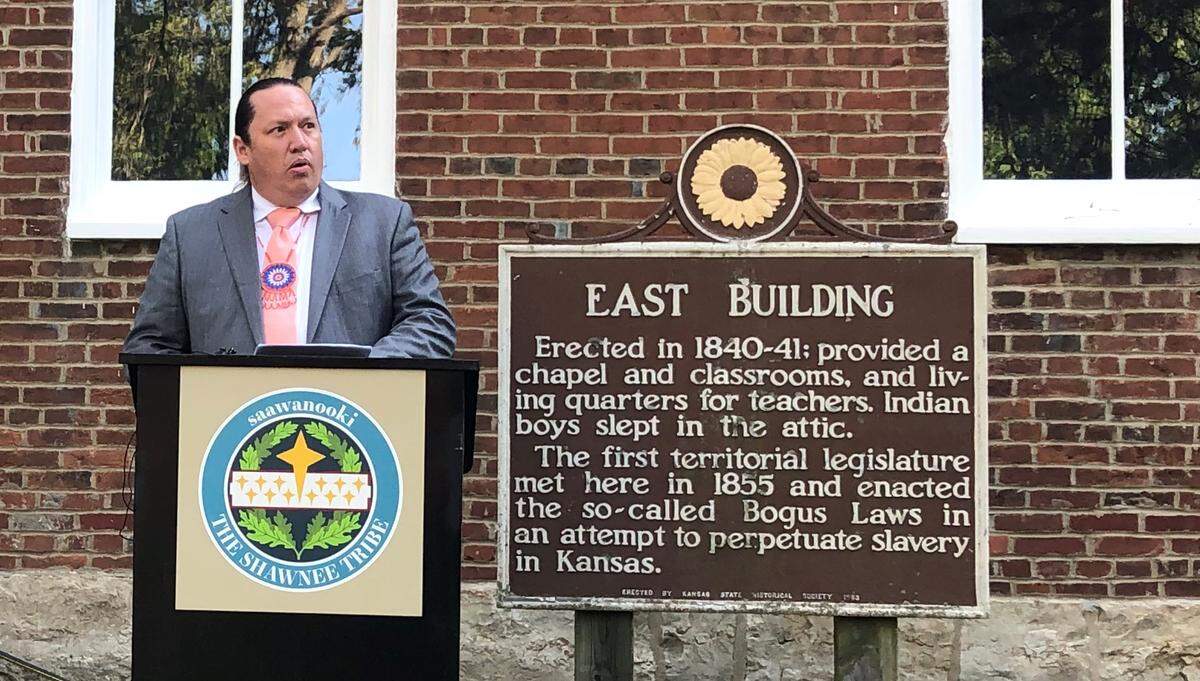
Original plans
In 2023, the state contracted with the University of Kansas Center for Research to use federal funding to conduct a ground-penetrating radar survey of the 12-acre site in Fairway off Mission Road after tribes called on federal and local leaders to investigate the former boarding school.
The National Historic site, originally located near Turner in present day Kansas City, Kansas, moved to present day Fairway in 1839, where a branch of the Santa Fe Trail passed through Shawnee land. The former boarding school was established by the Rev. Thomas Johnson, and housed students from 22 tribes and forced them to perform manual labor, with the intent of assimilating the children into white American culture and Christianity.
Historical records showed that four Native American students were reported to have died while attending the school, but the records are sparse with some believing there are likely other unreported deaths and unmarked graves.
“If that assumption is out there, let’s find out because I think if we were to find unmarked graves at the site of the mission, that completely transforms and changes how we program and welcome people to the site,” Fairway City Administrator Nathan Nogelmeier told The Star.
But when the Shawnee Tribe objected to the project, it became more bureaucratic and cumbersome to push the project forward because the project is using federal dollars and not private funding, Nogelmeier said.
“They (the Kansas Historical Society) have to go through the Kansas Ethics Commission. Even if you have a tribe opposed, [they] have to make sure that they have given every opportunity to consult and provide feedback,” Nogelmeier said. “That’s where we’re at now. The Historical Society is working with KU to figure out if we can get back on the schedule because we’d love to do it this fall.”
Kaw land
Other tribes, including the Kaw Nation, have supported the ground penetrating radar survey. Nogelmeier added that the Kaw have been “putting pressure on the Society to move forward.”
“The reality is this land was inhabited by the Kaw for hundreds of years before ceding the land to the federal government in 1825,” Nogelmeier said.
During a February House Federal and State Affairs Committee hearing that discussed HB 2834, Kaw Nation Tribal Council member Wesley Pappan shared the Kaw’s ongoing support for the ground-penetrating radar survey.
“It is acknowledged that Indian children are buried on and near Mission property, including Kaw children, but GPR is vital to determining the exact locations and number of burial sites,” Pappan said in his testimony. “This is an action that should be a part of an information gathering process, which needs to occur before the state considers further action.”
Earliest oral accounts show that the Kaw inhabited the land, which included the Shawnee Indian Mission Site, in 1540, and records show that the Kaw already occupied these lands when first encountered by European traders and trappers in the early 18th century.
“In sum, these lands which the Shawnee people temporarily occupied along with other tribes were the stolen aboriginal lands of the Kaw people,” he said in his testimony.
Kaw Nation Tribal Council member Pappan said that a survey “would be the proper thing to do.”
“There were 22 tribes that had children in that school. … I think that school was open for maybe 10 years or less. If a child died, they didn’t send them back to their homeland, they buried them there,” Pappan said. “It could be any of the 22 tribes that lost children there. That’s what hurts my heart.”
This story was originally published March 18, 2025 at 5:00 AM.