KS lawmakers weigh fate of Shawnee Indian Mission — again. Why city, tribe want to own it
Dozens sat in wooden pews and white folding chairs on a Saturday morning at the Shawnee Indian Mission for an educational event about one of the historical site’s founders.
Before the presentation could begin, Site Director Jennifer Laughlin stood before the crowd to ask them to voice their opposition for HB 2834, a bill that would change the ownership of the Shawnee Indian Mission from the state to the Shawnee Tribe — a years-long debate where the state and local partners and the tribe claim that they can make needed improvements to run the site efficiently and effectively tell the whole story of the boarding school’s history.
Originally located near Turner in present day Kansas City, Kansas, the Shawnee Indian Mission moved to present day Fairway in 1839, where a branch of the Santa Fe Trail passed through Shawnee land. The former boarding school was established by the Rev. Thomas Johnson — for whom Johnson County is named —and housed students from several tribes, requiring them to perform manual labor and assimilate into white Christian culture.
A Kansas legislative committee was expected to vote on the bill Thursday, but long hearings about other items pushed HB 2834’s discussion to next Tuesday.
On Saturday, Laughlin said the bill could move forward in the legislative process and called on folks in the room to take action against it in order to keep the 12-acre site owned by the Kansas Historical Society.
“So we still need the community to contact [the legislature] starting on Monday just to ensure that the community voice has been noted and heard,” Laughlin said.
Committee Chair Tom Kessler (R-Wichita) told The Star on Monday that he doesn’t have strong feelings one way or another about whether the bill should pass.
“I’m kind of just mediating the whole thing. I’ve been trying to stay neutral to all my people, let them make their decision based on how they feel. So I haven’t been pushing them one way or another,” Kessler said. “I don’t know where it’s going to fall, but if they have the votes to convey it, we’ll work it Thursday.”
Who would be able to access the site?
The Shawnee Tribe and the city of Fairway both denied any possibility of new development or changes to the site in interviews with The Star this week.
If the bill passes, the city of Fairway – which operates the site – and The Shawnee Indian Mission Foundation, which fundraises for the site – fear that public access to the site would be cut off and there would be no method of accountability should something go wrong, City Administrator Nathan Nogelmeier told the Star.
“I think the state has proven itself to be a good steward of the site and keeping it open to the public the best they can,” Nogelmeier said. “Residents said, ‘If I have a problem with how the Mission is being operated, I can come to you and I can make my complaint heard and you are held accountable.’”
If it’s not publicly owned, it loses the accountability mechanism, he said.
“The state of Kansas is responsible to its residents, the city of Fairway is responsible to its residents and we are held accountable for what happens here, good and bad. It’s very public and transparent and people can continue to come to the site,” Noegelmeier said. “Regardless of who – should the state decide to give this site away – there’s no guarantee that that entity would keep the site open to the public.”
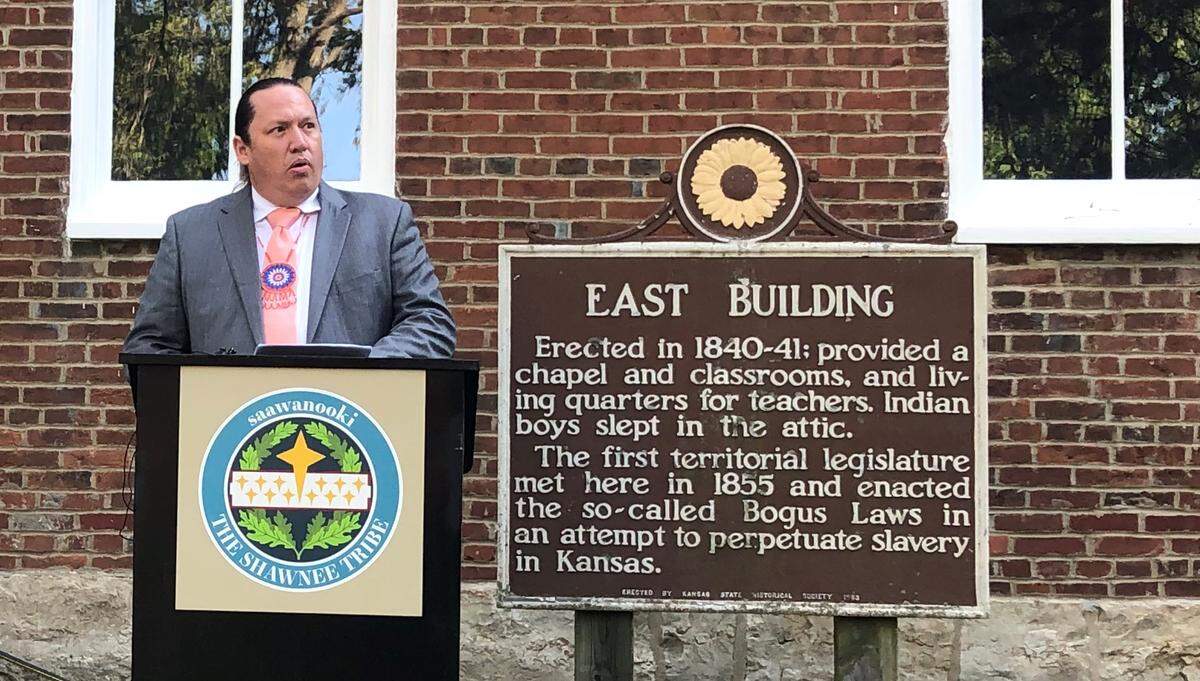
Shawnee Tribe Chief Ben Barnes said that the public would continue to have access to the site and that the site would still be subject to Fairway, Johnson County, and Kansas laws if the tribe obtained ownership.
“It’s a national landmark. It’s intended for the nation, not just Shawnee, not just Kansas. It’s a national landmark, it’s an important site for the entire nation,” Barnes said.
Barnes said that the site has suffered from decades of neglect in the state’s hands, and he fears that it would continue to get worse if nothing changes. Using the tribal government’s sources of income, the tribe would establish “a foundational model that would keep the site up in perpetuity.”
“This is one of those public-private partnerships that I can see conservatives behind because someone is bringing money to the problem and the state doesn’t have to spend one dime of public money,” Barnes said.
Are the buildings deteriorating?
The state used to oversee all operations and maintenance of the site. In 2014 agencies across the state saw funding cuts — including the Kansas Historical Society — because of the recession’s impacts to the state’s budget, Nogelmeier said. As cuts happened, the Shawnee Indian Mission’s operational hours shrunk from year-round to a two-week window in the summer.
In order to keep the site open, the city proposed an agreement with the historical society to take over daily operations and worked with the foundation to raise capital costs to offset operational expenses.
“The Historical Society is responsible for all the preservation. We will change lightbulbs, we’ll fix the sink faucet if it goes bad or starts to leak, but anything that has to do with the structure of the building is the historical society,” Nogelmeier said.
Chief Barnes said that the state’s ownership has caused years of neglect and deferred maintenance to the site.
In 2021, the Shawnee Tribe commissioned the Architectural Resources Group — an architectural firm that specializes in historic preservation, planning and conservation— to conduct an assessment on the site. The following report found that the three brick buildings are in need of significant repair and maintenance work in the next 12 to 18 months.
“The roofs have not been replaced in many years and show signs of significant deterioration at both the interior and exterior at each building,” the report stated. “There are ongoing water infiltration issues at the roofs of the East and North buildings and recent remediation and repairs due to water damage in all three buildings.”
Roof replacement and repair for all three sites should be carefully planned by preservation professionals and executed following the Secretary of Interior’s standards.
“This is especially crucial for the East Building as the attic, which appears to remain unaltered and was the boy’s dormitory and is therefore significant,” the report stated.
Barnes said that he has photos from two weeks ago showing holes in one of the roofs and is certain that there hasn’t been a repair job.
“The conditions are only getting worse as the necessary maintenance of that site continues to be dilapidated under the state’s management,” he said.
Nogelmeier said that there’s a new roof on the west building and the north building, and in the next two weeks the state will begin work at the east building — which currently holds the museum. The three roofs were repaired through a one-time $350,000 appropriation fund from the state of Kansas.
In the east building, work has begun in the attic where hundreds of wooden beams support the structure as site workers begin repairing the plaster before roof work can begin.
“The important thing to remember was why aren’t they coming in and making everything pretty again? That’s not the role of a historic preservation officer, their role is to preserve it,” Nogelmeier said.
How should we talk about history?
It’s not just the physical preservation, but the way the site is used to teach about historic that’s up for debate. The Shawnee Tribe says that the lessons being taught are outdated and incomplete.
“The interpretation leaves much to be desired, we’ve had historians come through from the University of Iowa and give us feedback on historical interpretations,” Barnes said. “It doesn’t give you any information about where the tribes are today. There was coercion and collusion, there were people making tough choices for their kids and none of these stories get told inside of these buildings.”
“It’s not just the structure of it, it’s the interpretation of history. It’s certainly not a community building, but it’s certainly being treated that way by the city of Fairway,” he said.
Yoga classes and chili sales are hosted by the city at the site. At one point, there were seances on the grounds, Barnes said.
“That’s a hard pill to swallow, and again it just disqualifies the management of the site, just again and again bad decisions are made,” he said.
Dr. Stephen Warren, a professor of History and American Studies at the University of Iowa, brought a graduate class to look at the Mission’s exhibits and analyzed its text over the course of a semester.
“We look for scholarship from professionally trained historians on the subject at hand, in this case boarding schools, and the most recent scholarship on boarding schools is not included in the site,” Warren said. “What we get is an interpretation of the past that would be familiar to someone in my parent’s generation, but not someone in our generation. To put it at a finer point: what’s really missing there are Native American perspectives on boarding schools.”
From his grad students’ perspective, the boarding school’s portrayal in the museum was relatively positive and “neglected the reality which is that children were removed from their homes and their cultures were actively destroyed.”
Warren said that he didn’t blame the volunteers or staff who work at the Shawnee Mission for the interpretation. They need help from the state and “the decline in support for public history sites is pretty glaring,” — resulting in deferred maintenance and neglected interpretation.
Nogelmeier recognized and agreed that the exhibits need updates to tell the full story.
“The last time this building went through a reinterpretation was in 2005 and obviously attention to Native American schools and their impact has certainly changed a lot in the last 20 years,” he said.
Earlier this year, the city, the foundation, and the state approved a new 10-year agreement, which calls for a complete reinterpretation of the site within the next three to five years where they would collaborate with stakeholders — including working with the 22 tribes that had children attend the school.
“Our goal from the very beginning is to make sure we’re having honest conversations about who was here, what occurred here to the best of our knowledge and to include other touchpoints in history this place has,” Nogelmeier said. “We have the opportunity to do some amazing things and be inclusive in the process, which maybe wasn’t the case before.”
The Star’s Matthew Kelly contributed reporting.
This story was originally published March 13, 2025 at 12:47 PM.