Kansas City ranked worst for handling chronic homelessness out of all major U.S. cities
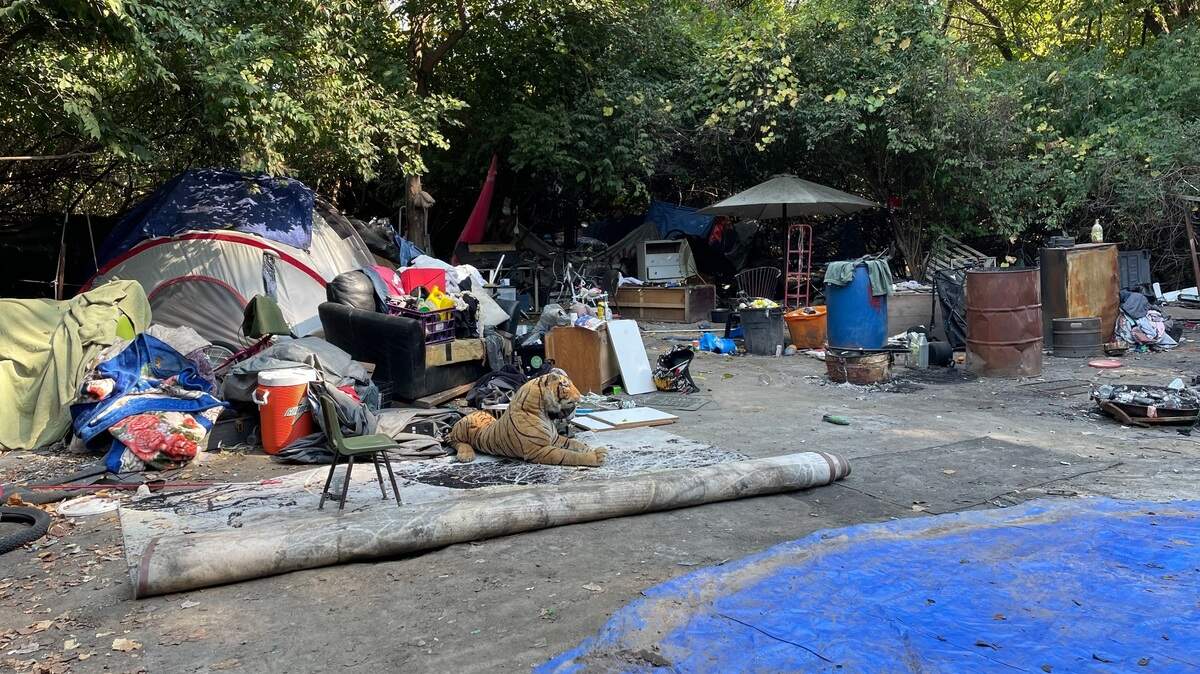
Bill has been living outside in Kansas City for a dozen years.
It’s “a long time to be out here, but I’m a survivor,” he said, requesting to use only his first name for privacy and safety reasons.
A copy of the book “The Little Book of Heartbreak” sat on a small table next to the 67-year-old in his encampment on the outskirts of Kessler Park in Historic Northeast Kansas City. A gray and white dog wandered over for belly rubs. Tents of varying sizes surrounded the area.
The share of Kansas City’s chronically homeless population living outside and not in some kind of shelter is bigger than any other major city in the country, according to the U.S. Department of Housing and Urban Development.
At 95.7%, the Kansas City area has the highest percentage of people experiencing chronic homelessness living unsheltered of any major U.S. city, according to a report by HUD. That rate is worse than places known for significant homeless populations like Los Angeles, which ranked second at 86.6%.
And it’s a number that grew locally by nearly 6% between 2022 and 2023. HUD’s data includes Jackson County on the Missouri side and Wyandotte County, Kansas.
The statistic does not mean that more people are experiencing homelessness in Kansas City than in Los Angeles. More than 30,000 people are chronically homeless in Los Angeles, while about 280 are in Kansas City. But it means that among those who are experiencing chronic homelessness, a higher share are living outside without shelter in Kansas City than in Los Angeles.
Third was Long Beach, California, at 1,338 people and 85.1% living outside.
The federal agency’s definition of chronic homelessness includes anyone who has been homeless for a year, or on at least four occasions in the past three years. HUD defines unsheltered homelessness as “when a person’s primary nighttime residence is a place that is not meant for sleeping,” such as in a car, park, abandoned building or campground.
Most major cities have a low-barrier shelter, which accepts people without requiring participation in things like religious programs or substance use treatment. Kansas City does not have a permanent shelter like this. After a man froze to death in winter 2021, the city opened a temporary low-barrier shelter during the cold weather months.
In September 2022, the city unveiled Zero KC, a five-year plan to end homelessness. A permanent low-barrier shelter was considered its first step.
But efforts have been slow to come to fruition.
‘A whole different society’
Bill said he doesn’t want to stay outside for another winter. He’s hoping help from outreach workers with the city could get him a mailing address for paperwork that could eventually lead to permanent housing.
He doesn’t always feel safe. The area he lives in is known as “Killer’s Alley.” Homicides and other violent crimes have happened nearby.
Bill said he has to watch who he trusts and carefully pick his friends.
“It’s been an experience. It’s a whole different society,” he said.
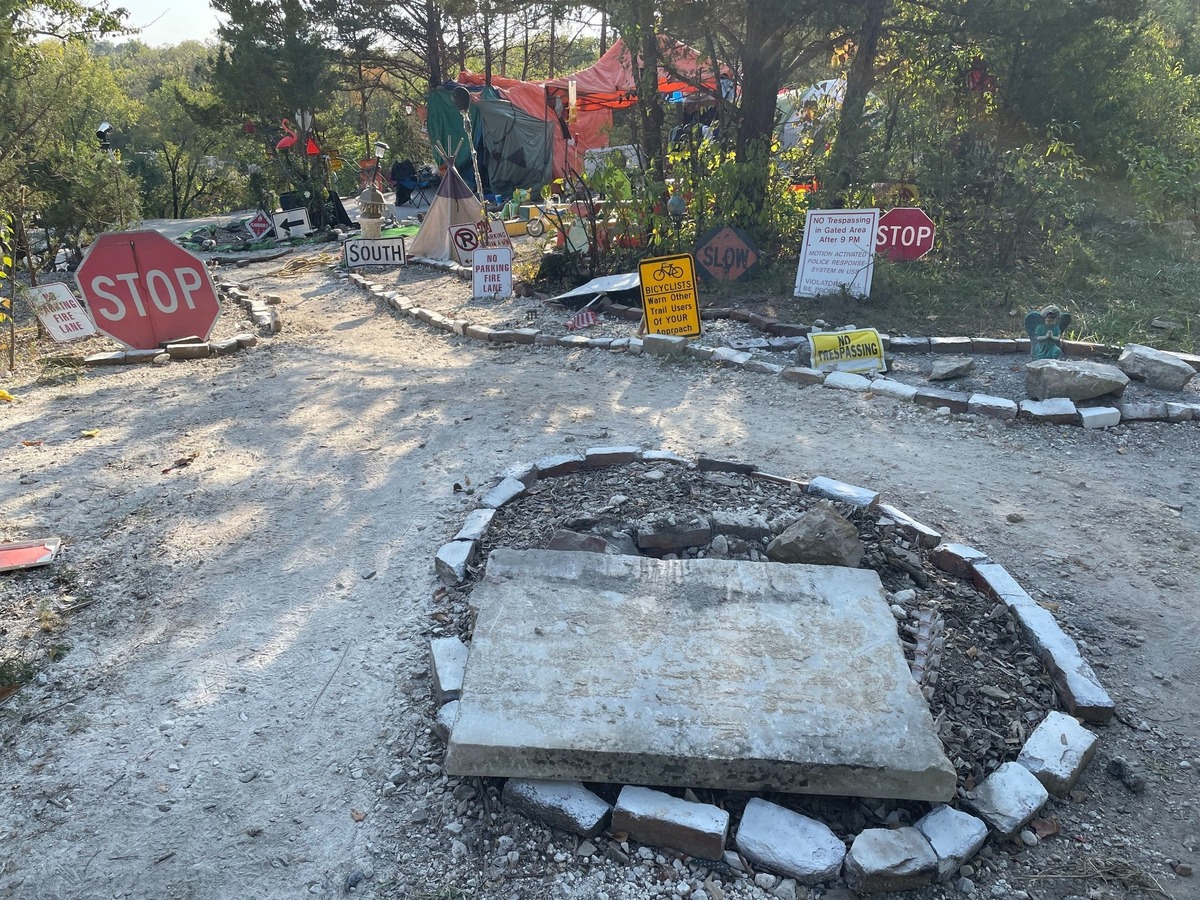
At another encampment in south Kansas City, the environment is less chaotic. Signs are placed neatly around the entrance’s stone-lined path and further down, a line of clothing dries in the fall sunlight.
Four women converge in a communal area. One is eating a candy apple, others pass around a box of Cheez-Its.
Linda is 67. She worked as a forklift operator before retiring. She requested to use only her first name for privacy and safety reasons.
When her landlord died, the house Linda had lived in for more than five years was sold, and she had 30 days to vacate. She said she couldn’t find somewhere else affordable to live on short notice.
Without anywhere else to go, she bought a tent.
“It’s tough because I’m filthy all the time,” she said, noting that she washes up in a nearby creek. She said she wishes the city or an organization could provide portable showers.
Raccoons get into the women’s food, and rumors have spread about police clearing the encampment soon. When that happens she said, there is nowhere to go.
She’s thin. She says she has lost weight in the past nine months living outside. She’s at risk of becoming chronically homeless, though she’s hoping she can find housing before the winter.
“I didn’t choose to be homeless,” she said.
When Nick Allen, an outreach worker with the city, asks if any of the women have heard of a low-barrier shelter, they say no. He explains the concept as “come as you are.”
One of them replies, “Wow.”
“Well they should do it,” Linda says.
Will Kansas City build its promised shelter?
In January, a proposal for funding the low-barrier shelter through the nonprofit Hope Faith Ministries was accepted and Mayor Quinton Lucas introduced the ordinance.
But in April, the City Council scrapped the plan, in part because of resistance from neighbors near the proposed site in the Historic Northeast.
Negotiations re-started in August.
Assistant City Manager Melissa Kozakiewicz said the shelter will happen. The new plan will need to be approved by HUD, and then it will go to the City Council again. At this point, the number of beds and timeline remain unclear.
“Of course we’d like to move quickly,” she said.
Josh Henges, the city’s houseless prevention coordinator, said the cold weather shelter, expected to open in December, will have 300 low-barrier beds. In March, 100 beds are expected to remain available until the permanent shelter opens.
“Everybody knows Kansas City needs a low-barrier shelter,” he said.
This story was originally published October 14, 2024 at 1:00 PM.