
Activists have 6 big demands for KC’s bus system. Here’s what transit officials say
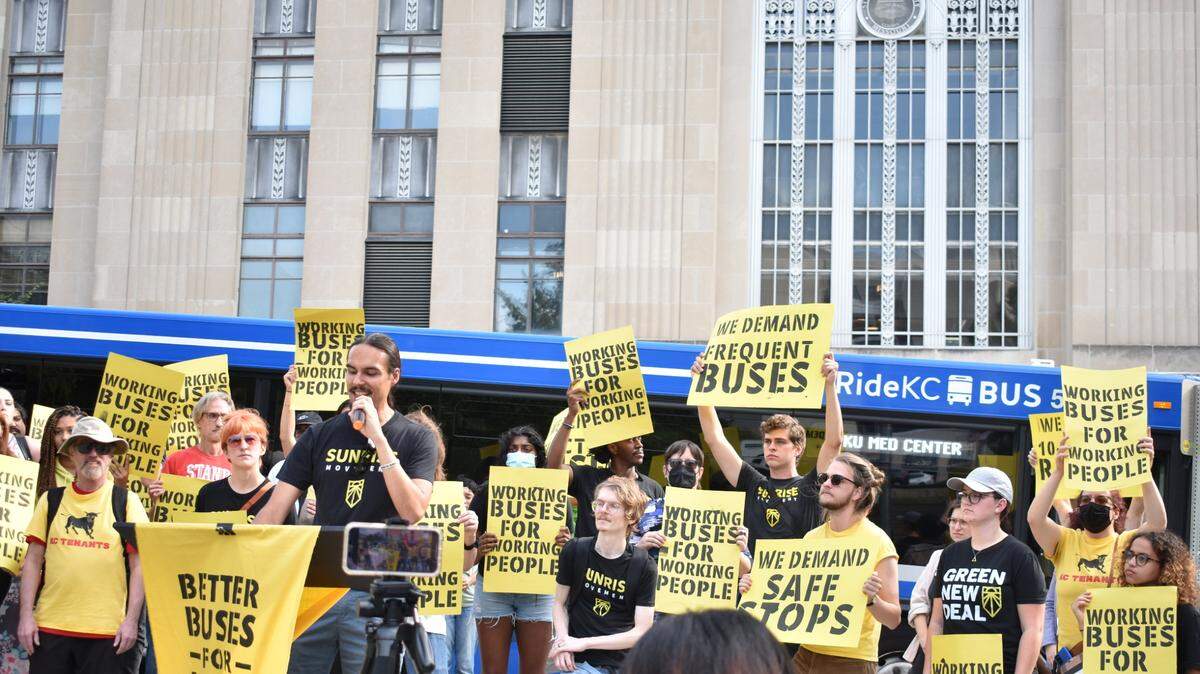
Kansas City activists are demanding improvements to the city’s public bus system in a new campaign called Better Buses for KC.
Around 60 people gathered in front of City Hall on Thursday to draw attention to the issue. The atmosphere was decidedly pro-bus: Some attendees cheered as city buses rolled past along East 11th Street.
More than half of those in attendance were organizers with the Kansas City chapter of the Sunrise Movement, a national youth-led environmental organization.
Speakers called on City Council to fund improvements like increasing bus frequency, adding new bus routes and stops, electrifying the city’s bus fleet and improving infrastructure like bus stop benches and shelters.
“We have a free option, but the reality is, if it’s not made reliable enough, then it doesn’t matter how free it is because people aren’t going to use it,” Sunrise Movement spokesperson Raymond Forstater told The Star.
An analysis by The Star of Kansas City’s bus system last summer found that many riders wait an hour of more for their buses, and that only 3% of Kansas City residents — 1% in the metro — use the bus to commute.
Organizers at last week’s rally argued that a more reliable bus system would improve residents’ access to jobs, medical care and other necessities as well as reducing air pollution by taking cars off the road. They also called for the city to continue bus system perks like free fare for riders and union jobs for employees.
The Star brought the campaign’s six demands to local union and Kansas City Area Transportation Authority (KCATA) officials to see what it would take to make them a reality. Here’s what we learned.
Better bus route coverage
Central to the campaign’s demands is bringing bus service into more city neighborhoods by increasing the number of bus lines. The group envisions a bus system wherein every Kansas City resident lives within a 10-minute walk of a bus stop.
“I was struck by the dichotomy of my experience living car-free downtown versus what I experienced on the East Side and the Northland,” said organizer Anthony Cunningham. “It can be feasible to live without a car in our city. The problem is, you have to live downtown or (in) Midtown to do so.”
Supporters called for an increase to east-west routes that connect the city’s residential neighborhoods to these more commercial areas. The city’s three major MAX bus lines, which claim to arrive every 10-15 minutes, currently only operate on north-south routes.
But the KCATA says this demand is unrealistic and would be inefficient in practice.
“With a land mass of 319 square miles, and a population of just more than 500,000, providing a 10-minute walk to a bus stop for every resident would be overwhelming,” spokesperson Cindy Baker told The Star. “Fixed route service is provided where there is more population density.”
She added that on-demand transportation services can be used to “fill in the gaps where a fixed route is not needed or efficient.”
Increased bus frequency
The majority of Kansas City’s regular bus lines arrive either every 30 or every 60 minutes, according to the KCATA’s route map.
Activists said that wait times average around 45 minutes, seriously hindering mobility for bus riders. The campaign plans to push for buses that come every 15 minutes on every line throughout the city.
Baker said this would require a “significant increase in investment in several areas,” including purchasing more buses and hiring more drivers and mechanics.
Back in May, as city leaders discussed preparations for being a 2026 World Cup host city, Mayor Quinton Lucas mentioned making transportation improvements before international visitors arrive. His proposal included improvements to the bus system.
Activists argued that this investment is long overdue.
“(Local leaders) agree that more investment in public transit is necessary. The problem is, it took a once-in-a-generation type of event in the World Cup to spawn these conversations,” Cunningham added. “(That) signals that our city leaders are only willing to prioritize transit for tourists, and not their everyday citizens.”
Improved bus stop infrastructure
Kansas City’s bus stops vary widely in quality, a feature KCATA says depends on ridership.
While some stops, like the ones at the intersection of 31st Street and Troost Avenue, have features like benches, trash cans, shelters and foliage, many stops throughout the city are merely a sign on a pole. Some don’t even have sidewalks around them.
Organizers are calling for all of the city’s bus stops to have sidewalks, benches and real-time transit information. KCATA said that this infrastructure comes at a steep price — one that doesn’t disappear once the construction is complete.
“Every shelter (costs) approximately $20,000, but maintaining that shelter and corresponding amenities is about $5,000 per year, per shelter,” Baker told The Star.
“While federal funds can be used to purchase the capital investment, federal funds cannot be used to maintain them, such as power washing, trash removal (and) repairing vandalism.”
That means at least some of the funding for improved stops would fall on the City Council, which organizers hope will listen to their demands. The campaign is currently gathering signatures of support from residents, with a goal of reaching 1,000 supporters.
Electrification of the city’s bus fleet
Sunrise Movement hopes to pressure KCATA to electrify the city’s bus fleet — something the city’s Climate Protection and Resiliency Plan also calls for.
But while KCATA has made some steps in the direction of electrification, only three city buses currently run on 100% electricity. Some others use compressed natural gas, which still produces greenhouse gas emissions.
Several factors stand in the way of an all-electric bus fleet, including the 2-year lead time and $1.2 million price tag to purchase just one all-electric bus, Baker told The Star.
“There are also operational considerations… for example, how far they can travel on a charge in Kansas City’s terrain and extremes in weather,” she said. “That data is still being gathered and will impact future decisions.”
She added that KCATA hopes to have 25 zero-emissions buses on the roads by 2027.
While battery-powered zero-emissions buses would reduce air pollution along their routes, much of the electricity used in the Kansas City area still comes from fossil fuels like coal and natural gas.
The Sunrise Movement and other local environmental groups are pushing to change that — but a switch to renewables will likely take far longer than the group’s ambitious 2025 goal.
Unionized bus system jobs
Local 1287 of the national Amalgamated Transit Union (ATU) represents bus operators and other transit employees in the Kansas City area.
But Sherrita Jackson, the local’s financial secretary, told The Star that she has seen a decline in union participation and an uptick in contracted work during her time with the KCATA.
“When I started over 20 years ago, the union controlled all the employees,” she said. “But when (the) Janus (Supreme Court decision) came in, it slowly started slipping away. They don’t have to have (new employees) be a part of the union. I believe the company did think it was easier to be able to contract work out.”
“Janus” refers to Janus vs. AFSCME, a 2018 Supreme Court decision stating that public employees cannot be compelled to pay union dues as a condition of their employment.
Jackson told The Star that while most KCATA employees in Kansas City still choose to be dues-paying union members, many in other areas do not. For example, only around one third of the 70 KCATA bus operators based in Johnson County have chosen to join Local 1287.
Activists with the Better Buses for KC campaign can’t force individual bus system employees to become official union members. Instead, they may pressure KCATA to directly employ more of its workers rather than contracting other companies to provide non-unionized labor.
Permanent free fare for riders
Kansas City’s free bus fare is a perk that activists support — and want to enshrine in the bus system permanently.
“A lot of folks are scared about zero fare doing away,” Forstater said. “Every time we go out to talk to bus riders, there are folks that are hearing rumors about when it’s going to be taken away.”
The KCATA didn’t comment on whether the funding source for free fares is at risk of depleting, but added that it is conducting a study this year to “evaluate the long-term impact of zero fare.” It expects results by the end of this year.
“At this point in time, zero fare will be available for the foreseeable future,” Baker wrote.
Not everyone is totally in favor of the free fares. Jackson with Local 1287 told The Star that assaults against bus drivers are on the rise, making employee retention a major challenge. She suggested that free fares have led to some residents using the buses for shelter rather than transportation.
Forstater responded that the Sunrise Movement envisions a bus system where driver safety and affordability for riders don’t have to exist in conflict — but that city leaders will need to step up in order to make it a reality.
Do you have more questions about transportation or green initiatives in Kansas City? Ask the Service Journalism team at kcq@kcstar.com.
.jpg)