One Johnson County city is trying out composting. Could it spread across Kansas City?
READ MORE
Let’s talk trash
Readers across the Kansas City metro kept asking us about trash: Is recycling really recycled? What’s up with all the trash on the highways? And where does our trash actually go when we throw it away? We’re digging in — literally.
Expand All
Editor’s note: This story is part of The Star’s series “Talking Trash.” All of the stories were inspired by questions and concerns we heard from Kansas Citians through listening sessions, an online callout and other conversations in our community. Stories will run throughout the spring, and you can find them all here. You can share thoughts in the form at the bottom of this story, or email kcq@kcstar.com.
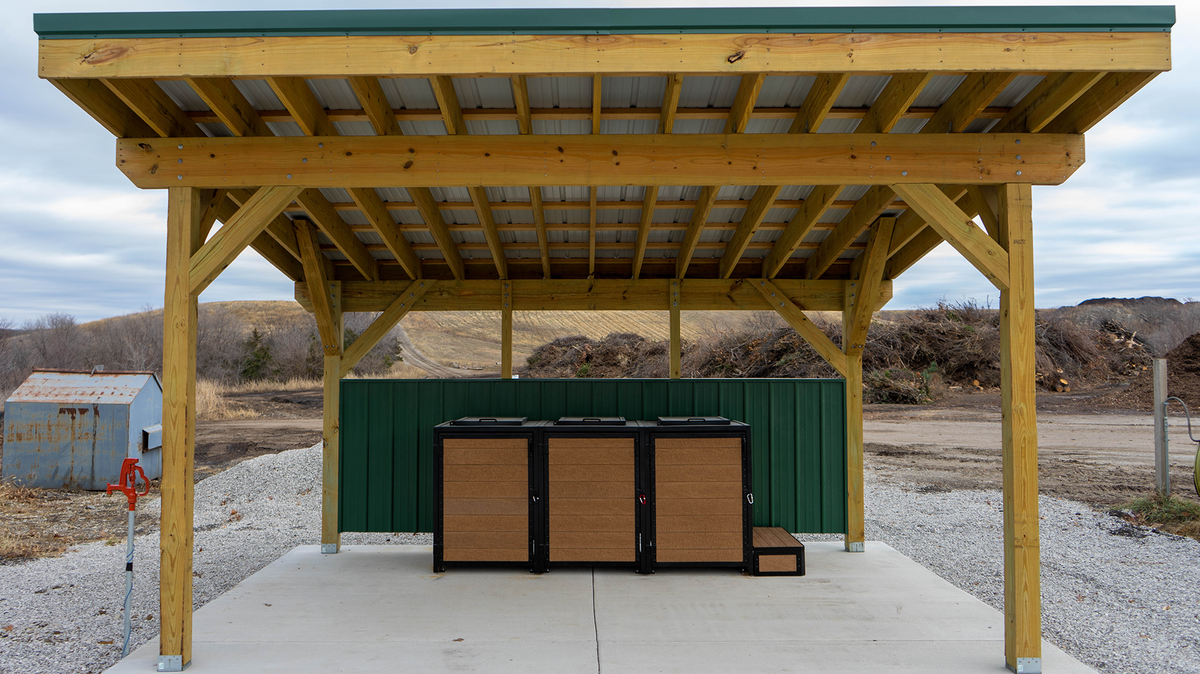
The city of Olathe will officially launch its compost dropoff program in the coming days, offering free disposal of food scraps to city residents at its multipurpose dropoff site at 1100 N. Hedge Lane.
Olathe residents can stop by during the site’s open hours to dispose of any food waste, from meat and bones to eggshells, dairy products, produce scraps and processed foods. Residents simply deposit their scraps into one of the three 95-gallon trash bins housed inside a wooden corral.
When The Star asked what questions readers had about trash around the metro, many people expressed enthusiasm and curiosity about city-run composting initiatives. While many municipalities collect yard waste to be composted, Olathe is the first in the metro to add food scraps to its dropoff options.
The program has been in its pilot phase since January, and feedback has been overwhelmingly positive, said Clayton Duffin, the city’s assistant solid waste manager.
“I think it’s pretty obvious it’s going to grow,” he said. “How fast it’s going to grow is going to be the question.”
Olathe isn’t alone in exploring the benefits of city-run composting. Kansas City has bold plans to launch a similar program this summer, with 12 dropoff sites planned around the city.
How does composting benefit the metro?
If you leave a head of lettuce out on the counter, it’ll start rotting away within a week or less. But when that same head of lettuce ends up in the super-compressed environment of a landfill, it can take up to 25 years to decay.
This drawn-out rotting process happens in the absence of fresh air, causing it to produce methane: one of the most potent greenhouse gasses that contributes to global warming.
Composting adds air back into the equation and speeds up the decay process. This both prevents the production of methane gas and turns the food waste back into nutrient-rich soil that can be used in gardens, parks and farms.
Indiana University estimates that around 28% of the waste we send to the landfill could be composted instead. That adds up to a lot of landfill space saved as well as lighter, cleaner trash bags for residents.
Enthusiastic composters can process their food scraps at home using an outdoor compost pile or a carefully tended indoor bin. But most residents don’t have the space, know-how or resources to do it themselves. That’s why the demand for dropoff and curbside composting programs has taken off in recent years.
Cities like San Antonio and Los Angeles already have municipal composting programs up and running. Olathe is just the latest to join this growing crowd — and Kansas City may not be far behind.
What happens to Olathe’s food scraps?
The city of Olathe is a unique example in the Kansas City area of a city that handles almost all of its solid waste disposal in-house. For now, food scraps are the exception: The dropoff bins are emptied three times a week by Missouri Organic Recycling, a local processing facility that turns organic waste like food scraps, tree limbs and yard waste into mulch and compost.
Olathe charges residents a flat fee of just over $20 per household per month for all solid waste services. These include trash and recycling pickup, yard waste pickup, free hazardous waste and food waste dropoff, and free compost from its in-house yard waste composting program.
“If (composting) weren’t an option, that same material would then be going into the regular trash and it would be run through our transfer station where a fee would still be incurred,” Duffin said. “We’re just paying (Missouri Organic Recycling) the fee to haul away and process it in a much more environmentally friendly way.”
Duffin told The Star that its current composting operation doesn’t have the necessary permits to process a large volume of food waste itself — but that the city might consider getting them in the future.
“If it got that big and the city was able to cite an appropriate location that we could permit correctly, that would be the ideal way to handle it: in-house,” he said.
What’s next for the composting program?
Currently, Olathe’s dropoff program collects several hundred pounds of food scraps per week. That’s a drop in the bucket compared to its in-house yard waste composting program, which Duffin says processes 20,000 tons of brush, leaves, lumber and garden clippings every year.
But the enthusiasm for food waste composting, coupled with the extremely low levels of contamination in the dropoff bins, has him hopeful that the program will soon outgrow its single collection site.
“A lot of the big questions coming from the public are, when do we plan to expand? Or, when can we add another drop off site on the other side of town?” Duffin said.
While the city doesn’t have any current plans to add a second dropoff site, he added that internal conversations are brewing around a mobile dropoff site at farmers’ markets. This single-bin service could travel around the city — and potentially raise awareness about the program.
Are other cities in the metro launching composting programs?
We heard from a handful of readers in the metro wondering whether city-run composting is in Kansas City’s future.
“So many other local governments (not to mention entire countries!) have figured out how to adequately incorporate composting into their waste services — why can’t Kansas City?” reader Melissa Hollon wrote in an email to The Star. “I’d love to see city sponsored composting offered here.”
It appears the city is listening. Public Works Director Michael Shaw told The Star that Kansas City has the funding in place to roll out a compost dropoff pilot program as soon as this summer.
“What that program is going to allow us to do is to purchase kiosks systems, and establish in 12 different locations, kiosks where people can come by and drop off their compost free,” Shaw said. “We wanted to avoid (charging) fees, because those are kind of barriers to entry. We wanted to make them free drop offs to get the conversation started.”
The details of the program aren’t public yet, but we’ll follow up when we know more.
Is curbside compost pickup in the metro’s future?
Reader Nathan Smith of southeastern Kansas City used to do his own composting in his backyard, but found it inconvenient. He now subscribes to a private curbside compost service, but wonders whether the city is considering its own curbside program.
“If more of our neighbors composted, perhaps it would make economic and environmental sense to have a truck come every week,” he wrote in an email to The Star.
Duffin predicts that city-run curbside composting will come to the Kansas City area eventually — but that this option is farther down the road.
Several small curbside composting services do already exist in the metro, including Compost Collective KC in Missouri, Food Cycle KC in Kansas Compost Connection, which only handles yard waste.
Although their reaches are limited, a growing appetite for composting may give rise to new curbside options: Duffin says it’s just a matter of logistics and time.
“You would need a whole other fleet of trucks, you would need a whole other group of drivers,” he said. “There’d be a lot more staff, a lot more equipment. And logistically, where are you going to haul it? If there’s only one processor in the region, that’s very limiting.”
But these barriers aren’t insurmountable — coastal states like California have mandated composting for organic waste, and Duffin says interest has grown significantly in the Kansas City area in recent years.
“Personally, I see the writing on the wall,” Duffin told The Star. “It’s only a matter of time, I think, before it comes in this way. It might not be for years, but I think it’ll happen.”
Do you have more questions about composting in Kansas City? Ask the Service Journalism team at kcq@kcstar.com.
This story was originally published May 10, 2023 at 6:30 AM.
.jpg)