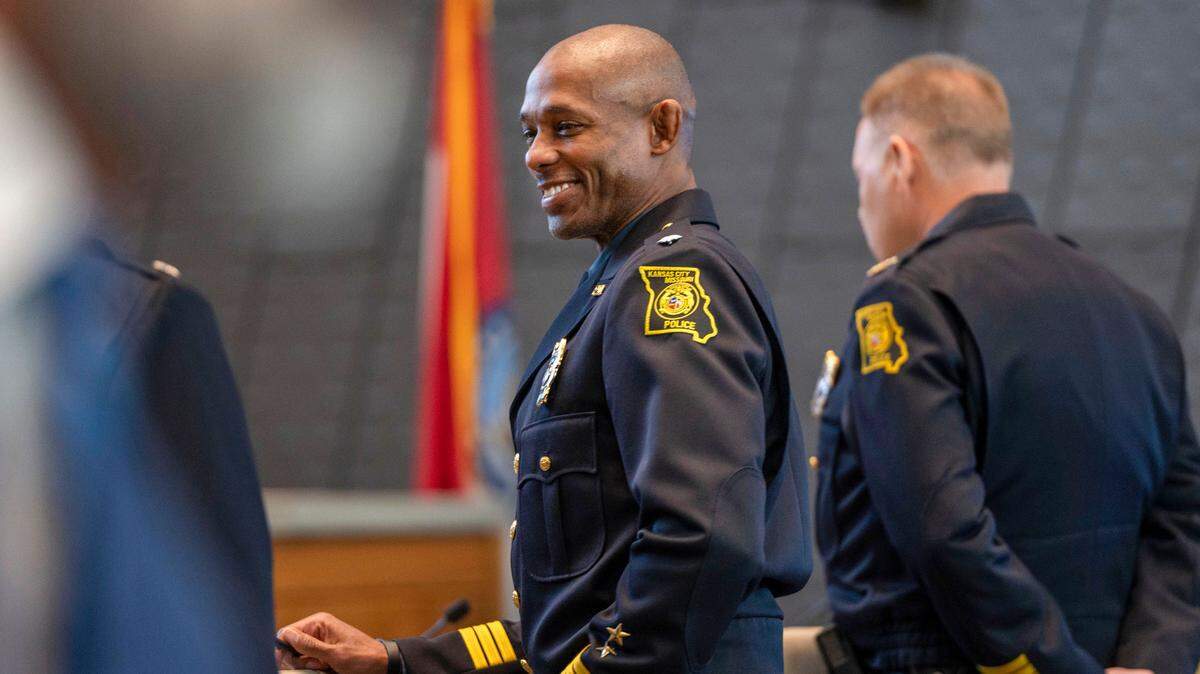
‘A daunting task’: Can interim Kansas City Police Chief Joe Mabin heal community wounds?
READ MORE
KC Interim Police Chief Joe Mabin hopes to rebuild trust
22-year veteran Joe Mabin was appointed the interim Kansas City police chief in April.
His challenge for his brief time leading the KCPD? Bridging the enormous chasm between the police force and the various communities it serves.
Expand All
On an unseasonably cool but sunny weekday morning, Kansas City’s top cop and Jackson County’s leading prosecutor went knocking on the doors of some of the city’s prolific criminals, those known for settling scores with gunfire.
Interim Police Chief Joseph Mabin and Prosecutor Jean Peters Baker spent three hours that day relaying the message: “We know what you’ve been up to. You are important to us. We really want you to choose a different path.”
It was reminiscent of years earlier when Mabin worked alongside Baker as part of the Kansas City No Violence Alliance, or NoVA, a crime-fighting initiative credited at the time for a sharp reduction in the city’s ongoing homicide problem.
The year NoVa was implemented in 2014, the number of killings in Kansas City dipped to a historic low of 86, the fewest in decades. The program focused on violent offenders in an effort to reduce crime by offering them help in finding jobs, getting an education and other assistance.
But by 2019, the program had been all but abandoned by Rick Smith, who inherited NoVA when he became chief but never fully embraced the effort. He pulled officers and other resources from the program, and homicides in Kansas City began to climb to new historic levels.
The recent morning stood out not only because it hearkened back to that program, but it also was a stark demonstration of how leadership of the department had changed in a short time. And it offered a glimpse of how residents say they hope the department will operate under a new chief.
In a series of recent forums, Kansas City residents said they hoped a new chief would be more transparent, focus on building community trust and have a clear crime-fighting strategy.
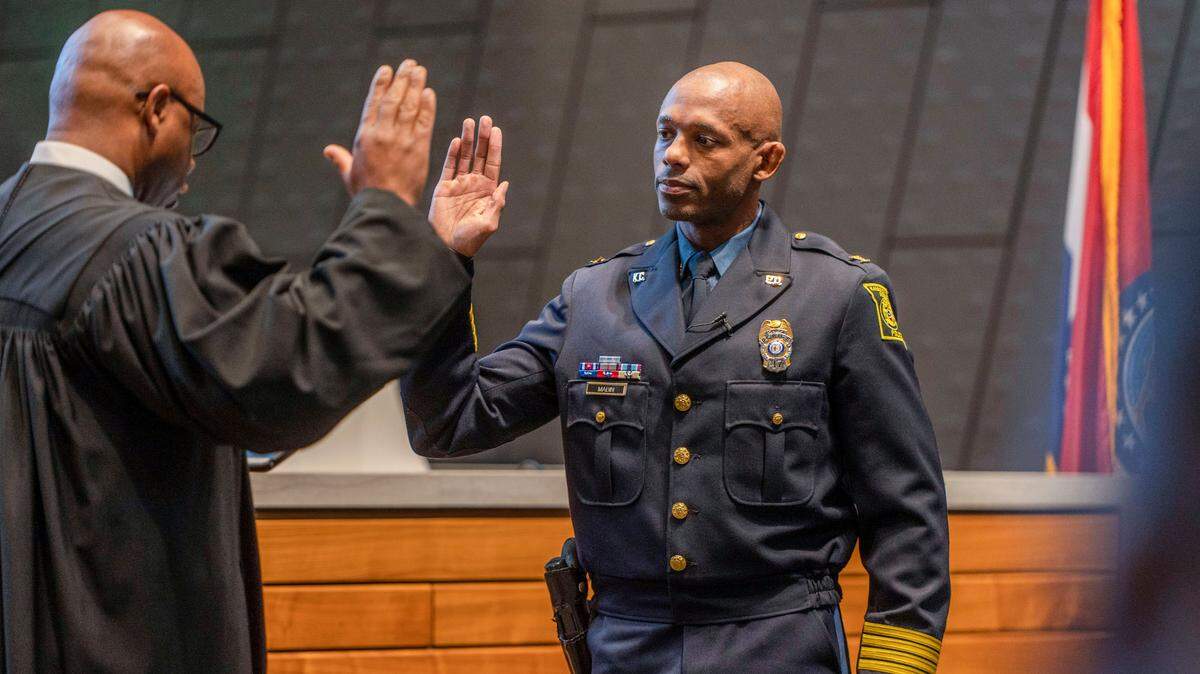
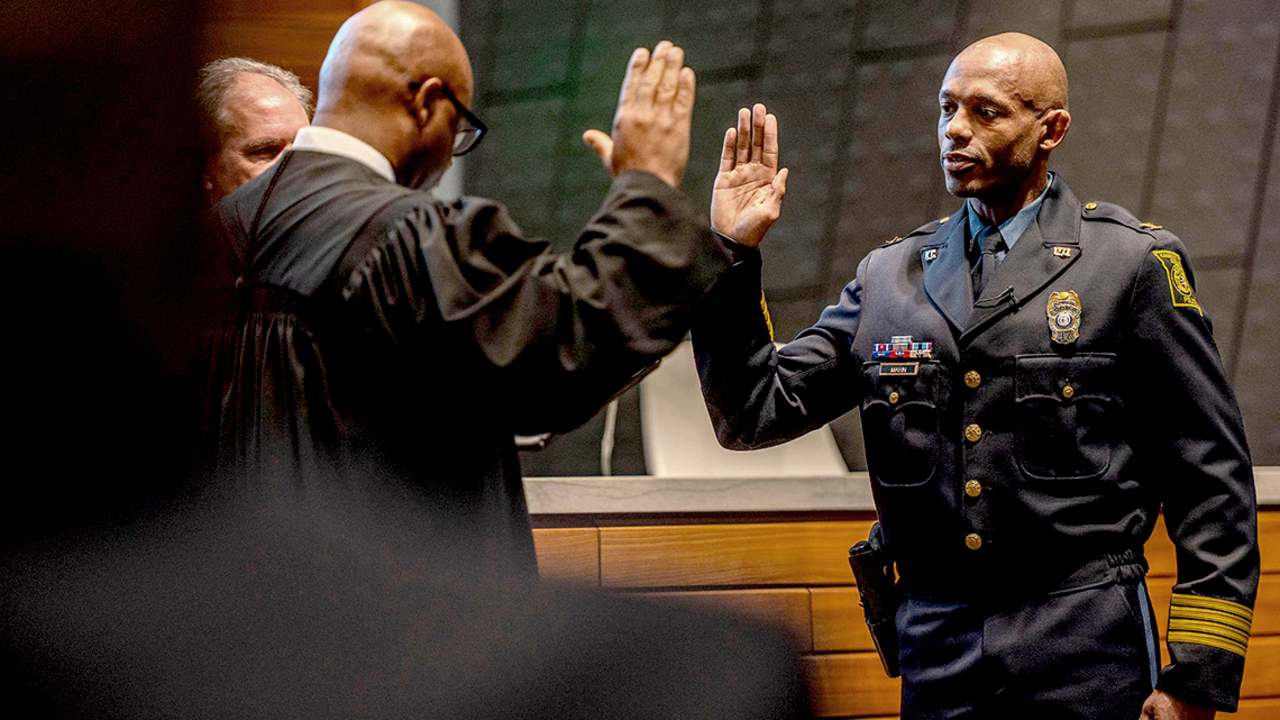
Since he was sworn in as interim chief April 22, Mabin has attended community meetings, listened to complaints about neighborhood drug houses and promised transparency to onlookers at the scene of a recent officer-involved shooting.
Yet Mabin also has found time to visit the city’s police academy, where he offered encouragement to a crew of officer cadets and then joined them as they did push-ups, pull-ups and raced around the track — all while he wore a weighted Crossfit vest.
Now given the task of keeping the department on track while the police board conducts a national search for a new chief, Mabin said his goals for the department are to “work on reducing violent crimes, building trust and strengthening relationships in the community.”
“One of the ways is to be available and be out in the community,” Mabin said in a nearly hour-long interview with The Star. “Meeting with folks and listening to their concerns ... and have a level of trust and the only way you can do that is by meeting with folks and being available to folks.”
Gwen Grant, president/CEO of the Urban League of Greater Kansas City, said while the next chief faces a number of significant challenges, the plan that Mabin has laid out is “laudable.”
“Community trust and authentic relationships are essential elements in the department’s ability to reduce crime,” she said. “The important question, however, is what will be his approach? I can’t recall a time when there was broadscale community trust in KCPD. Therefore, he has a daunting task ahead.”
The Kansas City police board selected Mabin, a 22-year veteran, after Smith retired following nearly five tumultuous years at the helm.
Mabin leads the 1,685-employee police department at a time when the city is again experiencing a spike in homicides, gun and street violence. For the past three years, the city has averaged about 160 homicides and solved just over half of them, Baker said recently.
Many view Mabin’s job, albeit a brief one, as bridging the enormous chasm between the police force and the various communities it serves.
“A restart needs to happen with the community,” Baker said. “He’s going to bring a willingness to say, ‘Hi, I’m Joe Mabin, who are you? Tell me about yourself. Tell me about your neighborhood.’”
Baker was among a number of elected officials, civil rights leaders and community activists who told The Star that while it is too early to assess Mabin’s job performance, they remain hopeful and optimistic about what he will accomplish in his interim role.
“He’s somebody who listens,” Mayor Quinton Lucas said. “He’s not a man of many words, but each word is considered and well judged, and I think reflects an understanding of our community.
“He’s a good man, who I think is a damn good officer and I think is leading us through what is a fraught and challenging time and is doing pretty darn well.”
Known to many outside and inside the police department for his quiet, congenial and often reserved demeanor, Mabin offers a sharp contrast to his predecessor.
Cut in the mold of the rank-and-file officer, Smith was often described as rigid, quick-tempered and resistant to the change that hundreds who took to the streets in protests over police tactics demanded.
During his tenure, Smith defended officers accused of using excessive force against Black citizens and an officer indicted and later convicted in the fatal shooting of a Black man.
Under Smith, the police department did implement some reforms called for in 2020 by protesters. They included turning over police shooting investigations to the Missouri Highway Patrol and securing funding for body cameras.
But critics such as Grant say those policy changes are only a start and more needs to be done.
“Building community trust will require Interim Chief Mabin to try to change KCPD’s culture, of which he has been a part, while at the same time demonstrating to our community that KCPD will be transparent, and officers will be held accountable when they violate a person’s rights under the law,” she said. “Anything short of that will appear disingenuous.”
The call to serve
Mabin didn’t start in law enforcement. By 1999, he had eased into the rhythm of serving as an assistant project manager for Walton Construction. But he felt the tug of a different career path.
He had graduated from Rockhurst High School in 1993 and later attended Florida Agricultural & Mechanical University, an historically Black university in Tallahassee, Fla., where he earned an undergraduate degree in business administration.
But Mabin said his family has a history of public service. Several of his relatives have served in the military, law enforcement and other areas. So deciding to become a police officer wasn’t much of a stretch.
Yet, those who have known Mabin over the years were caught a bit off guard by his decision to become a cop.
“I didn’t see it coming when we were in college,” said Kevin Vertreese, Mabin’s college roommate. “But now that I’ve seen it, it definitely seems to make sense. I mean, just because I think part of his personality is that desire to help others.”
It was the urge to serve others that Mabin said compelled him to leave Walton Construction and join the police force as an entrant officer in November 2000.
Fresh out of the police academy, Mabin was assigned to the Central Patrol Division. He later worked with youth while assigned to the Police Athletic League and then moved to Internal Affairs.
Mabin ascended through the ranks when he was promoted to sergeant in 2007 and worked stints at the Metro Patrol Division, the homicide unit, the street crimes undercover squad and the violent crimes intelligence squad.
By 2016, Mabin was promoted to the rank of captain, where he oversaw the robbery and training units. Four years later in 2020, he was promoted to major and spent a year commanding the Shoal Creek Patrol Division in the Northland before assuming command of the Violent Crimes Division.
The next year, Smith selected Mabin to become one of five deputy police chiefs. Before being appointed interim chief, Mabin was responsible for the investigations bureau, which consists of the violent crimes division, among others.
Weeks before he was appointed interim chief Mabin graduated from the FBI National Academy in Quantico, Virginia.
Mabin said he attended the academy to study with other law enforcement executives and prepare him for the opportunity to lead the Kansas City police force.
“I appreciate the board placing their trust in me to do so,” he said. “I think some of my knowledge, skills, abilities, some of the training, experience I’ve had in the past has led me to be available for this position.”
Challenges ahead
The department faces many challenges, both externally and from within its own ranks.
A yearlong Star investigation into racism within the police department, published earlier this year, revealed that Black officers were called racist slurs including the N-word and were disciplined more harshly than their white peers, leading to a police force that has fewer Black officers today than it did decades ago.
Mabin acknowledged that the department has been hampered by racism, saying, “any institution in America will particularly have an issue with bias inside its ranks. I think we do a good job in front screening that out in our hiring process. But obviously, no program is perfect.”
Former Kansas City Police Chief Darryl Forté said the police board made a wise decision in selecting Mabin as interim chief, but everyone should temper what will be the immediate impact.
“I have a lot of respect for him. He walked into a situation where I think some people think he’s going to change the world in 30 days but it’s a process,” Forté said.
Bald, muscular, lean and tatted, Mabin is also known for his athletic prowess and has traded boxing jabs and grappled during mixed martial arts matches.
Mabin, 47, who is married and has a daughter, recently completed the New York City marathon in 3:55:01.
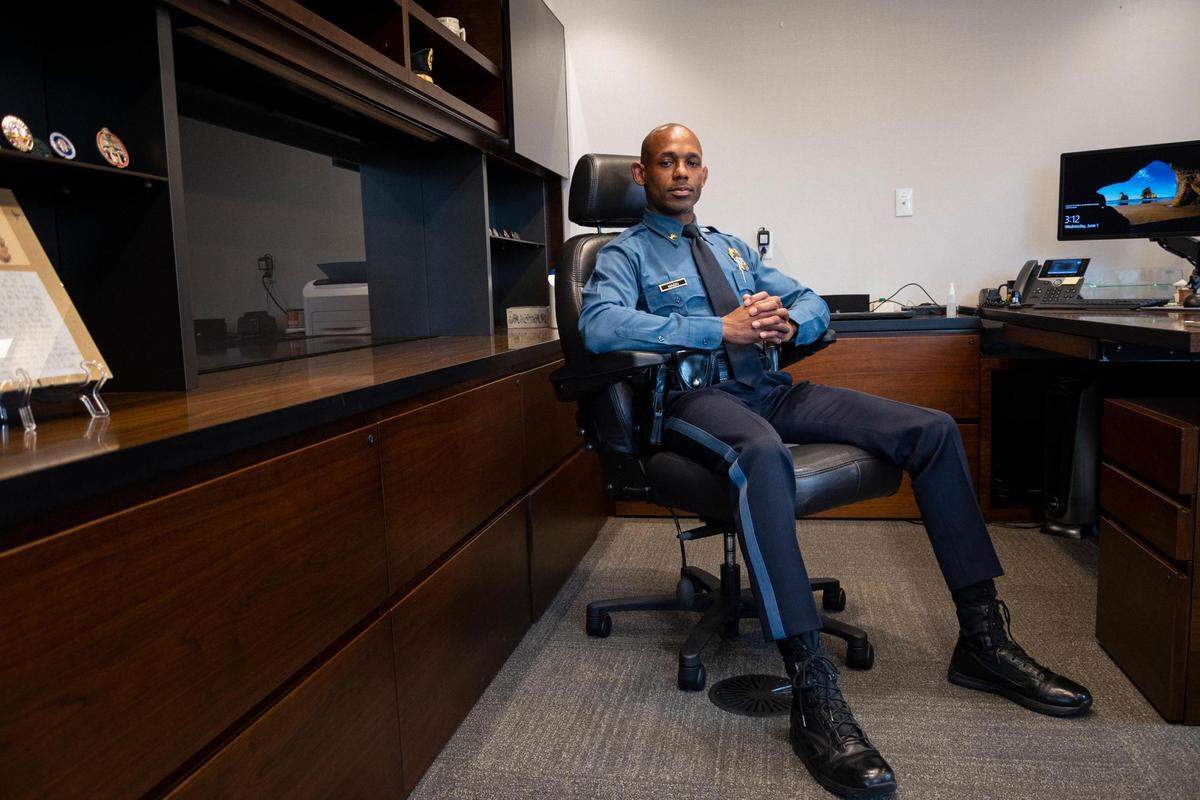
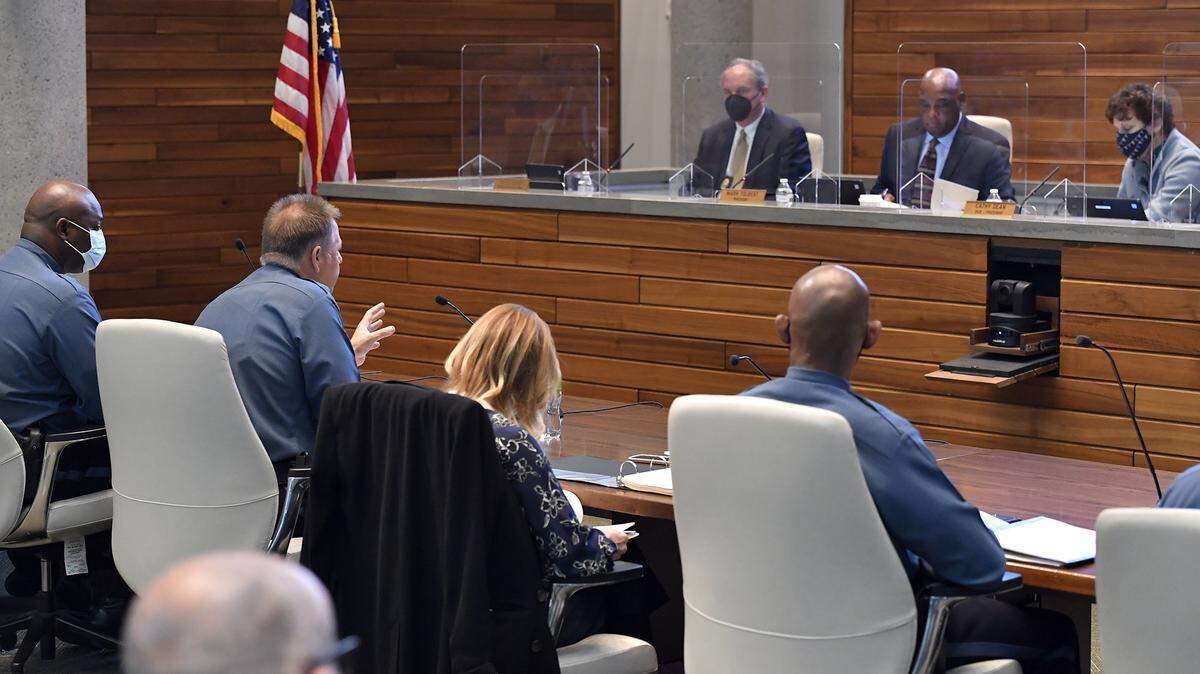
He’ll need that endurance because the police board hasn’t set a timetable on when they will pick a new chief. Board president Mark Tolbert has said it could take up to a year before they make their choice.
Recently, the board voted to hire Public Sector Search & Consultants, the only firm to submit a bid to help the board identify a slate of candidates for the job. Mabin said he’s not going to apply for the permanent job.
A number of current and former KCPD commanders have expressed their interest in becoming the next chief.
In the meantime, police and city leaders look to Mabin to provide a much-needed calm and steady hand.
Police Commissioner Dawn Cramer said “Mabin is a very strong leader who will lead with transparency and integrity. He is an excellent mix of being a great listener and being willing to speak up. He is passionate about making a difference ...”
Unrealistic expectations?
Among the criticisms leveled against Smith was that he seldom attended meetings on the city’s East Side. Smith’s habit, many have said, was that he only accepted invitations from those who supported his initiatives.
Kansas City Councilwoman Melissa Robinson, who represents the Third District, which is roughly bound by Independence Avenue to Blue Parkway and from the Paseo to Noland Road, said Smith frequently dispatched one of his commanders anytime she invited him to one of her neighborhood meetings.
Soon after his appointment, Mabin made a favorable impression on Robinson and others when he showed up at a meeting of city department managers in the Third District.
“He was responsive. He was engaging with the community. It was refreshing,” Robinson said. “I wanted to do some cartwheels when I saw Chief Mabin there. The community folks there were beaming.”
But Robinson said participating in neighborhood meetings alone will not solve the problems of gun violence that has for too long plagued her constituents who live in the most vulnerable portions of the urban core.
Sheryl Ferguson, with It’s Time 4 Justice, echoed the sentiment.
“I’m hoping that he’ll make such strong efforts to heal the community ties that whoever comes in as a full replacement will not be able to undo the policies that he can create,” said Ferguson, who has frequently attended the monthly police board meeting and has been a fierce critic of the department.
“But we have yet to see if he swings the pendulum in the other direction. Under Smith’s tenure there was a definite war towards the Black community.”
Damon Daniel, president of the AdHoc Group Against Crime, said repairing long-existing fractured relationships between the department and many pockets of the urban core might not be a realistic or attainable goal for Mabin or any interim chief.
“Communities of color have been treated unjustly and over-policed for centuries,” Daniel said. “Someone in a temporary position will never gain enough traction to peel back the historic layers of trauma and distrust that exist. There won’t be any improvement with solving homicides if trust is not improved.”
Instead, Daniel said, Mabin should focus his efforts on diversifying the department by focusing not only on recruitment efforts, but looking at changing specific practices that have been designed to weed people out.
Improved training for his command officers would help, Daniel said, by actually developing specific courses that involve leadership development, supervisor and management training.
“This will help with promoting more people of color for those positions,” he said.
Hopeful for ‘repair’
As Mabin continued to make the rounds on a recent weekend, he attended an assortment of community events that included working alongside Baker, picking up trash in the Washington-Wheatley neighborhood, visiting a gun reform rally and the city’s PrideFest events.
Mending the tattered relations between the Jackson County prosecutor’s office and the police department also appears to be underway.
Under Smith, the police department refused to provide Baker’s office with the probable cause statements in potential criminal cases that involved police officers.
This was highlighted in the 2019 police shooting death of Cameron Lamb. In announcing criminal charges, Baker said her office was “stymied” because the police department refused to issue a probable cause statement in the fatal shooting.
Just recently, Mabin and his commanders met with Baker and her team, ironed out the rough patches and agreed to work together.
The tension also made it difficult for prosecutors to get witnesses to come forward.
“It’s been hard watching the harm that’s been done,” Baker said. “So I’m just hopeful. I’m just hopeful that what’s ahead is a repair. It’s a time of repair and hopefully, and hopefully, a reduction of violence.”
This story was originally published July 10, 2022 at 5:00 AM.