
Soaring gas bills are straining Kansas City home budgets. Are more hikes on the way?
READ MORE
Heating bill increases cause financial strain in Kansas City
Spire and Kansas Gas Service customers in the Kansas City area are struggling to pay for gas with price and rate increases this year.
Expand All
Soaring gas bills are straining Kansas City home budgets. Are more hikes on the way?
What are you paying for? These taxes and charges determine your gas bill in Kansas City
Looking for help on your gas bill in Kansas City? These relief programs could come through
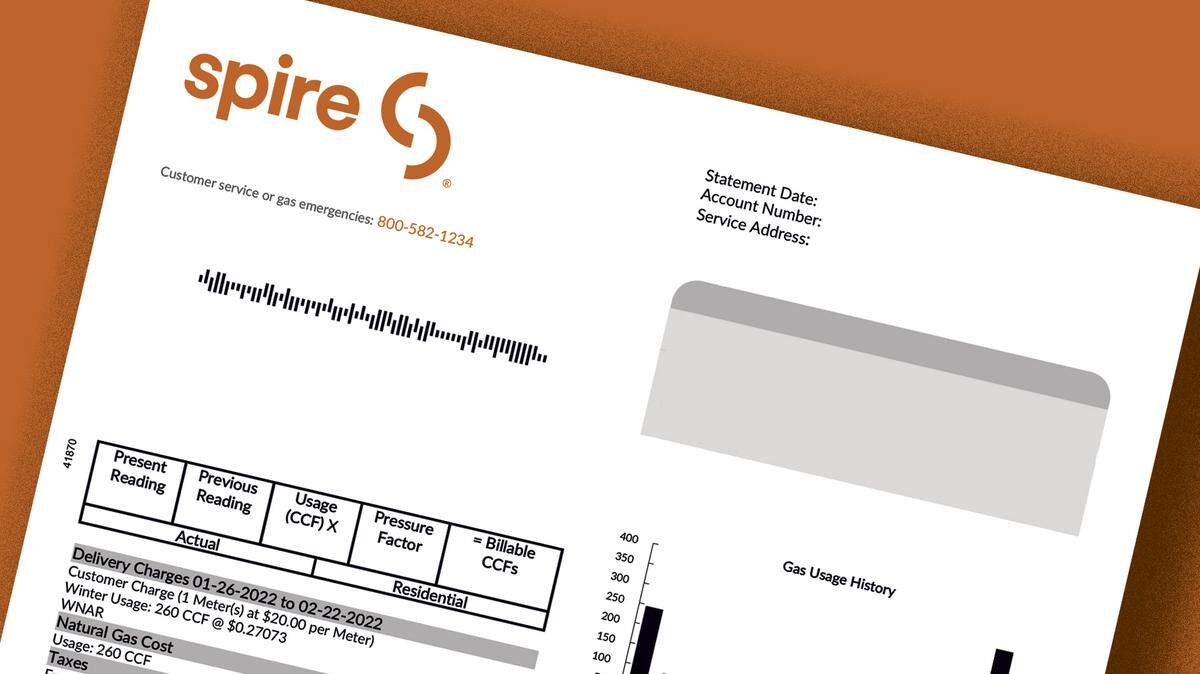
Confused by all the charges on your gas bill? Here’s a line-by-line explanation

Soaring natural gas bills compound Kansas City family’s financial worries
When Kelly Chesley opened her Spire Energy bill this January, her first thought was that she must have somehow missed months of payments. Her bill, usually around $90 in the coldest months of the winter, had ballooned to nearly $400.
But it wasn’t a mistake: The sky-high bill was just for the natural gas her family used in late December and early January. Multiple rate increases by Spire Energy had made the gas prohibitively expensive — and added another burden to the household’s already precarious finances.
“Essentially what we’ve been doing is just overdrafting our account to make ends meet and to make sure that our kids have groceries,” Chesley said. Since her husband lost his job at the beginning of the pandemic, the couple has delayed paying utility bills, applied unsuccessfully for food stamps and put off buying necessities like shampoo and deodorant in order to get by.
“It’s not a good feeling to feel worried about basic human necessities like staying warm,” Chesley told The Star. She now keeps her house at 65°F during the daytime to keep costs low. On the second floor, which is heated by electricity, her two young children play in front of space heaters to keep warm.
The Chesleys are not alone. Seventy people from both sides of the state line contacted The Star in recent weeks to tell us about skyrocketing natural gas bills that are straining their families’ budgets. The rate increases reflect the steadily rising wholesale price of natural gas, the lingering impacts of last year’s Winter Storm Uri and policy decisions by Spire Energy and other natural gas monopolies in the Kansas City area.
Our analysis revealed that customers’ bills are rising at a higher rate than Spire Energy predicted they would as a result of these recent changes — and more rate increases are on the horizon for residents in both Kansas and Missouri. Here’s what we found.
How much have natural gas bills increased?
In a November 2021 letter to the Missouri Public Services Commission (MPSC), which regulates utility monopolies in the state, Spire Energy predicted that customers would see a 42% increase on their natural gas bills over the course of this year. Another recent rate change was supposed to raise bills by just 2.8%. We’re only a few months into 2022, but it’s already looking like those predictions fall far short of reality.
Data collected by The Star shows that Kansas City customers in Missouri paid around 68% more on this January’s bill than on last January’s bill, despite using around 3% less natural gas on average. Readers also spent around 60% more on this January’s bill than on last March’s bill, despite using around 7% less gas than they did during Winter Storm Uri in February of 2021.
The difference between bills in January and in December, which shocked Chesley and many others, was due in part to colder temperatures and higher natural gas usage. Missouri customers paid around 87% more in January 2022 than they did just the previous month, while using around 75% more natural gas.
BEHIND THE STORY
MOREAbout the data we used
The Star’s analysis of recent rate hikes’ impact is based on a self-selected sample of 70 readers who contacted us to share their experiences. Some testimony included copies of Spire bills or personal finance logs, while some did not. The Star did not independently verify readers’ gas bills or usage data.
Some readers provided anecdotal information or data that did not include the three bill changes The Star studied; they were not included in our calculations. Some readers provided information about their bill increases but not their corresponding changes in gas usage. Their data was included in our bill change calculations but omitted from our gas usage change calculations.
The small size and self-selection of this sample group means that it does not necessarily represent the experiences of all natural gas customers in Kansas City. However, common themes of surprise, frustration and financial anxiety were evident in all the responses we received.
Bills in Kansas have been rising as well — just not as abruptly. Two natural gas companies serve the Kansas side of the metro area: Kansas Gas Service covers Wyandotte County and some parts of Johnson County, while Atmos Energy provides gas to most of Johnson County. Both companies charge a rate that changes month by month to account for fluctuations in the natural gas market.
Some Kansas customers have seen recent bill increases, which are due to the rising wholesale price of natural gas. But they will soon see additional charges for the expenses their gas companies took on during Winter Storm Uri as well.
How are these bill increases impacting customers?
More than half of the 70 readers who contacted The Star about their gas bills said the increases have created financial hardship for their families. Thirteen people mentioned having to adjust their household budgets to keep paying for essentials like gasoline and groceries.
“I’m very frugal and I don’t have very much fluff built into my budget,” said reader John Vasquez, who lives alone in an apartment in the Longfellow neighborhood of Midtown. “I will plan meals that use cheaper and fewer ingredients that last longer. I will plan errands and events around making my mileage most efficient.”
Vasquez told The Star that it has been months since he felt comfortable in his own home. His thermostat almost always stays off, even when that means an indoor temperature below 60°F. But despite relying on electric space heaters to stay warm, his bills still rose this winter. Vasquez paid around 43% more on this January’s bill than on his highest bill last year, despite using around 15% less gas than he did then.
He wasn’t the only reader who mentioned reconsidering his own comfort indoors in order to avoid high heating costs.
“We have a 1-year-old and cannot afford to not use the heat,” said reader Benjamin Gray of Lee’s Summit. Gray’s income alone currently supports his household as his wife attends school and his baby attends daycare. He told The Star that the biggest challenge is not having any other way to heat the family’s three-bedroom home in the winter.
“I don’t mind being cold, but a baby does not have as many options,” he said. “[And] I know that if we struggle with it, others are as well.”
National studies show that higher utility rates disproportionately impact lower income residents, who already tend to pay a higher percentage of their income toward their utility bills. Around Kansas City, service providers that help people access utility assistance are seeing a growing demand for their help.
“I can see overall that there is an increased need for all types of assistance — utility and housing,” said Lynn Rose, vice president of Community Services League, a local organization that helps people access government aid.
Data reviewed by The Star shows that, as of Jan. 31 of this year, 139,293 Missouri households were behind on their Spire energy bills. The company shut off gas to 34,246 Missouri households in 2021 for nonpayment. While Missouri regulators prevent utility companies from doing this when the temperature is below 32°F, all it takes is one day above freezing for a shutoff to go into effect.
Spire urges customers to apply for utility assistance if they are struggling to make their bill payments. A few programs offer discounts or credit towards future payments, but most involve adjusting payment schedules and moving deadlines.
Chesley said she doesn’t find that approach helpful when considering her family’s tight finances.
“Any kind of program that’s just allowing you to pay it later, to me it’s not worth it,” she said. “It just increases my stress and makes us feel like we’re more indebted.”
Why have natural gas bills increased so much recently?
The MPSC approved two Spire rate increases in late 2021: a gas cost increase of around 96%, and a delivery charge increase of around 73%. Now, the company plans to ask for yet another delivery rate increase this spring.
Gas companies don’t collect a profit from gas cost charges, but do profit off delivery charges. Scott Weitzel, Spire Missouri’s VP of Regulatory and Government Affairs, told The Star that the company’s next delivery rate increase will involve “making sure [they’re] healthy as a company” looking forward to the future.
“We need to have proper recovery of some of our expenses,” he said. “Our cost of service, to provide service to our customers, is not matching up to what was ordered for us.” Spire reported earnings of $67.2 million from their gas utilities in the last three months of 2021, down from $76.4 million during the same period a year earlier. The company’s quarterly report attributed the decline to unseasonably warm weather.
Spire’s stock dividends per share, one metric used to measure the success of a company, have been increasing for eighteen consecutive years. The company projects that 2022 will continue this trend.
Spire has not yet released the specific rate increase they plan to ask for. If the MPSC approves it, the new rate would start appearing on bills in early 2023.
Spire spokesperson Jason Merrill said that the rate increases in recent months have not been profit-motivated. Instead, he says they were driven by factors beyond the company’s control, including the elevated wholesale price of natural gas and the expenses Spire took on during Winter Storm Uri last year.
“The substantial reason for the increase is the actual cost of the commodity,” he said. “It’s the cost of the gas, and this isn’t just a Spire issue. This is all over the Midwest.”
The Star heard from customers in Kansas who have been seeing the impacts of these factors as well. But critics of Spire, including disgruntled customers and environmental groups, argue that utility monopolies take advantage of those who have no other source of heat.
“These companies take the money that we are forced to pay to stay warm and they use it to line the pockets of executives and investors,” said Raymond Forstater, a spokesperson for Kansas City’s chapter of the Sunrise Movement, a youth-led environmental action organization. The group also opposes the use of natural gas as a power source on environmental grounds.
Weitzel responded that most of the company’s executives are paid in equity and stocks, and that incentive compensation is removed from Spire’s base rates when it files for rate reviews. But this is a cold comfort to customers like Chesley, who are struggling just to get by as Spire continues to collect revenue.
“My hope would be that people who are running [utility] corporations would really be aware that decisions like this can affect people’s lives in really meaningful ways,” she said. “We’ve already been living in a manner that feels really uncomfortable… a change like this is just putting us deeper in a hole that we’re already in.”
The Star’s Kevin Hardy contributed to this report.
Do you have more questions about utility monopolies or the cost of living in Kansas City? Our Service Journalism team is here to help. Send us your questions at kcq@kcstar.com.
This story was originally published March 20, 2022 at 5:00 AM.