Here’s what leaders in Kansas City say they want in the search for a new police chief
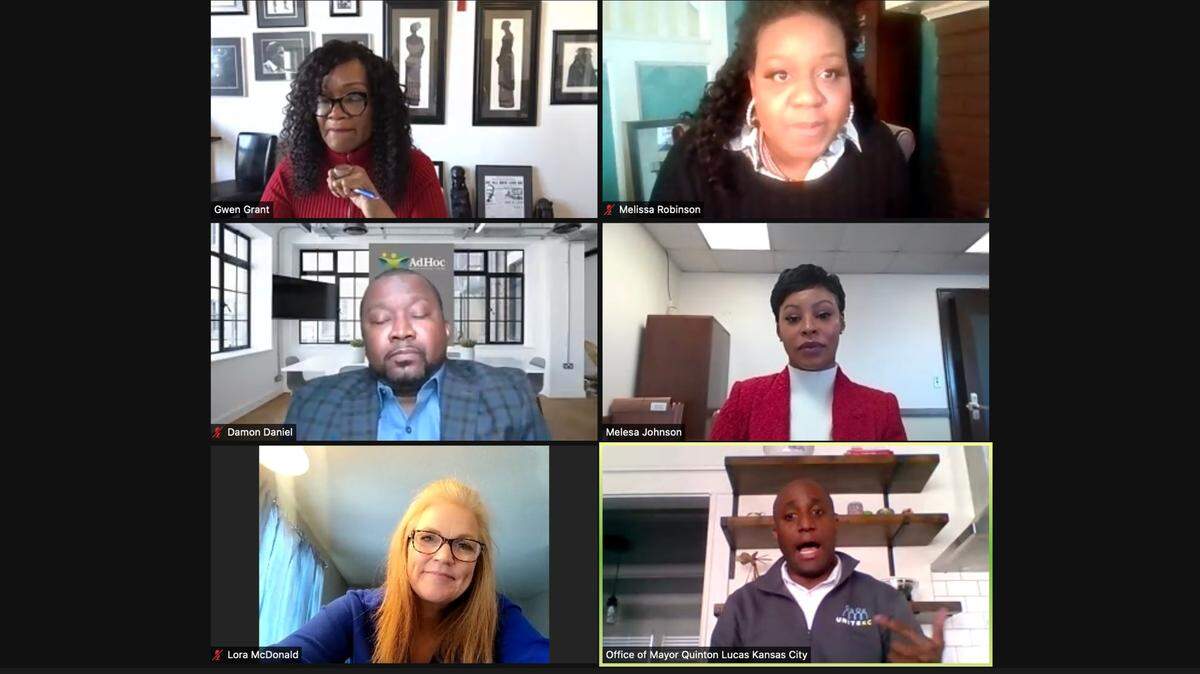
Gwen Grant was direct in what she wants to see play out during the process of hiring a new Kansas City police chief: community input.
At an online discussion hosted Saturday by the Urban League of Greater Kansas City, Grant presented examples of how other cities from across the country — Grand Rapids, Mich., Chattanooga, Tenn., Burlington, Vt. and Phoenix — went about selecting a new chief.
Grant, president of the Urban League, called Phoenix’s process “the gold standard.” The Arizona city’s search lasted one year and included 13 community meetings and online surveys to get feedback from the community.
“They created their job solicitation based on community input,” she said. “In fact, other cities and countries have actually taken a look at how Phoenix, Arizona, conducted their search because of this really, really robust community engagement process.”
Grant along with Damon Daniel, president of Ad Hoc Group Against Crime; Melesa Johnson, deputy chief of staff for Kansas City’s mayor; Lora McDonald, executive director of MORE2; and Councilwoman Melissa Robinson, who represents the third district, participated in the panel.
Mayor Quinton Lucas ended up joining the conversation too.
Kansas City will soon embark on yet another search for a new police chief — its second in six years — after Police Chief Rick Smith announced he would be stepping down in April.
His departure comes as he and the department have faced several controversies.
In November, former detective Eric DeValkenaere was convicted of second-degree involuntary manslaughter in the 2019 shooting death of Cameron Lamb.
Later that month, The Star obtained audio of Smith saying “the bad guy’s dead” just minutes after DeValkenaere killed Lamb, a remark that angered many in the community.
In January, The Star reported on police data showing officers in Kansas City use a disproportionate amount of violence on Black people: from 2019 to July 2021, more than 57% of the department’s use of force incidents were against Black people.
Five officers under Smith have faced criminal charges related to alleged excessive force.
One aspect unique to Kansas City is that its elected officials don’t get to choose the next chief. The Board of Police Commissioners does. Four of the board’s members are appointed by the governor while the fifth seat is reserved for the mayor.
The two most recent police chiefs — Smith and Darryl Forté — have come from within the department. But Lora McDonald, executive director of MORE2, a local social justice organization, said she thinks the next chief should be hired from outside the department.
“I think we need to do a nationwide search,” she said. “I think we should be very open to an outsider at this point.”
All of the speakers agreed that the next chief should be accessible to the community and beholden to the community it serves.
“It is going to be a tough job here in Kansas City but we need to be able to vet the qualifications on the front end,” said Johnson, with the mayor’s office. “I do think that policing in the modern age is a very, very nuanced and contextual field.”
Grant said she would like the next police chief to be able to change the culture of the Kansas City Police Department.
“This current department is plagued with a culture that certainly begs for change and transformation,” she said. “It would require a leader who has the capacity to dismantle a system that has been in place.”
Lucas addresses budget
Lucas unexpectedly joined the panel midway through. It gave him a chance to address the police department’s budget.
A bill sponsored by Sen. Tony Luetkemeyer, a Parkville Republican, would require the city to commit a minimum of 25% of its revenues to the department each year. Under current law, the minimum is 20%.
The bill is a reaction to last year’s attempt by Lucas and a supermajority of council members to reallocate millions in police funding. The Board of Police Commissioners sued and a Jackson County judge ruled that the council violated state law.
Lucas criticized Luetkemeyer on Saturday, saying the senator doesn’t live in Kansas City, but still is impacting the city’s policies. Lucas suggested he would not follow the law and called it “unconstitutional.”
Last month, Lucas spoke before a Missouri Senate panel in Jefferson City where he voiced opposition to increasing the minimum amount of revenue going to the police department.
The budget is being reviewed by city officials. A $272 million request — a 6% increase over the previous budget — was presented in October and the next month, the police board passed a $281 million budget.
This story was originally published February 5, 2022 at 2:49 PM.