
On The Vine: An appraisal of ‘A Dream’

I owe a lot personally to the civil rights organization that Dr. Martin Luther King Jr. helped found: The Southern Christian Leadership Conference.
I was either a freshman or a sophomore at Truman High School in Independence when I got my first taste of the SCLC Greater Kansas City Chapter.
It was two years of being engulfed in a cultural experience, and importance that never really occurred to me, despite a father who was fairly active during the Civil Rights movement of the 60s and 70s and a mother who took every moment she could for a lesson in history; identity.
Being involved with the SCLC broadened my scope and gave me a deeper knowledge of black culture and history in America.
I served as president of the youth council during that stint, tasked with helping to organize the MLK Day luncheon celebration and introducing Tavis Smiley to the audience after a short speech.
The SCLC took me on a tour of HBCUs through my first home in the south. And though I didn’t end up going to an HBCU — maybe my one regret — the SCLC gifted me a scholarship that helped feed my education and career.
Yeah, a lot is owed to the SCLC for the knowledge, experiences and gifts they gave a privileged, nescient little Black kid from the suburbs.
Beyond the block
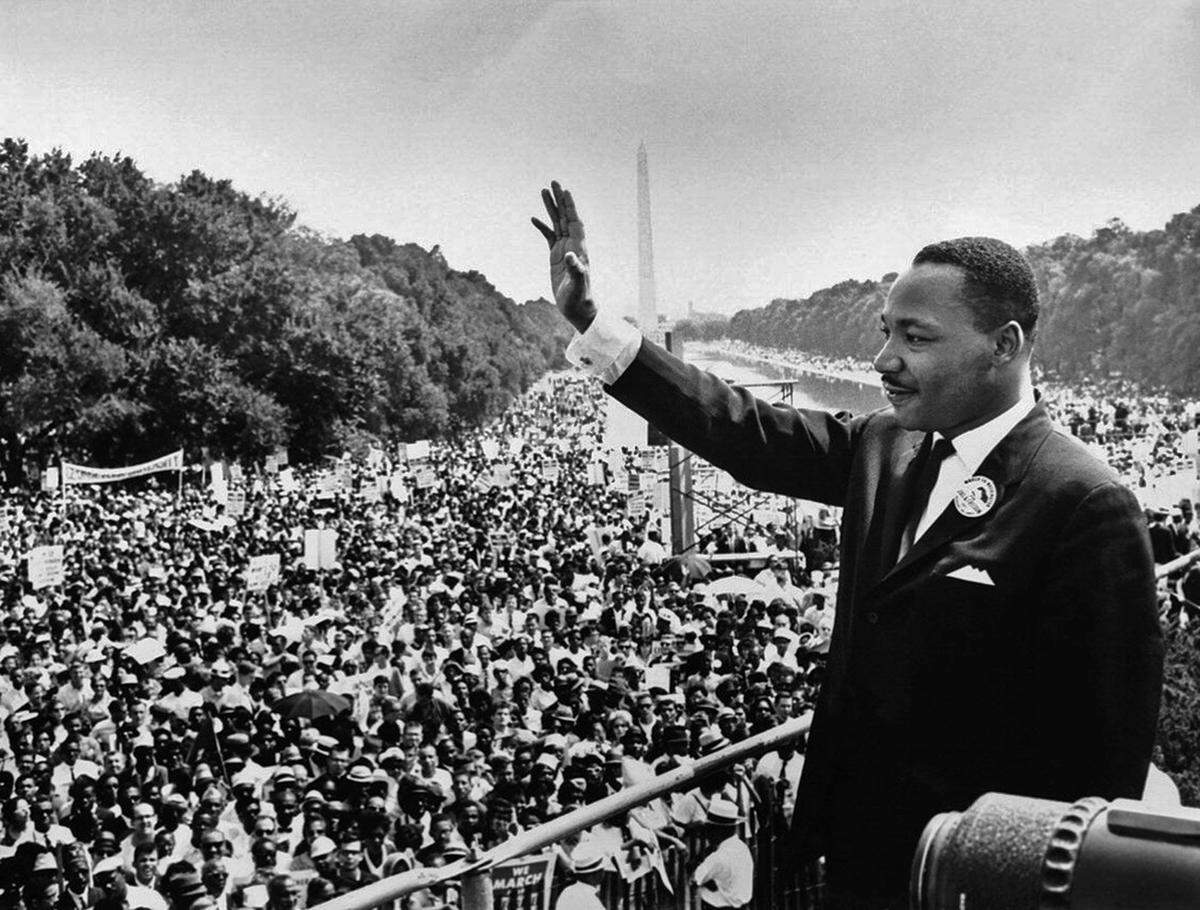
Martin Luther King, Jr.,’s History Lessons
If you’re not reading, or aware of the writing of Jelani Cobb, I’m here to tell you we need to right that wrong.
In this piece for The New Yorker, Cobb revisits a lesser-known speech of Dr. Martin Luther King Jr. titled “Our God Is Marching On!,” for which he addressed a crowd of 25,000 people on the grounds of the Alabama state capitol.
Cobb identifies the speech as revelatory; a precursor to what would be the principal force in King’s civil rights thought: “King understood the nation’s challenges as part of a continuous narrative. Today, a narrow view of America’s past could imperil its future.”
Cobb writes:
Referring to the historian C. Vann Woodward’s book “The Strange Career of Jim Crow,” King said that racial segregation had begun not simply as an expression of white supremacy but as a “political stratagem employed by the emerging Bourbon interests in the South to keep the southern masses divided and southern labor the cheapest in the land.” The so-called split-labor-market theory held that, by creating a hyper-exploited class of Black people, white élites could hold down the wages of white workers. And so racism didn’t just injure Black people, its immediate object; it took a toll on white laborers, too.
This holiday honoring Martin Luther King, Jr., sees a nation embroiled in conflicts that would have looked numbingly familiar to him. As school curricula and online discourse threaten to narrow our understanding of both past and future, it’s more important than ever to take stock of our history and its consequences, as King did in his speech more than half a century ago. In Montgomery, the civil-rights leader spoke of the intransigent optimism that had led activists to fight for change, in the face of skepticism about what could actually be achieved. President Biden struck a similar note in his Statuary Hall speech. For those who believe in democracy, he said, “anything is possible—anything.” This is true, as the events of both March 25, 1965, and January 6, 2021, established. Anything is possible right now, and that is as much cause for hope as it is for grave concern.
More to check out...
Around the block
How Bob Kendrick became the Kansas City Negro Leagues museum’s indispensable man
There are a few things in Kansas City I consistently rave about when either standing up for or selling my city to friends from the coasts or simply not from here. I’m still spouting the “second most fountains in the world behind Rome” line — 100% accurate or not — and I typically beam when saying Kansas City is home to the American Jazz Museum and the Negro Leagues Baseball Museum.
The history of those two staples of Black, Kansas City and American history are very much ingrained in who I am. And the NLBM has remained the institution it is today in large part because of one man: Bob Kendrick.
The Star’s Vahe Gregorian writes:
Bob Kendrick is about the most elegant and eloquent person you’ll ever meet. Outgoing as he is, odds are you will indeed meet this ever-engaging man if you haven’t already.
That persona, not to mention his hats and colorful suits and otherwise dynamic threads, are so entwined with the fabric of Kansas City that few might realize he’s of this place but not from it...
Because Kansas City has no more appealing ambassador than Kendrick, who can relate to anybody and has a remarkable knack for being able to align disparate places and events into a compelling narrative. Even in the Twitter-verse that Lucas notes can be a “toxic cesspool,” Kendrick prevails as a unifying force to people from all walks of life.
You can see that brought to life on any given day at the NLBM, where Kendrick has become so synonymous with the mission that his role almost seems destined here in the city where the Negro Leagues were founded in 1920 and gave birth to what became its most fabled team, the Kansas City Monarchs.
You gotta read this...
Kansas City Public Schools finally regains state accreditation. Here’s what that means
She had an abortion before Roe v. Wade. Here’s how a Kansas woman’s fight continues now
‘Touched so many lives’: Family mourns local Kansas City businessman killed in shooting
For the culture
Sidney Poitier Was the Star We Desperately Needed Him to Be
I first encountered Sidney Poitier in the 1963 classic “Lilies of the Field.” I’m not sure I remember a time before Sidney Poitier. I do know I thought all black and white movies were white movies, filled with white actors, telling white stories. The Black in black and white didn’t make sense until Mr. Poitier.
I can still hear him singing “Amen,” with those German Catholic nuns.
- Sidney Poitier Gave More Than He Was Given
- Halle Berry Pens Tribute to Sidney Poitier: ‘An Angel Watching Over All Of Us’
In the wake of the [no word aptly portrays his importance] actor’s death at the age of 94, Wesley Morris writes for The New York Times:
Were anyone to ask me who’s the greatest American movie star, my answer would never change. And it will never change because the answer is easy. The greatest American movie star is Sidney Poitier. You mean the greatest Black movie star? I don’t. Am I being controversial? Confrontational? Contrarian? No. I’m simply telling the truth.
Who did more with less? Of whom was less expected as much as more? Who had more eyes and more daggers, more hopes and fears and intentions aimed his way, at his person, his skill and, by extension, his people? Race shouldn’t matter here. But it must, since Hollywood made his race the matter. Movie after movie insisted he be the Black man for white America, which he was fine with, of course. He was Black. But the radical shock of Sidney Poitier was the stress his stardom placed on “man.” Human...
I believe with all my heart that Mr. Poitier was as crucial in the odyssey of freedom and equality for Black Americans — for personhood — as Frederick Douglass and Harriet Tubman, as Martin Luther King Jr. A clear descendant of Douglass’s rhetorical brilliance, he spoke the words of white people but from his own mouth. His projected image begot what is now a galaxy of other Black actors, doing acting as diverse and tiered as a shopping mall.
This is also for you...
Ronnie Spector, Who Brought Edge to Girl-Group Sound, Dies at 78
The poet Maya Angelou is the first Black woman to be featured on a U.S. quarter
Journalist and activist Ida B. Wells will be the next signature Barbie doll
See ya in the temple
Did someone forward this newsletter to you? You can sign-up here. If you’d prefer to unsubscribe from this newsletter, you can do so at any time using the “Unsubscribe” link at the bottom of this message.