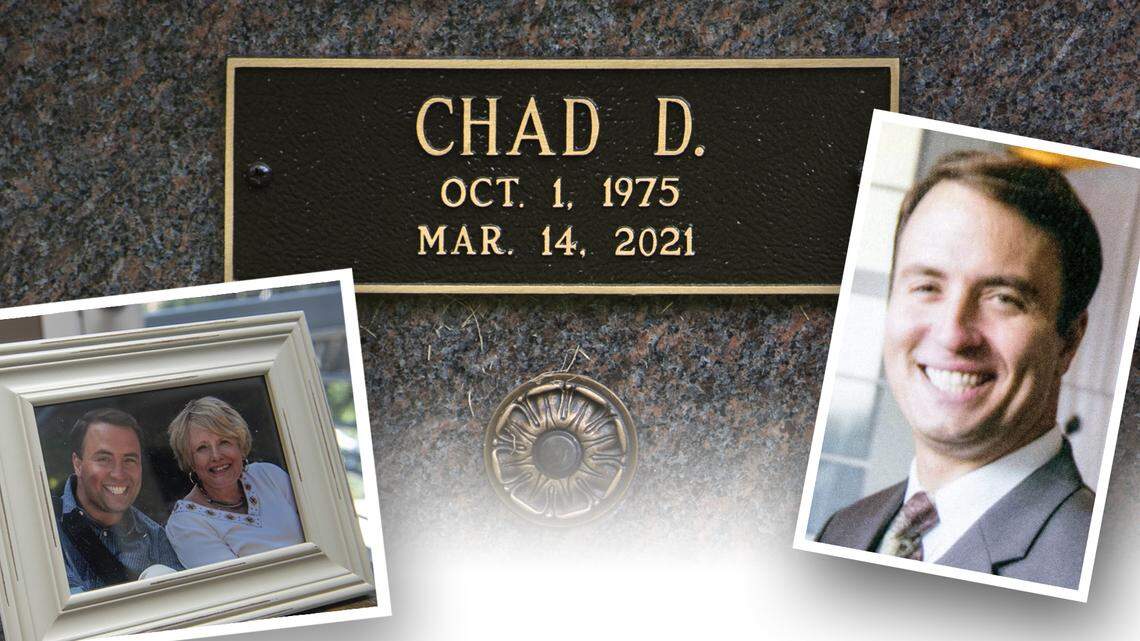
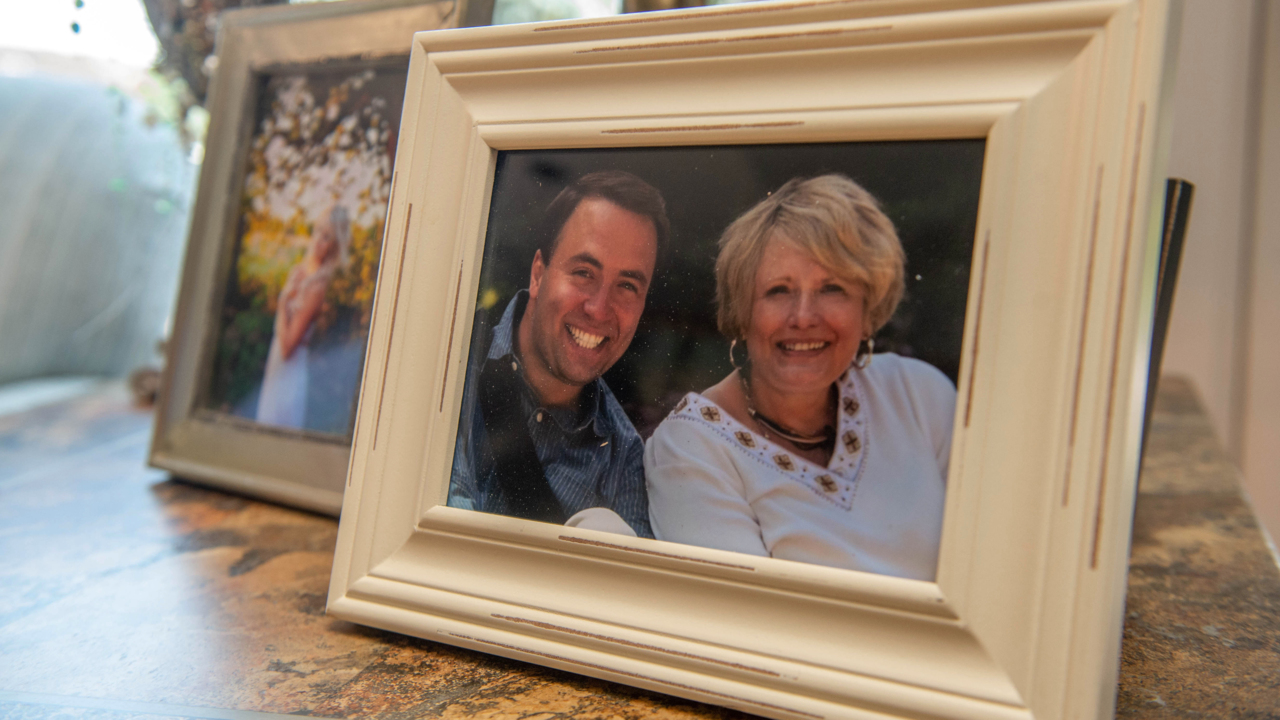
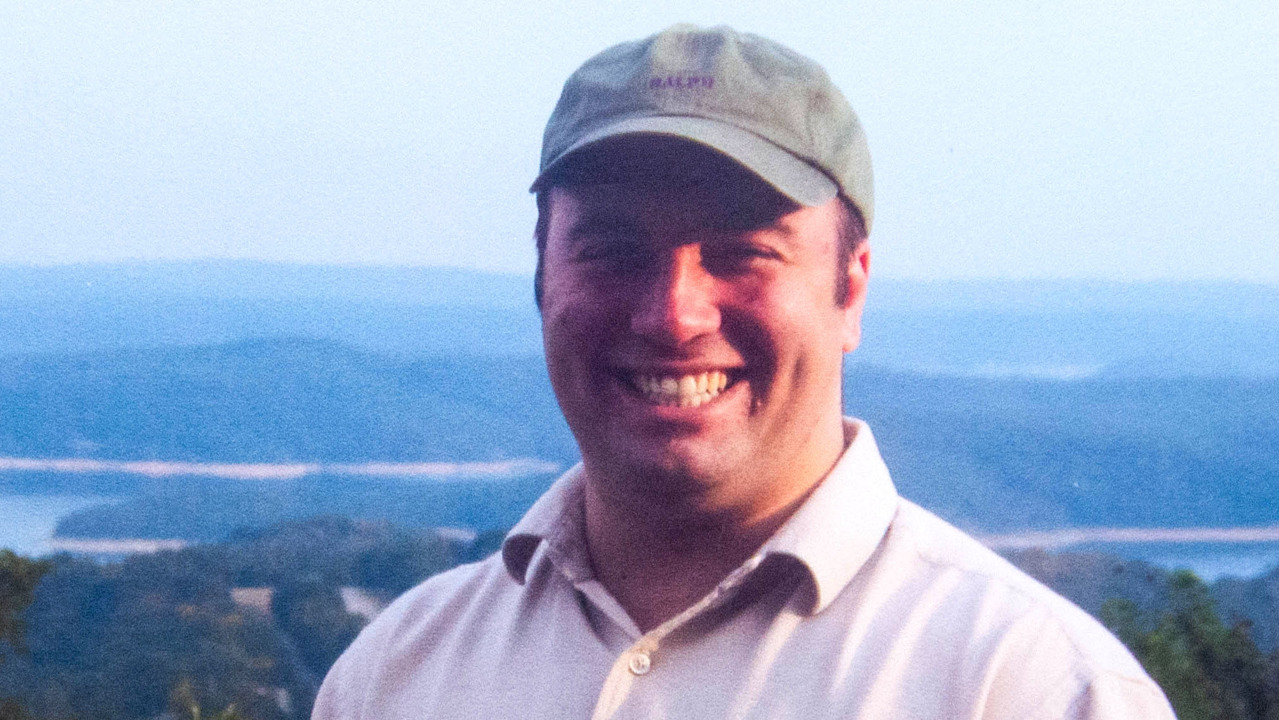
Heir to Kansas City tycoon dies. Family blames his mental illness — and his lawyers
READ MORE
‘There’s something terribly wrong’
His family tried to save him. They blame his downward spiral into death on his mental illness, and his lawyers.
Expand All
In the end — when the tragedy hit, as Paula Logan long feared it would — her love was not enough to save her son.
Nor was the fortune of her Kansas City area family, worth billions.
Chad Logan — grandson of Cecil Van Tuyl, the late real estate and car dealership mogul — was mentally ill, battling his demons for decades into middle age.
When Chad was found dead in his bed on March 14 at age 45, he was alone. He’d been feeling so for a long time.
He’d lost his home in the chaotic swirl that was his mania, depression, paranoia and delusions from bipolar and schizoaffective disorders. He’d lost financial support and a marriage to a loving wife who fought to rescue him. His self-worth had melted away like his own weight as he grew thinner, shuttering himself inside a dark apartment off the Country Club Plaza. Time and again, he had talked of killing himself, saying, “I’ve lost everything.”
A drug overdose was listed as the official cause of death, an overdose that his older sister, Angela “Angie” Payne, wants to believe was accidental. Their mother is less certain.
“I think it was suicide,” she said.
When the day came, sadness consumed Paula, but so did anger — pointed at a Kansas City area lawyer and law firm. Motivated by money, she believes, they took advantage of her mentally ill son in April 2016 when they filed a lawsuit on his behalf to gain control of $80 million in trust fund money. When the suit — filed by attorney Tom Busch, then a partner with Martin Pringle and now with his own firm — ultimately failed and triggered a countersuit that cut Chad off from any money, her son, Paula believes, sank ever deeper into a state of despair from which he never recovered.
Now she’s suing his lawyers in return.
First, in December 2017, came a civil suit filed on behalf of Paula and other Van Tuyl trustees claiming that Busch and his former firm engaged in malicious prosecution and, as the suit states, “motivated by greed,” filed a “frivolous” lawsuit that brought only hardship to Chad. A jury trial is set for January.
Then in June, three months after Chad died, Paula sued again in federal court. Busch and Martin Pringle, the suit states, are accused of “legal malpractice based on their complete failure to competently and carefully represent Chad.” Trial is set for December 2022.
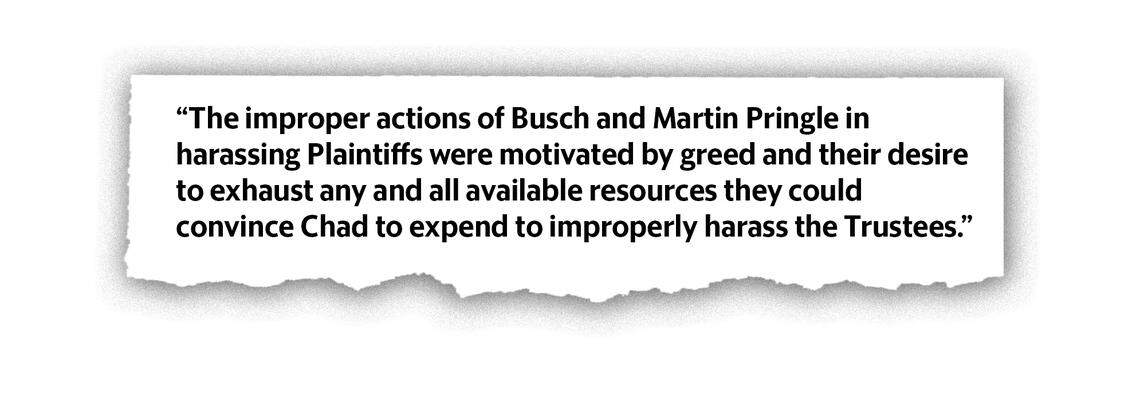
Neither lawsuit specifically blames the lawyers for Chad’s death.
Neither seeks a specific amount in damages. The wealthy family insists the cases are not about money.
“I want them to know you can’t treat a mentally ill person this way,” said Paula, seated with her daughter and their attorney at the dining room table of her home in gated Lake Quivira. “You took everything he had. He spiraled and spiraled into depression after this. They took advantage.”
Chad’s sister insisted justice demands accountability.
“They propped up all his delusions,” Angie said. “They knew he wasn’t well. They didn’t care. … I want it to be illegal for attorneys to do this. If attorneys are found doing this, I don’t want them to be attorneys anymore.”
Busch and the law firm, through their attorney Daniel F. Church of Morrow Willnauer and Church LLC, declined to be interviewed by The Star. But in an email, Church countered that Chad had the right to legal representation, like anyone else.
“Although Chad Logan suffered from a mental illness,” Church wrote, “he had a right to make his own decisions regarding his medical care and universal rights as a human, unless deemed incapacitated in a guardianship proceeding, which did not occur here. …
“Our civil justice system allows for legal representation of those who suffer mental illness to ensure their access to the judicial system is protected.”
The Van Tuyl family typically remains private. But Paula, 70, her daughter, 51, as well as Chad’s former wife, Amanda Logan, agreed to speak to The Star because the legal actions have unavoidably brought details of their private lives into the public realm. More important, they said, they want others to understand the devastation of mental illness — how, after Chad refused to take his medication or get help, his mental illness controlled and ruined his life.
Had Chad been a child, perhaps his family could have forced him to get care. But because he was an adult, they often felt powerless.
Love, interventions, not even the leverage of money were enough to save him.
“I still struggle with it,” Amanda, 40, said during a video call in which she fell into tears. “I don’t think I will ever get over it. I will always think there is something else I could have done.”
‘That’s not my family’
Chad’s troubles began early, although it hadn’t always been that way.
“Thirteen,” Paula said, “that’s when things started changing.”
Until then, Chad was his best self: smart, kind, artistic, a lover of cats, a devoted friend. He loved to sing. On good days in adulthood, he would launch into his favorite song: “I see trees of green, red roses, too. … And I think to myself, what a wonderful world.”
Born in 1975, he was raised in a privileged family. Cecil Van Tuyl by then had already become a rags-to-riches American success story.
“Show him that picture,” Paula urged Angie, who went upstairs to retrieve a framed black-and-white photograph of Van Tuyl’s parents.
In the photo, Paula’s grandparents stand outside their tiny clapboard farmhouse dressed in what looks like their Sunday finery: she in a long white coat and a prodigious hair bow the size of a tiny propeller, he dressed in a suit, vest and hat, one hand holding the bridle of a pair of horses attached to a carriage.
They farmed 80 acres outside La Cygne, Kansas. The house and property were submerged beneath 2,600 acres of water in the mid-1970s when Sugar Creek was dammed to produce La Cygne Lake.
“It was a shack, basically,” Paula said.
It’s where her father, born in 1927, was raised during the Great Depression, sleeping in an attic bedroom beside five siblings, with no heat but with a fierce work ethic. One of his favorite sayings even late in life was “Nothing will work unless you do.”
While still a teen, Van Tuyl joined the U.S. Navy in 1945 and afterward settled in Kansas City. He married Ruby, his wife of 64 years (who died in 2019), worked as a welder at a local General Motors plant and had two children, Larry and Paula, a year apart.
Then “Van,” as he was known, made a fateful decision: better to sell cars than to build them.
In 1955, he opened a Van Chevrolet dealership in Kansas City that would become the first in a network of about 75 Van Tuyl Group dealerships nationwide. The family, which also amassed extensive VanTrust Real Estate holdings in Kansas City, grew wealthy.
Van Tuyl died in November 2012 at age 85. Two years later, his son, Larry — who had been running the auto business, where he’d worked since he was 21 — sold it to investment magnate Warren Buffett for, estimates suggest, between $1.8 billion and $3.7 billion.
By then, Chad had been lurching from one extreme to another for years.
“Outgoing and fun-loving and sweet. He had a big heart,” his mother said. But he could also suddenly turn violent or emotionally inert.
Paula said that, at that time, neither she nor her husband, Denny Logan — Chad’s even-mannered father, an insurance attorney who in 2006 died at age 58 of a heart attack — were much familiar with the terms “bipolar” or “schizoaffective disorder.”
“When it first starts, you know there’s something terribly wrong,” she said. “But you don’t know what it is. You don’t know where to turn for help.”
This was more than teenage defiance.
Chad was barely in high school at Blue Valley Northwest, his mother recalled, when he and his friends broke into the garage of one of their teachers, stole a Moped, then drove it away and wrecked it. He’d later swipe beer from a beer truck. He got into fights.
“It seemed like every day,” Paula said of Chad’s troubles, “the police were at our door.”
Angie — 5 1/2 years older and a student at the University of Kansas at the time — would hear about Chad from her parents.
“It was so bizarre,” she said. “My family’s very conservative. We didn’t even say the word ‘butt’ — we said ‘bottom’ — because that was considered a cuss word in my house. I’m calling home, hearing these stories, thinking, ‘What in the world!? That’s not my family.’”
‘Highjacked his soul’
Confronting Chad often led nowhere.
“I would try to talk to him,” Paula said. “He would look at me with this blank stare, like he wasn’t even comprehending what I said.”
Chad skipped so much school, he didn’t graduate but later earned a GED certificate. Not long after Angie graduated from KU and was about to get married, Chad got into more trouble. He was arrested as a minor for a fight and pleaded no contest to battery, court records show. Paula said her first instinct was to try to rescue him, as usual.
“My dad kept saying, ‘He’s got to learn his lesson,’” Paula recalled. “’You’ve got to be hard on him. You can’t rescue him. Better to go to juvenile detention now than to prison later.’ It was such an awful time.”
A therapist urged the Logans to practice tough love, Paula said. Chad, a few months short of his 18th birthday, was sentenced to three months in juvenile detention. Only after pleas from Angie did a judge agree to let him out briefly to attend her wedding reception but not the ceremony. That was in 1993.
“My dad had to go leave the reception and take him back,” Angie recalled.
Between wondering what was wrong and blaming themselves, they sought medical advice.
“We took Chad to several doctors,” Paula said. “It was always the same story, that Denny and I spoiled him. We enabled him.”
They didn’t think that was the case.
“Once they say it enough times, you begin to wonder if it’s not all your fault,” Paula said.
Only after “the Jen incident” did everything change.
It took Chad seven years to get through college. He attended KU, quit, attended Johnson County Community College, only to return and finish up at KU. Before, during and after all those years, he had a girlfriend, Jen. Jen declined to be interviewed by The Star, and thus her last name is withheld.
In a brief text, she chose only to share the good in Chad.
“‘What a wonderful world,’ is how Chad perceived life before (and even during) his illness,” she wrote. “Appreciating the skies, roses, nature and people. … His smile and humor changed the energy in the room, always turning frowns upside down. The life of the party, people would congregate to hear his stories.”
She texted that he loved traveling, photography, nature and would rather rescue an insect than kill it.
“He was full of life, light and love,” she said. “That was Chad before the hard, indoctrinating corrupt world highjacked his soul.”
She didn’t mention the day he allegedly choked her on the floor. He was about 26 and had only recently graduated. They were living together in a small Overland Park rental.
“Chad was yelling at her,” Paula recalled. “They’d gotten into a big fight that night. Chad put a big hole in the wall. … He had her down on the floor with his hands around her neck. She told me later, she said, ‘When I looked at him in the eyes, it wasn’t Chad.’”
He let her go. Jen called Paula. Denny and Paula drove to the house that night. They packed up Chad’s clothes and took him home. Jen chose not to press charges.
Paula later spoke to Jen and her family. The year was 2001. “I said to Jen, ‘Something is horribly, horribly wrong. I don’t know what it is. But you’ve got to get away from him right now.’”
Not long after, with Chad living in her basement and Jen having left for another state, Paula typed two words into her computer browser: mental illness.
A link to bipolar disorder popped up.
“Denny,” Paula remembered calling upstairs to her husband. “Come here.”
“Chad,” she said, “had every symptom.”
Miracle to mania
A chronic disease with no single cure, bipolar disorder — long known as manic depression for its often unpredictable manic highs and depressive lows — can destroy lives when left untreated.
The depression can feel bottomless, leading to suicide. The highs, or hypermanias, can erupt into racing thoughts, feelings of invincibility and grandiosity that can trigger ruinous and hasty actions: sexual promiscuity, gambling, out-of-control spending, risky investments. Chad’s schizoaffective disorder brought cycles of delusions and hallucinations.
But with prescription medications, talk therapy and healthy habits such as proper sleep and exercise, the disorder is often manageable.
“You can equate it to any other chronic health condition,” said psychologist Jennifer Keller-McDaniel, senior director of behavioral health at Truman Medical Center. “There are plenty of people who live very fulfilling, successful lives with bipolar disorder. The key, of course, is management with medication, general wellness and having a good support system around them.
“The sooner there is intervention, the less likely it is to turn into a crisis or to really escalate.”
Yet once Chad was properly diagnosed, Paula said, the Kansas City psychiatrist they were dealing with, the same one who blamed them for Chad’s problems, still offered them little hope.
“I told him, ‘You’re not going to tell me when to give up on my son,’” Paula recounted. “And I left his office.”
Chad knew he was troubled, Paula said, telling his mother one night: “’Mom, I want to be different. I just don’t know how.’ I decided then and there I would go to my grave trying to help him.”
Not satisfied with Chad’s care in Kansas City, the family moved to California, where Denny Logan got a different insurance job and where Chad could be seen by noted psychiatrist Terence Ketter, chief of the Bipolar Disorders Clinic at the Stanford University School of Medicine.
The care brought hope for a while, until the disorder again took hold.
“Things got real bad,” Paula said.
Chad had again begun to rage. His sister had seen it before, his green eyes turning dark. “He threatened Dad’s life. He said he was going to kill my dad,” Angie said. He also threatened to take his own life.
Under California law, Section 5150 of the Welfare and Institutions Code, Chad’s mental state plus the threats were enough to place him in the hospital involuntarily for three days. He was handcuffed. Missouri has similar laws that allow involuntary detention through the courts if a person is judged to be an “imminent” danger to themselves or others. They can be held for 96 hours and, if later proven to be needed, up to a year. Kansas law allows involuntary commitment for those who are “likely” to cause harm to themselves or others if allowed to remain at liberty.
“It just broke my heart,” Paula said. “Chad was so angry to be put in there.”
Doctors at Stanford felt Chad needed long-term, inpatient care. The Logans were pointed to the private-pay Sanctuary House 280 miles away in Santa Barbara, which at that time cost several thousand dollars per month. It now costs more than $12,000.
The center over time found the right mix of medications and proper therapy.
“It was amazing,” said Paula, who began to get involved in the National Alliance on Mental Illness and to read as much as she could on mental illness. “They gave my son back to me. He was happy, a lot calmer. … It was a miracle.”
“He started having friends again,” Angie said.
Chad would later live in the center’s apartments to receive outpatient care. He studied photography at a local for-profit college. His close-up images of flowers, leaves, shells and raindrops on petals are framed on the wall of his mother’s staircase.
When, around 2005, Cecil Van Tuyl began to have mini-strokes, the transient ischemic attacks that can be a harbinger of a larger stroke, Paula and her husband returned to Kansas City. Chad followed.
Life for many years was stable, even good.
Chad had never held a job as an adult. His mother had worked for 25 years as part of the Van Tuyl commercial real estate interests. Chad eventually was hired to assist one of their property managers.
In 2006, when Chad’s dad died, he stepped up as a comfort to his mother.
“He was so good with me,” Paula said. “He really took care of me.”
In 2008, he met Amanda through the Plenty of Fish online dating site. Chad was 32, Amanda was 28. Born into a farming family in Williamsburg, Kansas, south of Ottawa, she worked at Mimi’s Cafe in Overland Park.
“I never met anyone like him that I clicked with on so many levels,” Amanda said. “I just remember after that date, we were together forever.”
First date: a karaoke bar. He loved cats; she loved cats. She knew more about sports than he did. On weekends, they’d search out antiques and estate sales, go to coffee shops and on walks where he picked flowers for her.
Chad’s family had bought a house for him in Kansas City’s Crestwood neighborhood, south of the Plaza. Soon, the couple were living together. Amanda knew about his history of mental illness. He was taking medication. She knew he was a Van Tuyl.
“He talked about his family from the beginning,” Amanda said. “He talked about his grandpa. You could tell he loved his grandpa very much and respected him and wanted to follow in his footsteps to be successful.”
No one knows exactly when Chad stopped taking his medication. In 2014, his mind had already begun to unravel. Eventually, he’d spiral into delusions and paranoia about being poisoned and watched.
Mistrust
Outsiders often misunderstand the Van Tuyl family. Just because Cecil Van Tuyl made a fortune in no way meant that his children or grandchildren would automatically swim in a river of money.
Yes, being a Van Tuyl came with undeniable perks, the family said.
Paula worked with her father, doing well in commercial real estate. Her brother, Larry, worked for the automotive side. It was only after Cecil Van Tuyl died and Larry sold the dealerships that luxuries like the $120 million, 200-foot super-yacht called Vanish became part of Larry’s life. It has since been sold to British billionaire Andrew Currie. Larry bought another yacht.
Cecil Van Tuyl himself valued hard work, not entitlement. Everyone in the family knew it. He’d driven the point home.
“He told me the first day I started (at the company): ‘You’ll get money when you earn it,’” Paula said. “He was that way until the day he died.”
Angie, trained to be a special needs teacher, cleaned houses when her children were young. Her family continues to live in a modest home in Basehor, in Leavenworth County. Her husband, Doug, is a retired Lawrence police officer working as a bailiff.
But beginning in about 2004, after suffering health problems, Van Tuyl — through an estate planning attorney at the law firm Husch Blackwell — began setting up a series of financial trusts for his family that included Chad and Angie. It wasn’t money they could have, like blank checks to do with as they wished.
The millions of dollars would be controlled, as it is now, by a group of five to eight trustees, with Paula, Larry and Angie among them.
Together, they have discretion to determine what the money can be used for. In keeping with Van Tuyl’s wishes, however, it was never meant to make anyone instantly rich. Instead, the trusts were to exist as “a backstop” to be used in special circumstances that include health, education and the broad categories of maintenance and support — often known as HEMS.
Angie, for example, used it to pay for her two daughters’ college education. Chad, meantime, had never shown that he could fully support himself. So Paula used trust money to buy the Crestwood home and give him about $3,000 a month for bills and as a stipend.
Later in court, as part of the family’s trust case, Van Tuyl’s attorney, Christopher Erblich, would testify to exactly what Van Tuyl’s wishes were.
“His overarching goal,” Erblich said, “was he wanted to make sure that his wealth helped his family, didn’t hurt his family. He wanted to make sure it didn’t de-incentivize people to work, but it rather encouraged people to work.
“He wanted to avoid any member of his family, whether it was children, grandchildren, great-grandchildren or, as he said, folks he would never meet, (from) becoming trust fund kids. He didn’t want them to be — his word — spoiled.”
Van Tuyl was so adamant that he built into each trust a kind of self-destruct switch — a “no contest” provision that stated that any family member who attempted to legally challenge or break the provisions of the trusts would be cut off and no longer be a beneficiary “as though the person were not then living.”
He also made something else clear, Erblich testified. Knowing that Chad lived with serious bipolar disorder, Van Tuyl did not want Chad to be named a trustee with greater access to the money. He worried about the cycles of Chad’s disorder and his judgment. He also worried that having unfettered access to such wealth would give Chad no incentive to work.
“He thought it would hurt Chad,” the lawyer said, “not help Chad.”
In 2016, Chad, with Amanda, moved to break the trust.
‘Running thoughts in his head’
Amanda could see Chad’s behavior changing long before then. She was in a difficult position.
In the summer of 2014, they were set to get married at Lake Quivira, where Paula lived.
Using trust money one year earlier, Paula had already bought a house for him there — it had been in foreclosure and vacant for a while — and suggested they rehab it and live there. Chad opted to manage the renovation as a kind of general contractor, thinking he could build equity and impress both his family and the trustees with his real estate management skills.
If he did well, maybe they would invest in him in that field.
Instead, the renovation dragged on, and by mid-2014, his anxiety had heightened.
“That was the beginning of when I noticed his mental illness getting a little more unmanageable,” Amanda said. “I could tell he was really stressed out about the remodel and the big wedding. So I kind of recommended we elope.”
That August, they married on the Caribbean island of St. Lucia. In wedding photos, Chad beams at Amanda. Green mountainous peaks rise in the background.
By then, his contracting gig had soured. Arguments erupted with one of the contractors. Chad claimed the contractor was stealing and had done multiple things wrong. He feared the house might even fall down.
The contractor wanted his money, but Chad wanted to sue.
Chad punched holes in the wall board. Lake Quivira police showed up.
Trustee Robert Holcomb, a longtime treasurer at the Van Tuyl companies, sent a team of Van Tuyl real estate experts to assess what Chad was upset about. In the end, they sided mostly with the contractor. The trust paid out the remaining $37,500 owed.
Chad felt betrayed. Livid, he saw it as a vote of no confidence, treating him like an infant.
He reeled. Over the ensuing months, into 2015, his thoughts turned paranoid and obsessive. He set up cameras outside his home and came to believe that the Lake Quivira police, in masks, were spying on him. He thought neighbors were watching him from the trees.
“He would record these videos and have me watch them,” Amanda said. To help her husband, to better understand his illness, she got a job at an area psychiatric center. “It was very emotional for me. He was describing things that weren’t there.”
Paula recalled a night they went to dinner at Houlihan’s, then in Fairway, and Chad pointed out a waiter.
“We had just sat down,” Paula recalled, “Chad says, ‘Mom, see that guy down there with the blond hair? He’s trying to kill me.’ I learned not to correct him, not to argue. If I corrected him, then his behavior would escalate.”
The family urged him to get help, to get back on his meds. Chad had all but stopped eating, losing nearly 80 pounds.
“A lot of times, it seems that no matter what you do, you’re not helping,” said Anthony Simpson, president of Kansas City’s chapter of the National Alliance on Mental Illness. “And all you want to do is help, you want to be there for that person. And there’s this huge struggle with a person a lot of times that is dealing with mental illness, because they refuse help.”
No matter the family or resources, the person with a disorder needs to commit to getting help.
Chad’s family explored what might be needed for an involuntary commitment and, in April 2015, sought help from the Johnson County Mental Health Center.
“We don’t know what to do. Can you help us?” Angie said they thought at the time. “How do we get someone treatment that is refusing treatment? He’s an adult. He’s refusing to take his medications. We’re really scared of what he’s going to do. We don’t really know if he’s going to harm himself or hurt someone else.
“You see all these stories, like in the paper, some mass shooting. Where was the family? Why didn’t the family tell them? I’m like, ‘We’re here. We’re in front of you, begging you to help us. Can you do anything?’”’
They realized there was very little they could do. The center took multiple reports from Amanda, Paula and a family attorney.
One reads, in part: “He reports he’s not eating due to ‘running thoughts in his head,’ according to his wife. He believes the water is poisoned/contaminated. … His paranoia is exhibited by his belief that people are looking in the windows and the family is stealing from him (from his trust). He also has a belief there is acid coming up from the flooring. His wife believes this is glue residue. … He insists there is a problem with the dishwasher and the line is contaminated by the contractor. He insists on eating off of paper plates. … Concerns include the client has 3-4 shotguns in the home. The family is also concerned that he will run if he is alerted of pending hospitalization.”
Chad, however, was intelligent and charming enough to present well, at least for short periods, his family said. Involuntary commitment in Kansas requires people being a ”likely” harm to themselves or others. Chad convinced doctors he was not.
It left the family in crisis. Voluntarily or involuntarily, they just wanted Chad to get help. They staged an intervention, urging him to see a hospital psychiatrist. He agreed. But, again, he put on his best face. When the doctor asked him if he was willing to restart therapy and his medications, he said he would.
But he didn’t, Amanda said. He complained about the side effects. She could see his prescriptions going unused.
Frustrated, the family decided to use the one lever they thought might work: money.
Together, with Amanda, they gave him what they hoped would be a “tough love” choice: Get help or be cut off.
All of the family’s trusts — which paid for Chad’s monthly stipend, paid for his new house — were predicated on the recipients leading productive and meaningful lives.
“The problem was Chad — with the house, with the money — had no motivation, interest to see a therapist,” Erblich, the trust attorney, would later testify. “And where most folks in society — when they have mental illness that is untreated, they will eventually get into a system, a mental health system, because they get evicted from their house or they will run out of money — Chad was frozen in a place where that will never happen to him.
“He could spend the rest of his life suffering from this mental illness untreated with the house and the distributions enabling that. The very thing Van didn’t want — the money hurting him, not helping him.”
They cut off the money. But Chad still didn’t comply. By Labor Day weekend of 2015, the trustees told Chad and Amanda they needed to leave the Lake Quivira house. If he wanted the money to flow again, he simply needed to show that he was getting help. But he wouldn’t.
Amanda, in an emotional call to Paula, debated and bemoaned how nothing they were doing was working.
“I feel like what we initially started to do was benefiting his mental health,” she said in one call, a transcript of which became part of a legal deposition. “I just, I feel very betrayed. When I initially came on board with you, I wanted to help him and get him back to a better place. I’m telling you that he is not in a better place.”
“He’s worse?” Paula asked.
“I don’t know why you guys thought that this was going to make it better. It’s not. It’s not making it better. … You cut off the income … and he has not said, ‘OK, I’m going to stop anything.’”
Then Chad hired a lawyer. His world fell apart.
‘Completely obsessed’
Few rules govern how lawyers should deal with clients facing mental illnesses.
The American Bar Association’s Model Rules of Professional Conduct state that when a client’s decision-making ability is diminished, the lawyer should still work to “maintain a normal client-lawyer relationship.” It also states that the lawyer should protect a client from physical or financial harm and protect privacy.
Just because clients have a mental illness does not mean they are at diminished capacity, said Douglas Richmond, chairman of the Kansas Bar Association’s ethics committee.
“Sometimes people, even if they have some sort of mental illness, they’re certainly having control over their own capabilities,” Richmond said. “I think it’s really tough to come up with any sort of once-size-fits-all scenario. To some extent, you have to trust lawyer judgment to be able to spot issues.
“And that’s not always easy.”
This year, famed pop singer Britney Spears placed the law, money and mental illness under a spotlight.
At age 39, Spears has never revealed a diagnosis, but in 2008, she was involuntarily placed in a psychiatric facility for a short period with what the media dubbed a “breakdown.” Her father was named her legal conservator and, until this summer, was not only placed in charge of her millions of dollars but also, according to Spears, private aspects of her life, including her use of birth control.
In July, Spears was victorious in court, winning the right to control her life and money.
Chad also wanted greater control of his life, to be out from under the thumb of his family and the trustees, with access to the millions of dollars that his grandfather had put in trust. Except there were two problems.
“Big difference,” said Jim Monafo, the lawyer with Husch Blackwell representing the family and trustees in the cases related to Chad. “Britney is the one who earned all her money. Cecil Van Tuyl is the one who earned all the money here. It’s the opposite of ‘Free Britney.’ The money wasn’t Chad’s.”
Moreover, Monafo said, “Unlike Britney, we had no ability to control Chad’s decisions.”
Also, there was Van Tuyl’s “no contest” provision, cutting off anyone who dared to challenge the trusts, put in place precisely to keep family members from having unfettered access.
The exact amount in each trust has not been revealed, but Chad — through his attorney, Busch — sent a letter in February 2016 initially asking for $80 million among other demands: $5 million in cash to be transferred to an account in his name; $75 million into a new trust with Chad as one of the trustees. He also asked for a house in the range of $500,000, with the title in his name.
In April that year, court documents show, Busch sent Chad a letter suggesting a “hybrid” fee structure. They would charge Chad $100 per hour, which he wouldn’t pay if the trust money came through. In case of a settlement, their fee would be 40% of the first million, 30% of the second million and 20% of any excess over $2 million — meaning if the $80 million came through, the lawyers would get more than $16 million.
The trustees refused to settle. Chad sued. Conflicted, Amanda signed on, she said, to show support for her husband.
The lawsuit, filed on April 26, 2016, repeatedly speaks of Chad’s mistrust of the trustees that he saw as controlling his life. Chad’s claim, spelled out in his suit, is that his mother, sister, uncle and other trustees “individually and collectively conspired together to deprive Chad of his legal right as a competent adult to control his person, actions and decisions.”
Monafo said that time and again, he, Chad’s mother and other trustees warned Chad not to file the suit. Because, in the end, it would trigger the “no contest” provision, and he would lose everything.
Monafo said they tried to convince Busch that filing the suit would only hurt Chad.
“Our job is to do what is in the best interest of our client,” Monafo said. “If it’s not in their best interest — if the client asks you to do something that is detrimental to their own interest — you don’t do it. It’s like if you go to a doctor and say, ‘I want my left arm removed.’ A doctor is not going to do it just because you asked him to.”
The lawsuit went forward. All went wrong.
Chad did not agree to their fee structure. Busch and Martin Pringle stayed on the case for only three months.

In the malicious prosecution case (filed in December 2017), Monafo for the trustees argues in court papers “despite knowing the lawsuit lacked probable cause … Busch and Martin Pringle filed it anyway … then bailed when Chad’s money ran out.” Chad paid his attorneys more than $125,000, money that had come his way through a previous trust.
“In short, Busch and Martin Pringle maliciously took advantage of a mentally ill man by exhausting his available resources to pursue a frivolous claim that ultimately caused great harm to their own client,” reads the trustees’ suit, which, while asking for no specific damages, requested $3 million to cover their legal fees.
Chad, with no money or attorney, ended up arguing his 2016 trust money case himself, as his own attorney.
He lost.
In dismissing the case in December 2016, Johnson County District Court Judge Kevin Moriarity tried to help move Chad forward, telling him that he had people around him who cared about him and were still willing to support him. He urged him to get help.
“You are your own worst enemy,” Moriarity said. “You are fighting everybody who cares about you. You see it about money, and they see it about your mental health.”
He added, “My comments to you today are to focus on what is apparent to everyone in the room but maybe you — that is, you are slipping and you need some help. … Please take this opportunity to get some help. Nothing is lost.”
But eventually it was.
Seventeen months later, in May 2018, Moriarity ruled that Chad had, indeed, broken the “no contest” clause of his trusts. By then, his life was already spiraling. His marriage to Amanda ended in divorce. In early 2017, he was arrested and spent 11 months in Franklin County Jail that included three months in the psychiatric facility at Larned State Hospital for making recordings that breached his ex-wife’s privacy.
The depth of the spiral, his family believes, stemmed from the original trust case that Busch and Martin Pringle filed.
“In my opinion,” his sister said , reading from a written statement, “the actions of Tom Busch and the Martin Pringle Law Firm played a role in my brother’s death. The lawyers knew he was not treating his illness, and that he was suffering from delusions. They fed into his delusions. …
“The lawyers only cared about money, and didn’t care about how the lawsuit might harm Chad and his family. Chad was completely obsessed with the lawsuit. And the fact that actual lawyers were willing to file it led Chad to believe that it must be right, it must have merit.
“The lawyers abandoned Chad after he ran out of money. But Chad remained obsessed with the lawsuit up until the day he died. He never got over it.”
For their part, Church, the lawyer defending Busch and Martin Pringle, argues in court papers that Chad believed the trustees invaded his privacy in trying to force him to get medical care and interfered with his right to an autonomous life. They also argue that although Chad’s trust lawsuit was dismissed in Johnson County, it wasn’t because it was frivolous. The legal merits of the case, they argue, were valid.
‘I forgave him and he forgave me’
In the years after his lawsuit, Chad’s life slowly withered.
“He was sick. He was very sick,” Paula said, yet he continued to deny he was bipolar.
Chad lived in a series of apartments, still being paid for by his mother. In the beginning, he moved repeatedly from one place to the next, Angie said, because he was paranoid and deluded, thinking people were out to kill him.
Over the years, he remained fixated on the lawsuit to get the trusts under more of his control.
“He was mostly depressed,” Paula said, often remaining in the dark in his apartment. “I would go down there about twice a week. He knew I was coming. He normally would be laying in the bed when I got there. And like Angie says, he wanted all the blinds pulled shut. He would lay in his bed all day.”
“Nothing” is how she described what he did most days.
“He would stay at his apartment all day. There were no groceries in the house. He was losing weight. His delusions became worse — seeing things that weren’t there. He heard voices that weren’t there,” Paula said.
He wasn’t shaving. He wasn’t bathing. If he was taking medications, he was not taking them regularly.
“I wish there were clearer answers,” Angie said. “I always thought, ‘Gosh, you can be born with about anything and there’s some kind of treatment you could get.’ But with mental illness, you can’t force treatment on anyone, and especially once they’re of age.”
Chad had been thinking about death. After he died, his family found what appeared to be a goodbye note written several months before in which Chad asked Paula to care for his cat of 22 years, Mia. The cat, however, died before Chad, which is how they knew the note was old.
On March 9, a Tuesday, Amanda had lunch with Chad at Aixois Bistro in Crestwood. Though divorced, they remained friends.
“I’m just grateful that I did get to see him,” Amanda said.
Chad, she said, was feeling sad that day. Aixois was one of the first restaurants he had ever taken her to. “And that was the last place we went,” she said. They’d always enjoyed it. She tried to keep the conversation positive.
“I’m glad that I forgave him and he forgave me,” she said. “We still had a connection. We still cared for each other, and we wanted each other to be OK.”
Paula said they felt like they’d made recent inroads. She and Chad had talked about him moving back to Santa Barbara, returning to the Sanctuary House that helped him years earlier. The idea was to go there in the coming weeks to get help and to work. The hope was that if he saw other people being helped by their medication, he’d follow suit.
But Chad had also been having trouble sleeping. They know he was self-medicating, occasionally using street drugs.
“I felt like we were this close to getting him some good help,” Paula said.
The next Sunday, a friend found him dead.
Never give up
The Logans struggle to know what lessons there are to be found in their story. They understand why others would be skeptical of any insights they might offer.
“In our family, I feel like we did everything there was to do,” Angie said. “I mean, we tried everything to get him help. There wasn’t anything that we didn’t try or wouldn’t have done.”
For years, they lived in fear of the phone ringing telling them of this very end.
“The constant stress wears you out,” Paula said.
She believes that Chad was never fully convinced of the severity of his illness.
“He didn’t want to admit that he was mentally ill,” she said. At one hospital, she said, he latched onto the diagnosis of depression as if it weren’t serious.
As lessons go, they said theirs are as fundamental as they can be difficult: Know the warning signs of mental illness, seek medical help early, get a proper diagnosis, proper prescriptions, effective counseling, educate yourself through NAMI or other experts.
Know when it’s time to disengage.
“I think it’s important to make sure you take care of yourself,” Amanda said. “I just dedicated all of my energy to trying to help him. I wasn’t eating well. I wasn’t exercising. I was just kind of going into a depression myself because I was so worried that I couldn’t figure out how to help him. Thinking back, if I would have taken care of myself better, maybe I could have helped him more.”
Angie said that there were periods when Chad’s anger and threats would become so intense that she simply had to remove herself.
“I don’t feel guilty for pulling away,” she said, her eyes misting, her voice catching. “I feel sad that there are no more chances for it to be different. There are no more chances for him to have happiness.”
On Oct. 1, Chad would have turned 46, marking 20 years from the time he was diagnosed. His remains lie at Johnson County Chapel & Memorial Gardens in Overland Park alongside his father, grandfather and grandmother.
“I tell you what I finally decided,” Paula said. “Treat them with unconditional love. That’s what they need: unconditional love,” adding later: “I think some of the best advice that I can give you (if) you have a loved one or a family member that is suffering from a significant illness is that they desperately need your help. They may act out in ways that are disruptive and harmful. But that is the illness and it’s not truly who they are.
“We have to help them. Never give up.”
This story was originally published September 19, 2021 at 5:00 AM.