Stop the hate. Stop the stereotypes: Asian activism rises in KC after Atlanta attacks
Born in China, raised from the age of 2 in the United States, JiaoJiao Shen of Overland Park was too shaken to sleep. Nearly all her life she had considered herself “a quiet figure.”
But in the Atlanta area, eight people — six of them women of Asian descent — lay dead, gunned down hours earlier in spas, allegedly by a 21-year-old white man who one police official would describe as having had “a really bad day.”
Enough was enough. Shen, 38, a public relations director for Hallmark Cards Inc. and former television reporter with two young children, both born on the Fourth of July, took to her computer.
It would be one of a growing number of calls to action in the Kansas City area, in the wake of the shootings as well as a year of anti-Asian rhetoric that escalated with the COVID-19 pandemic.
“It is 5:30 a.m. and I have not slept,” Shen wrote on Facebook on March 17, the morning after the killings. “I’ve not slept because I’m sad. I am scared. I am tired. I am emotionally drained. I am stressed. But mostly, I am angry.
“I am angry that the fear and the pain that the Asian American community feels has been ignored or silenced for so long.
“I am angry that six Asian women, several of whom reports say were in their 60s and 70s, were killed by a terrorist, yet authorities and media outlets continue to refuse to call white men who commit these mass shootings in the name of hate anything but a ‘suspect’ or ‘shooter’ or ‘gunman’ who ‘acted alone.’
“I am angry that so many Asian immigrants who are survivors of war and other traumas in their home countries come to the U.S. seeking a better life for their families only to be subjected to racism and violence at the hands of the people who used them to uphold their white supremacist institutions.
“I am angry that we continue to be labeled the model minority and used as a tool of systemic racism to oppress Black people.”
She made a call to conscience.
“I am angry,” she continued, “that I have seen very few people I know personally stand up in solidarity with the Asian American community. Where are your public declarations that this violence needs to end?”
The Star interviewed dozens of people of Asian descent in the area this past week. They spoke of being told to go back to where they came from. Of enduring jokes at their expense. Of fearing for their family so much that they bought a gun.
Calls to action in KC
Across the Kansas City area, Asian activism is now rising.
It emanates not only from new and often young voices, but also from those who say that white America is finally listening to warnings of the reality of anti-Asian aggression.
“I do think that the Asian community has been trying to get (media) exposure,” said Jackie Nguyen, 32, whose mother came to the U.S. after the Vietnam War. “Just now are we finding that, you know, it’s being covered. … You’re finally listening.”
Nguyen (pronounced “win”) first came to Kansas City with the Broadway touring production of “Miss Saigon.” In June she moved here with her boyfriend, an actor and Kansas City native, and soon opened Cafe Cà Phê, a Vietnamese coffee truck that in the winter became a shop in the West Bottoms.
Saying she was “shocked” and “scared” after the Georgia killings, Nguyen initially closed the shop, which she runs with her friend Madoka Koguchi, another former “Miss Saigon” cast member raised in Japan.
“I was really scared to operate,” she said. “I wasn’t sure of the motives of what happened. Naturally my mind went to, we could be next.”
Instead of giving into fear, Nguyen, at the suggestion of a customer, decided to respond, with what is becoming a growing response in Kansas City.
▪ The group Allies Against Asian Hate planned a rally, a “peaceful stand,” at 4 p.m. Saturday, March 27, at 119th and Grant streets in Overland Park.
▪ At 1 p.m. Sunday, a “Stop Asian Hate KC” vigil is slated outside Nguyen’s shop, 1101 Mulberry St. Nguyen is adamant that the event is not a protest. Instead it is a ceremony to honor the lives of the Asian women who were lost and to show unity.
“A lot of people are grieving,” Nguyen said. “I mean, we’re all — no matter if you’re Chinese, Japanese, Vietnamese — we’ve all been targeted. So, to me, just our whole culture as Asians, we need to be there and support each other.”
▪ One day after the killings, the Asian American Bar Association of Kansas City, together with other groups, released a statement citing the violence and condemning the term “China virus” as inciting “racial slurs” and “attacks.”
“The use of this dog whistle is simply unacceptable,” the statement said, “and we demand it end.”
It specifically called out Missouri state Rep. Brian Seitz, a Republican from Branson, for using the term in the Missouri House. Rep. Emily Weber of Kansas City, the first Asian American woman to be elected to the Missouri General Assembly, lodged an internal complaint, calling the term an “inappropriate racial slur.”
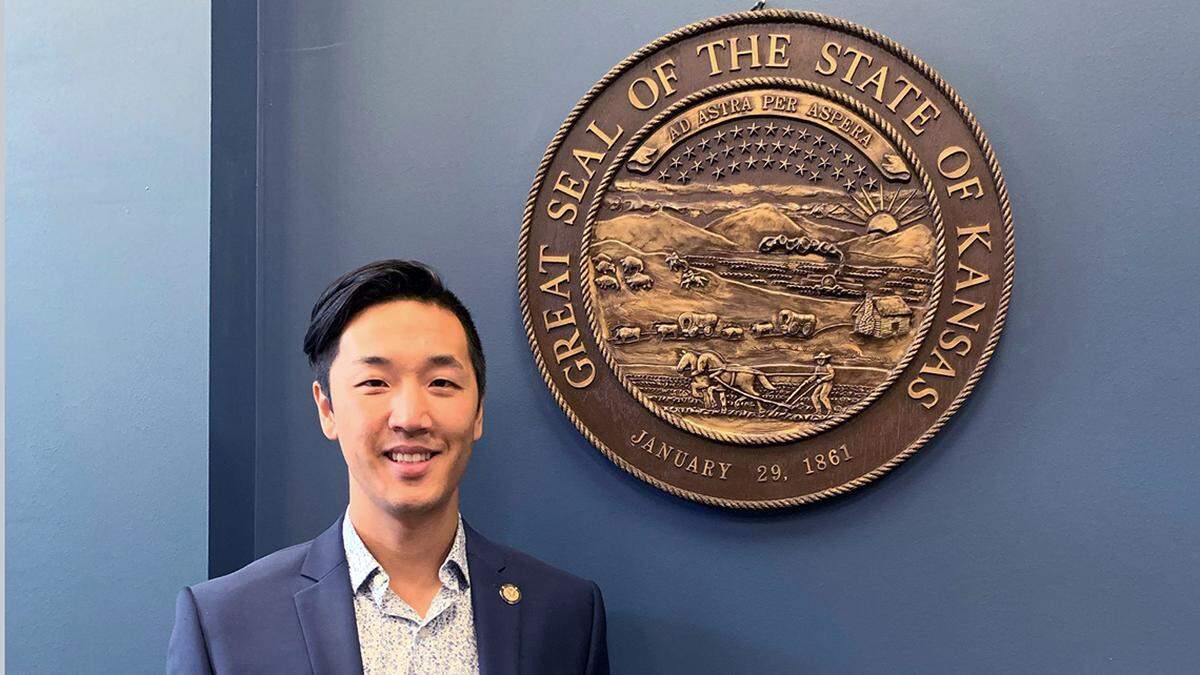
▪ Just over a week ago, Kansas state Rep. Rui Xu (pronounced Ree Shoe) of Westwood, the only Asian American serving in the Kansas House, spoke out after being threatened when he wore a COVID-19 mask into a bar in Russell, Kansas. “He’s probably carrying the virus,” he heard a patron say and then later scream, “Where the (explective) is he? I’m gonna kick his ass.”
▪ A billboard campaign to combat anti-Asian sentiments is now being contemplated by the Kansas City Chinese American Association, working with other local Asian groups. “First and foremost, we want to make sure that people are aware of the sentiment out there, which is very violent,” said board member Michael Li, who came from China in 1992 to attend graduate school in the U.S. and is now a vice president and senior portfolio manager for American Century Investments. “In the situation we’re facing today, we do have common ground.”
▪ In February, friends Katie Kwo Gerson and MaryAnna Huong Peavey had already launched an Instagram page highlighting the unique racial identity issues tied to being “hapa,” a slang term for people who are of partial Asian descent, such as half Asian and half white. They are calling on others to tell their stories.
“Atlanta was the icing on the cake that exacerbated what we had already been thinking about,” said Gerson, who is half Chinese and in 2004 became the first person of color to be named president of the Junior League of Kansas City. “Asian cultures and white cultures have often been misunderstood. She (Peavey, who is half Vietnamese) and I — with our Asian and white heritages — felt we could be bridge builders.”
Asian activists say racism was fomented during the Donald Trump administration, with the former president blaming China for lost jobs and, in particular, demonizing the country as the origin of the coronavirus, which he and others called the “China flu” and similar names.
The organization Stop AAPI Hate (it stands for Asian Americans and Pacific Islanders) has been charting the upswing. Since March 2020 — when most Americans realized COVID-19 had hit their shores — Asian people have told the group of 3,800 racist incidents — ranging from verbal assaults (68%) to shunning (21%) to physical assaults, civil rights and work violations to online harassment.
As soon as four months into the pandemic, 39% of Asian Americans in a Pew Research Center report said they newly sensed that others were now uncomfortable around them; 31% had been subjected to slurs or jokes; 26% feared being attacked.
KC’s Asian community
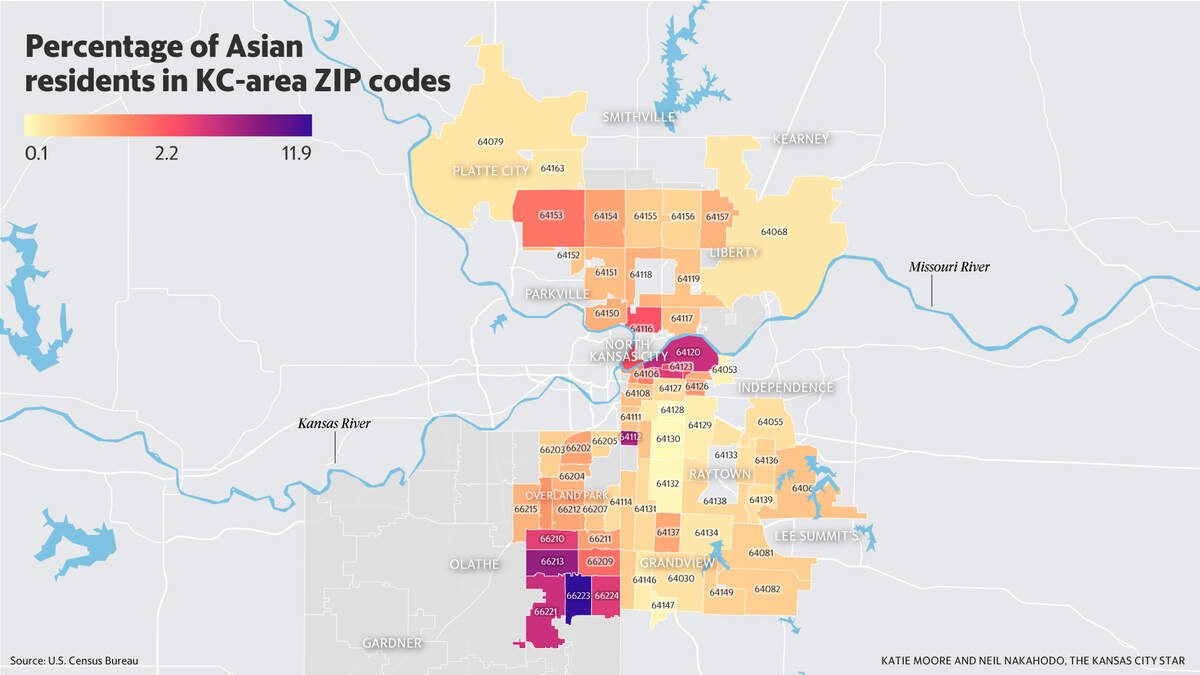
The Asian American population in the Kansas City area is not massive, but it is substantial with 80,200 people, about 3.7% of the area’s 2.1 million residents, according to census data. Nationwide, the 5.4% of people who identify as Asian American or Pacific Islander are part of the fastest growing racial group in the U.S., and one that is vastly diverse.
In the Kansas City area, people with ties to India, China, Vietnam, the Philippines and Korea make up the majority. But at least 17 other ethnic identities are also represented, including those who are Japanese, Taiwanese, Thai, Pakistani, Singaporean, Cambodian, Indonesian, Bhutanese, Laotian, Hmong, Samoan, Polynesian, Burmese, Micronesian, Bangladeshi, Nepalese and others. The 80,000 includes 14,000 who identify as part Asian, part white; nearly 3,000 are part Asian, part Black.
Diverse, the population is also spread out. In Independence, 0.4% of residents are Asian; in one Overland Park ZIP code, it’s 12%, or 1 in 8, the highest in the area — drawn there largely because of the Blue Valley public schools.
“Tiger moms always want their kids to go to the best schools,” said Maya King, who, born in China, came to the U.S. to attend the University of Kansas. An immigration attorney, King is president of Kansas City’s Asian American Bar Association.
Asian Americans are, in large part, educated and often successful: 53% have bachelor’s degrees, and at $81,000, their median household income is the highest of any racial demographic. Yet more recent immigrants or refugees from countries like Myanmar or Bhutan hold lower wage jobs at, say, factories, warehouses or area meat packing plants, King said.
A recent government report on “The Economic State of Asian Americans and Pacific Islanders in the United States” notes that poverty among Micronesian, Bangladeshi and Hmong Americans is at least 50% higher than the national average.
Meantime, thousands of others fill the the ranks of merchants (Asians own 4,000 small businesses in the KC area), doctors, lawyers, journalists, artists, professors, symphony musicians, engineers at places like Cerner, T-Mobile, Burns & McDonnell. One Asian immigrant, Min Kao, a native of Taiwan and co-founder of Garmin, is a billionaire.
“Economically, if you look at the Asian American community, they’ve done well ” said Vishal Adma, a psychiatrist and president of the Asian American Chamber of Commerce of Kansas City. In 1997, he came from South India to KU for a medical residency.
Prejudice and stereotypes
To be sure, numerous people interviewed by The Star said that, by in large, they have been treated well in the Kansas City area and could only think of rare instances of overt conflict or aggression pointed their way because of their race or heritage.
“Like I said, I have not experienced any of that,” said Joe Diep, 43, who came to Kansas City from Vietnam when he was 15, knowing no English. For 20 years, he and a brother have run Thanh Tung Video & Gifts, now at 650 E. Fifth St. “I guess I’m fortunate,” Diep said.
At the same time, there was not one unable to share a story, or many, as the target of subtle or blatant prejudice, which they say has escalated since the COVID-19 outbreak.
Nancy Pei, 15, a sophomore at Blue Valley High School, scrolled through Instagram after the Atlanta shootings and cried when she saw this post: “We came here hoping you would accept us.” She related.
In middle school, classmates would pull the skin taut around their eyes to make fun of her. She didn’t dare tell her classmates that she also attended Chinese school or celebrated Chinese New Year.
“People make jokes at the expense of Asian Americans,” Pei said. “And a lot of times we’re expected to laugh because, you know, ‘It’s just a joke.’”
Equally common for those long in the U.S. — even for those who are first-, second-, third-generation Americans — is the experience of dealing with a lifetime of racial stereotyping.
They tire of hearing the questions and assumptions: Why is your English so good? Where are you really from? Asian men get painted as good at math, but bad at sports. Asian women are seen as passive, violin-playing students, driven to excel by obsessed tiger moms, or sexually fetishized as “exotic” partners.
In Atlanta, Robert Aaron Long, who was charged with eight counts of murder, told police the killing was not racially motivated. Instead, he said he had a “sex addiction” that police said was a “temptation he wanted to eliminate.”
“That sense of the Asian being kind of a perpetual foreigner is something that I think is particularly pronounced (in the Midwest),” said Timothy Yu, a professor of Asian American studies at the University of Wisconsin in Madison, “because there is that assumption that you don’t have a community, you just kind of landed here from somewhere, so, ‘How did you get here?’”
At times, he added, there also is “this sense that you don’t really exist at all, or ‘What are you doing here? You don’t belong here.’”
Weber, the Missouri state representative, felt it in 2016, soon after the presidential election. Adopted from South Korea, she grew up in Kansas and said it was a racist comment from a stranger in a grocery store parking lot that pushed her into politics.
“I was told to go back to where I came from,” the Kansas City Democrat said. “It was kind of my slap in the face. … I wanted to do something.”
Anger has turned to profiling.
“Especially with COVID, I heard some people talking about like the ‘China virus’ and it’s just like those little comments really come after us,” said Grant Mao, 17, a senior at Blue Valley North High School.
Or coming after those you love, said classmate Samuel Wang, 17, who thought about his grandmother.
“When you have to fear for her safety because of the coronavirus, but also because someone might just attack her on the street, it’s kind of crazy,” he said. “It kind of makes you not want to show your face outside. … When the victims look like you, share the same cultural background as you and speak some of the same languages as you know, it’s like, well, if it can happen to them, it can happen to me as well.”
Shen of Hallmark said she saw signs of rising anti-Asian sentiments when COVID-19 was still in China, soon to head to the U.S. She was at a local grocery store and noticed a woman looking at her with what she called “a look of disgust.”
“I mean I always knew I was Chinese,” Shen said, “but I never really felt like, you know, nonwhite. Then, like, in that moment, I really felt like I’m being viewed as an outsider here.”
Yongfu Wang, 41, of Overland Park, with kids, ages 11 and 14, recently bought a gun.
His wife, Xia, had been keeping track of news reports of rising anti-Asian acts. She wanted the family protected. He signed up for a firearms training class. She took a self-defense class on how to use pepper spray. She feels the family is better prepared.
He feels no safer.
“For myself, no,” he said, because the “feeling” of a threat is hard to shake.
‘You have to be quiet’
The history of racial scapegoating in the U.S., especially in moments of turmoil, is as old as the country itself, as clearly evidenced by the Chinese Exclusion Act of 1882 and, during World War II, the forced internment of Japanese Americans.
After the Sept. 11, 2001, terrorist attacks, threats and violence were likewise broadly visited upon people of Middle Eastern heritage or Muslim faith.
In February 2017, two friends, Srinivas Kuchibhotla and Alok Madasani, who had come from India for school and engineeer work at Garmin, were shot in an Olathe bar by a gunman who allegedly mistook them for Iranians and, because of that alone, thought of them as terrorists. He yelled, “Get out of my country!” before firing. Kuchibhotla, 32, was killed. The gunman was sentenced to three consecutive life prison sentences.
Since the rise of COVID-19, such inchoate anger is focused on those from East and Southeast Asia who “look Chinese.”
At the Chinatown Food Market in Kansas City’s River Market, manager Donny Lo, 39, said that ever since the virus hit, they have increased security. At night, they started to close the market earlier to protect employees.
“Now when I go into big public spaces and walk in the city,” Mao, the Blue Valley North student, said, “I’m more self conscious and, like, I started thinking, looking around more, checking my shoulder.”
All recognize the significance of speaking out.
“If you don’t speak out,” Lo said, “people might just take your silence for consent.”
Gerson, with the hapa Instagram site, noted that for many Asian Americans, public dissent does not come easily.
Asia has had its own recent protest histories: the pro-democracy Tienanmen Square protests in 1989; the Hong Kong protests, started in 2019, against Beijing’s ever-tightening control; the current protest in Myanmar against a Feb. 1 military coup.
In the United States, she said, the lesson has been that one succeeds by not complaining, by working hard and following the rules.
“It’s cultural,” she said “It’s baked into the cultures of East and Southeast Asians: Be quiet. Don’t stand out. It is taught to kids. You can be in the room, but you have to be quiet. Put your head down. Work hard. Calling attention to yourself invites critics. Because of the baked-in racism around Asians, you don’t want to be criticized.”
Yan Li, a KU associate professor of East Asian cultures and languages, said that for many Asians, modesty and humility are valued over boisterousness.
“We like to show respect to others,” she said. “We don’t want to express ourselves, not as much as Americans do.”
King, the president of the bar association, said that traditionally has been the case even in the face of obvious prejudice or discrimination.
“That’s what your parents have taught you,” King said. “You keep things to yourself. You be the bigger person. We don’t want confrontation with anybody. I don’t want to report this to the police. I don’t want to burden anyone else with my problem.”
But Li quickly added, “I think it’s time for a change. Because I think we have suffered too much.”
To Cafe Cà Phê manager Koguchi, the carnage in Atlanta is just too powerful to ignore.
“I’m still really trying to process the anger that is within me,” she said. “That was a huge shock to me, the fact that people who look like me, women who look like me, women who have the same kind of history as me. … I felt like this can be me.”
Gerson sees the moment as an inflection point.
“This moment,” she said, “is one that I don’t think East Asians and Southeast Asians are going to let be forgotten. I think this will be taught in schools.”
Said Shen, “It’s taken me 37 years to get to the point where I realized it’s not enough for me to not be racist, I really have to be actively anti-racist. …
“Like both my kids were born on the Fourth of July, so they should be given the opportunity to live the true American dream, right? Without any biases or stereotypes. Or will they live in a world where that still exists?
“That’s the question.”
Includes reporting by The Star’s Katie Moore.
This story was originally published March 27, 2021 at 5:00 AM.