Young Kansas Citians carry on spirit of activism following year of protests, upheaval
It started with a call for justice.
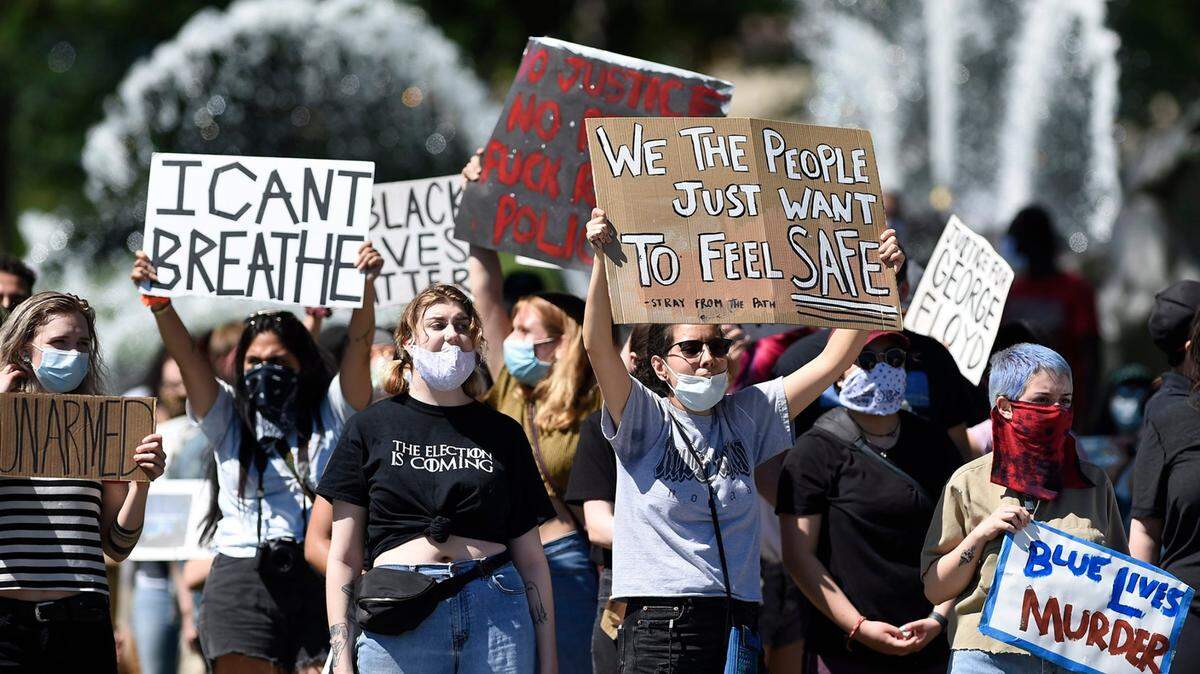
Hundreds of Kansas Citians filled the streets bordering the County Club Plaza during the first week of June, chanting what are now common refrains: “Black lives matter,” “no justice, no peace,” “I can’t breathe.”
Many of their faces were hidden behind masks — a result of the still prevalent pandemic — but their eyes were young. A youthful exuberance filled the Midwest air, thick with frustration. Young people had turned out in droves, many for the first time.
They organized more protests. They led marches down what was once J.C. Nichols Parkway. They continued their demands for justice and change, launching new advocacy and social justice organizations: Black Rainbow and White Rose KC, for example.
While the growth of youth activism has bubbled over the last several years, the protests following the death of George Floyd, killed by a police officer in Minneapolis, gave new rise to young activism and sparked a radical shift in Kansas City’s activism scene.
They now carry on the legacy laid by the activists of generations before them.
“I think young people everywhere have been radically transformed by the events that took place last year,” said Ryan Sorrell, co-founder of Black Rainbow, which grew organically out of the June protests.
His own draw to activism grew out of the trauma of watching events such as the acquittal of George Zimmerman, who fatally shot Trayvon Martin while he was in college. Then there was the lack of charges filed against Ferguson police officer Darren Wilson, who shot and killed Michael Brown.
Those killings — and the lack of justice — unveiled a system, Sorrell said, that would never be equal.
He took lessons, he said, gathered from following the likes of the Black Youth Project, a national research project launched in 2004 that examined the attitudes, resources, and culture of Black youth ages 15 to 25. The project explored how such factors, and others, influence the decision-making, norms, and behavior of black youth.
When he moved back to Kansas City from Chicago because of COVID-19, he wasn’t planning on staying. Then, George Floyd was killed and Black Rainbow emerged organically out of the protests, Sorrell said. He left his corporate job behind to focus helping lead, what he calls, a radical unapologetically Black organization.
Sorrell’s always known activism is what he wanted to dedicate his life to. But this summer, he said, was pivotal, “something that happens once in a century.”
Carrying on a legacy
In May 1963, more than 1,000 students in Birmingham, Alabama, skipped classes to call for justice.
Hundreds were arrested. And when they continued to show up, hundreds more were blasted by fire hoses, clubbed by police and attacked by police dogs.
It became known as the Children’s Crusade.
It’s that event that Kansas City-based organizer with the American Civil Liberties Union Justice Gatson pointed to as an example of the impact young people make in the fight for equal rights.
That crusade ultimately helped get the Civil Rights Act of 1964 passed.
Children, Gatson said, knew it was up to them. They knew then that they had to take a stand. And today’s young people know the same thing.
“There’s that kind of thing that young people just have,” said Gatson, who began her own activism as a teenager and over the years founded Reale Justice Network and a community bail fund. “That’s just fearless. And I see that here.”
During this summer’s protests, Gatson said she didn’t feel it was her place to get in the street with the megaphone. She saw young Kansas Citians picking up the torch and said she felt she should leave that space open for them to fill, to empower them.
“It is the young people who lead movements,” Gatson said. “It always has and it always will be.”
Organizing in Kansas City has a rich history. Gatson said in the time of the strength of the Black Panther Party in the 1960s, for instance, organizing was stronger.
With Pete O’Neal serving as the chairman of the Kansas City chapter of the Black Panther Party in the late ’60s, the city became a major player in the national movement and a focal point for capturing the imagination of young black activists across the Midwest, according to a University of Missouri-Kansas City project on major activists in the metro area done in conjunction with the Center for Midwestern Studies.
Kansas City’s close proximity to the Brown v. Board of Education case made it a bastion of civil rights activities through the 1950s, wrote Annie Derrell as part of the project.
But over the years, Gatson said, Kansas City’s organizing when it comes to activism has become “fragmented.”
“I know that the organizing community was stronger back in the day than it is now,” Gatson said. “I know because I was part of it.”
But now she’s watching a return to that strength.
Gwen Grant, president and CEO of the Urban League of Greater Kansas City, said she has seen young activists show dedication to social justice and racial equality. And she admires their passion, focus and intellect.
Grant said Martin Luther King Jr. was a “servant leader.” And as his legacy is commemorated this year, she said it’s important to provide the same selfless service in communities to continue to improve conditions King left behind.
“And we need to be reminded that freedom is not free,” Grant said. “We have to work for it.”
Demanding change
On the evening of July 4, in front of at least 100 people gathered in Mill Creek Park for a freedom rally, community activist Justice Horn told the crowd that people needed to organize to face issues such as housing, food insecurity and mental health. To affirming applause he criticized the police response to the first week of protests, the beating of Breona Hill — a Black transgender woman — and called for Kansas City Police Chief Rick Smith to resign.
His journey to activism, he said, began when he became the first multicultural openly gay college wrestler in the NCAA while attending Northern State University in South Dakota. His coming out received national attention.
Horn then transferred to the University of Missouri-Kansas City where he was elected Student Government Association president, advocating for LGBTQ protections in the student code. During his time there he said he even helped pass nondiscrimination ordinances.
But the summer of 2020 served as Horn’s foray into civil rights activism, he said.
“A theme of being a young person is never wait for anyone to give you permission,” Horn said, “because not only is this our future but this is the world that we’re gonna grow and live in and hopefully stay for a while.”
Young people aren’t waiting for those in power to make a difference, Horn said. Instead, they are challenging the status quo and enacting real change. He pointed to Black Rainbow and KC Tenants, which has fought to stop evictions in Jackson County, as an example.
On the rooftop of the National WWI Museum and Memorial in December, Horn celebrated the creation of an LGBTQ commission with other community leaders — a commission he helped push for. The first of its kind in Missouri commission, appointed by the mayor and city council, will provide policy advice on issues affecting lesbian, gay, bisexual, transgender and gender queer residents.
“We’re all in this fight together,” Horn said. “We need to stand with one another.”
Since the protests last summer, Horn said, he has seen the rise of youth activism across the country — especially in Kansas City.
For Kalvin Verner, he always felt there wasn’t much he could do to change what he always saw as injustices in his city.
Verner, a junior at Lee’s Summit West, caught the activist bug when he was 12 or 13 years old. His mother would drive him around Kansas City and he’d see potholes in the street and houseless people on the sidewalks. He realized the economic system is set up for poor people, and Black people, to fail, he said.
Until his freshman year of high school, it felt like there was not much he could do being so young. Over time, he discovered clubs at school with which he could get involved, which ultimately led him to the Sunrise Movement.
“I think there’s always been this fire in young people’s hearts,” Verner said.
One of the biggest challenges for many young people, especially those who aren’t yet 18, is just that: not being an adult. People sometimes don’t take him seriously, he said, and he often has to seek out adult help to get around red tape. And when race is added on top of that, Verner said, it makes it even harder.
“As a (person of color),” Verner said, “a lot of people have never been taken seriously in general.”
However, he said, when people see what he’s trying to do — whether it’s organizing a conversation about race in school or producing a podcast — they usually help out and support him.
Yazmin Bruno, a sophomore at Donnelly College, said the rise of young activists has been in the making for years. George Floyd’s killing, she said, mobilized young people.
Even her 10-year-old sister posted on TikTok about Floyd’s death.
Bruno, who is undocumented, works with the Kansas/Missouri Dream Alliance, a nonprofit youth-led student immigration organization. She’s known she’s wanted to be an immigration lawyer since she was in third grade. Bruno, who said she hasn’t seen a brown woman lawyer, wants to represent her community. She knows what it’s like to live undocumented. And she wants to help others.
Martin Luther King Jr. fought for people to be humanized, she said. “We do deserve our humanity.”
The fight for racial equality has been happening for centuries now. Bruno doesn’t want her little sisters fighting the same fight as they grow up.
“I know we can’t fix every problem in the world,” Bruno said. “That doesn’t mean I’m not gonna try. You have to have something to fight for.”