Rising positive rates for COVID-19 tests one more sign virus is spreading in KC metro
As coronavirus data trends in the wrong direction locally and nationwide, the percentage of COVID-19 tests that came back positive in the Kansas City metropolitan area has steadily risen in June and July, according to data maintained by The Star.
That shows increased spread of the virus in the community, said Frank Thompson, Deputy Director of the Kansas City Health Department.
“If we were seeing increased numbers but not an increase in positivity rate then that would suggest we were just catching up and identifying cases that were already out there,” Thompson said.
“The fact that the positivity rate or the percentage of the tests that are being conducted is also going up suggests that there actually is more infection happening out there in the community.”
The increasing positivity rates depict the swift spread of the virus locally. On Thursday Missouri saw a record number of new cases for the third day in a row and the Kansas City metro area set a record for a second straight day, adding 605 new cases.
The metro currently has a seven-day rolling average of 430 new cases per day. On June 4 that average was 102 new cases per day.
At least 300 people have died from the virus in the Kansas City area.
At the beginning of June, some jurisdictions in the Kansas City area were below 3% , or close to it, for cumulative testing positivity rate. As of Thursday, the cumulative rate had moved up rather than down for Kansas City, Jackson, Platte and Clay counties in Missouri and in Johnson and Wyandotte counties in Kansas.
None of the jurisdictions are within the 3% benchmark for cumulative test rates that experts say should be the goal. All are at least two percentage points above it.
If residents do not take the virus seriously, Thompson said, the Kansas City metro area could begin to see overwhelmed hospital systems similar to what is being reported in Florida and Texas.
“That is something that, not just us but every health department in the region, that is something all of us are watching closely,” Thompson said.
He added that he believed the lack of such consequences in the area had “lulled some people in to a false sense of complacency.” He emphasized the importance wearing a mask when in public and avoiding travel unless it’s “absolutely necessary.”
Samni Areola, director of the Johnson County Department of Health and Environment, said in an emailed statement that the increased positivity rate was a result of activities and events occurring in the county bringing people in close proximity and often without wearing masks.
“This is a prime way to spread the virus and that is what happened,” Areola said.
He added that the department has redeployed staff from other projects to work on coronavirus response and that an increase in infections is a “cause for concern.”
Nationwide, the total case count exceeded 4 million Thursday. More than 143,000 people have died from the virus.
“Certainly we are not winning the game right now,” said Dr. Anthony Fauci, director of the National Institute of Allergy and Infectious Diseases, on Wednesday, CNBC reported. “We are not beating it.”
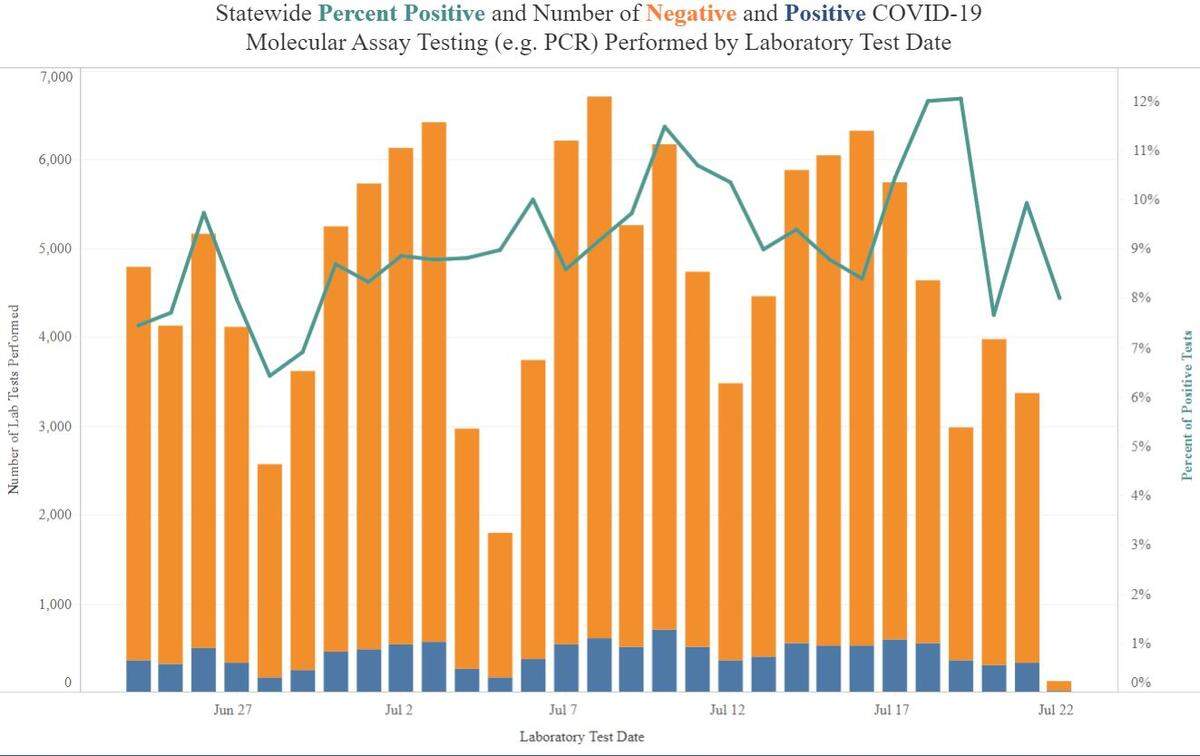
Positivity Rate
The positivity rate for new coronavirus tests is a data point that should be moving down, according to public health experts and officials.
If the percent of positive tests reported is 3 percent or below, that means an area is testing a wide swath of it’s population, including asymptomatic individuals, Jennifer Tolbert of the Kaiser Family Health Foundation previously told The Star.
Testing for the virus has become more difficult nationwide as processing labs are unable to keep up with demand and return test results at a slower and slower rate.
In Kansas City, Thompson said, results are coming back in five to seven days but the health department is being careful not to test so much that it overwhelms labs locally.
Testing numbers have not changed substantially in the Kansas City area, Thompson said. Therefore he said the increased positivity rate shows that new cases being reported are not simply the result of more testing. Thompson also said it is an indicator that testing is occurring in the parts of the area most heavily affected by the virus.
“There is infection out there in the community,” he said. “The question is is our testing actually finding it.”
Daily tracking of the positivity rate is not available on a county-by-county basis in the KC area. Therefore, the positivity rates provided by the local health departments are cumulative, depicting total testing since the beginning of the pandemic.
Wyandotte County has held the highest postivity rate since the beginning of The Star’s data set on June 4 when the county reported a cumulative rate of 15.9%. The number dropped to 15.3% by June 22 but began rising again reaching 17.3% by Thursday.
In Kansas City the cumulative positivity rate was 4.01% on June 4th. That rate raised to 5.6% by the end of June and dropped back down to 4.77% on July 13 before raising to 5.38% by Thursday.
In Jackson County the cumulative positivity rate was 3.96% on June 4th. The rate dropped to 3.7% by June 11 but then raised to 6.3% by Thursday.
In Clay County 2.11% of tests were positive as of June 4. By Thursday, that number had risen to 7.64% the data rose and dropped dramatically on some days during June and July.
In Johnson County the cumulative positivity rate was 4% on June 4. The rate dropped to 3.7% by June 16 and then rose to 6.3% by Thursday.
Platte County did not begin reporting its cumulative positivity rate until July 6. At that time the rate was 4.93%. It rose to 6.66% by Wednesday Thursday after dropping to 2.24% on Monday.
Kristi Zears with the Kansas Department of Health and Environment said the state has seen increasing positivity rates for four weeks straight.
The data was previously decreasing, she said, as more testing was being performed. Now, Zears said “what we are seeing is lots of testing, but more cases being found.”
“The trend correlates to what we are seeing with increasing daily counts of new cases and a clear second spike in cases across the state,” she said.
This story was originally published July 23, 2020 at 5:32 PM.