
‘Pools of infection.’ Vaccinations surge in some parts of KS, MO while others struggle
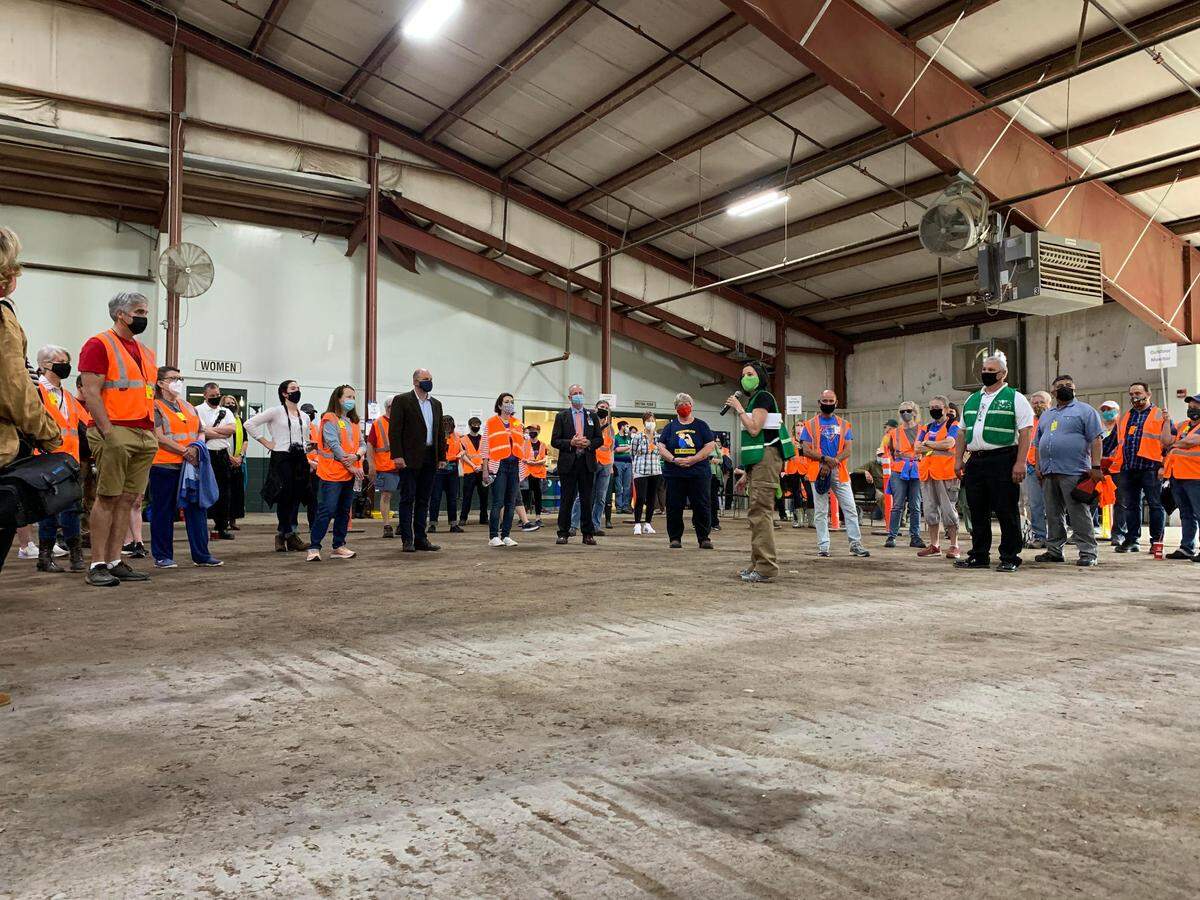
Inside a cavernous building on the Douglas County fairgrounds on a rainy Wednesday afternoon, dozens of volunteers wearing orange safety vests gathered to be briefed on the work ahead: watch out for needles, respect people’s privacy, stay inside if there’s lightning.
This would be the county’s last mass vaccination clinic for COVID-19, part of a coordinated effort that made Douglas County a state leader in delivering shots to arms. More than 45 percent of its residents have received at least one dose, the second-highest percentage among counties.
Compared to some neighboring counties, however, Douglas is a hot spot of vaccine interest.
To the southeast, in Miami County, just 30 percent of residents have received one shot. To the northeast, only 28 percent have gotten a first shot in Leavenworth County.
In Kansas, a 26-point gap exists between the county with the highest vaccination rate, Marshall, and the lowest, Geary. In Missouri, the gap is 33 points.
Vaccines have never been more available in Kansas and Missouri. After months of restricted access, everyone 16 and older has been eligible for weeks now.
But as the sprawling vaccination campaign continues across both states, it’s becoming increasingly clear that some communities are running far ahead while other, often rural, areas remain stubbornly behind.
If left unresolved, the gaps separating low and high-vax areas could lead to a split-screen summer, with counties, cities and even neighborhoods evolving into islands of vaccination while others continue to deal with hospitalizations, and possibly deaths.
“The higher vaccinated counties will have less disease and less impact,” said Lee Norman, secretary of the Kansas Department of Health and Environment.
Health officials in Lawrence are paying attention.
“It’s vitally important that that work in other counties continues and is successful because we do not live in a bubble,” said Dan Partridge, director of the Lawrence-Douglas County Health Department.
At the same time, disparities in vaccine uptake could also make it difficult for even high-vaccination areas to truly control the virus as the unvaccinated continue to work in and visit these places.
Alan Morgan, CEO of the National Rural Health Association, said if rural and urban areas aren’t vaccinated at the same rates, it creates the potential for “pools of COVID infection.”
“We’re a mobile society, and if you have adjacent rural towns and rural communities not vaccinated, you’re still allowing this pandemic to continue into the future,” Morgan said.
Derik Flerlage, the infectious disease division manager for the Shawnee County, Kan., Health Department, said a county with a high vaccination rate next to one with a lower rate “does create the potential for an outbreak situation.”
“I think what I worry about is having these pockets of potential outbreaks, these pockets of transmission,” he said.
A more targeted approach
While vaccinations have never been more available, the days where thousands would converge on a mass site are coming to an end. Demand for shots is falling and the resources required to operate large clinics can be intensive.
“The interest in getting vaccinated is now waning. We’re having lots of vaccine in refrigerators waiting for arms to put it in, and if more adults don’t get vaccinated, this virus is going to continue to spread,” said Dr. William Schaffner, infectious diseases expert and professor of preventive medicine at the Vanderbilt University School of Medicine in Nashville.
Officials in both states are now turning their attention to smaller clinics and mobile operations to reach individuals. And they’re emphasizing the importance of conversations with vaccine hesitant individuals.
The coming weeks and months will test whether the more intimate, targeted approach can close the vaccination gap.
“We want to make sure we reach all people in all counties and there’s still a lot of work to be done,” Norman said.
Illustrating the divide, just over 35% of Kansas City residents have started the vaccination process. But two counties to the north, in Buchanan, the number falls to 18%
In Joplin, nearly 40% of residents have at least one dose. But out in the two counties where the city sits — Jasper and Newton — it’s less than 20%.
Overall, 38% of Kansans have received at least one dose of vaccine while 37 percent of Missourians have started vaccination. That’s well short of the 70-90 percent rate that health experts say may be needed to achieve herd immunity, where the virus begins to die out because it can’t find more people to infect.
Vaccination data for both Kansas and Missouri show the number of doses administered is falling after peaking in late March in Kansas and early April in Missouri. As recently as April 11, Missouri was averaging 54,319 doses every week. Earlier this week, the average dropped below 25,000.
“So while we’re opening up, we’ll still have spread of the virus,” Schaffner said. “We will not be at the point where we can say this virus has been controlled. We won’t get there unless a lot more adults come forward to be vaccinated.”
Current vaccination trends suggest that by May 7 about one-fourth of Missourians will have completed a COVID-19 vaccine series, according to the Missouri Hospital Association.
That would mean about 58% of the state’s residents would have protection either from a vaccine or a previous infection, falling short of the 65% to 85% coverage needed to prevent community spread of the virus, the association says.
Age, politics, insurance
Missouri has some hard convincing to do with certain groups, a poll of 800 adults conducted by the Missouri Hospital Association revealed in April. Half of those surveyed had been vaccinated and another 11% said they planned to get vaccines.
But 28% said they didn’t plan to get the vaccine, a level of resistance which could hinder the state’s ability to reach herd immunity without a significant change in attitudes toward vaccination, the survey warned.
Age, politics and insurance status are all forces working against these efforts in Missouri.
The survey found that conservatives were less likely to indicate they would get a shot. Missourians ages 18 to 44 who self-identified as Republicans were the least likely to get vaccinated — a potential barrier in a state where the GOP dominates rural areas.
There was hesitancy among Black residents, too, a group hit hard by the virus. And, 51% of uninsured Missourians indicated they will not get vaccinated — only 15% have so far. That’s a group, Dillon said, that needs to hear over and again that the vaccines are free.
Some efforts are underway to reach vaccine-hesitant conservatives. Kansas Republican Sen. Roger Marshall, a Great Bend OB-GYN, last week appeared in a public service announcement with other GOP doctors in Congress encouraging vaccinations.
The ad framed vaccinations as a way to “live life as free as before” the pandemic.
Several of the least-vaccinated counties in Kansas are in the southeast and southwest parts of the state. Marshall said he’s appeared at a number of town halls in both areas where people with libertarian philosophies feel like they’ve been deceived, talked down to and lied to about the vaccines.
“Almost like America’s tried to shame them into this and it’s kind of backfired,” Marshall said in an interview. “So they’re dug in now and saying you can’t make me do this.”
Marshall said people need to hear from their nurse, pharmacist, or doctor. “They need it from somebody they trust enough,” he said.
Morgan, of the rural health association, said so far the messaging about the importance of vaccines has not been “rural relevant. It has not been helpful from a rural perspective.”
“And I say that because at least from what we’re hearing from our membership, having the CDC tell people what they can and can’t do, and having politicians tell rural communities what they can and can’t do just is not a successful messaging strategy,” Morgan said.
“And where we’re seeing successes in communities it’s local leadership driving this, and that’s how it has to be going ahead,” Morgan said. “We really have to put small town doctors and nurses at the front of promoting vaccinations in a rural context.”
In Barry County, Missouri, home to about 36,000 people, roughly 30% have received first vaccine doses and 27% second doses, said the county’s public health administrator Roger Brock.
Those are “pretty good” numbers for that area of southwest Missouri, though he’d like to see them higher, Brock said. “But we are running into the point now where we’re getting into some of the younger age groups that are a little more hesitant and have a little more concerns about vaccinations.”
He ran into less resistance from older residents, likely because for “most of them vaccines have played a role in some family member’s life or their life with polio and those type things,” Brock said. “I think that makes a difference.”
“It is mostly, from most of the ones that I’ve heard from, how quickly they were able to produce a vaccine and they’re concerned about what it might be 20 years from now and we don’t know … is it going to be this or that or whatever,” said Brock.
‘Give every opportunity’
Even though some rural counties have especially low vaccination rates, Kansas City and other metro areas still have a long way to go before achieving ideal rates.
Both Kansas City and St. Louis City lag the Missouri average for beginning vaccinations.
Niki Lee Donawa, chief community relations officer for Truman Medical Centers/University Health, leads an eight-person, bilingual team at the hospital that sets up vaccination clinics in neighborhoods known to have high rates of COVID-19. Their work has taken them to Black churches, community centers that serve Hispanic clientele, even the Mexican consulate.
It’s gotten tougher over the last couple of weeks to find takers, she said. Now the team has started going where the workers are, visiting restaurants, grocery and neighborhood corner stores.
“We know that those are the workers that will tend to kind of fall by the wayside, if you will, if we don’t reach out,” she said.
Donawa said the hospital went through a phase where people were clamoring for the vaccine but there wasn’t enough. Then they reached people who waited it out initially but came forward after they saw that vaccinated people were doing fine.
Now it’s time to reach those who might need more education about the vaccine. She thinks they’ll still be trying to encourage vaccinations through the end of the year, “especially in some of the areas that we will venture into.”
“At the end of the day, it’s everyone’s own personal decision,” she said. “But we do want to make them comfortable enough and give them every opportunity we can give them.”
Back in Douglas County, health officials are pushing ahead after holding their final mass vaccination clinic. The city-county health department plans an all-comers clinic this weekend focused on reaching people of color.
Even with at least 45 percent of residents partially vaccinated, another 25 percent or more of the population needs shots before the county begins to approach herd immunity.
Months ago, the agency conducted a survey to get a handle on interest in the vaccines. Just about everyone who said they were ready to get the shot has now been vaccinated, said Partridge, the health department director.
The people who haven’t shown up are those who said they weren’t ready or needed more information.
“That’s the work that lies ahead,” Partridge said. “To do that hard work of convincing people that this vaccine is for them.”
The Star’s Bryan Lowry contributed reporting
This story was originally published May 2, 2021 at 5:00 AM.

.jpg)