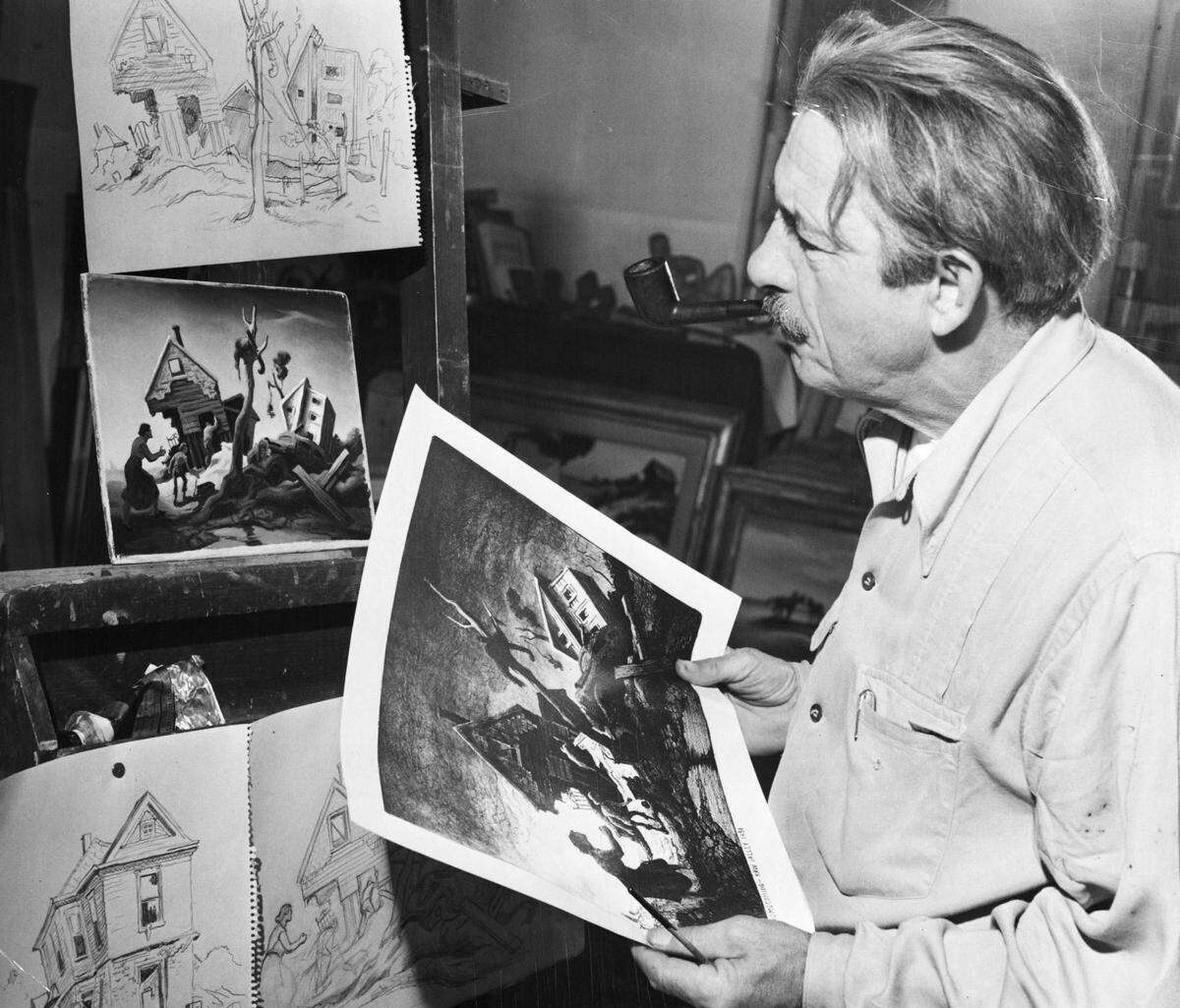
Kansas City bank triumphs in five-year legal battle over Thomas Hart Benton’s artworks
Thomas Hart Benton’s heirs were seeking $85 million. They got $35,000.
That’s the culmination of a five-month trial over a lawsuit brought in 2019 by the Kansas City artist’s daughter and her three children, who alleged that UMB Bank had lost more than 100 pieces of Benton’s art and improperly cared for other works. The Benton family also said UMB, which was the trustee and executor of Benton’s trust, had engaged in self-dealing and sold pieces for less than their market value.
Jackson County Circuit Court Judge Mark Styles Jr., who presided over a bench trial from February to July 2023, viewed matters differently. In a 59-page judgment entered last Friday, Styles concluded that the Kansas City bank did not breach its fiduciary duty to the Benton trust and that there existed only five works of art that UMB was unable to account for.
Those works were not paintings but “likely sketches or studies,” Styles wrote. Collectively, their value was estimated to be $35,000, which is the amount Styles awarded the Benton heirs.
“We are disappointed by the verdict and are currently considering all our options, including an appeal,” said Kent Emison of the Langdon & Emison law firm, which brought the suit on behalf of the Bentons. “Despite the decision from this trial, we still strongly believe in the merits of the case for the Benton family.”
Filings from the case suggest at least two of the plaintiffs — both grandchildren of the artist — showed what the judge called “disinterest” in the case. One repeatedly contradicted the claims of his own attorneys and another attempted to withdraw from the suit.
Mariner Kemper, chairman and CEO of UMB, called the court’s decision “vindicating” not just for UMB but for the legacy of his father, R. Crosby Kemper Jr. who managed the trust until retiring as UMB chairman in 2004.
“From the beginning of this dispute, the plaintiffs and their lawyers have made a number of baseless allegations which this decision unequivocally disproves,” Kemper said in a statement. “Their attempts to exploit false claims and ruin the reputation of our company, my father and the many upstanding UMB associates who worked on this account did not succeed, and the Court’s decision proves that justice does prevail, even if it may take time.”
A five-year slog
The dispute pitted two historically influential local families against one another.
On one side was the acclaimed Kansas City artist’s daughter, Jessie Benton; her son Anthony Gude; and her daughters Daria Lyman and Cybele Benton McCormick.
On the other was UMB, owned by the Kemper family, whose banking lineage in the state goes back more than 100 years.
Benton and his wife, Rita Benton, both died in 1975. Benton’s will named UMB Bank and his attorney Lyman Field as co-trustees of the Thomas Hart Benton Trust. Field died in 1999, at which point UMB became the sole executor and trustee of Benton’s trust, with broad authority to sell and promote Benton’s art.
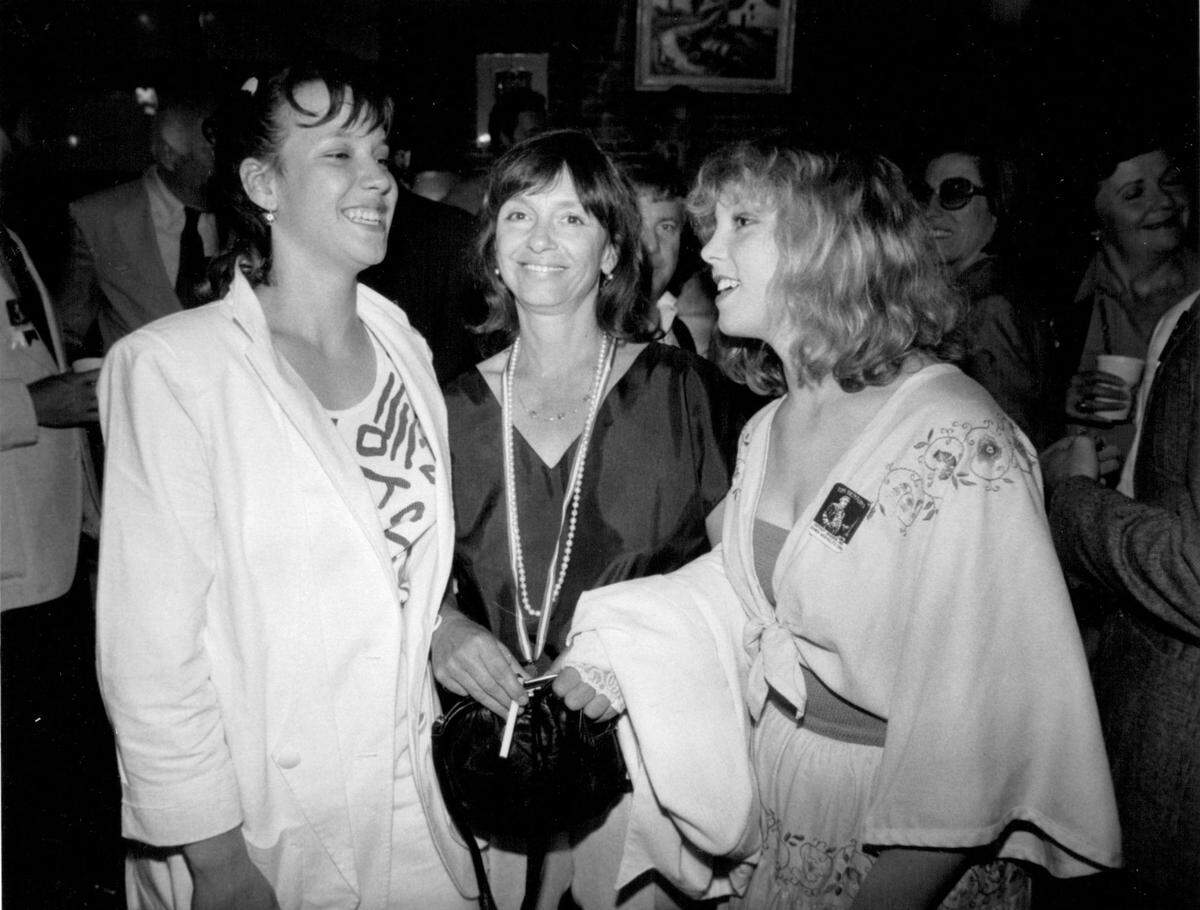
While in town in 2015 for a retrospective of her father’s work at the Nelson-Atkins Museum of Art, Jessie Benton visited a vault UMB had built to store Benton’s paintings and felt it was without adequate temperature and preservation controls. It also seemed to her that several paintings were missing. She contacted her attorney, Andre Boyda, setting in motion a yearslong inquiry by Boyda and later the law firm Langdon & Emison into UMB’s handling of the Benton trust.
In the resulting 2019 lawsuit in Jackson County probate court, the Bentons alleged a host of claims regarding UMB’s mismanagement of the trust and demanded the bank be removed as trustee.
Two years later, UMB filed a suit of its own against the Bentons, alleging in the U.S. District Court of Western Missouri that the Benton heirs engaged in a racketeering effort aimed at defrauding the bank. UMB said the family was motivated by its involvement in the Fort Hill Community, a secretive group that some have characterized as a cult. That suit was later dismissed.
Jessie Benton died in Los Angeles on Feb. 16, 2023, 10 days after the probate trial began. But the proceedings moved ahead, with Judge Mark Styles hearing the testimony of 67 witnesses between February and the trial’s conclusion 74 days later in July.
The judge’s findings
In his ruling, Judge Styles found that the Bentons and their attorneys had consistently failed to establish many of their claims regarding the bank’s mismanagement of the trust.
He repeatedly cited the testimony of Thomas Hart Benton’s grandson, Gude. A plaintiff and the only member of the family that testified at the trial, Gude made several statements that contradicted the arguments of his own attorneys, Styles said.
Gude is an artist himself and “was active in multiple sales of artwork belonging to the Benton trust,” Styles wrote. Gude regularly made suggestions “as to the pricing of artwork, which dealers to use, which gallerists to involve, the commissions to be paid, the exhibition shows to hold, and which trust administrators to work with.”
Regarding UMB’s allegedly improper storage of Benton’s art, Styles wrote that Gude testified that he had visited and even stored some of his own paintings in UMB’s vault and never expressed concern with the conditions.
“Plaintiffs failed to show in any way that any artwork kept inside the vault was damaged or that the Benton Trust itself suffered damage as a result of UMB storing Benton’s artwork in its vault,” Styles added.
Another of the plaintiffs’ allegations was that R. Crosby Kemper Jr. sold Benton paintings to Barbra Streisand without appraising them first or negotiating a price. But Gude testified that Jessie Benton and her husband at the time “took part in the transaction and had a major say in which paintings were to be shown to Ms. Streisand and what the price of those paintings should be.”
The plaintiffs also alleged that UMB had failed to monetize the assets of the trust by mass producing Benton’s paintings in a commercial setting, resulting in the loss of millions for the trust. But Gude testified that “it would be demeaning” to do so, and that his grandfather’s paintings were “more appropriately placed in museums rather than shopping malls.”
Styles also found no evidence that the 2002 sale of eight paintings to Kansas City philanthropist Shirley Helzberg constituted a conflict of interest because her spouse, Barnett Helzberg, was a member of the UMB board of directors at the time of the sale. He cited Gude’s testimony that sales to high-profile individuals such as Shirley Helzberg were “great exposure” and thus not a breach of fiduciary duty.
Another conflict of interest allegation regarded the sale of “Persephone,” widely regarded as one of Benton’s masterpieces. UMB sold it privately to the Nelson-Atkins Museum of Art in 1986 for $2.5 million. At the time, Kemper and another UMB board member were also on the museum’s board.
“No competent evidence was introduced to demonstrate that the Benton Trust was harmed by the sale of Persephone to the Nelson-Atkins Museum,” Styles concluded. “In fact, Anthony (Gude) opined to the contrary. Anthony testified that having Benton’s artwork displayed in a museum such as the Nelson was a major benefit to the value of Benton’s artwork.”
After the trial concluded in 2023, one of the other plaintiffs, Daria Lyman, contacted UMB and its attorneys at Shook Hardy & Bacon to request she be removed as a plaintiff, according to court filings.
“I was forced to be a plaintiff by my mother who was the corrupt leader of a demonic commune as I tried to imply during my deposition,” Lyman wrote in an email to UMB’s attorneys in April of this year. “Now that she has passed I feel I must shed light on the truth. I wish to relinquish my role as plaintiff but I don’t even know how to go about it. This is a plea for help.”
Styles denied UMB’s motion to dismiss claims alleged on Lyman’s behalf but noted in his ruling a perceived apathy on the part of the plaintiffs.
“The evidence clearly and overwhelmingly established that the Plaintiffs were all at some point led to believe that UMB lost millions of dollars’ worth of Benton’s paintings,” Styles wrote. “During the discovery phase of this litigation, it became apparent to the Plaintiffs that this fact had little to no merit, and they became extremely disinterested in this case. However, the bell had been rung.”
He continued: “After ringing that bell, the Plaintiffs’ experts got involved and forced UMB to pull back its curtains and open up its books. During this process, the Plaintiffs’ experts were able to find a few instances during UMB’s over 40-year administration of the Benton Trust wherein UMB committed acts that on their face appear careless, irresponsible and neglectful.”
The Benton family’s attorneys highlighted those mistakes in an effort to show that the bank “failed to follow the customs and norms of a reasonable corporate trustee,” Styles said, but in doing so “failed or otherwise refused to consider that the customs and norms of a reasonable corporate trustee managing priceless art changed over the years.”
After five years, a 14,000-page trial transcript and 3,700 exhibits, Styles determined that UMB’s only real failure was losing track of five pieces of art among 3,500.
“Plaintiffs are entitled to $35,000.00 for the five (5) pieces of artwork that are unaccounted for,” Styles wrote. “Any and all other relief requested is hereby denied.”
This story was originally published December 17, 2024 at 2:29 PM.