‘We really need help.’ How one Kansas City group is building up Black-owned businesses
LaRonda LaNear has always been the type to cook for family and friends, the one who put out big spreads for holidays and parties.
“I kind of started thinking why don’t I just make money off of it,” she said.
The thought birthed We Got It Covered Catering, a company that also offers meal prep and corporate dining services. LaNear, 32, started the business at home on the side and eventually went full time.
But she has had to finance the endeavor on her own, an all too frequent experience for minority-owned businesses.
“We can’t just walk into a bank and get financing,” she said. “I started with nothing.”
Her business, which operates out of a kitchen at The Combine restaurant at 30th Street and Troost Avenue, recently received a $10,000 boost from a new group seeking to build up Black-owned businesses in the urban core.
GIFT, which stands for Generating Income for Tomorrow, was founded by people who grew up on the east side looking to build Black wealth and create jobs in Kansas City’s distressed neighborhoods. Launched earlier this year, it offers grants to burgeoning businesses that show potential but lack the capital needed to grow.
The group’s first grant went to the popular Ruby Jean’s Juicery. Its second went to We Got It Covered, which will allow LaNear to outfit her commercial kitchen. She said she applied for support through two federal pandemic relief programs, but never got a response.
“I barely made it through COVID,” she said.
Aside from helping her business weather the pandemic, she said GIFT is helping small Black-owned businesses that lack the connections, financial resources and name awareness to get off the ground.
“We really need help right now,” she said. “We get told no so many times just because we are unknown.”
To Brandon Calloway, executive director of GIFT, the grant will do more than just help LaNear’s bottom line. With a fully outfitted kitchen, she can do more catering events. And with each gig, she’ll have to hire staff to help, giving others a paycheck.
“We know we are not going to be the complete savior of everyone,” he said. “But she was in a critical point where this $10,000 grant could propel her.”
Calloway’s organization, which is precisely targeting businesses like We Got It Covered, launched at a time of renewed calls for serious changes in systems that exclude or oppress people of color.
He wants to give grants to existing Black-owned businesses that could grow to employ more people in some of the city’s poorest neighborhoods. Grant recipients get funding and a year of business mentoring.
“We are identifying businesses that are already there to help them grow for the residents that are already there,” he said. “By doing that, we have the potential to increase property values in the urban core, increase income and spur upward economic mobility for an area that has been historically redlined and is made to be an intentional economic dessert.”
‘This problem seems big’
Calloway grew up on Kansas City’s east side, which has largely been left out of the economic growth that has boosted areas like downtown and the suburbs. That reality became clearer to him in adulthood as he worked in places like Brookside and Olathe.
His organization dug into the data and found huge disparities between the six highest populated Zip codes east and west of Troost Avenue, historically Kansas City’s racial and economic dividing line. Of the 107,000 residents who live east of Troost, more than 75% are Black. And the poverty rate is 36%.
But the 146,000 people who live in the six most populated Zip codes west of Troost and in the Northland are 92% white. And the poverty rate is about 5%.
Calloway said the stark disparity is evidence of the persisting legacy of redlining and racial covenants used by developers in the 1920s to keep Black Kansas Citians segregated from their white counterparts.
Like many cities, Kansas City’s neighborhoods were largely segregated by race for generations. Racially restrictive covenants routinely banned Blacks, Jews and other ethnic groups from certain areas.
“It is 2020 today,” he said. “It was nearly 100 years ago and there is still this huge racial wealth gap.”
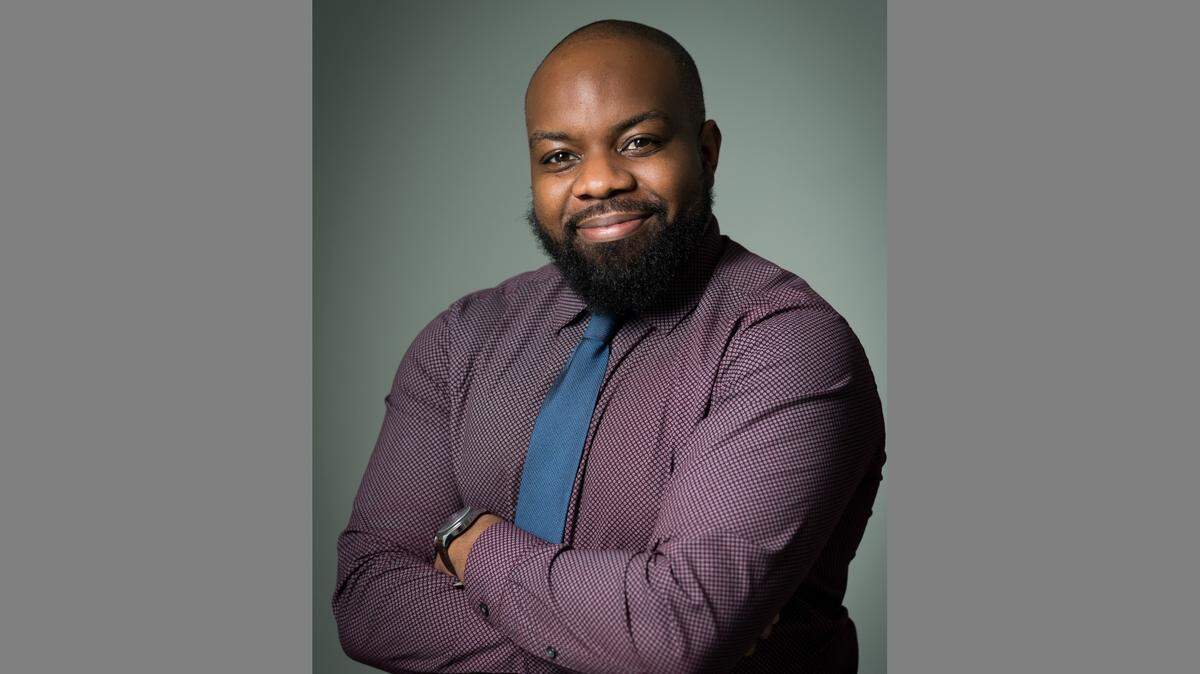
The racial wealth gap is a massive and complex challenge. It reaches into the worlds of politics, criminal justice, education and economic development. But as Herculean as the problem is, Calloway is betting on a relatively small and narrowly defined solution.
GIFT began as a Facebook group with 15,000 members. The cofounders posited that if every member gave as little as $10 a month, they could raise tens of thousands of dollars to build up Black businesses in the urban core on their own.
“It’s about everyday people who are saying there is a problem, this problem seems big, I don’t know what to do about it,” he said. “If you give $10 a month, collectively we put that all together, we can use that as the driving power to actually make a change, make an intentional change.”
Economic development conversations often center on big projects: a new factory with hundreds of jobs, a big apartment building that will bring new homes to market or a downtown office tower that will repaint the skyline.
But Calloway said GIFT wants to keep its focus on small businesses.
The organization is constantly raising money to give it away. It hopes to raise $250,000 this year. But even if the group far outpaced that goal, it would still target the smallest operations.
Of the 30 applications for funding it has received so far, nearly all would have created at least one new job.
“While 30 jobs is not huge immediately, it is very impactful and beneficial for those 30 people and it aids in that gradual increase in the economic viability of that area,” Calloway said. “We don’t have $1 million to put into a big development project right now. But even if we did have $1 million, we would want to spread that around and invest it in these smaller businesses.”
‘It’s always harder for us’
While access to capital is a constant battle for nearly all startups, Black-owned businesses have long faced added hurdles in receiving funding from traditional means like bank loans.
Accessing capital is difficult without a positive credit history. Many entrepreneurs use their homes as collateral for loans. But that also makes it harder for Black homeowners who live in historically redlined areas where home values are lower, said Brent Never, an associate professor at the University of Missouri-Kansas City’s Henry W. Bloch School of Management. Without enough collateral, many could be forced to seek high-interest unsecured loans.
“All these things really stack up against only minority-owned businesses,” he said.
And the pandemic hasn’t helped.
This summer, Never analyzed public data about which Kansas City area businesses received support from the Paycheck Protection Program, a federal relief program designed to quickly infuse small businesses with cash to support payrolls.
About 4,700 businesses, churches and nonprofits across the Kansas City area received loans of at least $150,000 each. More than 3,000 of those loans went to LLCs or other corporate structures that did not report ethnicity of owners. But only 24 of the more than remaining 1,600 qualifying firms were identified as Black-owned.
“Comparatively, if you’re talking about two auto shops and one is west of Troost and one is east of Troost and they both are serving the same group of people who have auto issues, the data shows that the one west of Troost was probably much more likely to get the PPP loan than the one east of Troost,” Never said. “So that’s just an inequity.”
The UMKC analysis found that 34 PPP loans went to Hispanic-owned firms and 33 went to Asian-owned businesses. Across the nine-county Kansas City metro area, only 250 of 4,700 loans went to businesses identified as being owned by women.
“It’s always harder for us to get into the industry because we don’t often have the advantages or the support system that are granted to other people,” said Nika Cotton, who owns the Soulcentricitea tea house.
She recently opened her shop in the former Wonder Bread building, which also houses The Combine at 30th and Troost.
“There’s a significant symbolism to that,” she said of her location on Troost. “And we’re trying to build a place that brings people together and restores hope.”
Soulcentricitea is a for-profit business, but Cotton wants it to be a place where social justice organizations can gather. She specifically hopes the focus can be on Black women, who she said face dual battles against white supremacy and patriarchy.
“Often we come to the race having jumped over 5,000 hurdles before we even got out of the starting gate,” she said.
Unable to secure a bank loan, Cotton built her business with her own savings and the investment and work of friends. She hopes to receive a GIFT grant to allow her to hire a part-time employee so she can have a few days off per week.
Aside from funding, she said there seems to be a different standard for minority-owned firms. While her storefront previously housed a coffee shop, she said she had trouble with health inspectors who required a new drop ceiling in the kitchen before she could open.
It may have just been an oversight, but she said she often feels held to a higher standard.
“There’s no room for error,” she said. “So it can be exhausting.”
Has 2020 changed things?
Jay Allen started his 2923 Comics company three years ago on a mission to tell stories about abuses of power and bring Black characters to the pages of comic books.
His Scarlet Knight series was named after the mascot at his alma mater, Southeast High School. The first book, “Scarlet Knight: Defender of the Block,” tells the tale of two orphans who return to their hometown of Martin City after graduating from medical school.
Allen relied on crowdfunding early on to start the business and brought in cash by selling his comic books at conventions like Comic-Con. But those opportunities dried up during the pandemic, leaving him with hundreds of unsold copies of his first and second books.
He said Black-owned businesses need access to funding above all else. And programs like GIFT are especially powerful because they offer grants rather than other programs that offer loans.
“People forget that debt is a bad thing when you’re a small business because you’re robbing Peter to pay Paul,” he said. “They’re trying to even out the playing field and at least give you a fighting chance. That’s important for Black-owned businesses because you have so many things against you.”
American society has grappled with racial inequities for years. But 2020 has sparked a deep national debate over race. The police killing of George Floyd in Minneapolis fueled Black Lives Matter protests in big cities and small towns across the nation.
In Kansas City, the name of J.C. Nichols has been stripped from the fountain and street named for him because of his racist development practices. And Jackson County voters this week will decide whether to remove the statutes of President Andrew Jackson, a slave owner who oversaw the removal of Native Americans, that stand guard outside both county courthouses.
Allen likened the year 2020 to a grave warning from a doctor who identifies a health problem that will only get worse unless something changes.
So far, it’s unclear to him whether this year’s talk will bring meaningful change.
“The real test is going to be next year. That’s when we’re really going to see who was just talking and who was willing to do the work,” he said. “I think Black people are just sitting here waiting to see what the world is going to do now. We know that you guys see it. But what are you going to do now and what are we going to do now?”