Kansas City malls were struggling before the pandemic. Now dozens of stores are closed
Just two years ago, the Country Club Plaza seemed poised for a bright future under new owners.
Kansas City’s iconic outdoor shopping center enticed Nordstrom to leave rival Oak Park Mall and open a new store anchoring the Plaza’s west side in 2021. They also signed New York-based cult favorite Shake Shack for a prominent corner.
But the COVID-19 crisis has upended the retail landscape.
Nordstrom has pushed its Plaza store opening back to fall 2022, citing the impact of the pandemic. Several chain stores have closed their Plaza locations since March — Sur La Table, Mac cosmetics, Sperry Top-sider — along with local tenants such as Parkway Social Kitchen and T. Loft. That’s left the Plaza with more than two dozen dark storefronts.
Still, Oak Park Mall isn’t faring much better with more than a dozen empty spaces.
“The malls are going to be pretty challenged over the next two months in one sense but in another sense they’re certainly going to be in a position where all of a sudden they see renewed interest again,” said Marshal Cohen, chief industry analyst for market researchers the NPD Group Inc. “The big challenge is going to be how they are going to handle some of the big vacancies that retailers are leaving.”
According to Coresight Research, U.S. retailers have announced 7,643 store closures and 3,326 openings this year. Closings of individual apparel stores such as Victoria Secret’s, Gap and Chico’s account for most of the shutdowns, Coresight said. But department store closures tend to have the greatest repercussions since they serve as anchors for most malls. Smaller tenants that have co-tenancy clauses in their leases may then be able to pay less rent or even terminate their leases.
The widespread closures were a major factor in Coresight predicting that one-quarter of all U.S. malls could close in the next five years.
“Almost all of the tenants are struggling,” Scott Zigler, general manager of Zona Rosa Town Center, said of the Northland shopping center. “Traffic’s down. Sales are down. Profits are down for just about all of the retailers and restaurants.”
Malls say Kansas City customers are growing more comfortable with shopping now that metrowide stay-home orders have lifted. But even as some celebrate new store openings, shopping patterns have changed and few stores have seen sales bounce back to pre-pandemic levels.
Many shopping centers were already struggling before the pandemic as the rise of e-commerce and the downfall of major department stores threatened the traditional mall model. With less brick-and-mortar presence, many were pushing to diversify with “experiential retail” with selfie shops, fitness centers, children’s entertainment and movie theaters.
But that strategy is unlikely to help them recover quickly in the current “mask economy,” according to Coresight Research. Instead, that firm thinks malls may seek out tenants considered to be more stable like grocery retailers, healthcare facilities and distribution centers.
David Block, president of Kansas City-based Block & Company Inc. Realtors, which owns and manages commercial property across the Midwest, remains bullish on the future of retail. He said people have grown more comfortable shopping.
His company has deferred three months of rent to 2021 for many tenants, both locally owned and national chains, so they can keep their employees on staff and rebuild their business through the holidays.
“This is different but not new,” he said, noting that the commercial real estate sector has suffered in past economic downturns.
Still, some restaurants and retailers are seizing the opportunity to open in prime locations that are move-in ready as others go out of business.
“We’re going to fill these spaces,” Block said. “It is a great opportunity for businesses to make good deals.”
Oak Park’s challenges
In Overland Park, Oak Park Mall has more than 15 empty spaces and has recently lost such exclusive retailers as American Girl and Microsoft.
But its biggest challenge may be the financial state of its parent company CBL Properties, which plans to file for Chapter 11 bankruptcy protection by Oct. 1. The Tennessee-based firm has pledged that shoppers “will not notice any change in our operations.” The company has been struggling amid a loss of major tenants like JCPenney and Sears across the country.
Company officials declined an interview request, but CBL spokeswoman Stacey Keating said in a statement that the firm expects traffic to increase through the holidays as retailers start Christmas promotions earlier to spread out the all-important shopping season.
Oak Park has added car-side pick-up zones during the pandemic so retailers can deliver purchases directly to customers’ vehicles. And the mall previously sought to diversify its tenant mix by adding businesses such as The Culture House Stage & Studio, which offers dance, theater and art classes.
“The pandemic has underscored the importance of diversifying outside of retail with dining, services and entertainment as well as essential business and other use,” Keating’s statement said.
In Overland Park, sales tax revenues sank 6.5% for the first half of the year compared to 2019. Sales tax collections account for nearly 40% of city-generated revenue in Overland Park, the second-largest city in the state.
City spokesman Sean Reilly said sales tax revenue from hotels, restaurants and apparel have been hit the hardest so far.
“We are constantly monitoring our city’s revenue streams, and believe 2021 will be as much of a challenge as 2020,” Reilly said.
Johnson County Commissioner Janeé Hanzlick, whose district includes Oak Park Mall, said she is watching the mall closely. She’s worried about how the pandemic will hurt one of the metro area’s leading retail centers. And she’s “very concerned” about Oak Park’s eventual loss of Nordstrom, a major anchor tenant.
Still, she said sales taxes haven’t dipped as much as some feared. And a recent virtual meeting with mall management buoyed her optimism. She doesn’t expect consumer demand for brick-and-mortar retail to disappear, though she said places like Oak Park might have to find ways of changing what that looks like in the future.
“It’s the lifeblood of our community and county,” Hanzlick said. “And not only on the impact of tax revenues, but our quality of life. We like going out to restaurants. We like being able to go shopping. Those things are important and part of why we live here.”
Traffic is down, but spending is up
The pandemic has pushed Zona Rosa to work with most tenants on rental rates, particularly those who were forced to close entirely amid stay-at-home orders.
“We have been in close communication with most of the tenants,” Zigler said. “And many of the tenants have received some form of rent concession or are still negotiating some form of it.”
He said most recent closures were tied to bankruptcy or other financial struggles of national chains like J. Jill, Justice, New York & Company and the Children’s Place. The center has also seen chains Bar Louie and Abuelo’s close big restaurant spaces at Zona Rosa in recent weeks.
Zigler said the tenants performing the best are those that excel at mixing online ordering with in-person experience. Zona Rosa has added curbside pickup spots, which have helped some stores lure wary customers.
“This has accelerated change across the board in our culture and our economy,” he said.
While traffic is down, Zona Rosa’s stores have reported a higher spend per outing.
“So instead of someone coming once a week and spending $100, they’re coming once a month and spending $400,” he said.
Still, vacant storefronts abound. Gap recently closed its 7,000-square foot store at Zona Rosa. And more than 50 storefronts sit shuttered, many of them clustered around the second phase of the center near the Dillard’s department store.
Last week, clerks for Sephora and Victoria’s Secret sat outside their respective stores but had no customers to greet.
Some customers grabbed lunch at 54th Street Grill, which had doors swung wide open to create an open air dining experience. But Bo Lings remained closed for dine-in service.
In 2018, Trademark Property Co. purchased Zona Rosa with big plans on revitalizing the development. Zigler said few of those plans have materialized yet, but owners still plan on major reinvestment at Zona Rosa. He said he hopes to see the mall keep a strong mix of retail, while also adding entertainment options and office space to the mix.
“People have been saying the mall is dead for 10 years,” he said. “We’ll change. We’ll evolve with the times. And I’m excited about what we’re going to look like in the future. It’s definitely going to look better than it looks right now.”
‘This, too, shall pass’
Even as the pandemic has accelerated retail closures, the Country Club Plaza has still managed to land new tenants.
Six years after it was founded in Liberty, jewelry and accessory creator Nickel & Suede is opening a Plaza storefront. Sterling Bank recently opened in the former Zoom toy store space and Bruu Cafe plans an October opening near Shake Shack.
“The retail industry has seen plenty of disruption over the decades and the key is for us as the landlord to be nimble and rise to the challenges presented. This, too, shall pass,” the Plaza’s general manager Kasey Vena said in a statement.
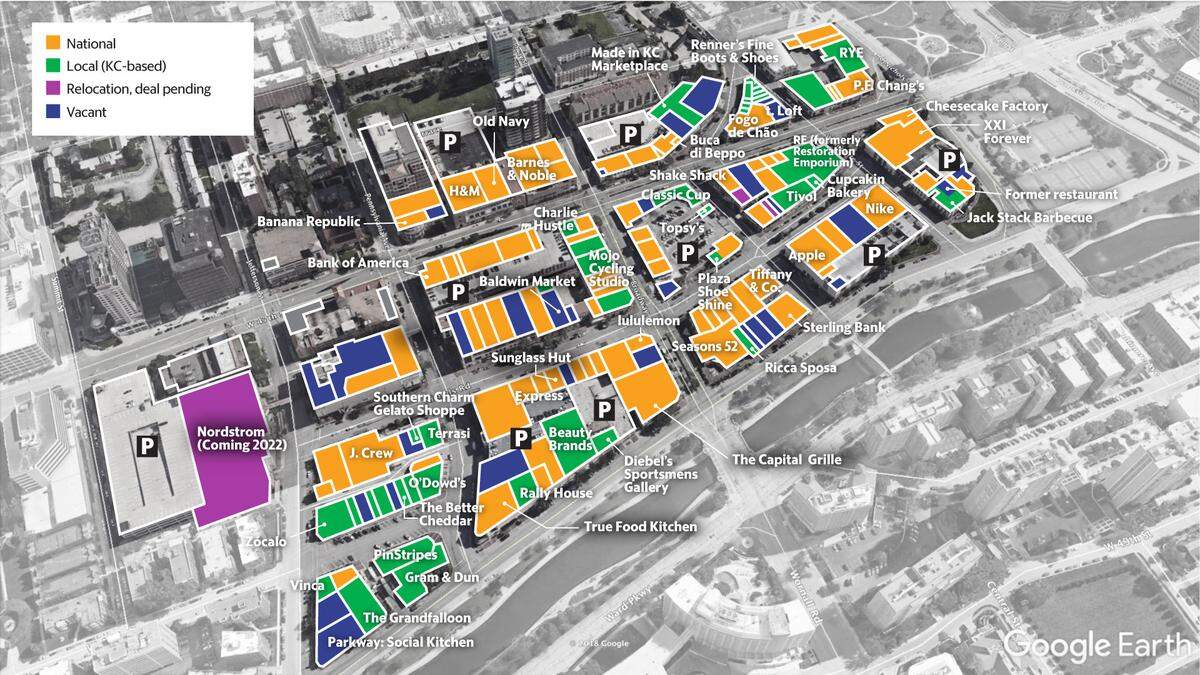
Plaza officials said they are trying to be as flexible as possible when their tenants seek rent relief, but they also must continue to fulfill their “significant obligations, such as paying taxes and utilities.”
Jeff Martin, owner of Southern Charm Gelato Shoppe on the Plaza, recently closed his Decadent — A Coffee and Dessert Bar in Overland Park’s Prairiefire after five years and is looking for another Johnson County spot.
“Landlords want pre-COVID prices and we just couldn’t get to that number,” Martin said, noting negotiations were taking longer than usual. “In five years will it be better? Probably. But how long will it take?”
The Plaza’s new Nickel & Suede store finalized its lease in March and received some concessions, but not as much as they expected in this retail environment.
Officials with the Legends Outlets in Kansas City, Kansas, wouldn’t comment on their negotiations with tenants. But marketing director Jessica Kinsey said traffic has rebounded better than expected.
She said shoppers seem more comfortable visiting outdoor centers like the Legends. And she expects retail centers to survive the pandemic. The Legends just announced a new Sephora store will open there next year.
“People are just ready to get out,” Kinsey said. “I don’t think it’s going to have a lasting negative effect on retail or shopping centers as a whole. I think it’s all temporary.”
Over the summer, some malls sought to create outdoor experiences like concerts or movie showings. The Power & Light District downtown blocked off streets to allow restaurants to offer alfresco dining.
The Legends will continue to find ways to be flexible in this environment, Kinsey said. Backyard Butchers is holding a pop-up meat sale at the shopping center through the end of September.
Last week, big box stores like TJ Maxx and Homegoods saw steady flows of traffic at the Legends.
Wilsons Leather Outlet advertised a going-out-of-business sale and the Lane Bryant Outlet sat dark. But signs of more normal times abounded as kids played in the center concourse and a family ducked into a photo booth.
Still, traffic is nowhere near normal, said Melissa Franco, general manager of Leawood-based Demdaco. The company had planned to open its first retail store at the Legends in April but postponed until June 15.
“You see 30 people out now and it’s like, ‘Oh, it’s so busy,” Franco said. “It’s not like it used to be.”
With a mix of entertainment, retail and dining options, the Legends is the kind of place folks might spend an entire day wandering around. But Franco said shoppers now seem less likely to linger.
“People are coming to Legends to do what they need to do and then they go home,” she said. “They’re not just out here bored. The majority of customers are here to shop.”
Cohen, with market research firm NPD Group, said consumers are now less likely to purchase clothes a season ahead of time. Likewise, uncertainty about school openings has disrupted the typical back-to-school season.
“They are buying what they need now. Simply because we don’t know what is coming next,” he said. “We don’t know if we are going to work from home or be in the office.”
Franco said Demdaco has also heard from people who have already started their holiday shopping.
“Those are the smart people,” she said, “because no one knows what’s going to happen.”
This story was originally published September 8, 2020 at 5:00 AM.