
‘1917’ racks up film awards, but what do experts at Kansas City’s WWI Museum think?
Matthew Naylor, Doran Cart and Jonathan Casey possess about as much information about World War I as three brains can hold.
That’s what happens when you go to work each day at Kansas City’s National World War I Museum and Memorial.
Even so, the trio say that “1917,” director Sam Mendes’ new film set on the battlefields of that massive conflict, provided them with new insights into a subject they thought they knew inside out.
The movie, which opened in Kansas City on Friday, goes well beyond statistics, politics and geography to mine “a profoundly human element … a deeply personal story about ordinary people,” said Naylor, the museum’s president and CEO.
“This film is an important representation because it allows people to understand the carnage that was World War I.”
At last Sunday’s Golden Globes, the film won best picture-drama and a directing award for Mendes. It’s expected to be a major player when Academy Award nominations are announced Monday.
Mendes’ screenplay, which he co-wrote with Krysty Wilson-Cairns, is based on a kernel of information from his own family’s history. As a child he often heard war stories from his paternal grandfather, WWI veteran Alfred Mendes. The filmmaker carried a vague memory of a tale about “a messenger who has a message to carry” and turned it into a cinematic yarn that contrasts intimate human emotion against a background of vast destruction.

In “1917,” two British soldiers, Blake (Dean-Charles Chapman) and Schofield (George MacKay) are tasked with a seemingly impossible mission. They are to cross nine miles of no man’s land in northern France with orders to call off a British attack on “retreating” German forces. Aerial surveillance has shown that far from retreating, the Germans are laying a trap for their English foes.
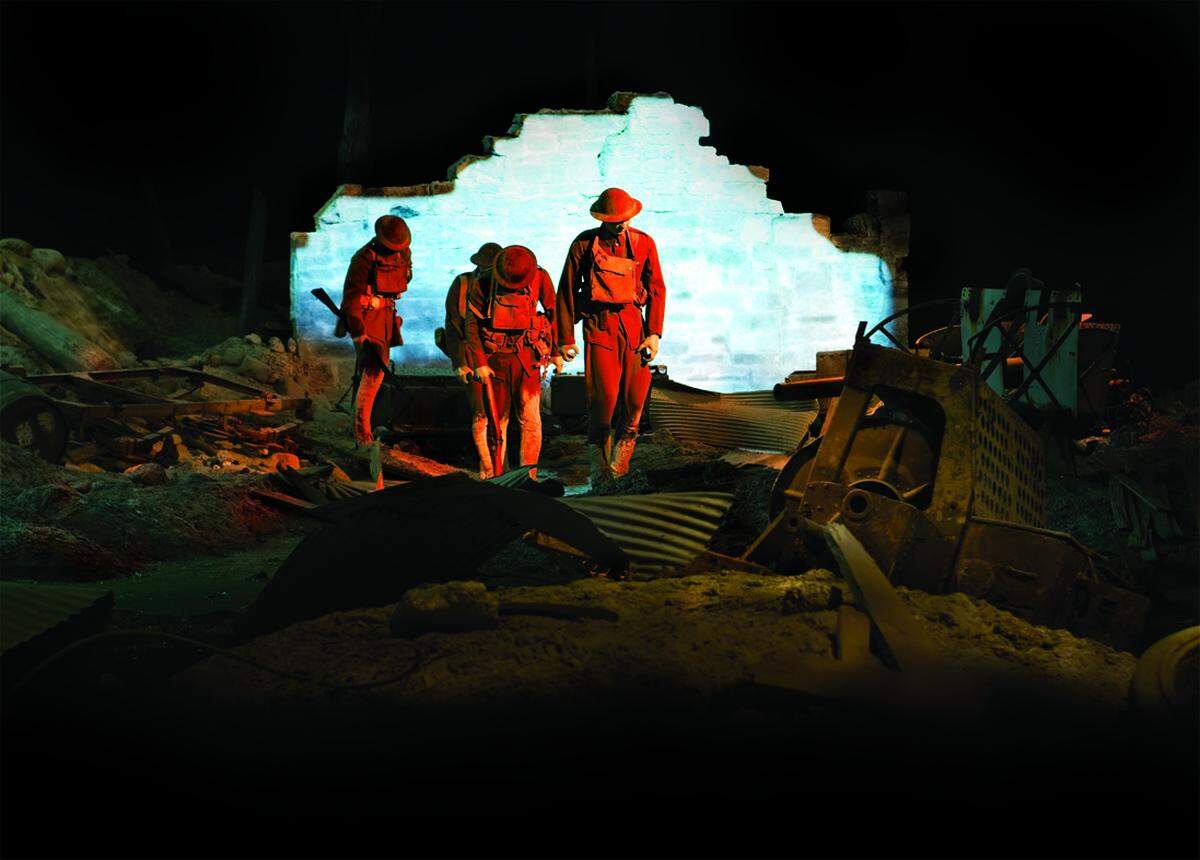
The film presents itself as one long (two hours) uninterrupted shot that follows the soldiers through trenches, across shell-pocked and corpse-strewn landscapes, into an abandoned German fortification and through the ruins of a French town. There are innumerable close calls.
Making it relatable
By focusing the story on just two men, Naylor said after a recent viewing of the film, “1917” makes complicated and confusing history more compelling to 21st-century audiences.
“This is an enormously difficult war for people to understand,” he said. “It involves weaponry and approaches to warfare that are largely unfamiliar to people today; some of the countries involved no longer exist. But the film helps people access this era and be open to learning about World War I.”
Cart, the museum’s senior curator, agrees that the film is as much about emotional impact as history: “It lets us look at the enormity of what was going on around these two men, and also the absurdity of it. That’s one of the things we try to show at the museum — that this was a case of humans involved in endeavors they were never intended to be engaged in.”
While Naylor, Cart and Casey all praise the historical authenticity of the film’s detailed art direction, they were particularly impressed with the often grotesque but realistic depiction of the war. At one point a horrified soldier finds his arm elbow deep in the rotting body of a long-deceased soldier; in another the ever-moving camera seems to float through a cloud of flies swarming around a dead horse.
And ever present are house cat-sized rodents feasting on the carnage.
“They must have had a rat wrangler,” Casey, the museum’s director of archives, said.
But the film’s ghastliness is often softened by what Casey calls “the human decency that comes through in just little bits. It can be as simple as helping a fellow up or saying thank you. I know if I was in that situation I wouldn’t be so polite. I’d be like ‘Get me out of here!’”
The film is peppered with moments when the characters try to do the right thing, Naylor said. There’s an encounter in a cellar with a young French woman caring for an orphaned baby. Blake and Schofield save a downed German pilot from the burning wreckage of his biplane. And despite some bickering, the two men are deeply connected, both by their desire to complete the mission and by their shared humanity.
“That’s one of the big revelations here,” Casey said. “Despite the chaos and terror there are moments when they calm down, and we realize we’re still human beings.”
In one such moment, the film depicts a unit of British soldiers awaiting orders to attack the Germans. In these last few moments before violence erupts, a lone soldier stands and sings the haunting folk song “Wayfaring Stranger,” with its promise that “There is no sickness, no toil, nor danger/In that bright land to which I go.”
It’s an emotionally devastating scene, and entirely plausible, according to Cart:
“I’m sure that they sang in all sorts of situations … when they were frightened or happy, when they were ordered to or away from the battle lines.”
He noted the famous Christmas truce in 1914: When Belgian troops began singing carols, the Germans responded with their own, and the two sides briefly laid down their weapons to exchange gifts and play soccer in no man’s land.
“In our collection we have songbooks that the soldiers carried in their pockets,” Cart said. “It makes sense. People react in different ways when they’re frightened, and music is a calming influence.”

Attention to detail
The three museum workers admitted that the film’s attention to detail was gratifying.
Cart was impressed with the insignia pinned on the back of an officer’s collar. It was placed there, he said, so that he could be identified by men following him into combat.
And Casey appreciated how, as the main characters work their way through a network of trenches toward the front, the activity around them subtly changes:
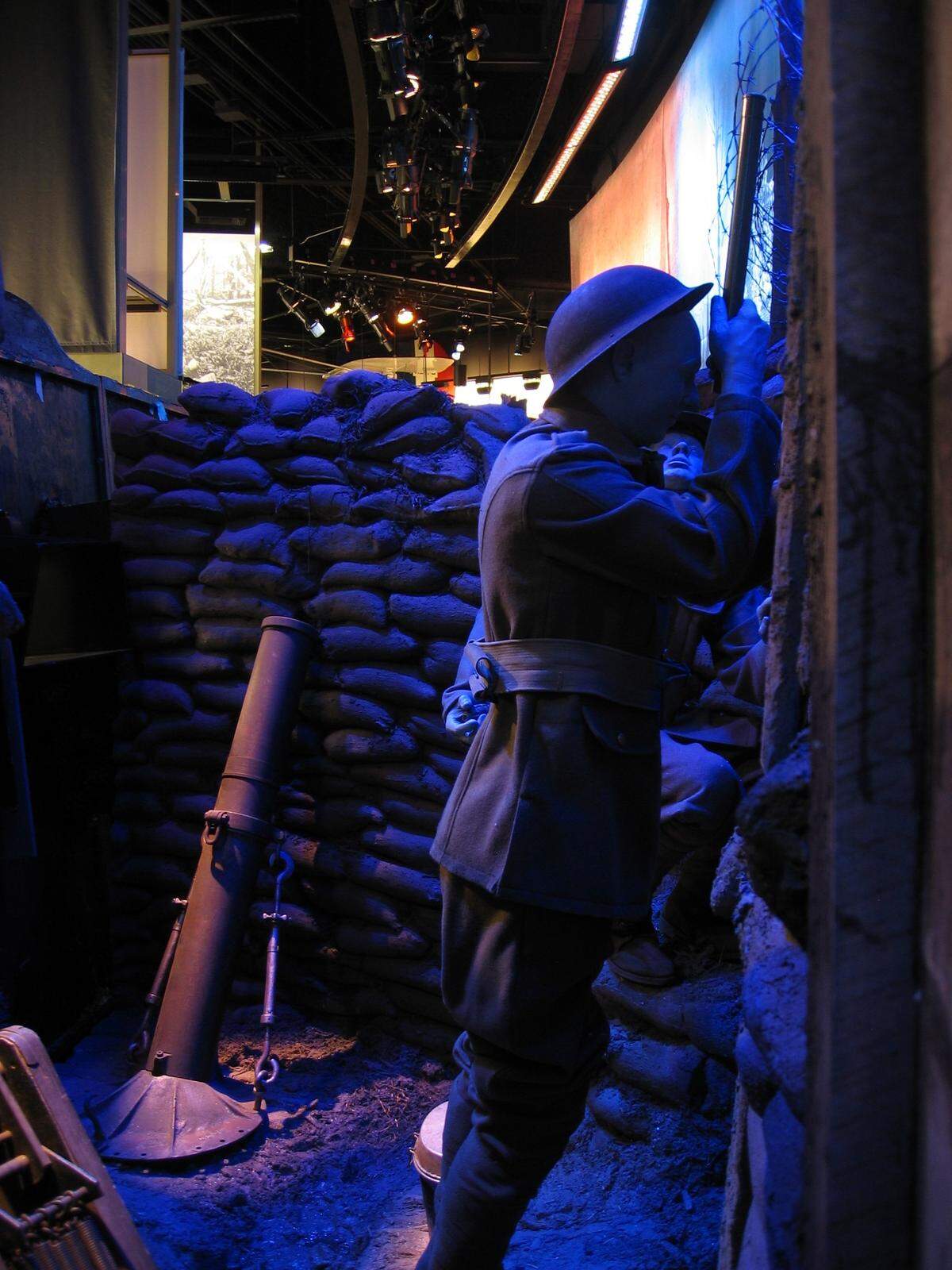
“I was feeling the dread as they get closer and closer to the front lines. There’s less movement at the front because you’ve got to keep your head down. You notice a dead man over here and a dead horse over there, and you’re told that these dead bodies are landmarks to help you find your way. And you’re warned not to fall into a shell hole because they are so deep and steep you’ll never get out.”
One particularly satisfying touch was the difference between the British and German fortifications. The English hunker down in muddy trenches held up with boards and tree limbs. By contrast, the Germans live in relative comfort with concrete walls, subterranean passages and underground dormitories equipped with metal bunk beds.
The different architecture of the two armies was real, Casey said. “After a certain point in the war the German attitude was that they were there to stay. They figured they’d outlast their enemies, so their trenches had a permanence.”
The English and the French did not share that attitude; their goal was to push the Germans out. They thought of their entrenchments as temporary, as evidenced in their relatively slipshod construction.
As for “1917’s” most jaw-dropping aspect — the way it appears to unfold in one uninterrupted shot — the museum experts said it was more than just a gimmick.
“For me it goes to the relentlessness these men must have felt,” Naylor said. “They went through this day after day after day. We’re sitting through it for only two hours, but the fact that it’s done in just one shot helps me to appreciate what that restlessness must have been like.
“Without conventional editing there’s no looking away; it goes on and on and on. It’s a very powerful choice.”
‘1917’ contest
Members of the AMC Stubs program can enter the 1917 WWI Museum Sweepstakes, a joint effort of the museum and the Leawood-based movie theater chain. Through Jan. 16, Stubs members can enter the contest by purchasing tickets to the movie or via mail. The winner receives a trip for two to Kansas City (transportation and lodging included) and a VIP-curated tour of the museum. Visit amctheatres.com/giveaway/1917 for details.
This story was originally published January 12, 2020 at 5:00 AM with the headline "‘1917’ racks up film awards, but what do experts at Kansas City’s WWI Museum think?."