
In the end, Royals beat baseball’s system with James Shields trade
The system is rigged against the Royals.
This is true in many ways, but is most obvious when a player becomes a free agent. If that player is coveted by other teams, and would like the biggest (or close to the biggest) contract, the Royals are making other plans.
Even in an offseason where they bumped payroll by more than 20 percent, the Royals figure to defend their American League championship with a payroll bigger than just five teams of the other 14 teams in the league. They are, still, something like the man driving a Honda trying to win the heart of a woman being courted by a Mercedes driver.
If we can stretch the analogy a bit, the Royals are finally emphasizing their reliability and superior gas mileage more than the other teams’ granite trim.
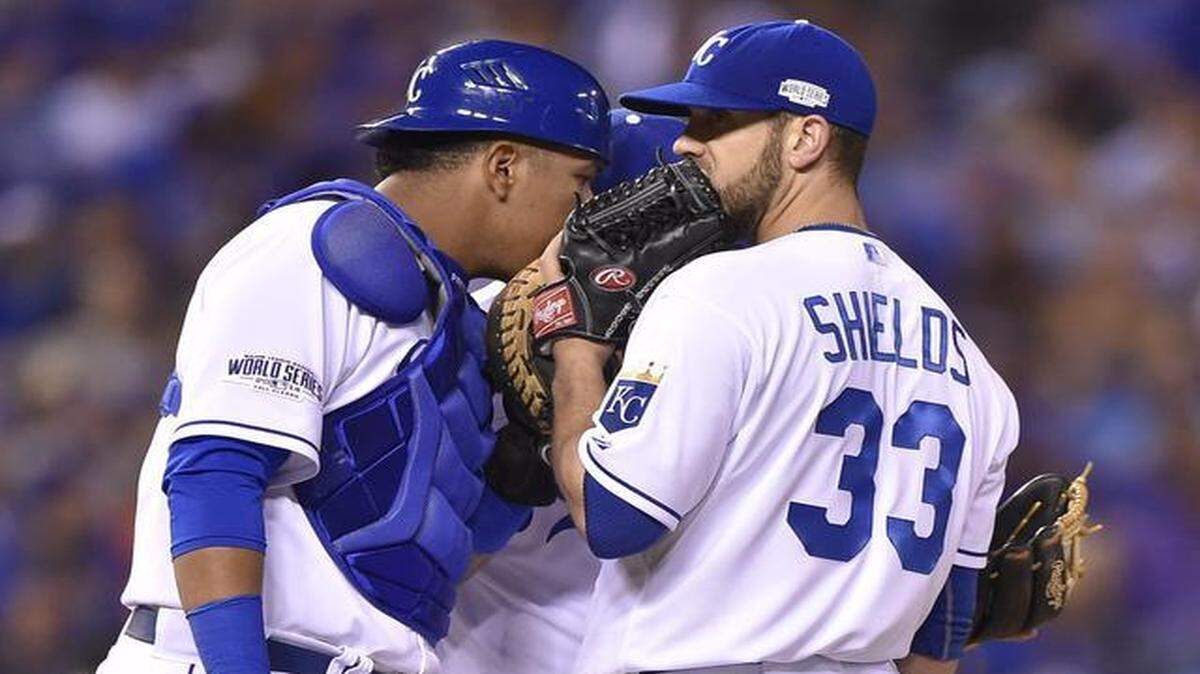
The most obvious example of this is the 2014 AL pennant, but the more subtle and illustrative point was completed when James Shields reportedly signed a four-year deal worth $75 million with the Padres.
Shields will be remembered by Royals fans for, and this is vaguely in order: being the face and voice of the franchise’s push from loser to winner, helping Danny Duffy harness so much talent and energy, being the inspiration for a thousand misinformed debates and jokes about that Big Game James nickname, and popularizing a regular postgame celebration with a neon deer butt and smoke machine.
But, really, as much as anything other than the World Series, Shields should be remembered as the ultimate example of the Royals beating the system that remains rigged against them.
Shields came to Kansas City in the most important personnel move of general manager Dayton Moore’s eight years in charge, a trade that had many other parts but was digested primarily as Shields for Wil Myers.
Here it’s worth remembering that the Royals owned Myers’ rights only because they used one of the few loopholes in talent acquisition available to small-money teams (and one that’s since been closed). Myers was a first-round talent who slid because of his signing-bonus demands.
The Royals — after so many years of drafting players who would sign for less — took Myers in the third round and paid him first-round money. He developed fast, and within three years was one of baseball’s best prospects.
The Royals loved his talent, of course, particularly the power hitting. But even when Baseball America chose him as its 2012 minor-league player of the year — especially when this happened, actually — the Royals never quite loved his talent as much as the rest of baseball.
So just as Myers’ value peaked — and it was always true that his value was unlikely to be higher than after being named the game’s best minor-league player — the Royals had a need for a frontline starting pitcher with some leadership.
They found a match with the Rays, who are even worse off than the Royals financially and were ready to deal Shields with two years and $22.5 million left on his contract.
The Royals, mostly, were verbally assaulted by fans and media for the trade (for what it’s worth, I respected the guts but thought they gave up too much). The criticism only grew louder that first year when Myers won the AL Rookie of the Year award and the Royals’ playoff drought grew to 28 seasons.
But last year, Myers missed nearly half of the season because of an injury and was mostly terrible when he did play. Shields, meanwhile, had a 3.21 ERA over 227 innings.
That’s the kind of production the Royals aren’t going to be able to afford on today’s open market. They can get a pitcher like that one of two ways: either develop him, or trade a homegrown player for him.
Here, with Shields, they did it in one of the most efficient ways possible. They traded Myers at his peak value, and in exchange got a frontline pitcher making less than he’s worth. That the rest of the trade sent other prospects to Tampa in exchange for Wade Davis, who was as good in 2014 as any relief pitcher in recent baseball history, only adds to the Royals’ profit.
Shields signed with San Diego for $20 million more than the Royals have ever given in a single contract. They were never going to be a serious bidder for Shields, mostly because of the money — long-term, big-money free-agent contracts for starting pitchers rarely work out for teams — but also because they will now get a compensatory first-round draft pick.
So, to review: they drafted Myers, flipped him and other pieces for a frontline starter and lockdown reliever to help a run to the World Series, and now receive a higher pick than the one they acquired Myers with. This is something like the dream circle of life for the Royals.
The system remains rigged against the Royals, and there is too much luck and projecting involved to expect them or any other team to pull this off every time.
But the Royals nailed it in this instance, which just so happened to be the most important. The playing field is tilted against them, but there remains enough room for smart scouting and steady development for baseball to fairly claim some level of parity.
The next cycle, of course, starts in four months when the Royals use that extra draft pick on a player they need to develop into their future.
To reach Sam Mellinger, call 816-234-4365 or send email to smellinger@kcstar.com. Follow him on Twitter: @mellinger. For previous columns, go to KansasCity.com.
This story was originally published February 9, 2015 at 3:44 PM with the headline "In the end, Royals beat baseball’s system with James Shields trade."