
St. Louis should not give in to billionaire Rams owner who wants a better stadium
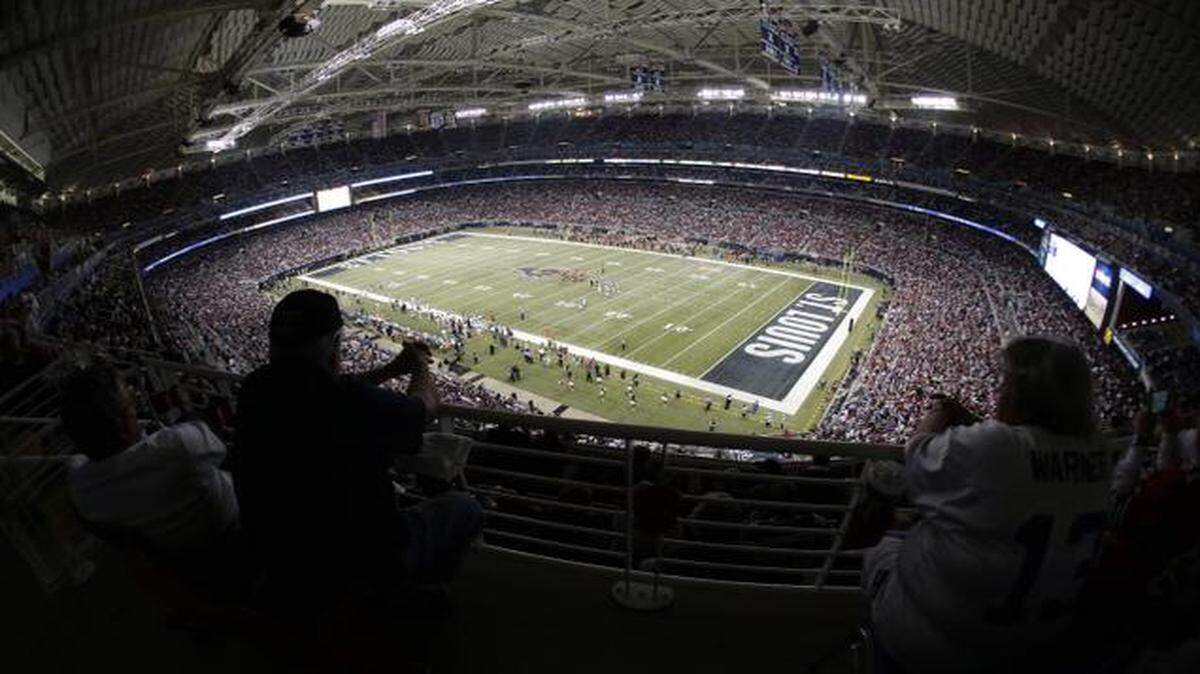
The Missouri governor and a two-man committee will largely determine how St. Louis responds to what sure sounds like a grave threat of the Rams skipping town. This is the nightmare scenario for every sports fan in every town, particularly those of us not in markets like New York, Los Angeles and Chicago.
The Rams are leveraging for public money to upgrade or replace what is widely considered a dump of a stadium, so St. Louis apparently has one last chance to keep its NFL team. As noninvested observers in a similar-sized market, we Kansas Citians should have one clear hope:
Tell ’em to bugger off, St. Louis.
“It does set a precedent,” says Neil deMause, co-author of “Field of Schemes,” and an outspoken critic of the roughly $2 billion of annual public subsidies for new professional sports facilities. “When you see cities say no to sports team owners, and either call their bluff and nothing happens, or call their bluff and the team does move, you find out the sky doesn’t fall and your city continues to be livable.”
This is a difficult spot for St. Louis, of course. Rams owner Stan Kroenke has long eyed the LA market, and has now gone public with plans to build an NFL stadium in the area. The Rams can soon convert their lease in St. Louis to year-to-year, making the franchise a free agent of sorts. NFL rules require teams to bargain in good faith with existing markets before relocating, so this is a power move from Kroenke to get the best possible offer from St. Louis.
Nobody wants to lose a sports team, and it is much easier to watch this game of chicken from a distance than be directly involved in the fight. But it will be better for everyone who is not a Rams fan in St. Louis if the city tells Kroenke there won’t be a dime of public money.
At the very least — and this would be a low-ball offer — Kroenke is probably looking for a few hundred million dollars in taxpayer funding for a new or upgraded stadium.
Gov. Jay Nixon’s committee is in the unenviable situation of making St. Louis and an outdated shack of a stadium more attractive than Los Angeles and a brand-new, state-of-the-art facility.
The only way to do this is to think of any and everything the team could possibly want, make it happen, and then be prepared to provide even more. The only way to do this, really, is to make the same mistakes that St. Louis made 20 years ago — the same desperate mistakes like the current lease that obligates St. Louis to keep the Edward Jones Dome in the top quarter of the NFL stadiums or risk losing the team.
If St. Louis caves, it would put the next cities to face this form of sports blackmail at a further disadvantage.
Kansas City — and other places like Cleveland, Oklahoma City, New Orleans and Charlotte — are not entirely unaffected spectators here. The Chiefs’ and Royals’ leases at the Truman Sports Complex, for instance, run through 2031. That’s a long time from now, obviously, but the context of those negotiations are being built right now.
Think of it this way: we are roughly at the halfway point between the 2006 lease extension and the beginning of the next negotiation.
The last time around, the teams paid for less than one-fifth of the $575 million renovations, and that was without any credible threat of relocation. That’s $475 million of public money that could go to our schools or roads or homeless or downtown instead going to billionaire owners to make even more money.
Study after study indicates that public investment to build new stadiums for pro sports teams are a prolific waste of resources. The economic impact provided to cities has just never been proven worth the investment, except to the already wealthy owners who are given shiny new palaces to make even more money.
The landscape in which St. Louis faces this unenviable situation is very different than the one in which Kansas City forked over nearly a half-billion dollars for the Chiefs and Royals.
For starters, the economy crashed. But there also has been a wider awareness of the phony economics that often prop up campaigns for public funding. If Kroenke proceeds with plans to build an NFL stadium in LA without public money, it will be the second straight new building constructed without taxpayers, something the NFL would not be thrilled with.
Part of this is circumstance. California politics make it relatively easy to shoot down public funding, and the 49ers had the benefit of selling personal seating licenses in and around the wealth of Silicon Valley.
Here it’s worth pointing out that Glendale, Ariz., recently completed the first year of a painfully bad 15-year agreement to keep the NHL’s Coyotes. Also, in the last week or so, Las Vegas and Washington, D.C. have announced plans for the two biggest subsidies ever for American soccer stadiums.
But in San Francisco and LA, there are signs of what might be a growing distaste for what is an objectively uneven culture of taxpayers helping billionaire owners make more money off themselves.
If St. Louis holds the line and refuses to double-down on the what-else-can-we-do-for-you-sir approach to landing the Rams in the first place, at the very least it would add to the 49ers and make the NFL’s two newest stadiums built without taxpayer assistance.
St. Louis could very well lose the Rams over it, and there is no question it is not that city’s burden to fight the fight for other mid-markets. But the city may lose the team either way. They have an owner who appears hellbent on beating the Raiders and Chargers to the LA market — and at least this way would maintain some dignity in the process.
It’s interesting that Kroenke is the one demanding public money here. He is one of the richest owners in American sports, and among his many holdings is a majority share in Arsenal of the English Premier League.
In 2006, at a cost of about $700 million, Arsenal opened a new stadium. It did this without public money, because that’s how it works in Europe. The club financed it privately through sponsorships and loans and naming rights and even an innovative bond program.
The club did all of this because it knew that a new stadium would help make money, no matter who paid for it.
Kroenke knows the same is true in America, and it’s understandable why he’d ask for public subsidies if he thinks he can get it. Nobody turns down free money.
But it would be for the greater good if St. Louis did not cave. It would make it easier for the next city to do the same, and to eventually — hopefully — force sports leagues and owners to admit that publicly funded stadiums should no longer be the expectation.
To reach Sam Mellinger, call 816-234-4365, send email to smellinger@kcstar.com or follow on Twitter @mellinger. For previous columns, go to KansasCity.com.
This story was originally published January 6, 2015 at 7:40 PM with the headline "St. Louis should not give in to billionaire Rams owner who wants a better stadium."