
Not big enough? John Brown’s journey from Pitt State to the NFL proves otherwise
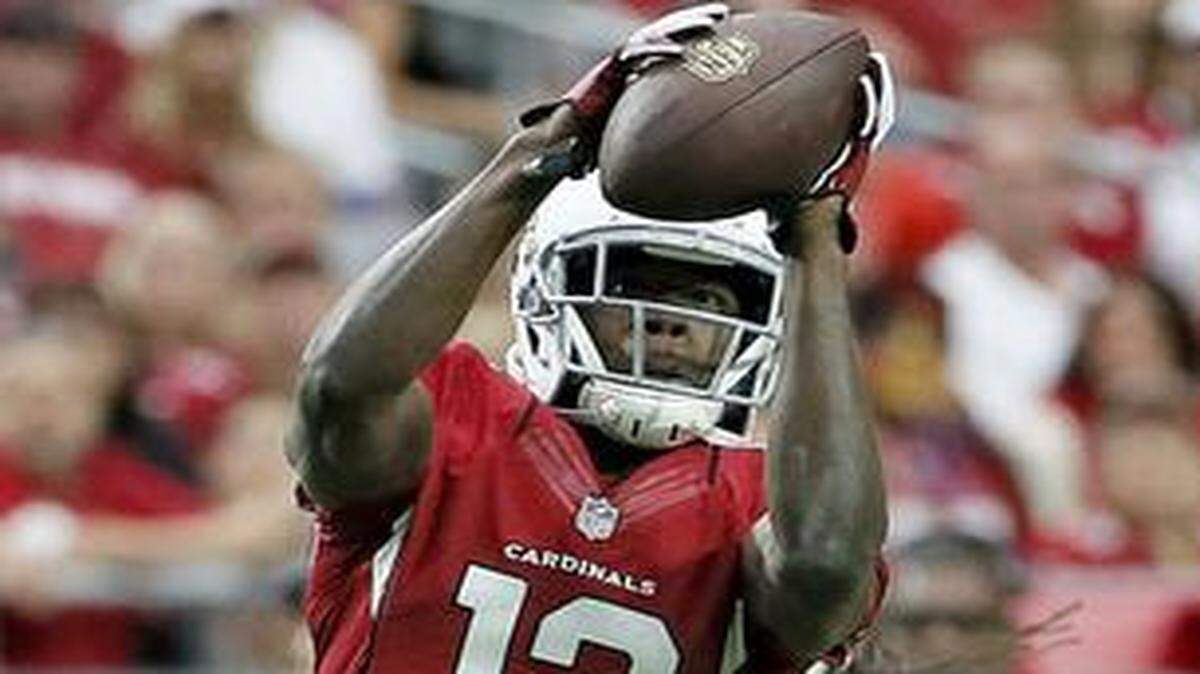
John Brown isn’t supposed to be here. Not in the NFL. Certainly not as a rising star, a man who one year ago was catching passes for Pittsburg State and is now part of a deep group of talented rookie wide receivers helping push America’s favorite sport faster and faster every week.
He was supposed to stop long ago, and this isn’t just about growing up in the sad urban cliché of violence in South Florida — though we’ll get to that part. No, this is about something much more direct, something much more about him than anyone else.
Brown was too small.
That’s what they thought, anyway. Not just too small to catch 39 passes for 569 yards and five touchdowns for the Arizona Cardinals so far this season. Not just too small — he’s 5 feet 11, 179 pounds — to be one of the major points of emphasis for the Chiefs as they try to win an important road game on Sunday.
Brown was too small for high school football. Seriously. A coach at South Dade High told him he’d never play varsity. Find something else to do. You’ll never play football here because you’re too small. Brown was 15 years old.
“Yes, sir,” Brown says now. “Those were his same, exact words.”
He told his brother what the coach said. James Walker told Brown to never let someone tell him what he can’t do. Brown always loved his brother. So he transferred high schools, caught touchdowns, made it to Pitt State, caught more touchdowns, and is now with the Cardinals — for whom he’s caught three go-ahead, fourth-quarter touchdowns this season.
In that blur, he lost his brother in a cold-blooded murder outside a nightclub. Brown nearly quit football over it, the grief overwhelming him. Instead, he decided to play for his brother. Brown now has three tattoos with his brother’s name, including a football with wings.
On Sunday, like he does before every game, the man too small to play high school football will look through pictures of his brother in the locker room. Tears will fall down his cheeks.
He will know exactly why he’s playing this game.
Tim Beck recruited John Brown hard to Pitt State. Saw him many times in person, even went to a basketball game just to see him. Beck may not have known Brown would be this good, but he had an idea that Brown could be this good.
Finally, one morning, the phone in Beck’s office rang. Brown was calling.
“Coach,” he said, “today is your lucky day.”
This was Brown’s way of telling Beck he was coming to Pitt State. That sounds arrogant, right? But Beck is quick to point out it wasn’t arrogance, it was truth.
“He was right,” Beck says. “That was our lucky day.”
Brown’s path to Pitt State was full of detours, and not just the coach who told him to give it all up. He started his college career at Division II Mars Hill in North Carolina. He didn’t last, mostly because of academics. That’s when his brother was shot.
That was July 2010. Walker had enough talent that he played at MidAmerica Nazarene in Olathe. Back for the summer, he promised the boys’ mother that he wouldn’t get in trouble, and had stayed in the car even after a big fight broke out. He was in the passenger’s seat when someone walked up to him and shot three times, one bullet into Walker’s head and two in his chest. He lay in a hospital bed, paralyzed, for months.
Brown spent that fall at Coffeyville Community College in Kansas, which is about 70 miles southeast of Pittsburg. Rules restrict how many out-of-state players can be on scholarship, and Brown was not on the active roster. He could only practice, which is how Beck saw all of that speed.
Brown felt guilty being so far away from his brother. They were supposed to do this football thing together. They were going to the league, together. They talked about it all the time. The distance, and the loneliness, ate at Brown.
In April 2011, Brown made that call to Beck. Told the coach it was his lucky day. Then Brown found out that his brother had passed away in the hospital, and he didn’t know what to do. He thought about quitting. Thought hard about it, actually, for a week. Football would seem so different without his brother around to talk to, to ask questions, to joke around and motivate.
After that week, the energy changed. The death of his brother nearly pushed him out of football. The memory of his brother push him forward.
“That’s what brought me back into it,” he says.
Before the first game of his college career, more than a thousand miles from home, Brown sat in front of his locker in tears. He was looking through pictures of his brother, from the time they were little boys playing together to the time they were almost full grown men.
Something about those pictures, the way it made him feel, Brown needed it. His life has been about proving people wrong. Before games, he likes to remember who he is proving right. It’s a routine he’s kept up.
As it happened, Brown’s locker was next to his quarterback’s. Before they went onto the field, Brown told him the Gorillas would be up 7-0 before the quarterback ever touched the ball. Brown didn’t know if it would be a kick return or a punt return. He just knew he was scoring.
Pitt State’s defense forced a three and out on the first possession, and Brown returned the punt 84 yards for a touchdown.
“I’m telling you,” Beck says, “that punt, most guys wouldn’t have even gotten to the ball.”
They started to get used to seeing Brown do things most guys can’t. It was equal parts natural talent — he ran 40 yards in 4.34 seconds at the NFL Combine, and was clocked as fast as 4.29 in college — and relentless work. Brown was always the first player in line during practice, and the first to go catch extra balls from the quarterbacks after. In his first season at Pitt State, the Gorillas won the national championship.
Brown has a clear, unapologetic confidence that sometimes sounds like arrogance. But it’s always backed up by work, and focus, and complete concentration. Back in college, he’d come into Monday practices telling his coaches about which NFL receivers weren’t running their routes properly or catching the ball the way they should.
To him, it was more cold analysis than any cockiness.
“I watch everything and I try to learn to be better,” he says. “I watch other peoples’ mistakes, and try to learn. I’ve always been confident. I put in the hard work, I did stuff other guys wouldn’t do.”
Every day now, Brown thinks about his brother when he wakes up. This is his motor. This is why he never thought that flunking out of a Division II school in North Carolina and not earning a scholarship at a juco in Kansas would ever stand between him and the NFL.
“I have been around some guys very similar,” Cardinals coach Bruce Arians says. “Emmanuel Sanders, Antonio Brown, Mike Wallace. And (Cardinals assistant) Tom Moore, who I trust as much as anybody, every time I watch him on the practice field I say, ‘Tom, who does he remind you of?’ He says, ‘he looks just like Marvin Harrison and he has a work ethic like Marvin.’”
Brown has achieved everything he dreamed of. He’s made it. He’s caught touchdowns of 75 and 48 yards. He’s paid for his family to come watch him play NFL games, including his 2-year-old daughter, Caia, and even celebrated one of those touchdowns with the Doo Doo Brown dance, which he and his friends used to do as kids back in Miami.
But Brown also feels like he’s on the cusp of something more. Something even bigger. That coach back at South Dade may never have thought he’d make it this far, but Brown keeps playing for the brother who thought he’d make even farther.
That’s why he’ll thumb through those pictures before the game on Sunday.
“I sit back and smile,” Brown says. “I think about stuff I have to do just to keep him smiling.”
Every little boy in Pittsburg wants to be John Brown now. That’s how Beck puts it. Christmas wish lists are full of John Brown jerseys, at least from the kids who haven’t already talked their parents into buying them one.
If he had gone to a football factory like Alabama or Oregon or Ohio State, Brown would be remembered fondly. They’d have his jersey framed on a wall somewhere next to other program alumni in the league. He would be a point of pride, certainly, stories about that long touchdown catch or great punt return in the big game being told for years.
But at a place like Pitt State, Brown is much more than that. Pitt State is a proud place, and Brown isn’t the first player from there to play in the NFL. But there are fewer Division II NFL players, and so they mean a little bit more.
Players who go from places like Pitt State to the NFL become more than good memories. They become inspirations, and often shorthand for coming stardom.
The other day, Beck was talking to a coach at Coffeyville. Brown’s name hadn’t been brought up, but then, when Beck talks to someone at Coffeyville it never takes long.
“Hey,” the coach told Beck, “we’ve got another John Brown over here.”
Beck was laughing a little as he told the story. He knows there is regret at Coffeyville for not keeping Brown. Beck doesn’t think they realized quite how good Brown really is. Losing someone like that makes the pursuit of the next hidden star all the more enticing.
Maybe Coffeyville really does have another John Brown. Maybe.
Then again…
“There’s a lot of people who say that in our league every year,” Beck says.
To reach Sam Mellinger, call 816-234-4365 or send email to smellinger@kcstar.com. Follow him on Twitter: @mellinger. For previous columns, go to KansasCity.com.
This story was originally published December 6, 2014 at 11:44 AM with the headline "Not big enough? John Brown’s journey from Pitt State to the NFL proves otherwise."