
What Justin Houston means when he calls his sacks ‘a group effort’
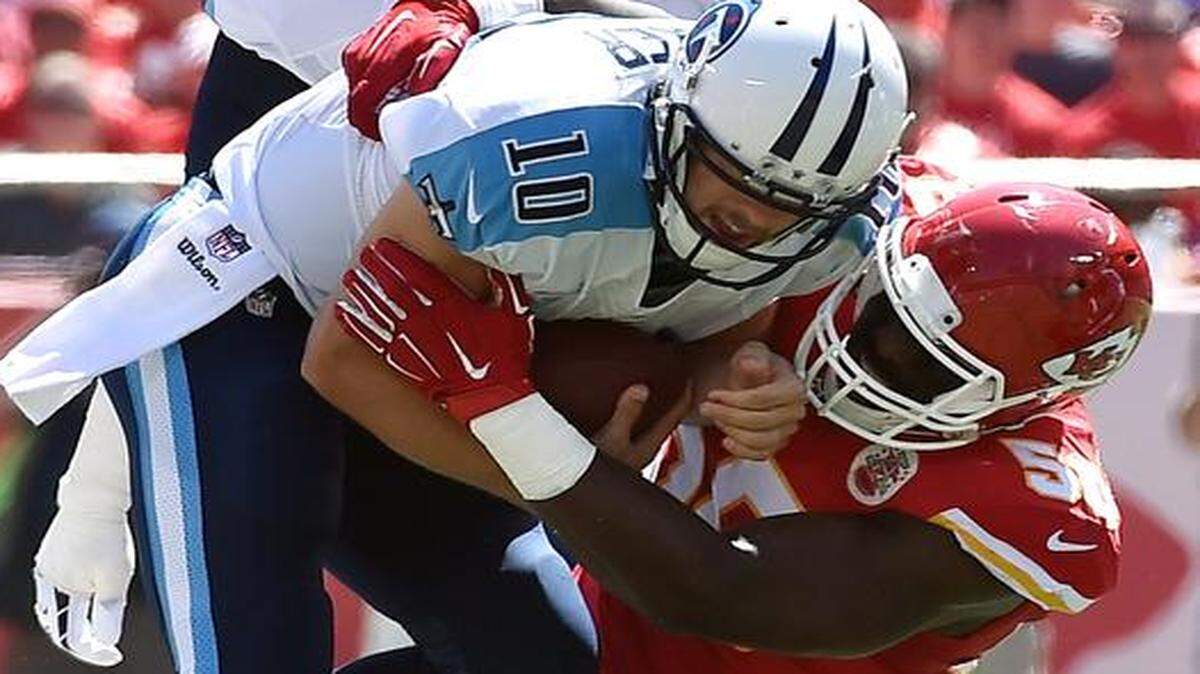
Justin Houston stood in front of his locker, still sweaty from an afternoon spent trying to beat linemen much bigger than him so that he could go chase down a quarterback much faster than him.
This is the job description of a pass rusher, and the rewards are enormous. J.J. Watt, the best there is at what Houston does, just signed for $100 million, including $51.8 million guaranteed. Houston’s friend and Chiefs teammate, Tamba Hali, says that the money and recognition that come with being the best are driving Houston to what is currently a pace for more sacks than any man has ever made in a season.
Houston doesn’t talk much about negotiations for a contract extension. This is after the Jets game, and Houston answers a question about his awesomeness as a pass rusher after getting Michael Vick twice the same way he’ll answer a question about his awesomeness as a pass rusher if he gets Kyle Orton twice in Buffalo on Sunday.
“It’s a group effort,” he says. “I’m receiving all the credit, but I can’t do it without everybody else. Tamba, (Allen) Bailey and (Dontari) Poe do a great job rushing, and we’ve got great coverage down field. It’s a group effort.”
That’s the kind of quote that usually has reporters and fans rolling their eyes. Yeah, yeah. Team effort. Couldn’t do it without my guys. Houston is wildly talented, a 6-foot-3, 258-pound man who broke weight-lifting records of much bigger men at Georgia. He is now complementing a body made to sack quarterbacks with a mind learning how best to do it.
So team effort or not, there’s a reason Houston is, in his words, receiving all the credit. He has 12 sacks, after all. His teammates, all of them together, have 15.
But what if this group-effort talk is more than humility?
What if it’s just the truth?
On the first sack of the most important and so far best season of his life, Justin Houston missed.
He lines up on the edge of the defense, outside of Titans left tackle Michael Oher and even outside of the tight end. No hand in the grass, no three-point stance. No pretense. This will be a speed rush. Titans quarterback Jake Locker stands in the shotgun, takes the snap, looks to his left, and there’s nobody open. He goes to his second read, and nothing.
Oher keeps a stable base and pushes Houston back, 11 yards behind the line of scrimmage and 5 behind his quarterback. This should be enough to keep Locker clean.
But the Chiefs’ coverage is strong, and the quarterback starts to panic. He is scrambling before pressure is actually there. First to his right, pausing, and now to his left, heading directly into Houston’s arms for a sack and a 2-yard loss. Locker goes down 4.1 seconds after the snap.
On the second sack of the most important and so far best season of his life, Houston was stopped.
He lines up over the right shoulder of Titans center Brian Schwenke, and tries to stunt across to the other side. The problem is in left guard Andy Levitre, who has perfect technique, driving both hands into Houston’s chest and keeping him from affecting the pocket.
But Locker has a problem, too. The blitz is coming, and he doesn’t have his first read. He decides to bail, first to his right, but there he sees defensive back Chris Owens coming in, sneaking his shoulder underneath Schwenke. This is no place for a quarterback. So Locker goes back to his left, but it’s clogged there, too, so the quarterback heads straight ahead in the organized chaos that defines most NFL games.
But straight ahead means Dontari Poe, a 346-pound genetic freak who could put Locker out of the game and in lots of pain. So Locker heads to his left, again, and this time Houston is there to drag him down for a one-yard loss. Depending on how you count it, Houston is the fourth or fifth player with a shot at the sack. Locker goes down 6.1 seconds after the snap.
Some common threads in those two sacks: Houston’s original plan to get to Locker didn’t work, but he had more time than is typical for a sack because his teammates up front held the pocket firm, his teammates behind him provided strong coverage, and the coaches made the right call.
These are just two examples, of course, but there are 10 others that collectively tell a similar story.
There are times when Houston simply dominates his matchup. He trucked Chargers right tackle D.J. Fluker, for instance, getting his first sack in five games against Philip Rivers just 2.4 seconds after the snap.
He also turnstiled Jets right tackle Breno Giacomini, using a combination of strength and speed to get Vick from the blindside 2.8 seconds after the snap last week.
But overall, Houston’s 12 sacks — that’s already a career high, and three more than anyone else in the league — have taken an average of 3.75 seconds. A look through J.J. Watt’s 20 1/2-sack season from 2012 showed he got to quarterbacks in an average of 3.1 seconds. These are clocked by hand, and even taking the median of three times on each play, there is surely some margin for error here.
But consider that according to Pro Football Focus, all but four of 28 qualifying quarterbacks average less than 3.75 seconds per sack. The median is 3.4 seconds. On most snaps, quarterbacks are trained to get the ball out in three seconds.
Deflecting credit to his teammates has always been Houston’s nature. It’s part of what makes him popular in the locker room and front office. But it’s not just the stand-up thing to do.
It’s also the truth.
If he’s going to turn what is effectively a contract year into a historic individual season, he’s going to need help.
Justin Houston will need to average one sack per game to tie Derrick Thomas’ franchise record of 20, set in 1990. He will need 11 over the last eight games to break Michael Strahan’s NFL record of 22 1/2, set in 2001.
One of the remarkable parts of Houston’s sack pace is that he’s come at this thing more tireless than spectacular. Sacks tend to come in bunches, like a run at the blackjack table. Houston’s are coming more like a steady wage.
Thomas, of course, had seven of those sacks in 1990 against Dave Krieg and the Seahawks. Add three sacks at Indianapolis, and half of Thomas’ production came in two games. Strahan, somewhat similarly, had 10 1/2 sacks bunched in three games in 2001.
Houston has had one or two sacks in each game but two — three sacks against the Rams, and none against the Broncos.
The trick is that the eight games in front of him will probably be harder than the eight games behind him. Last week, Jets coach Rex Ryan talked consistently of Hali being the pass rusher his team would focus on. You can joke about that being the kind of thing the coach of a 1-7 team says, but there’s no doubt that teams will push more energy toward stopping Houston now.
The other part is that — at least after this weekend — the quarterbacks Houston will be chasing are harder to get to than the ones he’s already chased.
Kyle Orton, who will make his fifth start for Buffalo after replacing the struggling E.J. Manuel, has been sacked on more than 10 percent of his dropbacks, the highest rate in the league.
But after Orton, none of the quarterbacks the Chiefs can expect to play rank higher than 15th in sack percentage. The Chiefs are scheduled to face four quarterbacks — Carson Palmer, Peyton Manning and Derek Carr twice — ranked 30th or below.
Michael Vick doesn’t have enough snaps to qualify, but the seven quarterbacks the Chiefs have faced hold onto the ball for an average of 3.44 seconds before a sack. The current starting quarterbacks on the remaining schedule hold onto it for an average of 3.18 seconds.
None of this means that Houston can’t break the record, of course. It just means that the hardest part is still ahead.
And that he’ll need even more help from those around him.
To reach Sam Mellinger, call 816-234-4365 or send email to smellinger@kcstar.com. Follow him on Twitter: @mellinger. For previous columns, go to KansasCity.com.
This story was originally published November 7, 2014 at 2:20 PM with the headline "What Justin Houston means when he calls his sacks ‘a group effort’."