
Sam Mellinger: Royals’ fortunes turned when team focused on defense
The stories about what Dayton Moore took over as Royals general manager nine years ago this May sound made up. Because, really, a big-league baseball team once skipped the team picture because nobody involved thought the group worth remembering? That’s a real story?
It sounds like a movie, and a bad one, some sort of “Major League” knock-off without the cutout of the sexy owner in lingerie. Because you can close your eyes and imagine Willie Mays Hays climbing the outfield wall for a ball that bounces in front of him like Kerry Robinson once did for the Royals, right?
Or instead of Esteban German, it could’ve been Roger Dorn who forgets to put his sunglasses on, takes a fly ball off his face, and then uses the sunglasses to hide the shiner.
But this was all so real. Inescapably real for the Royals. They were a big-league team by only the most technical definition and, really, the makeover could’ve focused anywhere. Other than T-shirt giveaways and dollar hot dog night, the Royals didn’t do much of anything right.
What would eventually set this construction apart from all the others was a laser focus on the most fundamental and obvious way the Royals were not a big-league operation. Moore and the rest of the Royals front office would make sure that, if nothing else, their team would no longer be the one to let a routine fly ball drop between two outfielders who each assumed the other one would catch it.
The Royals were regularly failing at the most basic part of baseball, in other words. They could not catch or field or throw the ball to big-league standards. It was embarrassing.
“As a manager,” Ned Yost says, “the things that (tick) you off are making errors and (pitchers) coming in and walking guys. We know we’re going to make mistakes, but we know we need to limit the mistakes. That’s how we’re going to win.”
This is a sports success story, of a team understanding its limitations while still pushing its possibilities. More than anything else, this is how the Royals built themselves from the bottom of baseball to the top of the American League.
Because sometimes, knowing what you cannot be clarifies what you can become.
If you ever talk to Dayton Moore about the Royals, you are bound to hear him say something to the effect of: “we’re never going to make excuses for our market ... ”
We live in a soundbite world, particularly in sports, so it is true that people sometimes hear those words as an excuse for the Royals’ market, which ranks ahead of only Milwaukee and Cincinnati among big-league cities.
But what Moore is trying to say is that playing in the third-smallest market means the Royals have to operate differently than teams in New York (biggest), Chicago (third biggest) or even Detroit (12th biggest, but with a pizza baron owner willing to lose a ton of money).
Everybody wants home run hitters, but unfortunately for the Royals, “everybody” includes all the teams with more money to spend. The worst contract the Royals have given out under Moore was $36 million for Jose Guillen, a second-rate slugger who got more than he was worth because the Royals were outbid on Torii Hunter and needed somebody to hit in the middle of the lineup.
That’s no way to build a winner.
Players on opposing teams used to joke about singling to shortstop against the Royals when Angel Berroa played there. By 2008, the Royals had the worst defense in baseball according to FanGraphs’ Defensive Runs Saved. The next year, they were nearly twice as bad.
That team played Yuniesky Betancourt at shortstop, Miguel Olivo at catcher, Billy Butler at first base and Mitch Maier in center field. In 2010, they were terrible again, but for different reasons. Scott Podsednik played left field and David DeJesus played right, meaning opposing third base coaches were waving runners around so often they might join the pitchers in icing their shoulders.
Every recovery needs a low point. Every good rehab story starts at rock bottom, and that 2010 season is the Royals’ version of a drunken rant at the family reunion.
That offseason was their intervention. This is about when the Royals’ vision began to clarify.
“When I first got up there, got the chance to see what we had, we were lacking speed in the outfield,” says Jarrod Dyson, who debuted in 2010. “We were lacking a whole lot, but we had a whole lot in the minor leagues. We got better every year. We kind of stunk it up for a few years in the beginning, but we got better every year.”
That next season, 2011, Alex Gordon played his first full season in left field, and was a revelation. Eric Hosmer replaced Butler at first base. Salvador Perez ended a revolving door at catcher. And the biggest shift came with a trade the Royals were mostly criticized for at the time.
Zack Greinke had blossomed into one of the great young pitchers in baseball, just like every Royals fan hoped. But he had become convinced that he would never win in Kansas City, just like every Royals fan feared.
Greinke was in tears when he told Royals management he wanted out. Eventually, the club found a fit with the Brewers and a trade built around the defensive abilities of shortstop Alcides Escobar and outfielder Lorenzo Cain.
It is an example of the winds of chance that this wasn’t the Royals’ first choice. They had gone deep into talks with the Nationals, but that trade fell through when Greinke wouldn’t agree to a long-term contract there. As it turned out, the Nationals’ package wasn’t nearly as good as the Brewers’.
Good thing it didn’t work out with the Nationals, because the Royals built much of their success from that trade and the ripple effects it created. In one year, they went from 30th to seventh in defense.
By 2013, the Royals had their first winning season in a decade, and it was an accepted fact in the industry that they played better defense than anyone in baseball.
Best of all, it was sustainable, affordable and, like the right paint color, made everything around it look better.
Last October, when the men in this clubhouse were rewriting a franchise’s sorry history and making people in Kansas City love baseball again, there was this story on Grantland about how the outfield of Gordon, Cain and Dyson had only given up 15 hits on fly balls in 360 1/3 innings together and ... wait, what was that?
Fifteen hits?
In 360 1/3 innings?
“I didn’t know that,” Dyson says this spring. “That is shocking.”
“I’m stunned right now to even hear that,” Cain says. “That’s pretty damn good.”
As much as anything, this symbolizes the way the Royals have sneaked around baseball’s economics and found success in the margins.
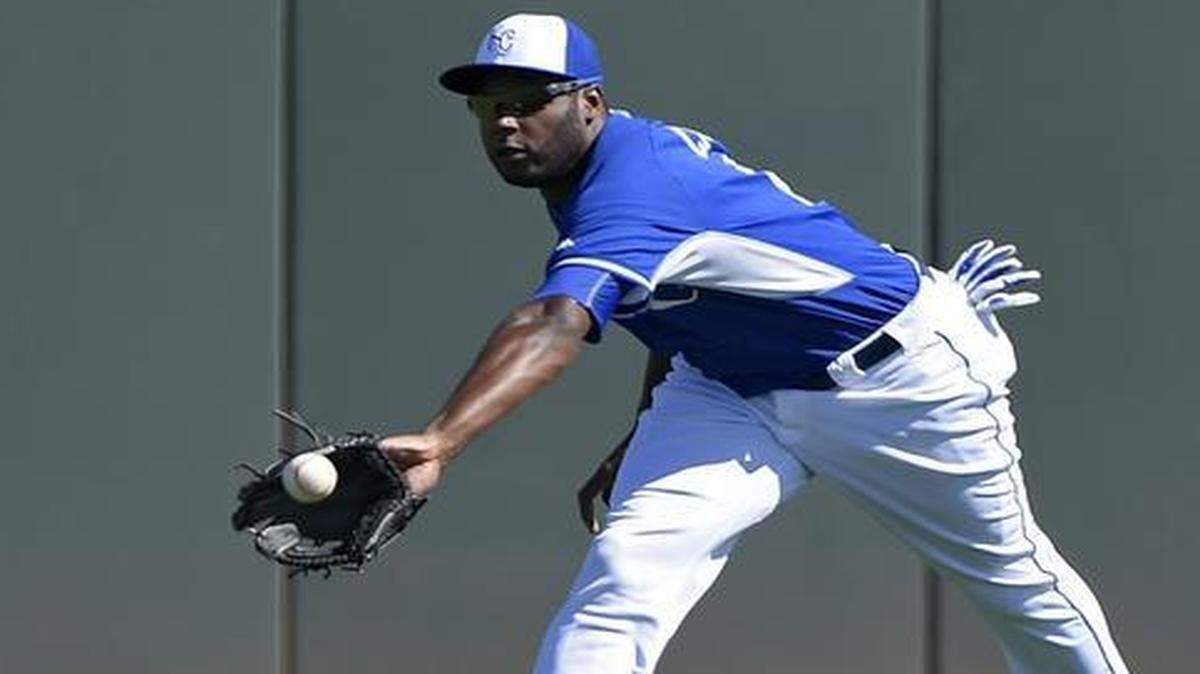
The Royals have found and shown to the world that investing in defense can pay off in so many ways. The obvious is in the run-saving catches, the ones that dotted the Royals’ postseason run, from Cain in the gaps to Mike Moustakas over the dugout suite railing to Gordon going full Ray Nitschke into the wall.
But there is more to it than that. The average big-league at-bat lasts a fraction less than four pitches. Once you account for what that extra plate appearance may lead to — especially since there would typically be at least one runner on base — it’s easy to imagine a diving catch by Cain sometimes saving 10 or more pitches.
The Royals are built with strength at the end of games. Last year, they won 65 of 69 games when leading after six innings in the regular season. They won all six of their playoff games when leading after six.
So if those four or eight or 12 extra pitches help get Yordano Ventura through another out or two, that’s a sturdier bridge to the cyborgs at the back of the bullpen.
Beautiful thing, too, when a group of players recognizes and embraces what they’re good at. Yost says he noticed this — his players sharpening their focus on defense — about two years ago. No coincidence the Royals have had consecutive winning seasons for the first time since 1994.
“That’s one thing I can tell you we don’t slack on,” Dyson says. “Every now and then you get a hitter who might take a pitch off and try to hit a bomb or something, but I can tell you on defense we look at it like every play counts. Every play counts. We can’t have our pitchers throwing extra pitches for something we can eliminate. If we can eliminate it, let’s eliminate it.”
Royals fans don’t need to be reminded that it doesn’t always work like this. They have a long history of disappointment to refer to.
But it has here, at least in this instance. The Royals have found an undervalued and overlooked way to improve themselves with a group of players who have committed themselves to the bigger cause.
No more embarrassments. Quite the opposite, actually.
To reach Sam Mellinger, call 816-234-4365 or send email to smellinger@kcstar.com. Follow him on Twitter: @mellinger. For previous columns, go to KansasCity.com.
This story was originally published April 4, 2015 at 5:00 PM.