
One phrase sums up KU’s plan to beat Wichita State
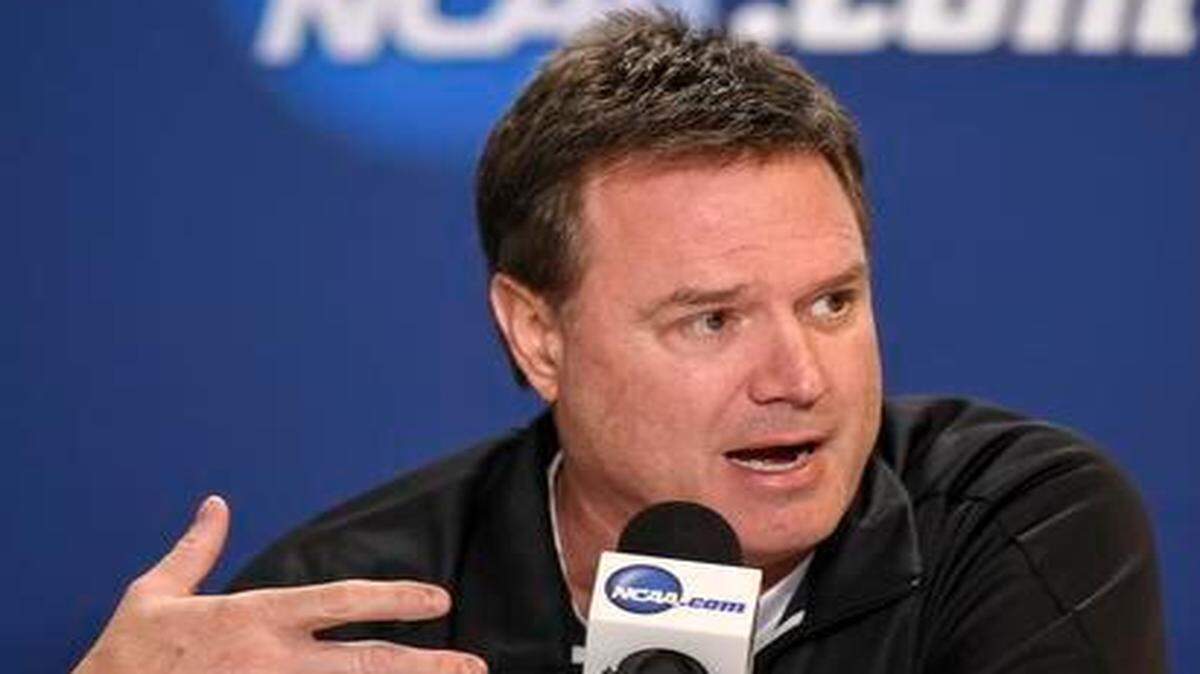
The phrase is simple and to the point, somehow both specific and vague. It is strong enough to be the basis of how Bill Self maintains one of college basketball’s powers, but flexible enough for him to bend into the moment.
He says it all the time, a hundred times a day by one player’s estimation, and that might be conservative. If you are a Kansas basketball fan, or have just heard Self talk once, chances are you have heard him say it in some form.
Make the other team play bad, he says, over and over and over again. Before games, Self tells the media and his guys that to win they will have to make the opposition play bad. During timeouts, he usually spends time measuring in occasionally graphic detail if they are making the other team play bad. And after games, the phrase is a lock to be mentioned in some form at least once.
“I think we made them play poorly,” Self says after beating New Mexico State on Friday, and this is like a father telling his boy, ya did good, son.
The phrase has been Self’s companion on his journey from the bottom of college basketball to the top, as much a part of his rise as his Oklahoma charm and that superstition of blowing in his hands before games. More than any time this season, he’ll need his team to live those words as Kansas faces Wichita State on Sunday for a spot in the NCAA Tournament’s Sweet 16.
Make the other team play bad was a creation of the early 1990s, when Self was just 30 years old and went 6-21 his first year at Oral Roberts. That was the program’s first season in NCAA Division I, and it was still playing with NAIA talent.
Everything was a struggle back then. Everything required creativity. No amount of X’s and O’s was going to make up for the talent difference.
So, Self ran his players so hard they finished practice with blood in their socks from the blisters, and they used to run a drill where a player stood under the basket and put his hands over his privates to protect himself while taking a charge from a teammate with a sprinting start from half court.
“We didn’t have very good players,” Self says now. “If it became a talent contest, you were probably going to lose. If the other other team has better players, you need to make those players not play as well.”
Those were the days where Self’s job as head coach included licking envelopes for fund-raising, but he has largely kept the same approach now that he has the kind of job where even his assistants have access to private jets.
Self says these words so much that the phrase becomes a security blanket for players in interviews, and even makes its way into what is said and written about the team by both fans and media.
This is entirely unscientific, of course, but if you type “make the other team play bad” into Google the first five hits are stories about Kansas basketball. Maybe other coaches say this same thing, but it would be the chorus of Self’s theme song.
“No sir,” says Brannen Greene, when asked if he’d ever heard the term before playing for Self.
“No, I had not,” says Kelly Oubre, asked the same question.
One of their teammates has heard it, and this is no exaggeration, thousands of times.
“Since I started playing basketball,” says Tyler Self, Bill’s son. “My whole life.”
Tyler is a good place to go for a translation from Self-ish to English. He says make the other team play bad is a cousin to other lines from coaches like “impose your will” and is most generally characterized by defense, but the way his dad lives the mantra is a bit more nuanced.
It is about knowing what the opponent wants to do, and taking that away. Making them uncomfortable. If a guard likes to shoot three-pointers off ball screens, the quickest way to get benched is to go under a pick.
There are a lot of ways to make a team play bad. One is to always be aggressive, which is most often spoken in terms of attacking the rim but which Self most often measures through his mathematically questionable demand that his guys get 70 percent of the 50-50 balls.
Self doesn’t run that drill anymore where his guys have to protect their privates, but one of his favorites now is a sort of street-ball scrimmage where there is no out of bounds and no fouls called unless you can see blood. His favorite wins are the kind others might call ugly.
“It’s energy and effort,” Tyler says. “That correlates to getting easy buckets, transition layups, and it works on both ends of the floor but it definitely has a defensive priority.”
That approach is the common thread between Self’s teams where the starting point guard was a walk-on who approached him at a Subway restaurant, and his teams where future millionaires come off the bench.
It has been a particularly valuable trait for this team, which has struggled scoring at times and lacks a talent such as Andrew Wiggins or Thomas Robinson.
As much as any team Self has had at KU, this one has adopted make the other team play bad as its identity. This group has made an incredible amount of progress defensively, pushing its efficiency rating into the top 10 nationally — a higher mark than last year, with Joel Embiid, or the Morris twins’ last team in 2011.
Kelly Oubre went from a bench player to a projected lottery pick as he learned to defend and make profit out of loose balls. Landen Lucas has filled in for Cliff Alexander mostly by muddying the other team around the rim.
They’ll need all of that on Sunday, too, because Wichita State is one of the country’s more difficult teams to shake. Fred VanVleet and Ron Baker are among the best pairs of guards in the sport, and only four teams have committed fewer turnovers than the Shockers.
Geography and drama have turned this into more than a typical NCAA Tournament game. There is some shared experience among the players, and more among their fans. In some real ways, the season of this game’s winner will be looked at as a success and the loser as a disappointment.
For the Jayhawks, it will largely come down to their ability to live the mantra they’ve wrapped their arms around this season, the one their coach has ridden from the bottom of college basketball to the top.
To reach Sam Mellinger, call 816-234-4365 or send email to smellinger@kcstar.com. Follow him on Twitter: @mellinger. For previous columns, go to KansasCity.com.
This story was originally published March 21, 2015 at 5:36 PM.