
Depressed and broken, this Royals minor-leaguer quit. A year later, his dream is alive
A little over a year ago, minor-league pitcher Bryan Brickhouse left the Royals’ spring-training complex in Arizona with no intention to return for the foreseeable future.
He’d spent the better part of three years there, toiling in the heat as he rehabbed from Tommy John surgery and stress fractures in his throwing elbow. He was often alone, surrounded by coaches and coordinators but none of his family, friends or teammates. The routine had grown old: Train, complete a throwing program, see live action, feel like his right elbow would snap in half and start rehab all over again.
He was once a top prep prospect, with enough talent to earn a scholarship to the University of North Carolina and become the Royals’ third-round draft pick in 2011.
Now he was a depressed 24-year-old who failed for six years to make his major-league dream come true. He spent much of his downtime thinking — about the work he’d put in and the results he wasn’t getting. He too often turned to alcohol to cope, wasted too much time playing Call of Duty or Madden alone in his apartment.
His body had rejected the game he loved, that had inspired him to jot goals in dry-erase marker on the bathroom mirror at his childhood home in Texas.
So Brickhouse did, too. He retired from baseball during spring training in 2017.
But not for long.
“I was just ready to move on and just try to get a fresh breath of air,” Brickhouse says a year later, chatting on the phone this week from Delaware, where he’s playing his first minor-league games since 2015 with the Wilmington Blue Rocks, the Royals’ Class A-Advanced team. “I felt like I was kind of stuck in a rut.
“I didn’t necessarily think when I walked away baseball was completely over. It’s just I needed something different, needed to walk away to see if I ever had a chance to play again. I felt if I kept doing the same thing then nothing was going to change.”
Pitching with new-found elbow strength and a four-seam fastball that can hit 100 mph, Brickhouse might struggle to count the number of things that have changed in a year. His mental fortitude, his health, his penchant for binge drinking, his pitching motion. His career for a few months as he ventured into the real estate business and began work for Keller Williams in his hometown, The Woodlands, Texas.
But even away from the game, baseball reeled him back in.
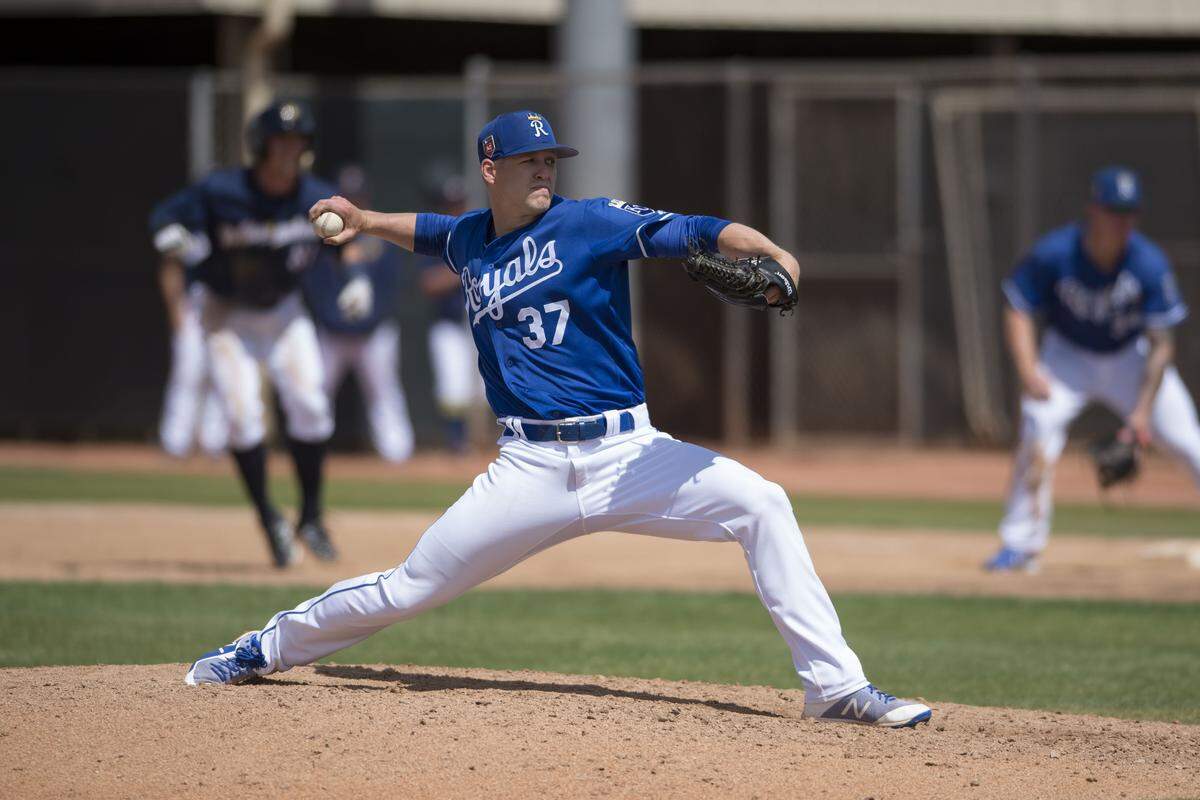
Brickhouse stood on a mound at the Dynamic Sports Training facility in Tomball, Texas, this winter, unfurled his retooled delivery and zipped a fastball out of his right hand.
The pitch didn’t have the sinking action it possessed before a screw was drilled into his right elbow in 2015 and again in 2016. It spent more time riding through the strike zone than it did when he unconsciously hyper-extended his elbow while pitching and sustained a stress fracture.
But that the pitch did anything at all sent chills through Kevin Poppe, one of his trainers.
Brickhouse had progressed from throwing in the low 80s to consistently touching 94 mph on the radar gun — just like he did when healthy early in his career — within a couple of months. A few weeks after that, the radar gun spit out a reading of 98 mph.
In a bullpen session.
“We work with Trevor Bauer and I’ve never seen him throw harder than 92,” said Poppe, the director of operations at the DST North campus Brickhouse frequented. “That’s really hard in a bullpen.”
But before he could climb onto that indoor mound where he wowed Poppe and pitching coach David Evans of Premier Baseball, Brickhouse had to do some searching.
He came home from Arizona and began a cleanse, in both the figurative and literal sense. He took up 30-minute yoga sessions, 45 of them to be precise, to help untie himself from his own lofty expectations. He improved his nutrition. He stopped drinking.
There were so many more productive things to do than to “curl up in my apartment and not really move” like he did when he felt stranded all that time in Arizona.
Inspired by his mother, Tina, Brickhouse pursued a real estate license. He filled his days learning a new craft, working his upper body like he never had at the gym and soaking in the first 55 episodes of the Jocko podcast series from author Jocko Willink, a retired Navy SEAL who co-founded a leadership program called Echelon Front.
“He would listen to it and a lot would be about mental toughness and how you have to push through adversity,” said Tina Brickhouse, who works for Keller Williams in Savannah, Ga. “I think that is what Bryan learned how to do.”
It turns out all Brickhouse ever needed was time to unshackle himself from the perpetual heartbreak his setbacks had caused.
Gradually, movement in Brickhouse’s elbow became effortless, like it had been his first couple of years in the Royals organization, where he was drafted 90 picks after the Royals made the injury-riddled Bubba Starling the fifth overall selection in 2011. Brickhouse had finally let his elbow rest long enough that he could recover easily from workouts. It helped, too, that he dropped about 30 pounds as he worked his 6-foot frame back into shape. He’s listed at 195 pounds now.
In early September, Brickhouse called Evans for the first time in years. They met at the training facility some 20 miles from his hometown at 11 p.m. and developed a plan.
Evans suggested the Driveline program, developed by Kyle Boddy in an attempt to help pitchers increase velocity in a healthy way. The methods include using small weighted balls, tossing at long ranges and throwing frequently to encourage the elbow to adapt to stress.
Brickhouse hadn’t been able to throw on consecutive days in years. Just before he retired, three days would pass before he felt comfortable enough to throw off a mound — and despite being healthy in the structural sense, the bones in his elbow were still too weak to support ongoing rehab.
“It felt like my elbow was snapping in half every time,” Brickhouse said. “I could hardly get through a 25-pitch bullpen and play catch and recover from that. We had exhausted all our options at that point because my elbow had healed and I was still not feeling good.”
But he hadn’t tried Evans’ solution yet.
“I had nothing to lose at that point,” Brickhouse said.
A few weeks into the reeducation program, wherein he and Evans spent hours remapping his arm path, Poppe came into the picture. Evans and Poppe worked in tandem as they have for years. As Evans helped Brickhouse relearn how to pitch, Poppe helped Brickhouse increase the mobility in his torso and power in his lower half.
By mid-October, Brickhouse had begun to master his new delivery. He reached a point where he could throw a bullpen at maximum effort one day and be able to throw off the mound again the next day.
“He was hesitant to give it another go. He was sure the pain was gonna come back,” Poppe said. “When he came and started working with David on his throwing, and started seeing a little bit of progress and believing what David was saying, you could see there was like that ‘OK maybe I can still do this’ moment.”
Brickhouse alerted the Royals of his desire to return to baseball in November. After Royals scouts watched him pitch during the winter and provided encouraging reports, the club welcomed him back.
The results have finally matched Brickhouse’s work ethic. Real estate, for now, has taken a back seat.
He hit 100 mph for the first time in his life during a spring-training game in Arizona. He was assigned to Wilmington shortly thereafter — a move that checked a goal off the list he now scribbles into a journal.
“Once I walked away I realized how much I loved competing and how much I loved stepping out on the mound,” Brickhouse said. “I wanted to get back to that. I had missed that for so long. It grew my determination. I set some goals for myself back in June. I’ve accomplished half of those already and I’m looking to accomplish a couple more over the next year or two.”
Entering Saturday, Brickhouse owned a 2.13 ERA in 12 relief outings. He’d converted seven save opportunities, surrendered three earned runs and yielded two hits. Although he’d walked 14 batters, he’d struck out 19.
In a few weeks, he will turn 26. He hasn’t yet pitched against Class AA hitters outside of a failed experiment in the Arizona Fall League that led him to his first screw surgery.
For the Royals, his lack of experience is not a bad thing. Once Brickhouse starts climbing the ranks again, he could easily forge a path to the Royals’ bullpen.
That didn’t escape Tina Brickhouse’s notice.
She had always hoped her son would find his way back to the mound. He’d fought so long and too hard to give up.
Yet sometimes she can’t stem the wave of disbelief that hits her when she remembers: Bryan Brickhouse is back in a professional baseball uniform. The major-league dream is no longer out of reach.
“He was driving me back to the airport around Christmas and at that moment, I was just thinking, ‘This is gonna be an incredible story,'” Tina Brickhouse said.
It might yet be.
This story was originally published May 19, 2018 at 11:20 AM with the headline "Depressed and broken, this Royals minor-leaguer quit. A year later, his dream is alive."