
The only reporters who covered Loyola long before the Final Four? They're students
Even the most dedicated reporter covering Loyola-Chicago basketball didn’t believe the Ramblers’ run to the Final Four was possible.
Nick Schultz, the men’s basketball beat writer for the Loyola student newspaper, the Loyola Phoenix, had the No. 11 seed Ramblers losing in the Sweet 16 to Cincinnati.
That, of course, did not happen. They beat Nevada in that round. Kansas State in the next one. And now they’re here, competing for a chance at the school’s first basketball national title since 1963.
“My bracket’s in shambles,” said Schultz, a sophomore at Loyola. “...You can’t plan for a Final Four.”
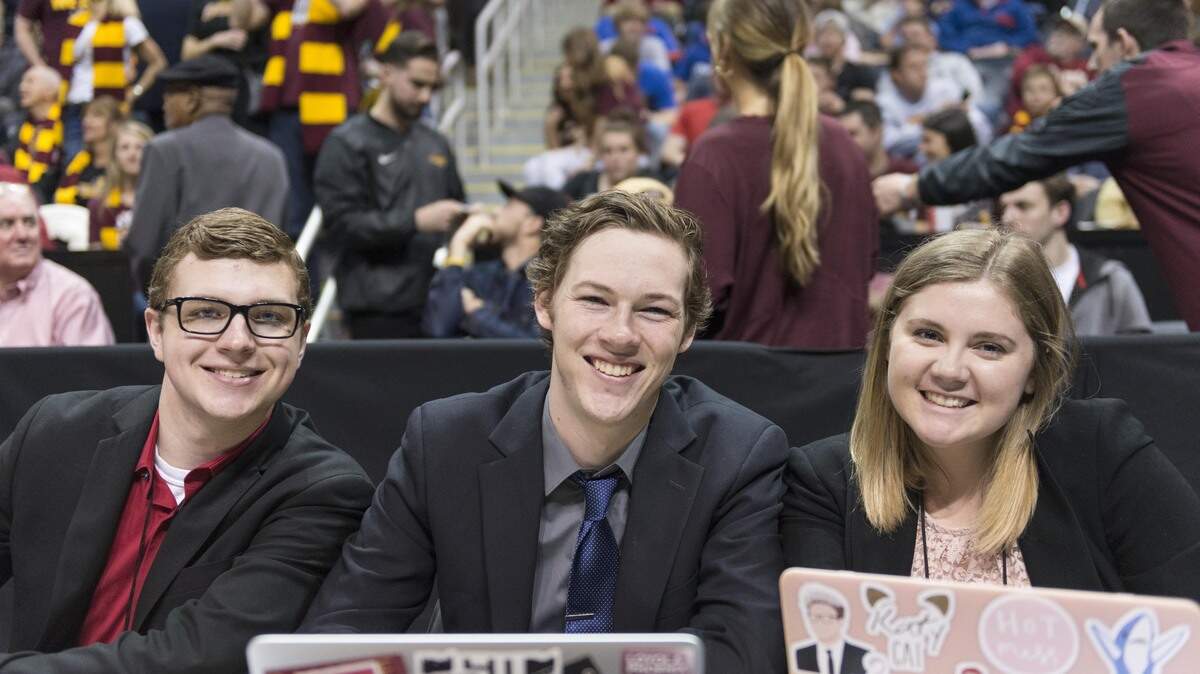
Schultz also could not have envisioned how Loyola would turn into national media darling, how hordes of people would want to ask the Ramblers about Sister Jean, or about their coach Porter Moser, or how they would beat Michigan in the national semifinal Saturday. Henry Redman, the sports editor at the Phoenix, and Hayley Spitler, who produces a weekly Loyola sports TV show, did not understand just how much of a media frenzy March Madness could be until they saw the frenzy come for the team they cover.
Now the three have a unique perspective. They might be the only people outside of the Loyola program who understand just how drastically life has changed for this Rambler team.
“The first game of the year I was like, ‘Wow, there are students here,’” Redman said. “There were probably 500 students. It’s a school of 16,000, so that’s not very many.”
Thanks to layoffs in the media industry, Loyola’s sports information director Bill Behrns said the student newspaper is the only outlet that has regularly attended Rambler home games for the past five seasons.
Behrns said a Northwestern student who runs a website covering Chicago-area basketball occasionally attended Loyola games. The Chicago Tribune and Chicago Sun-Times were sometimes there, too. But only the Phoenix was always there — well before January, when the Ramblers kept winning and attention was on an uptick.
“It was just a lot of local stuff,” freshman player Christian Negron said of media coverage the Ramblers received to begin the season. “The Loyola Phoenix. Our guy Nick Schultz.”
Schultz has taken the shuttle to the school’s downtown campus with Negron. They talk when they pass one another on the way to Schultz's dorm. And Schultz, a sophomore who wants to work as a sports writer, stops to say hi to players when he sees them in a dining hall.
The Ramblers say Schultz deserves credit for being on their story early.
“Nick Schultz is sitting press row — or what we call press row — every game,” forward Carson Shanks said.
Most athletes say they don’t read about themselves, but some Ramblers admitted they do. It wasn’t hard to for much of this season. The Phoenix is a weekly newspaper, so there were only one or two Loyola basketball stories published most weeks.
“If you got your name in the Phoenix, that was big-time,” Shanks said. “... (And) if you got a scathing review in the Phoenix, it was like, oh man, all of Chicago is going to see this.”
Schultz is most proud of a story he wrote about Moser’s relationship with the late Rick Majerus. Moser worked as an assistant under Majerus at Saint Louis University. But Schultz's recent work has garnered more web traffic.
Loyola-Chicago basketball is a thing people Google now. A lot. So much so that the Phoenix’s website crashed when Schultz tried to publish his game story from the Ramblers’ Elite Eight win over K-State.
Redman said he and Schultz were often the only reporters talking to Rambler players during media availabilities. Now stories about Loyola basketball are everywhere, and the media sessions seem to be never ending.
The Ramblers locker room has been open to reporters throughout the NCAA Tournament, per NCAA policy, and the players didn’t understand what that entailed until the first time it happened. After they beat Miami in the first round, “a hundred people came in,” freshman Dylan Boehm said. Reporters stepped on forward Nick DiNardi’s feet.
On Thursday, the crowd surrounding star guard Clayton Custer’s locker was so massive that you had to break through a few layers of people just to see him.
The Ramblers have learned that everything they do now qualifies as worthy of documentation. Shanks only feels safe in his hotel room or a restroom.
“You’re trying to eat, and there’s a camera in your face,” DiNardi said. “Why do you have to film me eating this piece of lasagna?”
None of this is to say the Ramblers are unappreciative of their moment. Those early season postgame press conferences, when they’d walk into Gentile Arena’s media room and just see reporters from the Phoenix, are reminders of how far they have come. Not all of it is great — answering different versions of the same questions never is — but Loyola, like any other team, would rather be here than at home.
“It’s good to get more coverage and more exposure for the Loyola community,” guard Ben Richardson said. “This is part of the process. That’s what coach always says. It’s different and it’s an adjustment, but this is part of the process that we’ve been working for.”
The Phoenix reporters are networking with sports reporters who would never be at a Loyola game during any other season, and people now know their school for something.
“We were the first group of students to cover Loyola winning the Missouri Valley tournament,” Spitler said. “Then getting to go to the NCAA Tournament was so fun. Then (they) continued winning.”
The postseason run has been costly for a student media outlet with a measly budget. Loyola's student media manager, Ralph Braseth, estimated that the university had spent at least $30,000 to fund the students’ coverage of the basketball team.
Braseth knows that’s a lot to spend on just a few people. But he figures there is no better learning experience, and it could be another 55 years before Loyola students have this opportunity.
This story was originally published March 30, 2018 at 10:30 PM with the headline "The only reporters who covered Loyola long before the Final Four? They're students."