
Mystery of Missouri black man in Thomas Hart Benton mural is finally solved
Not even Thomas Hart Benton, the famed Missouri painter who memorialized the black man's image, could remember his name. So he called him "Mr. Sharkey."
But who really was the model for this man? For decades experts on Benton and his expansive 1936 mural, "Social History of the State of Missouri" — which covers the walls of the House lounge in Missouri's state Capitol — had no idea.
Certainly the figure in the mural is conspicuous.
Dressed in a dark suit with a blue collar, the gentleman stands alone as the only black man in a crowd of white people during a fiery political speech given by Benton's own father, U.S. Rep. Maecenas Benton. The man leans against a tree. His arms are crossed. His head tilts to the right, covered by a white hat, as he listens intently.
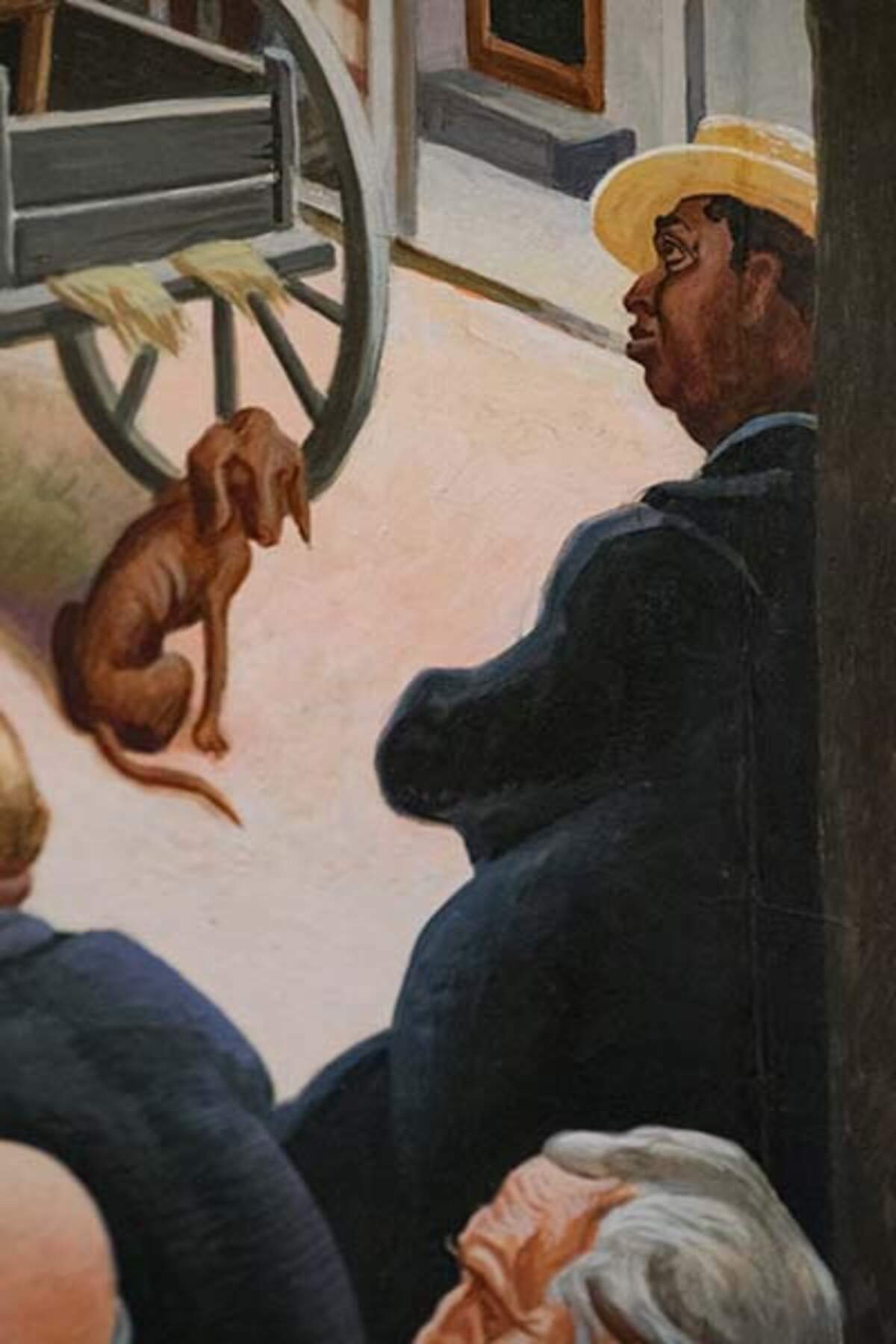
In the distance, far behind the man's back, is the figure of another black man and another tree. But the man in the background is being lynched.
In 2012, James Bogan, having retired at age 67 as a professor of English at the Missouri University of Science and Technology in Rolla, made it his retirement project to find out who the standing man was. Twenty years prior, Bogan had directed a documentary on the mural. He didn't know then. The mystery pestered him.
On Monday, following several years of on-and-off research, Bogan published his findings on the University of Missouri Extension website. The "mystery man," he determined, was St. Louis black politico Jordan W. Chambers, a remarkable and powerful leader in both St. Louis and national politics more than 30 years before the Voting Rights Act of 1965 would be signed into law.
"This is a discovery," said Henry Adams, a Benton scholar and art historian at Ohio's Case Western Reserve University. "I suppose that would have been recognized (at the time), but I never came across any reference to it in the contemporary literature."
"He is a really fascinating character," Bogan said of Chambers. "He is an old-time political boss who fed people during the Depression, found them jobs, stuck up for civil rights. When he was 19, he wrote a letter to (American labor leader) Samuel Gompers asking, 'How do I start a union?'"
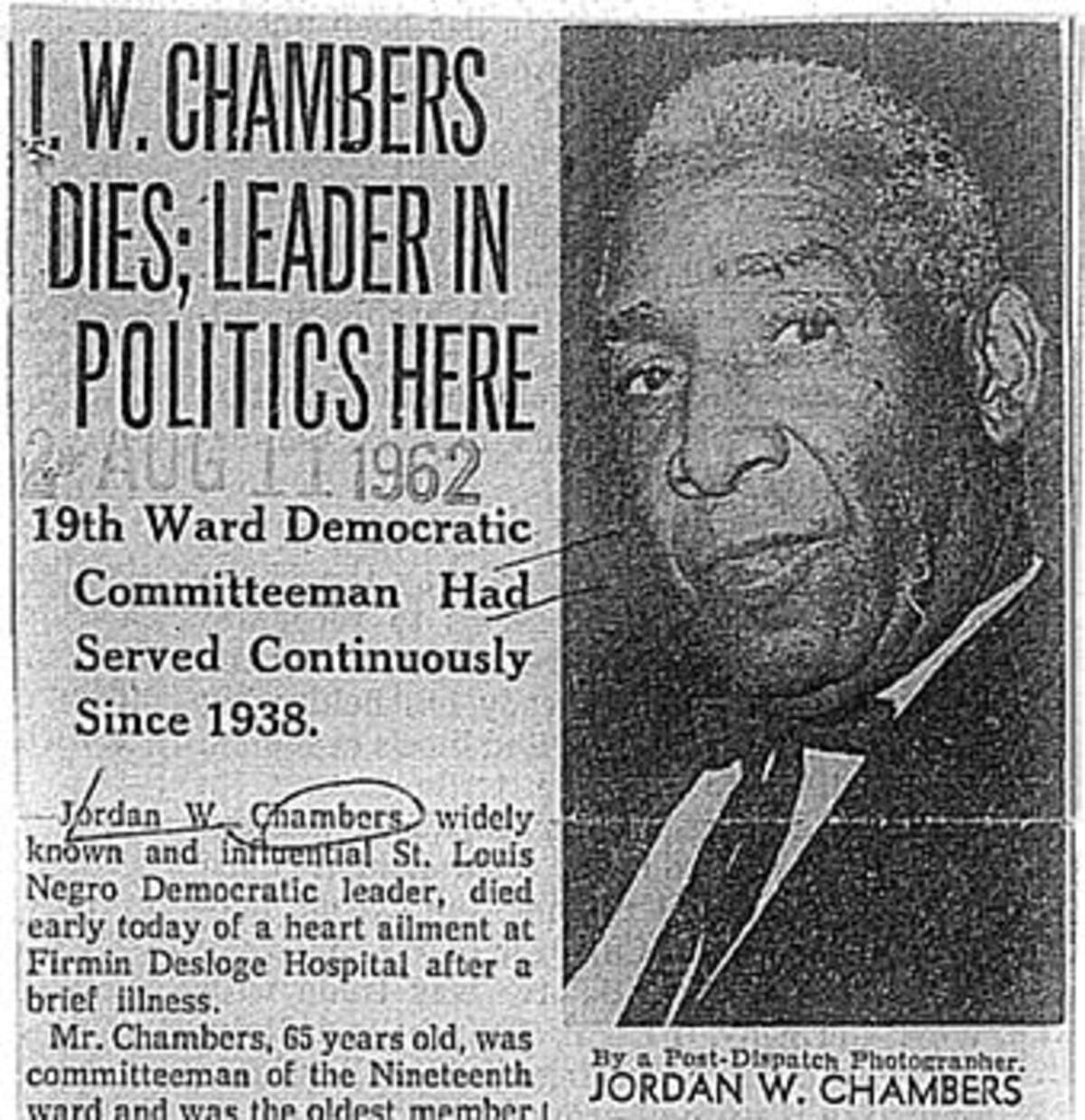
Born in 1897, Chambers was an avowed Republican in his early years, out of fealty to the party of Abraham Lincoln. But in the wake of Herbert Hoover, in the 1930s, Chambers switched to the Democratic party. The St. Louis Post-Dispatch newspaper referred to him as the "Negro mayor of St. Louis."
The leader of an important political ward, Chambers would later be credited with delivering the black vote that helped land Harry S. Truman the presidency. When Chambers died, the then-governor of Missouri, John Dalton, delivered his eulogy. President John F. Kennedy sent a message of condolence.
A park in St. Louis bears Chambers' name.
Bogan said it was Benton's own story about the mural, some of it in Benton's unpublished memoir, that led him to conclude that the figure is Chambers.
Benton had written that in part of the mural he had depicted "black slaves working under the whip of an overseer in some primitive lead works. A Negro political faction in St. Louis took offense at this representation and sent a delegation to the governor asking to have it effaced."
The governor, Guy Park, reluctantly asked Benton to change that part of the mural.
"'Governor,' I asked, 'how important is the leader of this St. Louis crowd?'
.jpg "Figure-1-Godsey-1936-Photograph(1).jpg")
"'The most important black vote "getouter" in the town,' he replied, 'and he knows it. Plumb full of himself. That’s why this business is touchy.'"
Benton asked to meet with the man, calling him by the fictional name "Mr. Sharkey" in his recounting of the story. Benton brought this "Mr. Sharkey" to the painting.
"I was at the moment working on a representation of an old-fashioned outdoor Missouri political meeting, where my father, as speaker, addressed a country town audience. Standing as a listener in a very prominent position was a figure for which I had not yet found an appropriate face. I pointed out this figure and said, 'Mr. Sharkey, I’ve been looking for a face of a prominent politician of your race for this figure. I want to show the progress of Missouri’s colored people from their unhappy beginnings, shown by the lead mine scene, to their present position of political importance in the State.
"'The lead mine scene is a bad part of our history, I’ll admit, but it’s necessary to show how the colored people overcame their misfortunes and rose up to the position of power that you represent. How about my putting your face on that figure? You’ll be up there on this State House wall as a permanent record of the colored man’s accomplishments in our state.'
"'Why, Mister Artist,' he replied, 'I think that would be all right.'"
The prime clues for Bogan were the fact that the gentleman was from St. Louis and known to get out the vote. None were more powerful in that regard than Chambers. And then there was a white hat in the painting, prime headgear for Chambers, as well.
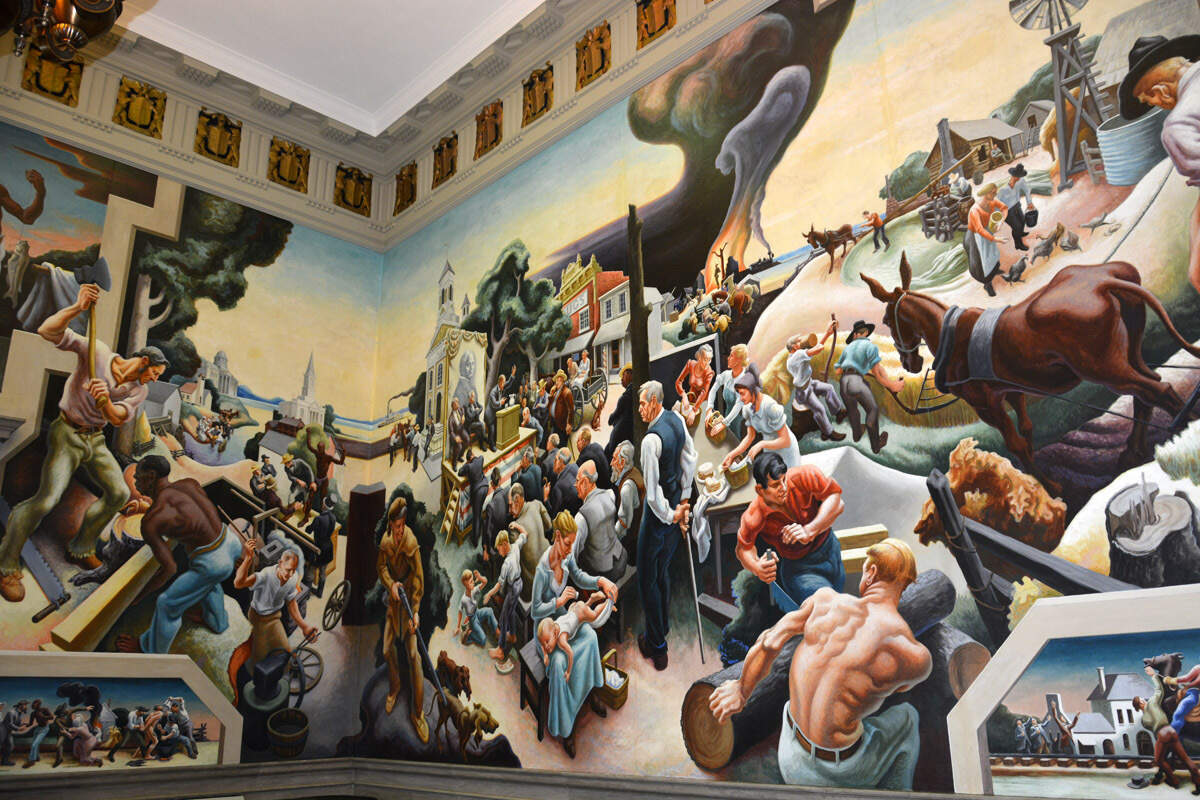
The image in the painting also bears a resemblance to some images of Chambers. Benton often used real people, real faces, as his models. Kansas City political boss Tom Pendergast and developer J.C. Nichols, as well as the Missouri governor all appear in the mural.
“You always want to know who the people are in the mural," said Bob Priddy, the president of the State Historical Society of Missouri and author of "Only the Rivers are Peaceful: Thomas Hart Benton's Missouri Mural." "This is really a key figure. Benton was looking to show the African-American people in Missouri."
Priddy notes how the figure stands by himself away from the white crowd.
"It changed the mural and showed where African-American people were at the time in Missouri," Priddy said. "They were in the political system, but not of the system. Part of it, but not."
This story was originally published April 9, 2018 at 5:54 PM with the headline "Mystery of Missouri black man in Thomas Hart Benton mural is finally solved."