
Greitens vowed he would survive his scandals — until Tuesday. What changed the game?
A day after Gov. Eric Greitens’ startling announcement that he will resign on Friday, Missourians were left to piece together what finally pushed the scandal-plagued governor to quit after months of declaring his innocence and vowing to remain in office.
In announcing his resignation Tuesday, Greitens said he was basing his decision on a desire to put an end to the “pain and difficulty for the people that I love.”
Yet hours before Greitens announced his resignation, a Cole County judge ordered his political nonprofit — A New Missouri Inc. — to turn over communications and documents that lawmakers think could demonstrate efforts to illegally circumvent the state's campaign disclosure laws.
And GOP legislative leaders were insistent that Greitens abide by a separate subpoena compelling him to appear on Monday to testify before the House committee that’s been investigating him for months as a precursor for possible impeachment.
Greitens’ resignation could make both subpoenas moot.
"The judge has an order," House Speaker Todd Richardson, R-Poplar Bluff, said Wednesday. "We’ll have discussions with them about whether they intend to comply with that order, but the House’s jurisdiction over those matters will go away at some point with the governor’s announcement yesterday. I don’t have a better answer for you at this point."
In St. Louis, Circuit Attorney Kimberly Gardner said Greitens’ attorneys had approached her over the holiday weekend with his offer to resign as part of an agreement to dismiss a felony computer-tampering charge he faced.
She agreed to the deal, which did not require Greitens to admit guilt. The agreement also released Gardner and all members of her office and consultants from any civil liability related to the tampering case or a previous felony invasion-of-privacy case against Greitens.
"Now it’s time for all of us to come together," Gardner said. "It’s time to heal the wounds of our city and state and focus on building a place where people feel they are heard. Where victims, regardless of their station in life, know that we will do what is right regardless of the powers against them."
Divulging donors
Several sources with knowledge of the nonprofit told The Star that donors to A New Missouri Inc. had been quietly panicking behind the scenes at the prospect that the House's investigation could reveal their identities.
Catherine Hanaway, a former House speaker who is representing A New Missouri, said Tuesday that she was considering options for an appeal. She did not respond to a request for comment Wednesday.
The timing of Greitens’ resignation, so soon after the judge's Tuesday order, had many speculating that the prospect of divulging the inner workings of his secretive nonprofit may have contributed to his decision to quit.
“I think the trigger today was the courts saying that they were going to demand that the subpoenas were fulfilled for his donors and that whole area," said state Rep. Kevin Engler, R-Farmington.
Sen. Kiki Curls, D-Kansas City, said "the ruling by the court this morning was particularly a huge blow. ... I’m sure there were a number of things. I would suspect that the ruling this morning that would have had some impact on his decision.”
Witch hunt
Gardner on Wednesday disputed Greitens' past statements that she had been engaged in a politically motivated witch hunt against him.
"There has been no witch hunt," Gardner said. "No plans to bring pain to him or his family. Quite the contrary. The consequences Mr. Greitens has suffered, he brought upon himself. By his actions. By his statements. By his decisions. By his ambition. And his pursuit for power."
A copy of the agreement to dismiss the felony tampering charge obtained by The Star included seven terms. Two of the terms were blacked out and marked "under seal." Included was an acknowledgment by Gardner that the outcome of any trial on the tampering charge "would be attended with considerable public expense and the outcome could not be predicted."
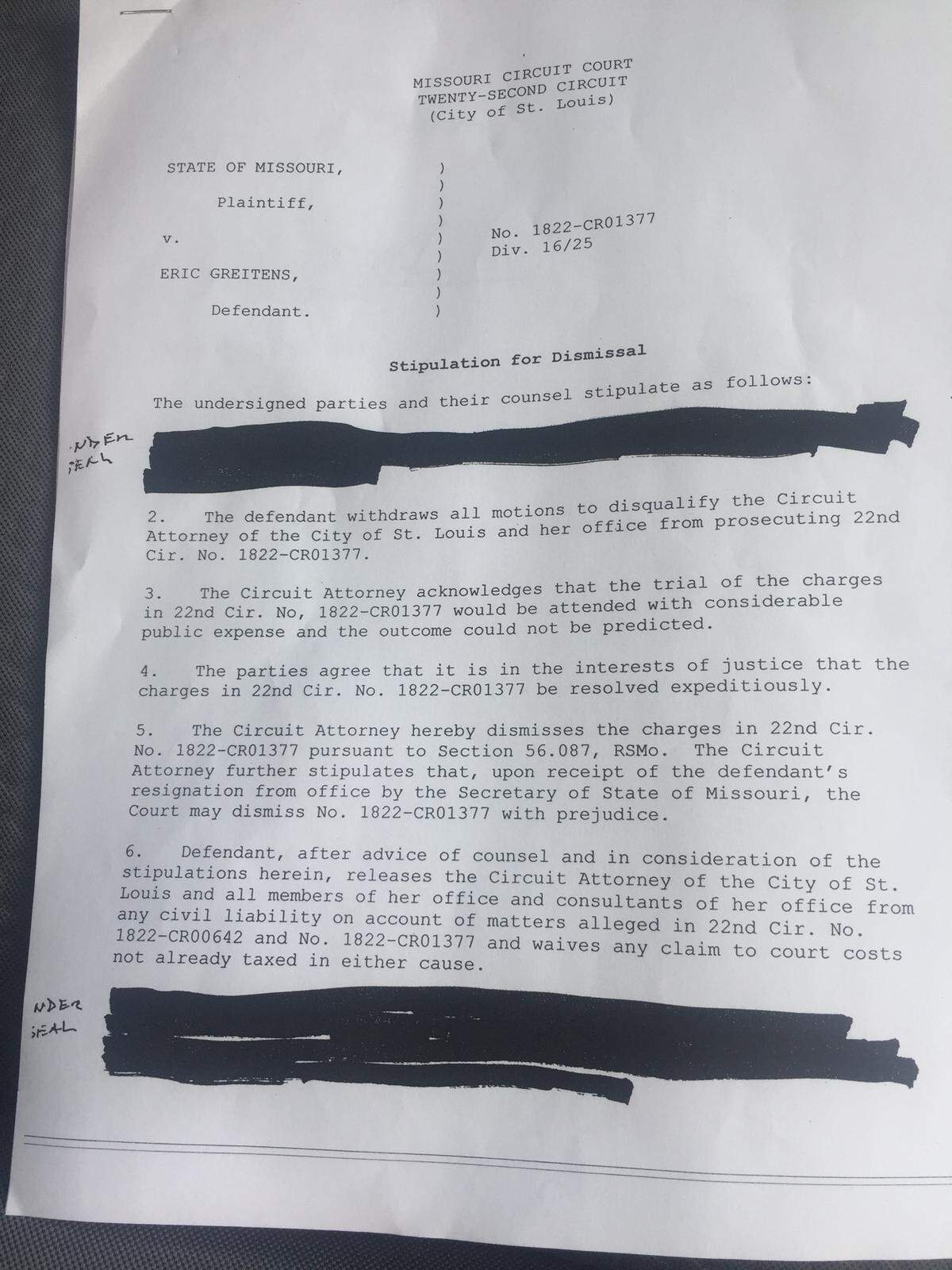
The agreement also noted that Greitens would withdraw all motions to disqualify Gardner and her office from prosecuting the case, and stated that all parties agreed it is "in the interests of justice" that the charge be resolved quickly.
In the agreement, Gardner stipulates that the court may dismiss the tampering charge with prejudice — meaning it can't be refiled — "upon receipt of the defendant's resignation from office by the Secretary of State of Missouri."
Greitens also agrees "after advice of counsel" to release Gardner, her office and any consultants from any civil liability and to waive "any claim to court costs not already taxed."
Susan Ryan, a spokeswoman for Gardner, said the provision releasing the circuit attorney's office from liability "was included in an effort to protect the city from having to pay to defend frivolous lawsuits."
Gardner dropped the invasion-of-privacy charge earlier this month after the judge in the case ruled that he would allow Greitens' attorneys to depose Gardner about whether she had knowledge of perjury committed by a private investigator hired by her office.
The private investigator, William Don Tisaby, was hired by Gardner to work on the invasion-of-privacy case.
Greitens' attorneys accused him of lying about his methods and the evidence he collected. Tisaby pleaded the Fifth Amendment in response to more than 50 questions in a deposition by the defense team.
Tisaby's attorney, Jermaine Wooten, has said the perjury allegations are without merit, and Gardner's office has said there's no evidence that any action by Tisaby was illegal or materially affected the case against Greitens.
Unusual agreement
Legal experts interviewed by The Star characterized the agreement reached between Gardner and Greitens as unusual.
It reads a bit more like a civil settlement than what is typically seen in a criminal case, with both the governor and the circuit attorney seeking mutual releases, said Jean Paul Bradshaw II, a partner at Lathrop Gage and a former U.S. attorney.
But Bradshaw said the deal is probably a good resolution of the charges.
"Given how at least the initial (invasion of privacy) case was handled, it raised some issues of personal liability on behalf of the circuit attorney’s office or staff members there, so I guess that makes this a little different," Bradshaw said.
"The state’s interest in seeing this case prosecuted is probably outweighed by the value of the resignation, so it’s probably a fair resolution of this. It’s just a very unusual agreement, but let’s face it, this is a very unusual circumstance."
Bradshaw and others raised concerns about the censored parts of the agreement.
"To have a confidentiality provision in something that’s actually filed in court, and where one of the parties is the state’s governor, I’m not sure what’s in the public interest there in doing that," Bradshaw said.
John Ammann, attorney and law professor at St. Louis University school of law, said he's very worried about the ethics of sealing significant provisions in the agreement, especially since the deal ties Greitens' criminal case to his threat of a civil lawsuit against Gardner.
"There’s all kinds of trouble with it," Ammann said. "What the hell is the redacted stuff? The public should be able to see the entire agreement. This is about the governor."
Ongoing investigations
Although the agreement between Gardner and Greitens resolves the tampering charge, a separate investigation will continue into allegations of wrongdoing by Greitens during his 2015 affair with his hairdresser. Jackson County Prosecutor Jean Peters Baker is leading that probe.
Baker took over the investigation into Greitens' alleged misconduct after Gardner dropped a felony invasion-of-privacy charge against the governor. That charge stemmed from allegations that Greitens had photographed the woman while she was bound and partially nude in his basement.
The woman later would testify to a bipartisan investigative committee of the Missouri House that Greitens also held her in a bear hug when she tried to leave the basement and coerced her into oral sex as she sobbed uncontrollably.
Gardner dropped the invasion-of-privacy charge after the judge in the case ruled that he would allow Greitens' attorneys to depose Gardner about whether she had knowledge of perjury committed by a private investigator hired by her office.
Meanwhile, a source close to the House investigative committee says it will continue to probe into the source of $120,000 in payments to Al Watkins, a St. Louis attorney who represents the man who first publicized blackmail allegations against Greitens.
The money was paid to Watkins by Scott Faughn, a newspaper publisher who testified under oath that it was payment for secretly recorded tapes of the woman confessing the affair that he planned to use for a book.
Watkins disputed that claim, testifying under oath that Faughn told him the money came from an out-of-state Republican donor with a personal grudge against Greitens.
Greitens' attorneys have requested that the House investigative committee issue subpoenas to a developer and a banker involved in low-income housing tax credits, an industry the governor has sharply criticized and has suggested may have conspired to intensify his legal problems.
The lawsuit against the governor's office over its use of a self-destructing text messaging app called Confide will continue unabated.
A judge on Wednesday ordered Greitens' attorneys to turn over a list of everyone in the governor's office who used Confide and the telephone numbers they used.
Confide is an app allows someone to send a text message that automatically erases after it is read.
The app also prevents anyone from saving, forwarding, printing or taking a screenshot of the text, raising concerns among government transparency advocates that the app could be used to subvert the state’s open records laws.
Two St. Louis attorneys sued in December, alleging Greitens and his staff conspired to use Confide to circumvent the state's Sunshine Laws.
"The Confide litigation has never been about removing a particular person from office, the litigation is about exposing secret communication systems within our government and revealing the truth about those communications," said Mark Pedroli, one of the lawyers who sued the governor. "That litigation continues."
All told, 12 senior members of Greitens staff have admitted they had Confide accounts associated with their personal cell phones. Greitens also has an account under the user name "Er Robert," and he has admitted that he “occasionally used Confide to communicate with members of the Office of Governor about scheduling in a manner that was consistent with the requirements of the Open Records Law.”
This story was originally published May 30, 2018 at 6:24 PM with the headline "Greitens vowed he would survive his scandals — until Tuesday. What changed the game?."