
It's been 40 years since lead paint was banned, so why are we still being poisoned?
Freddie Mae Slaughter has kept her Kansas City home clean in 19 years of ownership, painting interior walls at least two or three times to keep them bright white.
She hadn’t thought that the window sills between the inside and outside panes needed a coat, too.
That out-of-sight strip within windows is easy to neglect.
Contractors working to make Slaughter’s home safe from lead exposure said every time she’d slide up her windows to let in fresh air, dust from lead paint of a long-ago era would float into the home, endangering the 2-year-old girl in her care on weekdays.
On the 40th anniversary of the banning of lead paint for home projects — and a quarter-century after American motorists stopped pumping leaded gasoline — potentially severe health threats linger. In fact, the estimated number of lead-poisoned children in Kansas City has swelled in recent years, from 800-1,200 in 2013 to 1,200-1,500 now, said Amy Roberts of the city's health department.
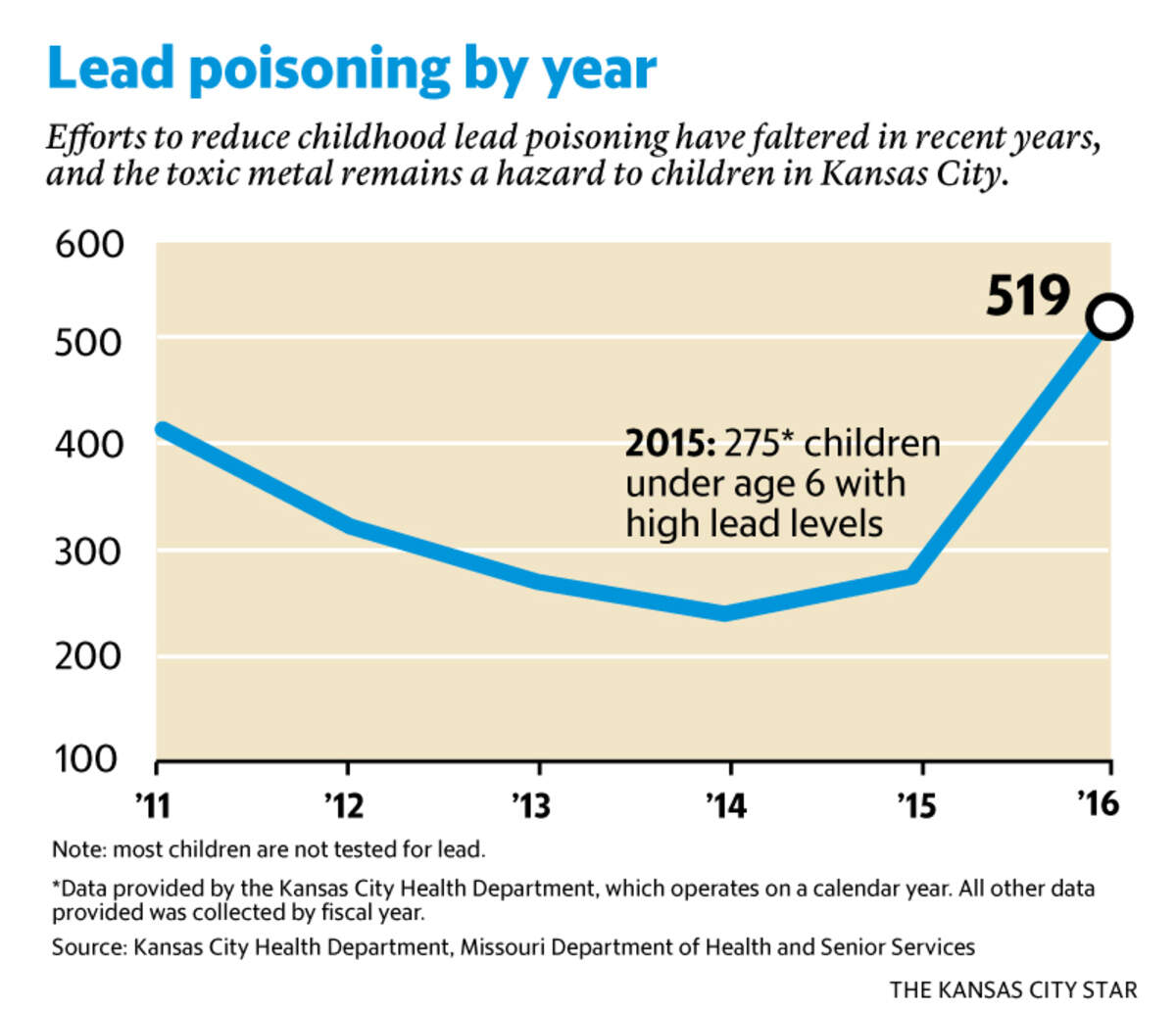
In 2016, 519 Kansas City children younger than 6 tested positive for high lead levels in their blood, compared to 275 just a year earlier and about 400 in 2011.
Another 1,500 youngsters are thought to be poisoned in Wyandotte County, which in 2017 received its first federal housing grant in six years to reduce the risks in homes. During the funding gap, which county officials attribute to staff cuts by the Kansas Department of Health and Environment, unknown numbers of Kansas City, Kan., toddlers had contact with excessive lead that could affect their brains for the rest of their lives.
And children aren't the only people endangered: New research suggests that more than 400,000 U.S. adults die annually from heart disease and other conditions aggravated by lead exposure in their younger years. That’s 10 times the previous estimates of deaths linked to long-term effects of living with lead.
“These results suggest that low-level lead exposure is an important, largely overlooked risk factor for death in the USA, particularly for cardiovascular disease deaths,” according to the peer-reviewed study published March 12 in The Lancet Public Health.
All experts agree that risks within homes have been radically reduced since 1978, the last year that newly built houses — along with older ones getting paint jobs — were slathered in lead.
The takeaway from The Lancet report, said chief scientist David Jacobs of the National Center for Healthy Housing, is that while even subtle past lead exposure is not fixable, future threats need to be conquered through public awareness.
“It’s not just a low-income problem,” said Jacobs. “We still have large reservoirs of lead that have not been controlled. We’ve made a lot of progress but have a long way to go.”
Among all houses in the nation, the Environmental Protection Agency has estimated that more than 20 percent still harbor lead-paint hazards. Of tens of millions of homes built before 1978 (Kansas City has more than 150,000 of those units), most have never been professionally inspected, much less treated, for lead, said Jacobs.
Across Kansas City, budget and staff shortages make even reported threats hard to check out.
Of 350 complaints received last year by the city's 311 call center about home health hazards, from lead to mold to bedbugs, a housing report says officials responded to only five. Health department spokesman Bill Snook said those five were the only callers eligible for a home visit under guidelines set by U.S. Department of Housing and Urban Development for lead-prevention assistance.
To get that federally funded help, you must be low-income, a property owner and care for at least one child under age 6.
Lead, lead everywhere
Rising estimates in the local number of lead-poisoned children, after decades of declines, are partly due to more stringent recommendations by the Centers for Disease Control for addressing dangerous levels of lead in the blood.
The CDC has tightened the acceptable blood concentration from 40 micrograms of lead per deciliter in the 1970s to 10 micrograms in the 1990s to 5 micrograms per deciliter in the 2010s.
“The good news is that when I was growing up, the average blood level (for the presence of lead) was 15 percent,” or 15 micrograms per deciliter, said Jacobs, who is 65. “Today it’s 1 percent...
“The bad news is that lead exposure remains ubiquitous.”
Old, neglected windows aren't the only remnants of a society once saturated in lead. Regulated traces of lead still exist in aircraft fuel, road striping and even some cosmetics. Lead paint continues to be used to coat water towers and factory floors, Roberts said.
In some locales, high lead levels remain in the soil, leaching from home siding (a marketable feature of lead paint was its self-cleaning properties during rains) and from the exhausts of cars running on leaded gas.
Painting over walls and ceilings in homes older than 40 years greatly scales back the interior risks — so long as the fresh coats don’t deteriorate, experts say. Where scuffs appear along door jams and the edges of windows, or in the cracking, alligator-skin pattern on repainted exterior siding, even recently covered surfaces may emit lead dust.
As residents of Flint, Mich., learned in 2014, lead water pipes can contaminate drinking water when harsh sources flow through the system.
The developing brains of young children are most vulnerable to permanent damage from lead poisoning, experts say. Parents should be wary of cheap toys from China. In Wyandotte County, at least one family was poisoned from eating meals microwaved on unsafe, handcrafted plates from Mexico.
Even the newest carpet in old homes can get sprinkled with lead dust falling from ceilings when doors slam shut, putting crawling infants at risk.
And this 2017 warning from ScienceDaily.com:
"Most smartphones and other electrical or electronic products contain small amounts of lead, which doesn't sound like a big problem on its own," according to a University of Oslo report. "But when there are billions of such products, either in daily use or gone astray, the total sums up to very large amounts of lead."
The report noted that European and U.S. regulations cap lead amounts at no more than 0.1 percent of an electronic product's weight. To be safe, though, young children ought not be putting such items — including TV remotes — in their mouths, Roberts said.
The threat of lead dust flying in pre-1978 homes under renovation spurred the Environmental Protection Agency in 2010 to adopt a rule called RRP, for Renovation, Repair and Painting.
Many contractors scoffed at the need for special training, certification and plastic sheeting to mitigate potential lead exposure in well-maintained houses under repair. Some renovators comply, many don't.
"It's easy now to underestimate the risk," Roberts said.
Others say it's easy, as well, to misplace the source of lead poisoning.
The recent Lancet article about the fatal effects of lead in adults was done by the Institute for Health Metrics and Evaluation at the University of Washington. Institute director Stephen Lim said in an email to The Star "that lead exposure increases the risk of cardiovascular disease is not surprising; what's surprising is the magnitude of the effect," which Lim questions.
He said the results, based on studies of almost 14,300 participants, may have been affected by researchers not taking into enough account the lower socioeconomic conditions of the communities in which most lead poisoning occurs — conditions also known to pose higher long-term risks on health.
Still, the Kansas Healthy Homes and Lead Hazard Prevention Program, a function of the state Department of Health and Environment, isn't underplaying any threat. Like many public health advocates, the Healthy Homes program warns that the tiniest amount of lead exposure in children could lead to problems ranging from low IQ to high rates of violent crime.
"Take a penny and break it up in to 2 million pieces," the site states. "Now take 2 pieces out of the 2 million...
"Just those 2 pieces is enough to poison you."
Fixes continue
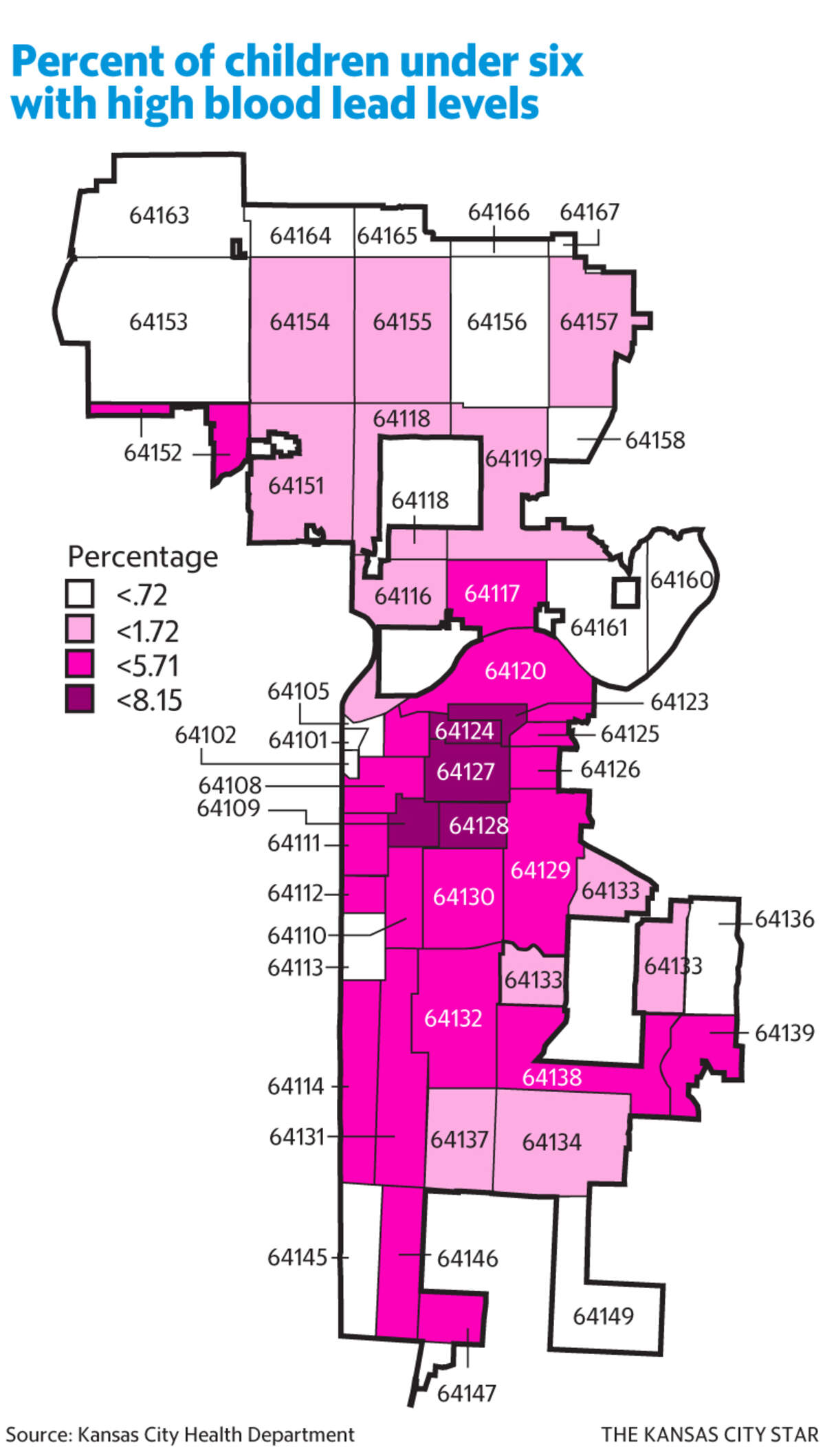
While lead exposure can happen anywhere, in Kansas City the threat remains mostly concentrated in the central city. A municipal report issued last summer determined more than half of local children with dangerously high blood lead levels live in five ZIP codes — 64109, 64123, 64124, 64127 and 64128, all with large minority populations.

However, higher than average incidence of lead poisoning reach to the city's southern border, where 5 percent to 6 percent of neighborhood children could be carrying high blood lead levels, the report said.
Slaughter's ranch home near 63rd Street west of The Paseo is outside the hottest cluster of inner-city ZIP codes.
Last fall, Slaughter, 63, approached a crew doing abatement work across the street and workers agreed to inspect her house. Because she babysits Monday through Friday, her 1950s home qualified for HUD grants for low-income households occupied by children younger than 6.
"Get your application in as quickly as possible," the crew told her after wiping the siding, windows and floors.
Kansas City officials hope to fix 70 lead-plagued properties this year using a 36-month federal grant of $2.9 million. In Wyandotte County, officials have $1.65 million to spend in three years.
"People don't know that lead can still be in the windows," Slaughter said. "It's in the vents. It's on the blades of the ceiling fans."
She and 2-year-old G.G. will have to find another place to stay on days the cleanup is being done. But Slaughter won't mind.
"This house is having a needed makeover, and that's divine," she said. "I'd call it heavenly."
For more information
Kansas City residents who suspect a lead hazard in their homes should call the LeadFree KC program at 816-513-6048 or email health@kcmo.org. Kansas residents should contact the state Department of Health and Environment, 866-865-3233 or www.kshealthyhomes.org. For questions about qualifying for assistance for lead programs in Wyandotte County, please contact the Unified Government of Wyandotte County and Kansas City, Kan., at www.wycokck.org.
This story was originally published March 23, 2018 at 7:02 PM with the headline "It's been 40 years since lead paint was banned, so why are we still being poisoned?."