
Share of U.S. workers in unions slips again
The percentage of U.S. workers who were union members slipped to 11.1 percent last year, down 0.2 percentage point from 2013, the Labor Department said Friday.
That share was mostly due to fairly stable representation in the public sector, where 35.7 percent of workers were union members in 2014. Unionization in the public sector has barely budged since 1983, when the U.S. Bureau of Labor Statistics introduced its annual report on union membership.
In the private sector, though, the share of workers represented by unions has shrunk faster since 1983 — a 10 percentage point plummet to just 6.6 percent.
The new report said 7.2 million public-sector employees belonged to unions, as did 7.4 million private-sector workers.
The 14.6 million total actually reflected about 48,000 more union members in 2014 than 2013. But because the overall size of the U.S. workforce grew by 2.3 million, the unions’ share of workers continued to dwindle.
The report noted that an additional 1.6 million workers last year were not union members but were covered by union contracts. Such collective bargaining boosted the total union representation to 16.2 million workers.
In 1983, the first year of comparable data, there were 17.7 million workers represented by unions, or slightly more than one in five workers compared with the current one-in-10 ratio.
The analysis, based on the statistics bureau’s monthly survey of households, said median weekly earnings of union members, $970, exceeded the nonunion workers’ $763. The report noted that the broad comparisons “do not control for many factors that can be important in explaining differences.”
Breaking down the union membership data, the bureau reported that representation was highest in the education, training, library and protective service occupations at 35.3 percent for each sector.
North America’s Building Trades Unions noted that union membership in the construction industry grew by about 53,000 last year.
“Excluding residential construction and non-union production/supervisory employees, the union construction industry is today approaching 40 percent market density,” the building trades alliance said in response to the new data.
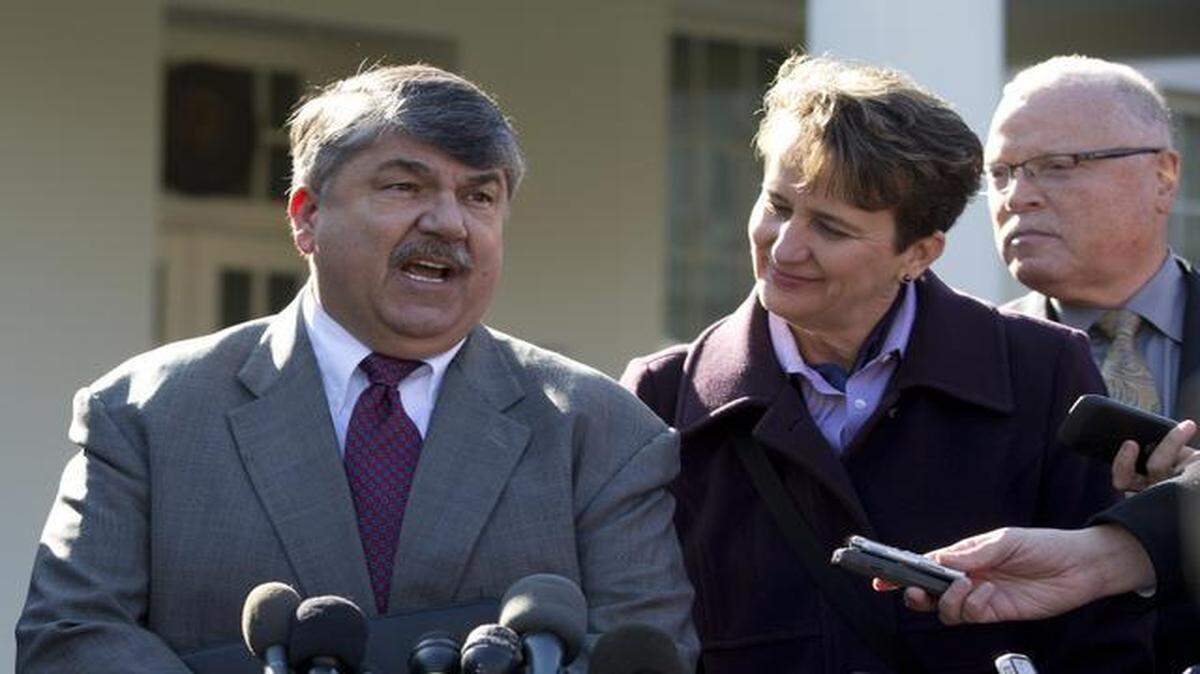
AFL-CIO president Richard Trumka said “extremist politics” had thwarted some union advancement. In a press release, the labor organization highlighted several collective bargaining gains last year, especially 92,000 workers joining AFSCME, including 20,000 home health care workers, and 14,500 customer service agents for American Airlines getting union representation with Communications Workers of America.
AFSCME president Lee Saunders said more than 131,000 public workers last year joined that organization, the nation’s largest public-service employees union, which represents nurses, corrections officers, child care providers, emergency workers, sanitation workers and others.
“At a time when too many Americans are struggling just to make ends meet, the Labor Department’s report reminds us today that we need to make it easier for working people to join together, form a union and negotiate for better wages and benefits,” Saunders said.
The Labor Department said the lowest unionization rates were for workers in agriculture (1.1 percent), finance (1.3 percent), professional and technical services (1.4 percent), and food and drink service (1.4 percent).
Union membership included a greater percentage of men than women, although that gap has narrowed over time. Blacks had a higher rate of union membership than whites, Asians or Hispanics. Workers between the ages of 45 and 64 had a larger share of union membership than younger age groups.
The National Labor Relations Board last month issued two rulings that make it easier for employees to organize into labor unions. Both of them are drawing opposition from business groups and political conservatives.
In one decision, the labor board said employees have the right to use an employer’s email system to engage in organizing activities on non-work time, unless the employer has totally banned the use of the email system after hours.
In the other decision, dubbed an “ambush rule” by union opponents, the labor board said union elections may be held in as few as 13 days after a representation petition was filed. Critics say the “quickie” or “fast track” election works against employers because it gives them less time to counter union arguments.
The new data estimated that 9 percent of workers in Kansas are represented by unions, with 7.4 percent of them being union members and the rest covered by unions’ collective bargaining contracts. In Missouri, estimates pegged union coverage for 9.7 percent of workers, with 8.4 percent of them union members.
Around the country, union representation ranges from nearly 26 percent of workers in New York down to 3.2 percent in North and South Carolina.
To reach Diane Stafford, call 816-234-4359 or send email to stafford@kcstar.com. Follow her online at kansascity.com/workplace and @kcstarstafford.
Union membership produced pay premium in most industries
Median weekly earnings of full-time wage and salary workers by union affiliation and occupation, annual 2014 averages, in dollars
Industry | Union members | Non-union workers |
Mining, oil & gas extraction | 1,150 | 1,130 |
Construction | 1,123 | 724 |
Manufacturing | 861 | 807 |
Wholesale and retail trade | 669 | 638 |
Transportation & utilities | 1,011 | 785 |
Information | 1,115 | 1,029 |
Financial activities | 879 | 942 |
Professional & business services | 805 | 918 |
Education & health services | 926 | 763 |
Leisure & hospitality | 636 | 500 |
Other services | 871 | 636 |
Federal government | 1,050 | 1,136 |
State government | 967 | 821 |
Local government | 1,026 | 780 |
Source: U.S. Bureau of Labor Statistics
This story was originally published January 23, 2015 at 10:25 AM with the headline "Share of U.S. workers in unions slips again."