
Protesters renew push for higher minimum wage, unionization
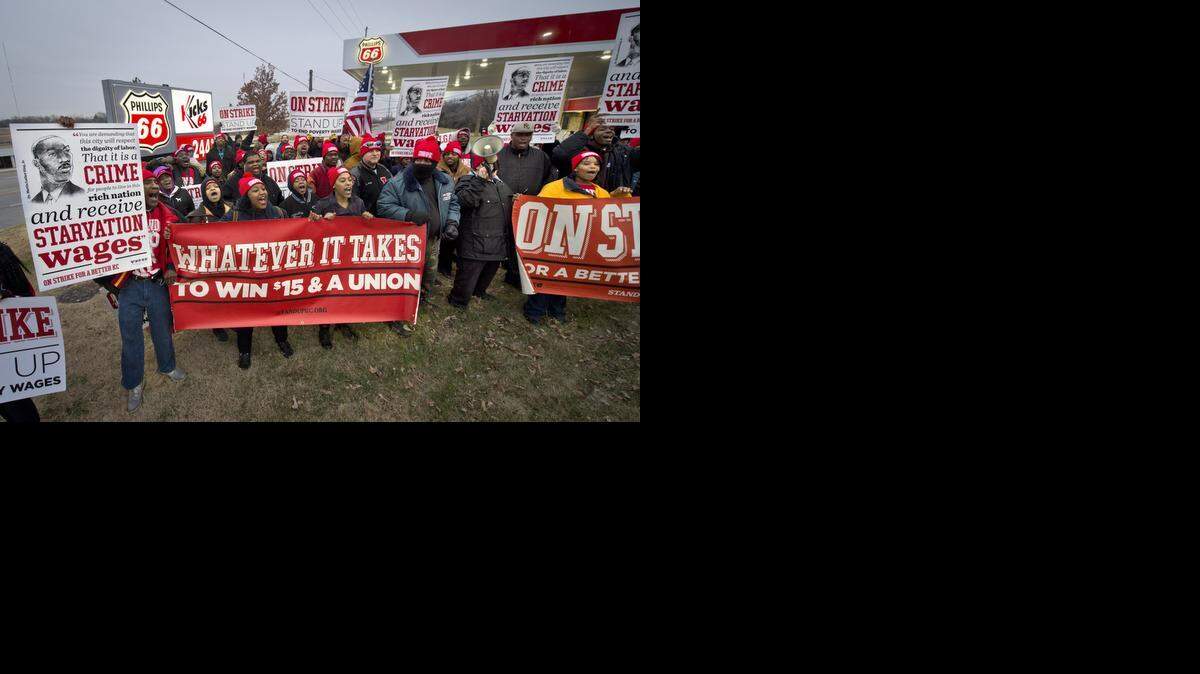
More than 150 protesters — mostly fast food workers, joined by workers from area gas stations and discount dollar stores — chanted and marched in pursuit of unionization and better wages Thursday morning outside a McDonald’s restaurant in Kansas City, Kan.
The marchers then moved on to a Sonic and a Phillips 66 gas station.
“Hey, hey, ho, ho, these poverty wages have got to go!” protesters chanted as they marched, many raising up placards calling for $15 minimum pay and a union.
“No burgers. No fries. Make our wages super size!” marchers also chanted.
The protest, which began at 6:30 a.m. in below-freezing weather outside the McDonald’s at 812 Minnesota Ave., coincided with what organizers claimed to be marches in about 190 cities nationwide. A second protest in Kansas City was held over the lunch hour at another area McDonald’s.
The movement to unionize and raise the pay of fast-food workers to $15 an hour began two years ago with a single protest in New York City. Since then, low-wage workers backed by strong financial and organizing support from labor unions have worked to spread the call for “$15 and a union” to other low-wage workers nationwide.
The cities involved in Thursday’s protest would make it the largest to date for the movement.
“To me, this is about justice and to improve our wages,” said Darrell Miller, 35, who works for $7.75 an hour at a Kansas City McDonald’s on Van Brunt Boulevard. “The rich are getting richer and the poor are staying poor.”
In a statement Thursday, McDonald’s said: “We respect everyone’s right to peacefully protest. The topic of minimum wage goes well beyond McDonald’s — it affects our country’s entire workforce. McDonald’s and our independent franchisees support paying our valued employees fair wages aligned with a competitive marketplace.”
The company also said it does not determine the wages set by its more than 3,000 franchisees and stated that a minimum wage increase should be implemented over time to reduce the impact on business owners.
Phillips 66 also issued a statement and noted that “station operators are responsible for their own pricing, service and management policies, including employment-related matters.”
In Kansas City, as elsewhere, protesters included workers from Wendy’s, Burger King, Pizza Hut, Jimmy John’s, KFC, Arby’s, Taco Bell and others. Low-wage home health care workers, gas station attendants and workers at local discount dollar stores also took part.
“It’s expanding all the time. This is such a profound justice issue,” the Rev. Donna Simon, minister at St. Mark Hope and Peace Lutheran Church, said Thursday of the movement and the protests. Her church at 3800 Troost Ave. has been in some ways the unofficial headquarters for the movement locally, formed under the group Stand Up KC.
“This, in many ways,” Simon said of poverty and the growing distance between rich and poor, “is the civil rights issue of our time. …A single person cannot live on $15,000 a year.”
But some of those who would be directly affected by unionization and the wage increase insist the protests are not about social justice for the poor, but about increasing power for the diminished labor movement.
“The protests are being conducted under the guise of increased wages,” Matthew Haller, a senior vice president and spokesman for the International Franchise Association, said in an emailed statement. “In fact, it is a blatant pretext to unionize employees at thousands of independently-owned local franchise businesses in order to grow the coffers of union leadership.”
Protest opponents criticize the movement for, among other points, its lack for transparency in attempting to cast the protests as an expanding grass-roots, worker-led movement. Critics maintain the workers are in varying degrees being trained, organized and financially backed by major unions including one of the nation’s largest, the SEIU, Service Employees International Union.
The National Restaurant Association released its own statement Wednesday in anticipation of the nationwide protests.
“National labor groups and their allies have spent millions of dollars on a coordinated campaign to paint an inaccurate and unfair portrait of America’s restaurants,” the statement said.
Instead of focusing on unionization and an arbitrary $15 an a hour minimum wage, the association said, the focus should be on job-growth policies, job training and education that leads to higher-paying jobs.
Crystal Nelson of Kansas City said that she didn’t come out to protest to help increase the influence of labor unions. She came out to help her family. Nelson, 35, works 36 hours a week for $7.50 an hour at a gas station in Grandview.
The federal minimum wage is set at $7.25 an hour, which is the same as the Kansas minimum. In Missouri, it is $7.50.
“I need more pay to raise my family,” she said. Her family includes three children ages 16, 15 and 10.
Nelson said that because her pay is so low, she relies on $190 a month in food stamps to make ends meet. She’d rather not have to take government help, she said, but even if she worked 52 weeks a year, with no paid time off for vacations or sick time, she’d at best be making about $14,000 a year.
It’s not that she isn’t working hard, she said, but at those wages, “they pretty much expect you to stay in poverty.”
Organizers insist that two years of repeated protests is having an effect. Two cities, San Francisco and Seattle, have acted to phase in minimums to $15 an hour over the next several years. Other cities are making similar moves, but for lesser amounts.
To reach Eric Adler, call 816-234-4431 or send email to eadler@kcstar.com.
This story was originally published December 4, 2014 at 11:05 AM with the headline "Protesters renew push for higher minimum wage, unionization."