
At Kansas City conference, natural gas vehicles seek a bigger transportation role
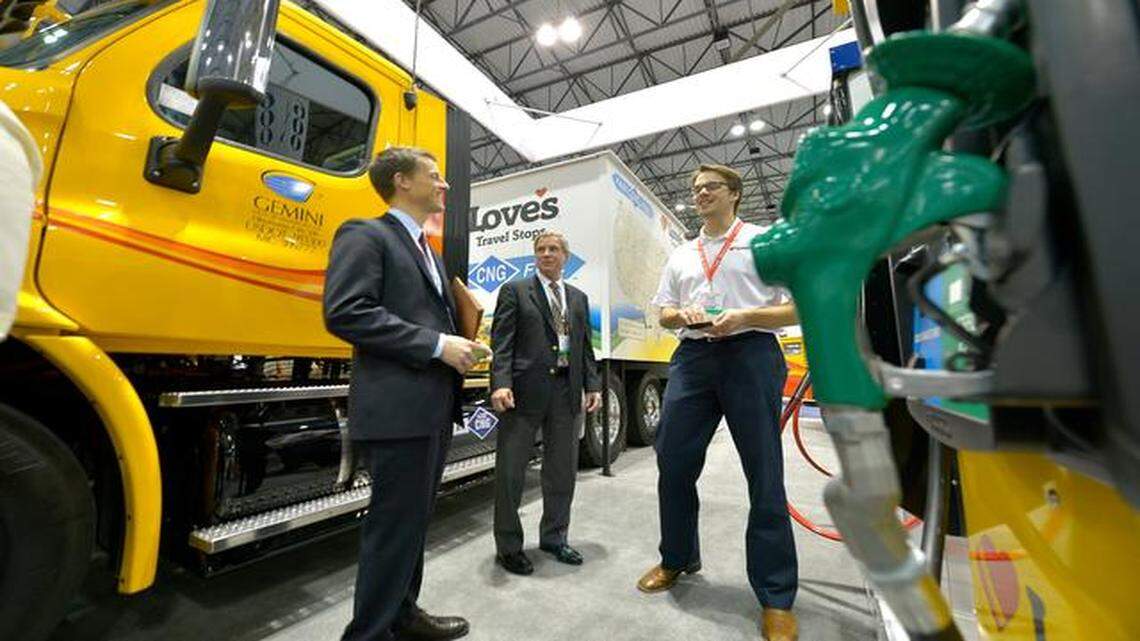
Matt Godlewski was walking around Bartle Hall and he liked what he saw.
In one corner was a natural-gas-powered semi truck and in another a Ford pickup with an innovative tank to hold the fuel. And in the middle of the exposition hall was a 10-foot-high color map of the United States plastered with red dots showing places to get a natural gas fill-up.
“We’re poised for growth,” said Godlewski, who is president of the Natural Gas Vehicles for America organization.
That remains to be seen, but for the last week Kansas City has been a showcase, with a twist of methane, for an industry that wants a bigger role in how America gets around.
The Natural Gas Vehicles Conference & Expo is the largest such event in North America, with about 700 people from around the country attending to mull over issues confronting the industry and take a look at what nearly 100 exhibitors are offering or planning to offer in the future.
General Motors was there with a Chevrolet Impala that can be ordered with a natural gas engine. Kenworth, Freightliner and Volvo brought their semi trucks that use the fuel. Absorbed Natural Gas Products Inc. had its prototype of a fuel tank using technology developed by the University of Missouri that uses tiny carbon particles to absorb the natural gas. That means a smaller fuel tank can be used.
But beyond the flash was a more sobering question: Can natural gas be more than a bit player in transportation?
If Kansas City is an example, it’s getting closer.
Kansas City’s municipal government has long been a leader in the field, and Sam Swearngin, the city’s fleet manager, was honored with an award at the conference for having the best government-owned green fleet in the country. The city has 300 natural gas vehicles, including dump trucks.
The city has been joined by the Lee’s Summit and Kansas City, Kan., school districts, which use natural gas to fuel their buses. The Kansas City Area Transportation Authority is shifting its bus fleet into one that will eventually use only natural gas. More businesses have dived in, such as AT&T, which has 240 vehicles using the fuel to ply the roads of Kansas and Missouri.
The Kansas City area — and the United States — could be at a turning point that could make natural gas a more popular transportation fuel. The fuel burns more cleanly than gasoline or diesel, and the boom in U.S. production has brought down the price of natural gas. But the lack of public fueling stations and the costly fuel pumps and other dispensing equipment needed to set them up has been a big obstacle.
A couple of years ago only one natural gas pump was available to the public in the Kansas City area.
That’s changing, with one public station with several pumps recently opening in Kansas City, Kan., and another expected early next year. In Kansas City, a natural gas station that will be available to the public is set to open next month. The Lee’s Summit School District’s fuel facility is already open to the public. And more announcements are expected for additional stations.
“There’s a lot going on, and it’s happening pretty quickly,” said David Albrecht, a program administrator at the Metropolitan Energy Center. “I think we’re right on the cusp of this becoming another option.”
One thing for sure is that natural gas has a long way to go before it would make a big difference in U.S. transportation. It has long been popular in many countries — Iran has more than 3 million vehicles that use it. In this country it barely has a toehold, with 150,000 vehicles on the road, mostly trucks.
Last year 19,500 natural gas vehicles were sold, and this year 22,500. But that’s far less than 1 percent of the cars and trucks that will be bought.
Even big supporters of the fuel caution against expecting a big surge in transportation use. They instead believe there will be a gradual improvement, especially in times like now when lower gas and diesel prices have made natural gas not quite as attractive.
“My take is slow and steady,” Swearngin said.
The fate of the fuel is unlikely to be decided by convincing everyday auto buyers to choose more natural-gas-powered cars. Honda has sold natural-gas-powered Civics for years but struggles to sell a thousand of them annually. GM hopes to find a niche by selling the Impala to fleets that will use them heavily so that the higher cost of the vehicle — $9,500 more up front — can be more quickly recovered by the lower fuel costs of natural gas.
Commercial vehicles and especially trucks are the core market for natural gas.
Though oil and diesel prices have declined, natural gas prices are still much cheaper — about $2 for the equivalent of a gallon of gasoline at public stations. A gallon of diesel was $3.63. Natural gas engines are about 15 percent less efficient at burning fuel, but using natural gas is still far cheaper.
Natural-gas-fueled vehicles are also more expensive. A semi truck costs an extra $50,000 or more. The extra cost and concerns about the availability of the fuel are two of the reasons that many truckers or companies are wary.
YRC Freight for now is focusing its new truck purchases on clean diesel technology, although it has been running test vehicles using liquefied natural gas in Southern California. A spokeswoman said the company will continue to evaluate natural gas and other alternative fuels.
The Owner Operator Independent Drivers Association in Grain Valley said its members are cool to the idea until there is a better supply chain across the country to ensure that fill-ups are available when needed.
But others have begun switching to natural gas. Seaboard Foods, which has offices in Johnson County, is using 103 semi trucks powered with natural gas and is buying 100 more. It also has 89 pickup trucks that use the fuel. The vehicles are cleaner-burning and economical, the company said.
“We’re all out to make a buck, but this is a good way to do it,” said Joe Goodwin, director of Seaboard Foods, at the conference in Kansas City.
Those who supply the fuel are convinced the demand is there and are investing to supply it.
Questar Fueling, a Utah company, has opened up public stations in Topeka and Kansas City, Kan. Each station, for now, has a different customer base. The one in Kansas City relies more on supplying trucks that shuttle from Denver to St. Louis and back. The Topeka station has Frito-Lay as one of its customers. Both are open to the public.
“We’re expecting some good growth,” said Carl Galbraith, Questar’s general manager.
Clean Energy, a natural gas station chain with 500 stations, is moving heavily into the Kansas City area.
It has one station close to opening in Kansas City, Kan., and the one opening next month in Kansas City, Mo. It operates a Lee’s Summit school bus fuel facility and is in talks with Hunt Midwest for a station there. Another company executive said Clean Energy isn’t done expanding.
“We have some other stuff up our sleeves,” said Peter Grace, senior vice president at Clean Energy.
To reach Steve Everly, call 816-234-4455 or send email to severly@kcstar.com.
This story was originally published November 14, 2014 at 1:27 PM with the headline "At Kansas City conference, natural gas vehicles seek a bigger transportation role."