
From rides to lodgings to financing projects and raising capital, sharing models are growing
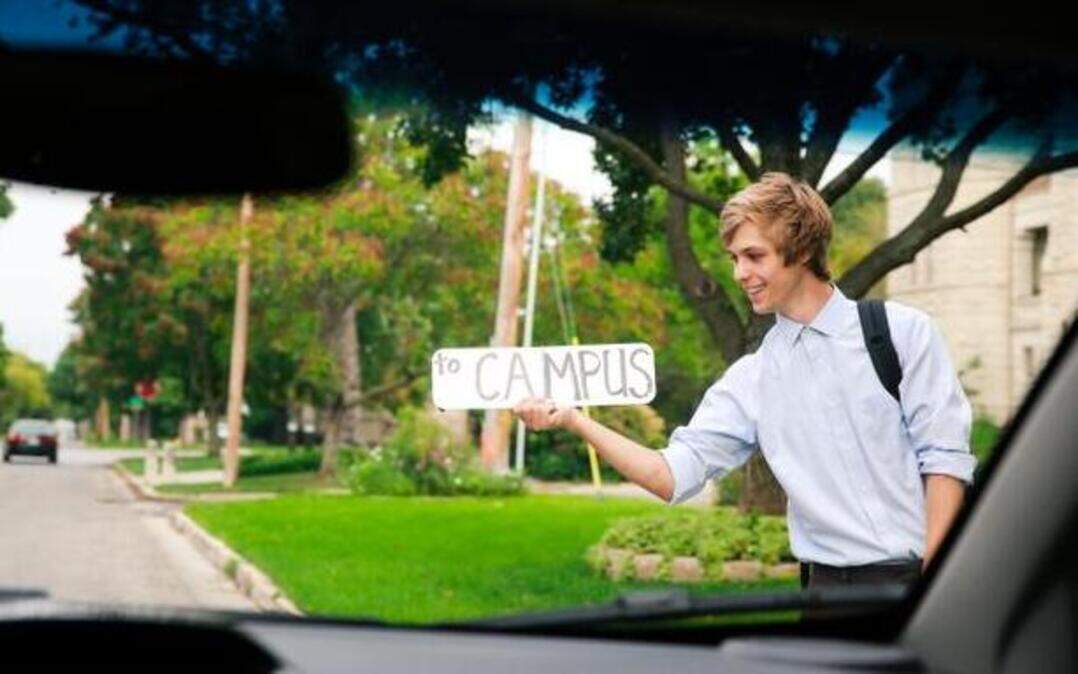
Jenny O’Brien can’t stop taking rides from strangers. In the past 18 months, she’s sat in the passenger seat of more than 100 cars to traverse the 12 miles from her home in rural Jefferson County to her workplace in Lawrence.
O’Brien, 46, has her own rules of the road. She never gets into a car after dark. She won’t ride with more than two men in a vehicle. She always makes sure the seatbelt works. And, oddly enough, she leaves her own car parked in the garage.
O’Brien is a community manager with CarmaHop, a new smartphone hitchhiking application set to launch in Lawrence later this month.
“It’s about a human being out there and not just a faceless stranger on the Internet,” says O’Brien. “Technology is a facilitator. It creates context. The guy on the side of the road doesn’t have context.”
CarmaHop, which is a 5-month-old project funded by the ridesharing application Carma, has been beta testing with a group of 20 people at high traffic spots in Lawrence. The “CarmaHoppers,’ are outfitted with foldable dry erase signs that display their destination, online profiles synced to their social media accounts and a smartphone app that tracks where they’re picked up and dropped off.
“We can either have fear and scrutiny or we can have trust and abundance,” says O’Brien.
Welcome to the shared economy, where hitchhiking occurs in an orderly line, your home is someone’s vacation getaway, and investors are a mouse click away. And the business of sharing — ridesharing (Uber, Lyft), apartment sharing (Airbnb), crowdfunding (IndieGogo, Kickstarter) — is booming. In July, Forbes estimated that the share economy would generate $3.5 billion in revenue for people willing to rent their cars, homes and goods this year.
Beyond changing how dollars change hands, the shared economy is also altering how we interact with businesses. Traditionally, a business would work to win over customers by delivering a consistent experience or product. That record was where consumers placed their trust. But in a system where Airbnb can launch in 2008 and have a valuation of $10 billion six years later, there isn’t time to build a track record. Instead of trusting a brand, consumers are using a business model that relies on trusting each other with our money, our possessions and even our personal safety.
“The new collaborative economy we’re seeing is really based on very traditional Midwest values of sharing, working together, helping a neighbor out,” says Ben Smith, the director of social and emerging media at Callahan Creek and co-host of the Collaborative Economy Resilient Summit. “The core values remain the same, just greatly amplified through mobile and social to extend beyond friends and family and to allow individuals to make those values more than just a neighborly act.”
The transition of our “Midwest values” online probably started with the idea of crowdfunding — raising money for a given project or cause from a large group of supporters — which has been around in the United States for more than a decade and synonymous with the company Kickstarter for the past five years.
Bryan Azorsky, an organizer for the Kauffman Foundation’s One Million Cups, holds a monthly meeting called Crowdfunding KC. Since January, several dozen entrepreneurs have convened to discuss how to authentically pitch their products and discover whether they’re actually ready to bring an idea to market.
“I think you have to be a real person,” says Azorsky, 49, of the campaigns that find success. “That creates a level of trust, which lowers the barrier for that decision to be made.”
He sees crowdfunding campaigns as the melding of personal and corporate reputations. Without having a physical product that somebody can see or touch, an entrepreneur instead has to rely on social capital. Azorsky says entrepreneurs can use social media as a springboard toward building consumer trust.
“I may not know you directly. You may not know me,” Azorsky said. “But we discover we have a friend in common and suddenly we’re off and running.”
It’s not just the idea that business is now personal. Those who support crowdfunding projects often do so precisely because it is personal.
“I feel like I’m helping this idea or dream come to fruition by helping fund it,” says Kyle Hamrick, the owner of the design firm the Feral Few, who has supported, by his estimate, 15 projects in the past several years.
He’s drawn to the projects of fellow creatives (an independent band looking to record an album or the lamp inspired by Super Mario Bros. and funded on Kickstarter that hangs in his living room), but Hamrick has also supported cause-based initiatives (unexpected medical expenses for an animator, replacing a Nashville photographer’s stolen camera gear).
“I may get nothing in return,” says Hamrick. “But at the end of the day, even if I don’t know you, it’s nice to have a sense of community.”
On the other side of the keyboard are people like Christopher Cook, a video producer currently working on the Web series Your Fellow Americans for Kansas City Public Television. With crowdfunding, Cook sees the platform bringing together investors such as Hamrick.
“You’re immediately getting to partake in a miniature movement,” says Cook, who has seen two of his projects successfully funded on Kickstarter. “But not only is there that communal thrill, there’s also offloaded due diligence. Everybody is doing it, so they must have a good reason.”
But people aren’t just opening their wallets; they’re also handing over their keys. Developer Jacob McDaniel, 33, has been renting out his downtown apartment since January as a host on Airbnb.
“If it seems a little awkward, I’m probably going to pass,” McDaniel says. “It’s like online dating. You’re vetting them. Is this somebody you’d introduce to your parents or invite over for dinner?”
McDaniel also relies on Airbnb’s policies as a way to help ensure good behavior on the part of his guests, or at least protect him against bad behavior. In 2011, Airbnb introduced Social Connections, which allowed users to add their social networks to their profile. A year later, the company announced it would cover up to $1 million in property damages for hosts.
“What if they steal your computer? What if I drop my computer crossing the street? That’s what insurance is for; it’s just a material thing,” says McDaniel, although he admits that he takes his laptop, tablet and cellphone before handing over the keys to an Airbnb guest.
A culture of peer reviewing, where diners vent on Yelp and consumers rate products on Amazon, has evolved to the point where we now rate individual’s performances like they’re a corporation.
“People and organizations have become more transparent because of their Web presences,” says Neighborly Engagement Director Sean Connolly. “If you want to know about the condition of your next Airbnb stay, just hit up the host’s reviews. Curious about who is picking you up for your next Uber ride? Check the app and you can greet them by name. In a lot of ways, the collaborative economy has made it easier to trust in services and companies.”
In Lawrence, O’Brien hopes to make the process of hitchhiking more transparent. She’s been working with the University of Kansas to compile data on who is riding and who is stopping — the early users of the CarmaHop prototype have waited an average of 7 minutes and know one out of every five drivers who give them a lift.
“It’s about being able to trust each other. This gives us the ability to use our resources in a way that we can put them to good use and in a way where we trust each other not to abuse the situation,” O’Brien said. “But it’s still a learning curve we’re figuring out.”
This story was originally published October 13, 2014 at 11:15 PM with the headline "From rides to lodgings to financing projects and raising capital, sharing models are growing."