
Faster job growth is forecast for the Kansas City area, even as the recovery slogs along
Kansas City’s job outlook is improving even as new risks — from layoffs at Sprint to U.S. airstrikes inside Syria — threaten the regional economy’s still sluggish recovery.
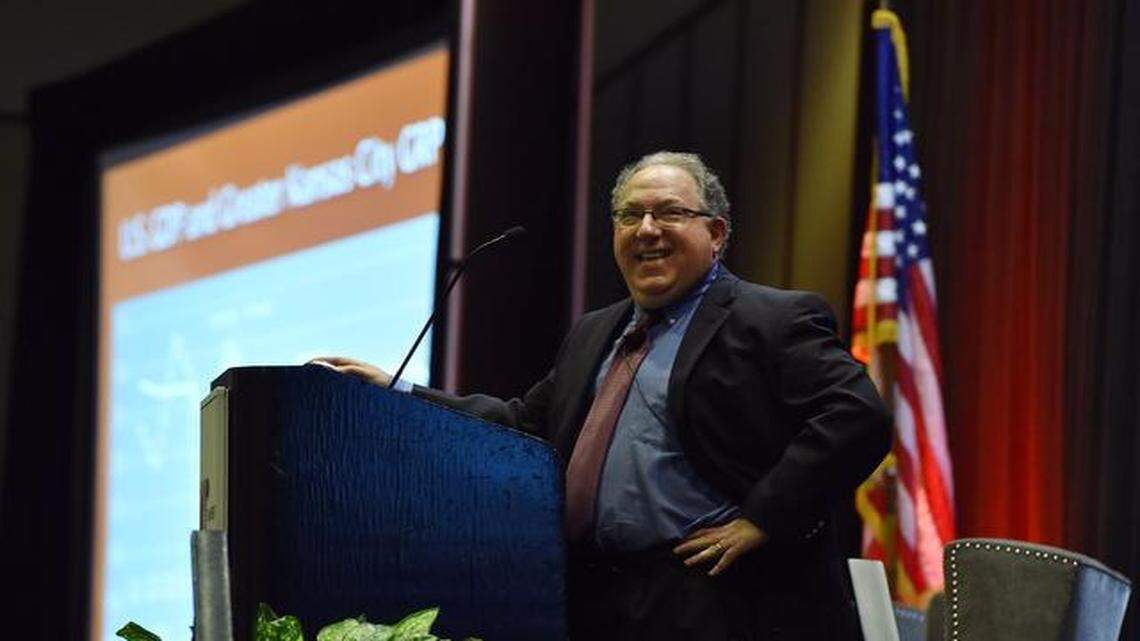
Three economists sketched that consensus Tuesday with the presentation of an annual forecast for the area economy from the Greater Kansas City Chamber of Commerce.
Local growth will “finally translate into significant job growth,” said the forecast prepared by Frank Lenk, director of research services at the Mid-America Regional Council.
By his math, that means close to 20,000 new jobs in the area next year.
“That will be the most jobs we’ve added since 2007,” Lenk told an audience of mostly business leaders.
It means rising local wages will become more prevalent, and that will boost area households’ finances, Lenk said, even more than might be expected from the area’s economic growth.
Looming on the horizon, however, are Sprint’s efforts to restructure its lagging wireless business and potentially disrupting geopolitical events. Don’t even ask what happens to the U.S. economy in the remote possibility that the Ebola virus reaches North America.
“You can forget all of the forecasts if that happens,” said Robert Litan, a former Kauffman Foundation researcher who now lives in Wichita as a senior fellow for the Brookings Institution.
Sprint recently dropped efforts to merge with T-Mobile US and named an industry outsider as its new chief executive officer. Marcelo Claure, a Bolivian-born billionaire, has promised to slash costs, and the Overland Park-based company has confirmed that some job cuts will come next month.
All of Kansas City feels what happens at Sprint because of its large local employment, the business it does with local companies and the wealth its national reach brings back to Kansas City.
“It’s been a huge player in our region’s economic fortunes,” Lenk said. “While there are other firms that are growing, like Cerner, the region is still nonetheless lagging behind the U.S.”
Sprint might have seen greater job cuts had it been able to merge with T-Mobile. But Lenk said there still was a risk that its headquarters would move to California to be closer to Tokyo-based SoftBank, which owns 80 percent of Sprint.
Short of big job cuts at Sprint, Lenk is predicting essentially normal job gains for the area. Although that’s much better than the disappointing pace of the recovery so far, he is hardly crowing about what lies ahead.
The area’s rebound from the Great Recession has been — and will continue to be — subpar compared with how this city climbed out of earlier setbacks. The area also has trailed the rest of the nation when it comes to creating jobs and won’t catch up any time soon.
“We’re growing much slower than the U.S. overall,” Lenk said.
And his official forecast concluded that job creation here would continue to “lag the nation’s by a considerable amount for the foreseeable future.”
The national recovery itself is limited by economic problems elsewhere, said Chris Kuehl, managing director of Armada Corporate Intelligence, who followed Lenk’s presentation.
“My job is to talk about international, and it’s awful,” Kuehl said.
He said harsh winter weather wasn’t the U.S. economy’s only problem early this year. Exports plunged 10 percent largely because Asia, Europe, Africa, Latin America and the Middle East all were suffering economically.
“It’s not that they don’t want our stuff,” he said. “It’s just that they don’t have any money, Even Germany is in recession now.”
Kuehl and Litan both raised political tensions and military hot spots as additions to the economic uncertainty ahead.
The United States has begun to bomb Islamic State targets in Syria as well as in Iraq as part of President Barack Obama’s pledge to degrade and defeat the group.
Russia’s foray into Ukraine also presents a cloud of economic uncertainty for the United States. The concern is that no one knows where Russia’s advance will stop or how it will be stopped.
“I feel like it’s 1913 or 1939,” Litan said in reference to the two world wars of the last century. “I can’t recall any point in my lifetime, and I’m 64 years old, with the exception of the Cuban missile crisis, when I’ve been as nervous about the world outlook.”
None of this was on the horizon a year ago when Lenk last forecast Kansas City’s economic future.
Still, he had turned heads by jettisoning the usual “things will get better” approach to economic forecasts. Lenk had put forth those optimistic scenarios for three years and, in his words a year ago, was “tired of being wrong.”
He set a course for tepid growth in the area’s economic output and job creation. This new forecast continues along the same subdued path, albeit with a bit brisker pace than Lenk had seen a year ago.
For example, Kansas City area employers probably will have created 16,500 jobs by the time 2014 ends, his updated forecast said. Payrolls will grow even faster in 2015, adding 19,300 jobs in the area, and in 2016, adding 17,500 jobs.
Lenk is calling that significant job growth in light of 2013’s disappointing 8,500 job gains.
And it is better than Lenk thought a year ago when he forecast only 14,300 added jobs this year.
The area is gaining more jobs because the local economy is growing differently from the previous years of this protracted recovery. So far, employers have relied mostly on the growing productivity of their employees. Now they are mostly adding employees to fuel further business growth, Lenk said.
Lenk made a point about faster job growth and declining unemployment locally: It will put pressure on employers to raise wages, which helps household incomes. Financially, he said, we will be making greater personal gains than the area’s economic growth rate would suggest.
To reach Mark Davis, call 816-234-4372 or send email to mdavis@kcstar.com. Follow him on Facebook and Twitter at mdkcstar.
This story was originally published September 23, 2014 at 2:30 AM with the headline "Faster job growth is forecast for the Kansas City area, even as the recovery slogs along."